Three Perils for a Quest(ion), Part 1

Eddie makes great pizzas but Jeremy thinks they stay in the oven just a little too long.  As he crunched an extra-crispy wedge-edge he mused, “Gravity aside, I wonder what it’d be like to land on a black hole.  I bet it’d be real slippery if it’s as smooth as Mr Moire says.”

Jennie cut in.  “Don’t be daft, lad.  Everyone’s read about the spaceman sliding through the event horizon unaware until it’s too late.  Someone far away sees the bloke’s spacetime getting all distorted but in his local frame of reference everything’s right as rain.  Right, Sy?”

“As rain, Jennie, if all you’re concerned about is relativity.  But Spaceman Jeremy has lots of other things to be concerned about on his way to the event horizon.  Which he couldn’t stand on anyway.”

“Why not, Mr Moire?  I mean, I said ‘gravity aside’ so I ought to be able to stand up.”

“Nothing to stand on, Jeremy.  It’d be like trying to stand on Earth’s orbit.”

“Pull the other one, Sy.  How can they be alike?”

“Both of them are mathematical constructs rather than physical objects.  An orbit is an imaginary line that depicts planet or satellite locations.  An event horizon is an imaginary figure enclosing a region with such intense spacetime curvature that time points inward.  They’re abstract objects, not  concrete ones.  But let’s get back to Jeremy’s black hole evaporation quest.  He’ll have to pass three perils.”

“Ooo, a Quest with Perils —  loverly.  What are the Perils then?”

“The Roche Radius, the Photon Sphere and the Firewall.  Got your armor on, Jeremy?”Astronaut and 3xBlack hole
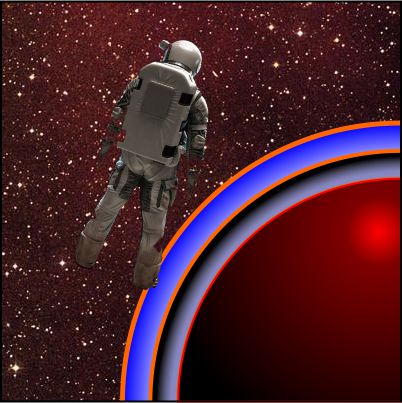
“Ready, Mr Moire.”

“Stand up.  The Roche effect is all about gravitational discrepancy between two points.  The two meter distance between your head and feet isn’t enough for a perceptible difference in downward pull.  However, when we deal with astronomical distances the differences can get significant.  For instance, ocean water on the day side of Earth is closer to the Sun and experiences a stronger sunward pull than water on the night side.”

“Ah, so that’s why we get tides.”

“Right.  Sit, sit, sit.  So in 1849 Édouard Roche wondered how close two objects could get until tidal forces pulled one of them apart.  He supposed the two objects were both just balls of rocks or fluid held together by gravity.  Applying Newton’s Laws and some approximations he got a formula for threshold distance in terms of the big guy’s mass and the little guy’s density.  Suppose you’re held together only by gravity and you’re nearing the Sun feet-first.  Its mass is 2×1030 kg/m³.  Even including your space armor, your average density is about 1.5 kg/m³.  According to Roche’s formula, if you got closer than 8.6×10⁶ kilometers your feet would break away and fall into the Sun before the rest of you would.  Oh, that distance is about 1/7 the radius of Mercury’s orbit so it’s pretty close in.”

“But we’re talking black holes here.  What if the Sun collapses to a black hole?”

“Surprisingly, it’s exactly the same distance.  The primary’s operative property is its mass, not its diameter.  Good thing Jeremy’s really held together by atomic and molecular electromagnetism, which is much stronger than gravity.  Which brings us to his second Peril, the dreaded Photon Sphere.”

“Should I shudder, Sy?”

“Go ahead, Jennie.  The Sphere is another mathematical object, not something physical you’d collide with, Jeremy.  It’s a zero-thickness shell representing where electromagnetic waves can orbit a massive object like a black hole or a neutron star.  Waves can penetrate the shell easily in either direction, but if one happens to fly in exactly along a tangent, it’s trapped on the Sphere.”

“That’s photons.  Why is it a peril to me?”

“Remember that electromagnetism that holds you together?  Photons carry that force.  Granted, in a molecule they’re standing waves rather than the free waves we see with.  The math is impossible, but here’s the Peril.  Suppose one of your particularly important molecules happens to lie tangent to the Sphere while you’re traversing it.  Suddenly, the forces holding that molecule together fly away from you at the speed of light.  And that disruption inexorably travels along your body as you proceed on your Quest.”

[both shudder]

~~ Rich Olcott

The Thin Edge of Infinity

Late in the day, project’s half done but it’s hungry time.  I could head home for a meal and drive back, but instead I board the elevator down to Eddie’s Pizza on the second floor.  The door opens on 8 and Jeremy gets on, with a girl.

“Oh, hi, Mr. Moire.  Didja see I hit a triple in the last game?  What if the Sun became a black hole?  This is that English girl I told you about.”

“Hello, Jennie.”

“Wotcha, Sy.”

“You know each other?”

“Ra-ther.  He wrote me into his blog a year ago.  You were going on about particles then, right, Sy?”

“Right, Jennie, but that was particles confined in atoms.  Jeremy’s interested in larger prey.”

“So I hear.”

The elevator lets us out at Eddie’s place.  We luck into a table, order and resume talking.  I open with, “What’s a particle?”

“Well, Sy, your post with Jeremy says it’s an abstract point with a minimal set of properties, like mass and charge, in a mathematical model of a real object with just that set of properties.”

“Ah, you’ve been reading my stuff.  That simplifies things.  So when can we treat a black hole like a particle?  Did you see anything about that in my archives, Jennie?”

“The nearest I can recall was Professor ‘t Hooft’s statement.  Ermm… if the Sun’s so far away that we can calculate planetary orbits accurately by treating it as a point, then we’re justified in doing so.”

“And if the Sun were to suddenly collapse to a black hole?”

“It’d be a lot smaller, even more like a point.  No change in gravity then.  But wouldn’t Earth be caught up in relativity effects like space compression?’

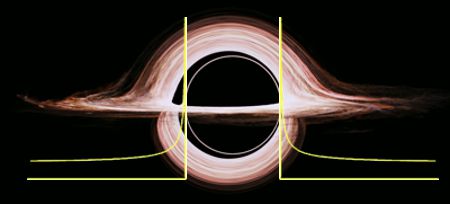
“Not unless you’re really close.  Space compression around a non-rotating (Schwarzchild) black hole scales by a factor that looks like Schwarzchild factor, where D is the object’s diameter and d is your distance from it.  Suppose the Sun suddenly collapsed without losing any mass to become a Schwarzchild object.  The object’s diameter would be a bit less than 4 miles.  Earth is 93 million miles from the Sun so the compression factor here would be [poking numbers into my smartphone] 1.000_000_04.  Nothing you’d notice.  It’d be 1.000_000_10 at Mercury.  You wouldn’t see even 1% compression until you got as close as 378 miles, 10% only inside of 43 miles.  Fifty percent of the effect shows up in the last 13 miles.  The edge of a black hole is sharper than this pizza knife.”Knife-edges
“How about if it’s spinning?  Ms Plenum referred me to a reading about frame-dragging.”

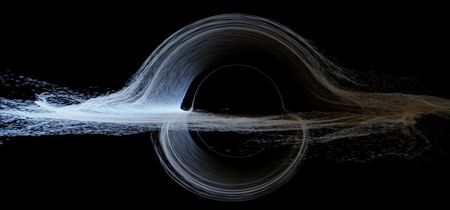
“Ah, Jeremy, you’re thinking of Gargantua, the Interstellar movie’s strangely lopsided black hole.  I just ran across this report by Robbie Gonzalez.  He goes into detail on why the image is that way, and why it should have looked more like this picture.  Check out the blueshift on the left and the shift into the infra-red on the right.”

better Gargantua
A more accurate depiction of Gargantua.  Image from
James, et al., Class. Quantum Grav. 32 (2015) 065001 (41pp),
licensed under CC BY-NC-ND 3.0

[both] “Awesome!”

“So it’s the spin making the weirdness then, Sy?”

“Yes, ma’am.  If Gargantua weren’t rotating, then the space around it would be perfectly spherical.  As Gonzalez explains, the movie’s plotline needed an even more extreme spacetime distortion than they could get from that.  Dr Kip Thorne, their physics guru, added more by spinning his mathematical model nearly up to the physical limit.”

“I’ll bite, Mr Moire.  What’s the limit?”

“Rotating so fast that points on the equator would be going at lightspeed.  Can’t do that.  Anyhow, extreme spin alters spacetime distortion, which goes from spherical to pumpkin-shaped with a twist.  The radial scaling changes form, too, from Schwarzchild factor to Kerr factorA is proportional to spin.  When A is small (not much spin) or the distance is large those A/d² terms essentially vanish relative to the others and the scaling looks just like the simple almost-a-point Schwarzchild case.  When A is large or the distance is small the A/d² terms dominate top and bottom, the factor equals 1 and there’s dragging but no compression.  In the middle, things get interesting and that’s where Dr Thorne played.”

“So no relativity jolt to Earth.”

“Yep.”

“Here’s your pizzas.”

“Thanks, Eddie.”

[sounds of disappearing pizza]

~~ Rich Olcott

No-hair today, grown tomorrow

It was a classic May day, perfect for some time by the lake in the park.  I was watching the geese when a squadron of runners stampeded by.   One of them broke stride, dashed my way and plopped down on the bench beside me.  “Hi, Mr Moire. <pant, pant>”

“Afternoon, Jeremy.  How are things?”

“Moving along, sir.  I’ve signed up for track, I think it’ll help my base-running,  I’ve met a new girl, she’s British, and that virtual particle stuff is cool but I’m having trouble fitting it into my black hole paper.”

“Here’s one angle.  Nobelist Gerard ‘t Hooft said, ‘A particle is fundamental when it’s useful to think of it as fundamental.‘  In that sense, a black hole is a fundamental particle.  Even more elementary than atoms, come to think of it.”

“Huh?”

“It has to do with the how few numbers you need to completely specify the particle.  You’d need a gazillion terabytes for just the temperatures in the interior and oceans and atmosphere of Earth.  But if you’re making a complete description of an isolated atom you just need about two dozen numbers — three for position, three for linear momentum, one for atomic number (to identify which element it represents), one for its atomic weight (which isotope), one for its net charge if it’s been ionized, four more for nuclear and electronic spin states, maybe three or four each for the energy levels of its nuclear and electronic configuration.  So an atom is simpler than the Earth”

“And for a black hole?”

“Even simpler.  A black hole’s event horizon is smooth, so smooth that you can’t distinguish one point from another.  Therefore, no geography numbers.  Furthermore, the physics we know about says whatever’s inside that horizon is completely sealed off from the rest of the universe.  We can’t have knowledge of the contents, so we can’t use any numbers to describe it.  It’s been proven (well, almost proven) that a black hole can be completely specified with only eleven numbers — one for its total mass-energy, one for its electric charge, and three each for position, linear momentum and angular momentum.  Leave out the location and orientation information and you’ve got three numbers — mass, charge, and spin.  That’s it.”

“How about its size or it temperature?”

“Depends how you measure size.  Event horizons are spherical or nearly so, but the equations say the distance from an event horizon to where you’d think its center should be is literally infinite.  You can’t quantify a horizon’s radius, but its diameter and surface area are both well-defined.  You can calculate both of them from the mass.  That goes for the temperature, too.”

“How about if it came from antimatter instead of matter?”

“Makes no difference because the gravitational stresses just tear atoms apart.”

“Wait, you said, ‘almost proven.’  What’s that about?”no hair 1

“Believe it or not, the proof is called The No-hair Theorem.  The ‘almost’ has to do with the proof’s starting assumptions.  In the simplest case, zero change and zero spin and nothing else in the Universe, you’ve got a Schwarzchild object.  The theorem’s been rigorously proven for that case — the event horizon must be perfectly spherical with no irregularities — ‘no hair’ as one balding physicist put it.”

“How about if the object spins and gets charged up, or how about if a planet or star or something falls into it?”

“Adding non-zero spin and charge makes it a Kerr-Newman object.  The theorem’s been rigorously proven for those, too.  Even an individual infalling mass has only a temporary effect.  The black hole might experience transient wrinkling but we’re guaranteed that the energy will either be radiated away as a gravitational pulse or else simply absorbed to make the object a little bigger.  Either way the event horizon goes smooth and hairless.”

“So where’s the ‘almost’ come in?”

“Reality.  The region near a real black hole is cluttered with other stuff.  You’ve seen artwork showing an accretion disk looking like Saturn’s rings around a black hole.  The material in the disk distorts what would otherwise be a spherical gravitational field.  That gnarly field’s too hairy for rigorous proofs, so far.  And then Hawking pointed out the particle fuzz…”

~~ Rich Olcott

Baseball And The Virtual Particle

Al was pouring my mugful of his morning blend (“If it doesn’t wake you up we’ll call the doctor“) when Jeremy stepped into the counter.  “Hi, Mr Moire.  I’m still trying to get my head around that virtual particle thing.  Hi, Al, a large decaf, please, double sugar, three creamers.  It looks like the shorter amount of time you give a particle to happen, the bigger it can get, but that doesn’t make sense because I’d think the longer you wait the more likely it’s gonna happen.  Thanks, Al.”

“Take a breath to blow on that coffee, Jeremy, or you’ll burn your tongue.  Hmm…  Word is your batting average is running about 250 these days.  That right?”

“Yessir.  I didn’t know you’re keeping track.”

“Keeping my ears open is part of my job.  So you’re hitting about once every four at-bats.  That gives Coach an estimate of when you’ll get your next hit.  What’s your slugging average?”

“What’s a slugging average?”

“Your total number of batted-on bases, divided by your at-bats, times a thousand ’cause sports writers don’t do decimal points.  You get one count in the numerator for a single, two for a double and so on.”

“Lemme think.  If I’m doing 250 overall and about half are singles and the other half are doubles that’d give me an SA of … about 375.”

“Pretty good.  So does that number tell Coach anything about when to expect another double?”

“Mmm, no, but what does that have to do with my virtual particle question?”

“In each case you’ve got a pair of statistics that tell you some things and hide other things.  Batting averages and your wait-time notion are about when to expect an event of some sort to occur.  You could hit another single or you could tag a homer — all Coach knows is that you should be able to get on base about once every four at-bats.”

“What about the other statistics?”

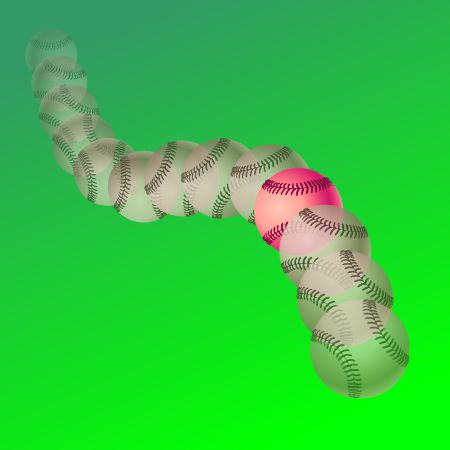
“They’re the flip side, sort of.  You could think of the SA as batting potential.  If you hit homers all the time your SA would be 4000.  If you whiff every pitch your SA would be zero.  Anything between those extremes tells Coach something about your productivity but nothing about when you’re going to produce.  Energy uncertainty works the same way for virtual particles.  If you’re doing long-duration energy evaluations you can be pretty sure that any single measurement will be close to the long-term average.  You might possibly see a significant deviation from that average but only if you check just the right brief interval.”Virtual baseball

“And for the particles in that empty space?”

“If you’re looking long-term, no particles.  That’s what ’empty’ means.  When there’s definitely nothing in a volume of space it makes sense to say its energy is zero because particles have mass and therefore embody energy.  But a particle might show up and go away after a very brief interval without significantly affecting that long-term average.  Quantum theory doesn’t say it will show up, just that it might.”

“So does it?”

“Oh yes, in space, in the lab and in commerce.  One explanation for your cell phone’s NFC function hinges on virtual radio-frequency photons being exchanged between devices.”

“Wait.  If a virtual particle shows up in that empty space, then it’s not empty any more and its energy isn’t zero any more, is it?”

“You’ve just discovered one aspect of zero-point energy, the quantum prediction that every system, even empty space, contains a non-zero minimum amount of energy.  People have thought about tapping that energy to power perpetual motion machines.”

“That’d be cool — the ultimate renewable.”

“Wouldn’t it, though?  But no can do, for a couple of reasons.  Virtual particles, by their nature, are random phenomena.  You can’t depend upon what kind of particle might show up, or when, nor how long it might hang around.  It’s not like NFC where antennas generate the particles.  The other issue is that ‘minimum’ means minimum.  If you could pull energy out of that space you’d lower its energy content and drop it below the minimum…. What’s the grin about?”

“Just wondering how they’d score hitting a virtual ball that disappears before the fielder catches it.”

~~ Rich Olcott

Virtualosity

No knock, the door just opened suddenly.

“Hello, Jeremy.  Rule of Three?”

“Huh?  No, I was down the hall just now when I saw you go into your office so I knew you hadn’t gotten busy with something yet.  Sir.  What’s the Rule of Three?”

“Never mind.  You’re up here about virtual particles, I guess.”

“Yessir.  You said they’re ‘now you might see them, now you probably don’t.’  What’s that about and what do they have to do with abstraction and Einstein’s ‘underlying reality’?”

“What have you heard about Heisenberg’s Uncertainty Principle?”

“Ms Plenum says you can’t know where you are and how fast you’re going.”

“Ms Plenum’s got part of the usual notion but she’s missing the idea of simultaneous precision and a few other things.  Turns out you CAN know approximately where you are AND approximately how fast you’re going at a particular moment, but you can’t know both things precisely.  There’s going to be some imprecision in both measurements.  Think about Coach using a radar gun to track a thrown baseball.  How does radar work?”

“It bounces a light beam off of something and measures the light’s round-trip travel time.  I suppose it multiplies by the speed of light to convert time to distance.”

“Good.  Now how does it get the ball’s speed?”

“Uhh… probably uses two light pulses a certain time apart and calculates the speed as distance difference divided by time difference.”

“Got it in one.  Now, suppose that a second after the ball’s thrown the radar says the ball is 61 feet away from the plate and traveling at 92 mph.  Air resistance acts to slow the ball’s flight so that 92 is really an average.   Maybe it was going 92.1 mph at the first radar pulse and 91.9 mph at the second pulse.  So that reported speed has an 0.2 mph range of uncertainty.”

“Oh, and neither of the two pulses caught the ball at exactly 61 feet so that’s uncertain, too, right?”

“There you go.  We know the two averages, but each of them has a range.  The Uncertainty Principle says that the product of those two ranges has to be greater than Planck’s constant, 10-34 Joule·second.  Plugging that Joule-fraction and the mass of an electron into Einstein’s E=mc², we restate the constant as about 10-21 of an electron-second.  Those are both teeny numbers — but they’re not zero.”

“So speed and location make an uncertainty pair.  Are there others?”Zebras“A few.  The most important for this discussion is energy and time.”

“Wait a minute, those two can’t be linked that way.”

“Why not?”

“Well, because … umm … speed is change of location so those two go together, but energy isn’t change of time.  Time just … goes, and adding energy won’t make it go faster.”

“As a matter of fact, there are situations where adding energy makes time go slower, but that’s a couple of stories for another day.  What we’re talking about here is uncertainty ranges and how they combine.  Quantum theory says that if a given particle has a certain energy, give or take an energy range, and it retains that energy for a certain duration, give or take a time range, then the product of the two ranges has to be larger than that same Planck constant.   Think about a 1-meter cube of empty space out there somewhere.  Got it?

“Sure.”

“Suppose a particle appeared and then vanished somewhere in that cube sometime during a 1-second interval.  What’s the longest time that particle could have existed?”

“Easy — one second.”

“How about the shortest time?”

“Zero.  Wait, it’d be the smallest possible non-zero time, wouldn’t it?”

“Good catch.  So what’s the time uncertainty?”

“One second minus that tiniest bit of time.”

“And what’s the corresponding energy range?”

“That constant number that I forget.”

“10-21 electron-second’s worth.  Now let’s pick a shorter interval.  What’s the mass range for a particle that appears and disappears sometime during the 10-19 second it takes a photon to cross a hydrogen atom?”

“That’s 10-21 electron-second divided by 10-19 second, so it’d be, like, 0.01 electron.”

“How about 1% of that 10-19 second?”

“Wow — that’d be a whole electron.”

“A whole electron’s worth of uncertainty.  But is the electron really there?”

“Probably not, huh?”

“Like I said, ‘Now you probably don’t’.”

~~ Rich Olcott