
Smack-dab in the middle

BridgeSee that little guy on the bridge, suspended halfway between all the way down and all the way up?  That’s us on the cosmic size scale.

I suspect there’s a lesson there on how to think about electrons and quantum mechanics.

Let’s start at the big end.  The physicists tell us that light travels at 300,000 km/s, and the astronomers tell us that the Universe is about 13.7 billion years old.  Allowing for leap years, the oldest photons must have taken about 4.3×10¹⁷ seconds to reach us, during which time they must have covered 1.3×1026 meters.  Double that to get the diameter of the visible Universe, 2.6×1026 meters.  The Universe probably is even bigger than that, but far as I can see that’s as far as we can see.

At the small end there’s the Planck length, which takes a little explaining.  Back in 1899, Max Planck published his epochal paper showing that light happens piecewise (we now call them photons).  In that paper, he combined several “universal constants” to derive a convenient (for him) universal unit of length: 1.6×10⁻³⁵ meters.  It’s certainly an inconvenient number for day-to-day measurements (“Gracious, Junior, how you’ve grown!  You’re now 8×1034 Planck-lengths tall.”).  However, theoretical physicists have saved barrels of ink and hours of keyboarding by using Planck-lengths and other such “natural units” in their work instead of explicitly writing down all the constants.

Furthermore, there are theoretical reasons to believe that the smallest possible events in the Universe occur at the scale of Planck lengths.  For instance, some theories suggest that it’s impossible to measure the distance between two points that are closer than a Planck-length apart.  In a sense, then, the resolution limit of the Universe, the ultimate pixel size, is a Planck length.

sizelineSo that’s the size range of the Universe, from 1.6×10⁻³⁵ up to 2.6×1026 meters. What’s a reasonable way to fix a half-way mark between them?

It makes no sense to just add the two numbers together and divide by two the way we’d do for an arithmetic average. That’d be like adding together the dime I owe my grandson and the US national debt — I could owe him 10¢ or $10, but either number just disappears into the trillions.

The best way is to take the geometrical average — multiply the two numbers and take the square root.  I did that.  It’s the X in the sizeline, at 6.5×10⁻⁵ meters, or about the diameter of a fairly large bacterium.  (In the diagram, VSC is the Vega Super Cluster, AG is the Andromeda Galaxy, and the numbers are those exponents of 10.)

That’s worth marveling at.  Sixty orders of magnitude between the size of the Universe and the size of the ultimate pixel.  Yet from blue whales to bacteria, Earth’s life just happens to occupy the half-dozen orders right in the middle of the range.  We think that’s it.

Could this be another case of the geocentric fallacy?  Humans were so certain that Earth was the center of the Universe, before Brahe and Galileo and Newton proved otherwise.  Is there life out there at scales much larger or much smaller than we imagine?

Who knows? But here’s an intriguing physics/quantum angle I’d like to promote.  We know a lot about structures bigger than us — solar systems and binary stars and galaxy clusters on up.  We know a few sizes and structures a bit smaller — viruses and molecules and atoms.  We’re aware of quarks and gluons that reside inside protons and atomic nuclei, but we don’t know their size or structure.

Even a proton is huge on the Planck-length scale.  At 1.8×10⁻¹⁵ meters the proton measures some 1020 Planck-lengths.  There’s as much scale-space between the Planck-length and the proton as there is between the Earth (1.3×10⁷ meters) and the Universe.

It’s hard to believe that Terra infravita’s area has no structure whereas Terra supravita is so … busy.  The Standard Model’s “ultimate particles,” the electrons and photons and neutrinos and quarks and gluons, all operate down there somewhere.   It’s reasonable to suppose that they reflect a deeper architecture somewhere on the way down to the Planck-length foam.

Newton wrote (in Latin), “I do not make hypotheses.”  But golly, it’s tempting.

~~ Rich Olcott

There’s a lot of not much in Space

A while ago I drove from Denver to Fort Worth, and I was impressed. See, there’s a lot of not much in eastern Colorado. It’s pretty much the same in western Oklahoma except there’s less not much because there’s less of Oklahoma – but Texas has way more not much than anybody.

That gives Texas not much to brag about, but they do the best they can, bless their hearts.

What got me started on this rant was a a pair of astronomical factoids Katherine Kornei wrote in the Nov 2014 Discover magazine.

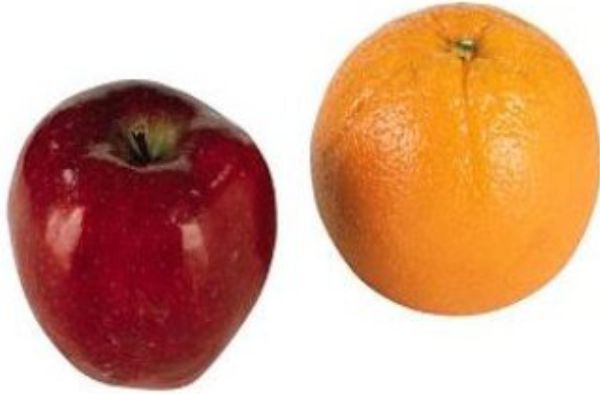
“If galaxies were shrunk to the size of apples, neighboring galaxies would be only a few meters apart….”
“If the stars within galaxies were shrunk to the size of oranges, they would be separated by 4,800 kilometers (3,000 miles).”

Apple orangeSo there’s a lot of not much between galaxies, but a whole lot more not much, relatively speaking, within them. I just measured an apple and an orange in my kitchen. They’re both about the same size, 3 inches in diameter, so I have no idea why she chose different fruits – perhaps she wanted to avoid comparing apples and oranges.

Anyway, if you felt like doing the galaxy visualization you could put two apple galaxies on the floor about 12 feet apart and then line up about 50 apples between them. A fair amount of space for more galaxies.

To see inside a galaxy you could put one orange star in Miami FL, and its on-the-average nearest orange neighbor in Seattle WA. Then you could set out a long skinny row of just about 63 million oranges in between. Oh, and on this scale the nearest galaxy would be about 2 billion miles (or 43 quadrillion oranges) away. Way more not much inside a galaxy than between two neighboring ones.

So if we squeeze all those apples and oranges together we’d get rid of all the empty space, right?

Not by a long shot. Nearly all those stars are balls of very hot gas, which means they’re made up of atoms crossing empty space inside the star to collide with other atoms. Relative to the size of the atoms, how much empty space is there inside the star?

Matryoshkii 1For example, every chemistry student learns that 6×10²³ molecules of any gas take up a volume of 22.4 liters at normal Earth temperature and pressure. For a single-atom gas like helium that works out to about 22 atom-widths between atoms.

Now think about emptiness inside the Sun. If it’s a typical star (which it is) and if all of its atoms are hydrogen (which they mostly are) and if the average density of the Sun (1408 kg/m3) applied all the way down to the center of the Sun (which it doesn’t), and if we believe NASA’s numbers for the Sun (hey, why not?), then the average density works out to about 0.7 atom-widths between neighbors.

So no empty space to squeeze out of the Sun, eh? Well, actually there is quite a lot, because those atoms are mostly empty space, too.

OK, I cheated up there about the Sun, because virtually all of the Sun’s atoms have been dissociated into separated electrons and nuclei. The nucleus is much smaller than than its atom – by a factor of 60,000 or so. Think of a grape seed in the middle of a football field.

To sum it upward, we’ve got a set of Russian matryoshka dolls, one inside the next. At the center is a collection of grape seeds, billions and billions of them, each in their own football field. The football fields are all balled into a stellar orange (or maybe an apple), but there are billions of those crammed into a galactic apple (or maybe an orange) that’s about ten feet away from the nearest other piece of fruit.

As Douglas Adams wrote in Hitchhiker’s Guide to The Galaxy,

“Space … is big. Really big. You just won’t believe how vastly, hugely, mindbogglingly big it is. I mean, you may think it’s a long way down the road to the chemist’s, but that’s just peanuts to space…”

The thing to realize is that the function of all that space is to keep everything from being in the same place. That’s important.

~~ Rich Olcott

Sir Isaac, The Atom And The Whirlpool

Newton and atomNewton definitely didn’t see that one coming.  He has an excuse, though.  No-one in in the 17th Century even realized that electricity is a thing, much less that the electrostatic force follows the same inverse-square law that gravity does. So there’s no way poor Isaac would have come up with quantum mechanics.
Lemme ‘splain.  Suppose you have a mathematical model that’s good at predicting some things, like exactly where Jupiter will be next week.  But if the model predicts an infinite value under some circumstances, that tells you it’s time to look for a new model for those particular circumstances.

For example, Newton’s Law of Gravity says that the force between two objects is proportional to 1/r2, where r is the distance between their centers of mass.  The Law does a marvelous job with stars and satellites but does the infinity thing when r approaches zero.  In prior posts I’ve described some physics models that supercede Newton’s gravity law at close distances.

Electrical forces are same song second verse with a coda.  They follow the 1/r2 law, so they also have those infinity singularities.  According to the force law, an electron (the ultimate “particle” of negative charge) that approaches another electron would feel a repulsion that rises to infinity.  The coda is that as an electron approaches a positive atomic nucleus it would feel an attraction that rises to infinity.  Nature abhors infinities, so something else, some new physics, must come into play.

I put that word “particle” in quotes because common as the electron-is-a-particle notion is, it leads us astray.  We tend to think of the electron as this teeny little billiard-ballish thing, but it’s not like that at all.  It’s also not a wave, although it sometimes acts like one.  “Wavicle” is just  a weasel-word.  It’s far better to think of the electron as just a little traveling parcel of energy.  Photons, too, and all those other denizens of the sub-atomic zoo.

An electron can’t crumble or leak mass or deform to merge the way that sizable objects can.  What it does is smear. Quantum mechanics is all about the smear.  Much more about that in later posts.


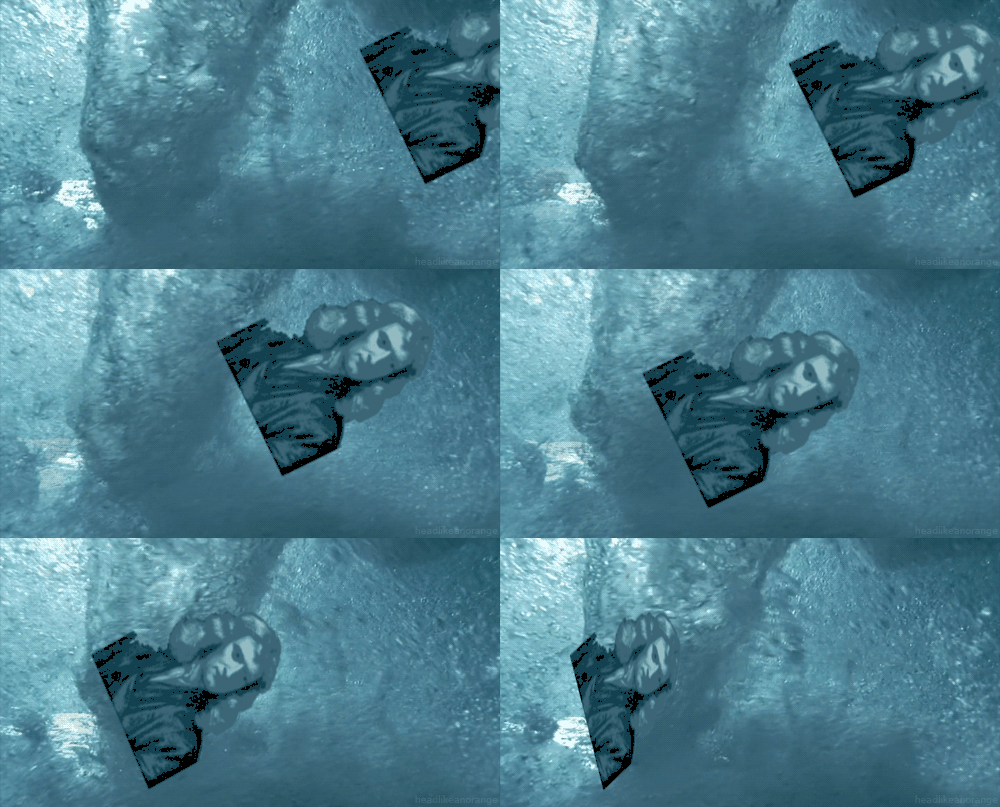
Newton in whirlpoolIf Newton loved anything (and that question has been discussed at length), he loved an argument.  His battle with Leibniz is legendary.  He even fought with Descartes, who was a decade dead when Newton entered Cambridge.

Descartes had grabbed “Nature abhors a vacuum” from Aristotle and never let it go.  He insisted that the Universe must be filled with some sort of water-like fluid.  He know the planets went round the Sun despite the fluid getting in the way, so he reasoned they moved as they did because of the fluid.

Surely you once played with toy boats in the bathtub.  You may have noticed that when you pulled your arm quickly through the water little whirlpools followed your arm.  If a whirlpool encountered a very small boat, the boat might get caught in it and move in the same direction.  Descartes held that the Solar System worked like that, with the Sun as your arm and the planets caught in Sun-stirred vortices within that watery fluid.

Newton knew that couldn’t be right.  The planets don’t run behind the Sun, they share the same plane.  Furthermore, comets orbit in from all directions.  Crucially, Descartes’ theory conflicted with his own and that settled the matter for Newton.  Much of Principia‘s “Book II” is about motions of and through fluid media.  He laid out there what a trajectory would look like under a variety of conditions.  As you’d expect, none of the paths do what planets, moons and comets do.

From Newton’s point of view, the only use for Book II was to demolish Descartes.  For us in later generations, though, he’d invented the science of hydrodynamics.

Which was a good thing so long as you don’t go too far upstream towards the center of the whirlpool.  As you might expect (or I wouldn’t even be writing this section), Book II is littered with 1/rn formulas that go BLOOIE when the distances get short.  What happens near the center?  That’s where the new physics of turbulence kicks in.

~~ Rich Olcott

Squeezing past Newton’s infinity

One of the most powerful moments in musical theater — Philip Quast Quastin his Les Miz role of Inspector Javert, praising the stars for the steadfastness and reverence for law that they signify for him.  The performance is well worth a listen.

Javert’s certitude came from Newton’s sublimely reliable mechanics — the notion that every star’s and planet’s motion is controlled by a single law, F~(1/r2).  The law says that the attractive force between any pair of bodies is inversely proportional to the square of the distance between their centers.  But as Javert’s steel-clad resolve hid a fatal spark of mercy towards Jean Valjean, so Newton’s clockworks hold catastrophe at their axles.

Newton’s gravity law has a problem.  As the distance approaches zero, the predicted force approaches infinity.  The law demands that nearby objects accelerate relentlessly at each other to collide with infinite force, after which their combined mass attracts other objects.  In time, everything must collapse in a reverse of The Big Bang.

Victor Hugo wrote Les Misérables about 180 years after Newton published his Principia.  A decade before Hugo’s book, Professeur Édouard Roche (pronounced rōsh) solved at least part of Newton’s problem.

Roche realized that Newton had made an important but crucial simplification.  Early in the Principia, he’d proven that for many purposes you can treat an entire object as though all of its mass were concentrated at a single point (the “center of mass”).  But in real gravity problems every particle of one object exerts an attraction for every particle of the other.

That distinction makes no difference when the two objects are far apart.  However, when they’re close together there are actually two opposing forces in play:

  • gravity, which preferentially affects the closest particles, and
  • tension, which maintains the integrity of each structure.
contact_binary_1
Binary star pair demonstrating Roche lobes, image courtesy of Cronodon.com

Roche noted that the gravity fields of any pair of objects must overlap.  There will always be a point on the line between them where a particle will be tugged equally in either direction.  If two bodies are close and one or both are fluid (gases and plasmas are fluid in this sense), the tension force is a weak competitor.  The partner with the less intense gravity field will lose material across that bridge to the other partner. Binary star systems often evolve by draining rather than collision.

Now suppose both bodies are solid.  Tension’s game is much stronger.  Nonetheless, as they approach each other gravity will eventually start ripping chunks off of one or both objects.  The only question is the size of the chunks — friable materials like ices will probably yield small flakes, as opposed to larger lumps made from silicates and other rocky materials.  Roche described the final stage of the process, where the less-massive body shatters completely.  The famous rings of Saturn and the less famous rings of Neptune, Uranus and Jupiter all appear to have been formed by this mechanism.

Roche was even able to calculate how close the bodies need to be for that final stage to occur. The threshold, now called the Roche Limit, depends on the size and mass of each body. You can get more detail here.

Klingon3And then there’s spaghettification.  That’s a non-relativistic tidal phenomenon that occurs near an extremely dense body like a neutron star or a black hole.  Because these objects pack an enormous amount of mass into a very small volume, the force of gravity at a close-in point is significantly greater than the force just a little bit further out. Any object, say a Klingon Warbird that ignored peril markings on a space map (Klingons view warnings as personal challenges), would find itself stretched like a noodle between high gravity on the side near the black hole and lower gravity on the opposite side.  (In this cartoon, notice how the stretching doesn’t care which way the pin-wheeling ship is pointed.)

Nature abhors singularities.  Where a mathematical model like Newton’s gravity law predicts an infinity, Nature generally says, “You forgot something.”  Newton assumed that objects collide as coherent units.  Real bodies drain, crumble, or deform to slide together.  Look to the apparent singularities to find new physics.

~~ Rich Olcott