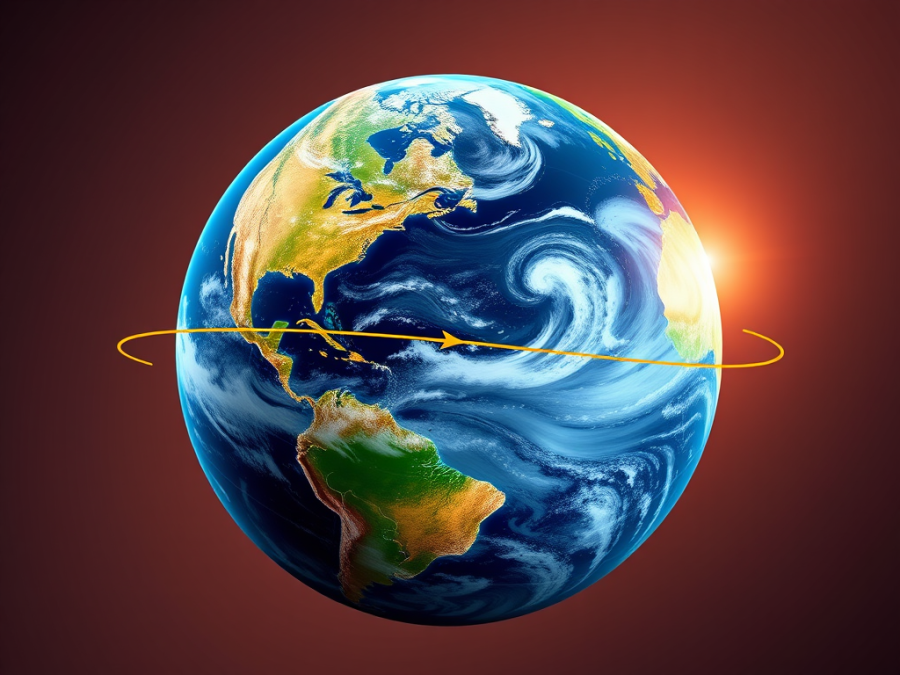
Tropical beach with palm trees next to icy polar region with glaciers.

The Big Water Pump

“Springtime! Could you make me a lilac latte, Cal?”

“Maybe if I left out the coffee, Cathleen. Lilac’s too delicate to stand up to coffee’s punch. How about a cold brew of light roast? I just made a batch. Plenty of caffeine in there, not too much intensity and you can imagine the flowery part.”

“I’ll have that, and a lemon scone, please.”

“Here you go, fresh from the filter. Hey, you sure lit a fire under Sy. He’s done a whole string of posts about Coriolois Effects.”

“Tsk, Cal, the scientist’s name was Coriolis. I’m not surprised there’s been multiple posts — the same pseudo‑force shows up in many ways.”

“Pseudo‑force?”

<looks around> “Good, Sy’s not here. He’d talk our ears off about inertial frames. My quick answer from a planet scientist perspective is that real forces are the ones that make things happen in systems where everything’s moving in straight lines at a steady pace.”

“Like on a pool table?”

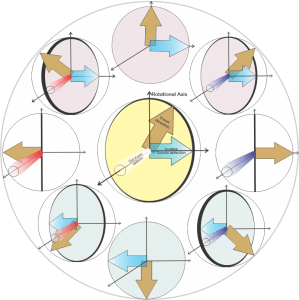
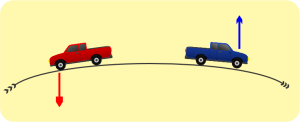
“Mm-hm. You can generally make good predictions on systems like that, which is how pool sharks make their money. But if part of the system is accelerating in some way, maybe it’s rotating, you’ve got two choices for predicting how the system will behave. The hard way is to calculate each individual component’s motion in a single coordinate system using just the real forces. The easier way is to group components that have a common acceleration. Pick a convenient group to serve as your base subsystem. Define another subsystem for the components that all have the same acceleration relative to the first subsystem and so on. Then you pretend a pseudo‑force drives the interactions between your subsystems.”

“Like Earth and our Moon make a subsystem ’cause they orbit the Sun together and you said rotation’s a kind of acceleration. The pseudo‑force is centrifugal, fighting against the Sun’s gravity to keep Earth’s subsystem in orbit!”

“I love it when that kind of connection‑making happens in my classroom. Thank you, Cal.”

“You’re welcome. So your subsystems are what Sy calls frames?”

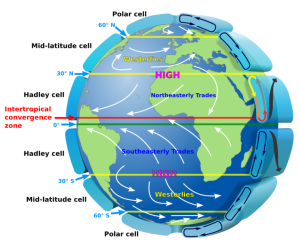
“Pretty much. Skipping some technical caveats, that’s the idea. When I think about atmosphere dynamics, I could try to calculate the planet’s whole atmosphere as an incredibly messy collection of atoms. I prefer to think of the Earth as a subsystem hosting some number of air mass subsystems, all embedded in the Universe system. The Universe enforces straight‑line inertia and the Earth adds rotational acceleration but the air masses are constrained to the planet’s spherical geometry. The Coriolis pseudo‑force summarizes all three effects. The calculation’s still messy, but it’s a lot more manageable. And then there’s water.”

“Water?”

“The piston that drives the climate. Water molecules are small so they move easily through the atmosphere. The important thing is, they’re good at transporting heat energy.”

“How’s that? They’d be the same temperature as everything else.”

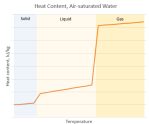
“Temperature doesn’t always measure energy. Water molecules like to hold onto other water molecules. It takes energy to get them apart. When they get back together, the energy’s released so it’s like the freed‑up molecules store heat energy. In solid water, every molecule is locked into position. Melting a given mass of water amounts to breaking those locks. The liquid mass at freezing temperature contains more energy than the ice did. When liquid water evaporates, the gas contains even more energy, because the molecules can roam even more freely. Visualize a bucket of water someplace warm.”

“A Hawai’ian beach.”

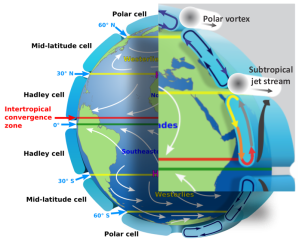
“That bucketful absorbs heat energy as it evaporates, cooling the Pacific Ocean. Winds sweep up the gas and carry it north to the Arctic where it freezes. In the process it warms the ice cap by giving up its liquid‑to‑gas heat and also its solid‑to‑liquid heat. Water’s two active phase transitions make it a far more efficient heat transporter than dry air alone.”

“One bucket’s teeny in the ocean, though.”

“Multiply that by gazillions. We have gigatons of surface water. The evaporate/freeze/melt process cycles as the icecaps degrade, continuously acting to moderate Earth’s temperature differences. If Earth were dry, the gradient would be far steeper. Thermal gradients drive air movement. A dry Earth’s extreme temperature discrepancies would generate permanent gale‑force winds towards the poles.”

~ Rich Olcott

Atmospheric Jiu-jitsu

A gorgeous early Spring day for a walk by the lake — blue sky, air just the right side of crisp, trees showing their young green leaves, geese goosily paddling around. As I pass the park bench I hear a familiar voice. “Hello, Mr Moire.”

“Morning, Walt. It’s been a while. What do your people want to know about now?”

“We’ve been reading your series of posts about the Coriolis Effect. You have masses of air pushing each other around, you have pendulums twisting about, and you have objects flying weird orbits around latitudes instead of the planet’s center. Which is the real Effect?”

“All three.”

“They’re so different. How can all three be right?”

“Knowing something of your interests, I can think of another Coriolis application will help clarify the connection. How do you steer an old‑fashioned artillery shell?”

“You don’t, you aim it.” <His eyes are looking inward.> “Those old howitzers, you traverse to the target’s coordinates, set the elevation for the distance and your munitions and whatever your barrel’s still good for, load ‘er up, let ‘er rip and wait for the forward observer to tell you how to adjust.”

“No correction for the Earth turning west‑to‑east beneath the shell’s trajectory?”

“No need. Inside a max 10‑mile range, the artillery, target and shell all share the same initial eastward vector. Windage and temperature inversions are more of a problem than Coriolis forces. That’s where judgement, feedback and reload speed come in.”

“Now stand that up against a cruise missile.”

“Very different situation. With cannons, all the propulsion happens at the start. That’s why they call it ballistic. Cruise missiles have an extended boost phase, maybe more than one, so they can do in‑flight steering. On the other hand, range is hundreds of miles or more so you do need to figure in relative easting.”

“And the easting correction takes power, right?”

“Of course.”

“From the missile’s point of view, that power goes to counteract the Coriolis force pushing it off‑course. You don’t see it from the ground but the missile does. Clearer now?”

“Give me a minute.” <sketches on his notepad> “Okay, counteracting attempt to deflect course — got it. Hmm, a pendulum’s even simpler, because it’s not trying to keep in sync with the Earth’s rotation. No forces in play crosswise to the swing plane so it can maintain orientation relative to the Universe. To museum visitors it looks like something’s twisting, but it’s us doing the moving. The air masses, though … forces are in play with that one.”

“It’s always important to keep track of who’s doing what to whom. That system has four distinct frames of reference: the Earth, a moving air mass, the air mass it collides with, and the Universe.”

“The Universe?”

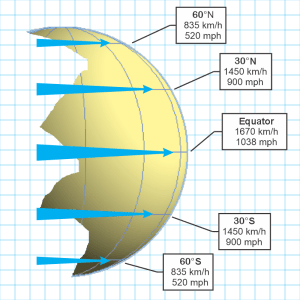
“Sets the stage for Newton’s First Law, about conservation of linear momentum. Say there’s an air mass hovering over Dallas, latitude 30° north. Relative to the Earth it’s stationary, but relative to the Sun and the rest of the Universe it has an eastward vector clocking 1450 km/hour. Now suppose that mass moves north relative to the Earth.”

“But there’s already an airmass taking up space there, say in Manitoba. There’ll be a collision, northbound momentum against Manitoban inertia.”

“Here’s where Coriolis gets into the game. Manitoba may have zero motion relative to Earth, but Manitoba and its air mass are also moving eastward relative to the Universe. Manitoba’s speed is slower than Dallas’ but it’s not zero. Manitoba’s momentum deflects the Dallas mass into an even more easterly vector.”

“You’re saying that Coriolis plays jiu‑jitsu with the atmosphere.”

“I wouldn’t have come up with that interpretation, but it’s reasonable.”

“What about the weird orbits?”

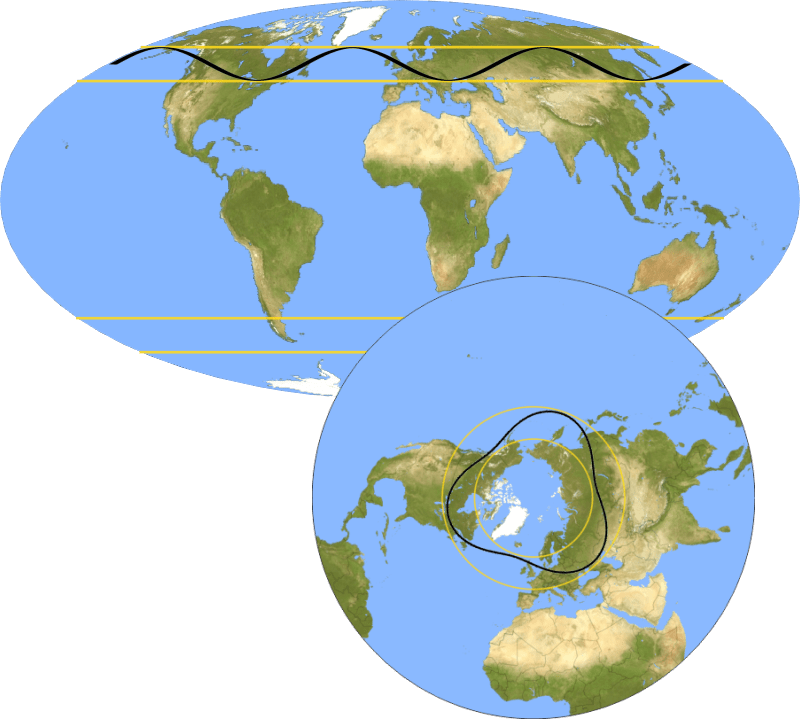
“Not really orbits, more like equilibrium bands. The concept comes from the theoretical notion that every latitude along a meridian has a natural equilibrium speed where air pressure balances other forces. The bands would be parallel circles around the globe except for geography and transient disturbances. Dallas’ 1450‑km/h number was an example. If you exceed your local natural speed, centrifugal force moves you towards the Equator; if you’re a slowpoke, you’re shoved towards the nearest pole. Real weather’s more complicated.”

“Everything’s always more complicated.”

~ Rich Olcott

The Polar Expression

“Good afternoon, Mr … Moire, yes?”

“The same. Can I help you?”

“Yes. I am Tomas Frashko. I am new to this University. I could not help overhearing—”

“The whole neighborhood couldn’t help overhearing.”

“Mmm, yes. My sympathy. But I have some questions, if you have a moment.”

“My coffee mug’s not empty yet. Please sit down. I’ll help if I can.”

“Thank you. I have often seen the Coriolis Effect explained as an atmospheric effect — northbound air with high‑speed low‑latitude momentum deflected eastward by slower‑moving air already at higher latitudes. The last part of your recent post goes to some trouble to avoid that explanation. Why is that?”

“Because the Effect doesn’t only play with the atmosphere. It drives gyre currents in the oceans and probably the magma flows deep inside Earth’s mantle.”

“So fluids, not just air. But it is still a matter of fluid with a velocity in one direction being diverted by fluid with a different velocity. Also, these cases are planet‑scale effects operating over large distances. Surely systems at small scale do not experience a measurable amount of Coriolis force.”

“But they do. Museum Foucault pendulums swing on a scale measured in meters. There’s dozens of them on display all over the world, they act just as Coriolis’ ideas predicted, and the host institutions go to a great deal of trouble to ensure the steady swinging isn’t disturbed by rushing air.”

“Ah, yes. I have seen the pendulum exhibit in our museum in the city where I grew up. A hypnotic thing, swinging back and forth on its wire, each swing a little closer to knocking down a pin … finally! Then slowly turning direction to knock down another one. The museum docent said the plane of the pendulum’s swing pivots to demonstrate Earth’s rotation, but then she mentioned that the full circle takes more than a day to complete. She couldn’t explain why.”

“If it were swinging from a point above the North or South Pole it would be a one-day completion, 15 arcseconds per second.. Scientists tried mounting one at the South Pole and that’s exactly what they determined. The poles are the only points on Earth’s surface where the the pendulum’s inertial frame matches Earth’s so it looks like the Earth is simply turning beneath the pendulum. On the other hand, along the Equator the Coriolis force doesn’t affect a pendulum’s motion at all.”

“Not at all?”

“Nope. Centrifugal force, a little bit, but not Coriolis force.”

“Does the one become the other?”

“Oh no, they’re quite different. Centrifugal force represents competition between dissimilarly rotating frames; Coriolis force represents their coupling. If you’re riding on a merry‑go‑round—”

“A what?”

“Mm, you’d probably call it a carousel.”

“Ah. Yes, go on.”

“If you’re riding on a carousel, your straight‑line inertia in the fairgrounds frame tries to drive you forward. To stay in position on the rotating carousel, you fight that outward inertial impetus by holding onto something. In the ride’s rotating frame, that looks like you’re exerting centripetal force to counterbalance a centrifugal force that the fairgrounds frame doesn’t see.”

“Yes, yes, but how does that differ from Coriolis force?”

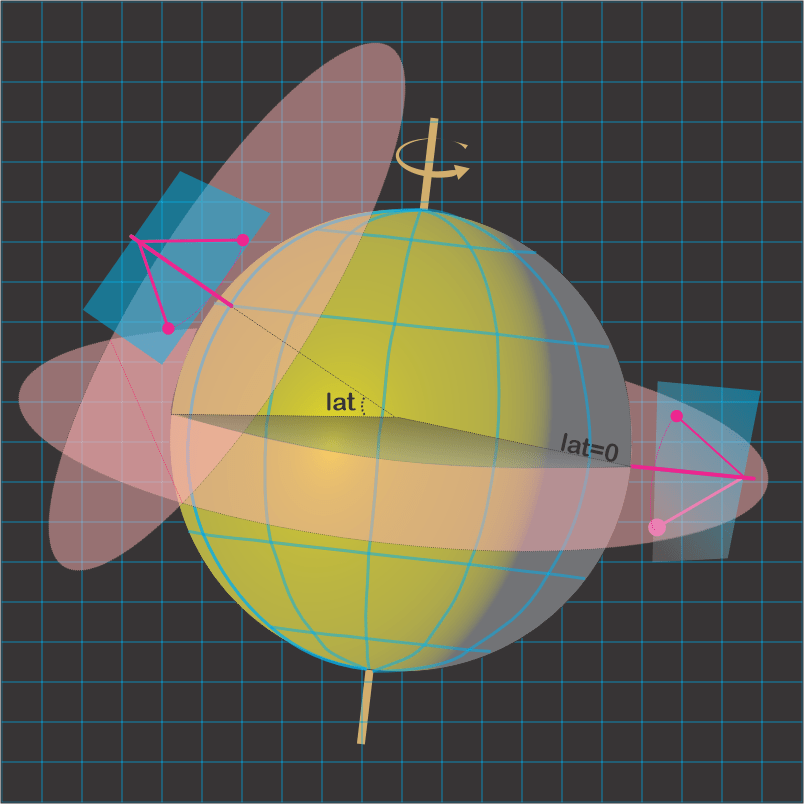
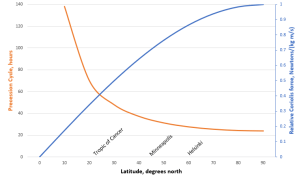
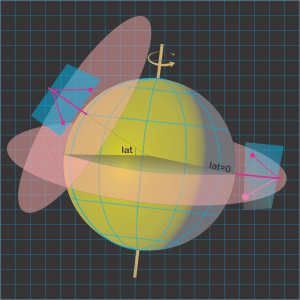
“Centrifugal force depends on an object’s distance from the center of rotation. Coriolis force doesn’t care about that. It rises with the sine of the angle between the object’s vector and the axis of rotation. On a sphere the relevant angle is the latitude. A northbound object, could be a pendulum bob, arrives at the North Pole traveling perpendicular to the Earth’s axis. Perpendicular angles have the maximum sine, 1.0. The Coriolis coupling is strongest there and that’s why a pendulum’s reference frame is locked to the Earth’s 24‑hour period. At the equator a northbound object moves parallel to the polar axis. Parallel lines have zero angle with zero sine so the Coriolis coupling’s zero. A pendulum’s plane of motion at the equator stays where it started, infinite precession completion time.”

“And in‑between?”

“In between. A pendulum’s cycle would run 27.7 hours in Helsinki, more than 60 hours at the Tropic of Cancer.”

“Small coupling, not much swerving.”

~ Rich Olcott

  • Thanks to Ric Werme for his thoughtful comments and suggestions.

Directional Reset

Professor of Astronomy Cathleen O’Meara barges into Cal’s Coffee Shop. “There you are, Sy Moire! You numbskull! You addlepate! You … nincompoop!

We’ve known each other since we were kids but I’ve rarely seen her this angry. “What have I done this time, Cathleen? I apologize, but what for?”

That last post you put up. One of the hardest things to get across to planet science students is the Coriolis Effect. You got it exactly backwards, you lummox! Confused the be-jeepers out of half my students and it’s going to take a whole class period to unwind it.”

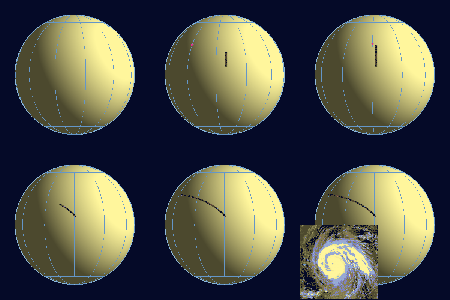
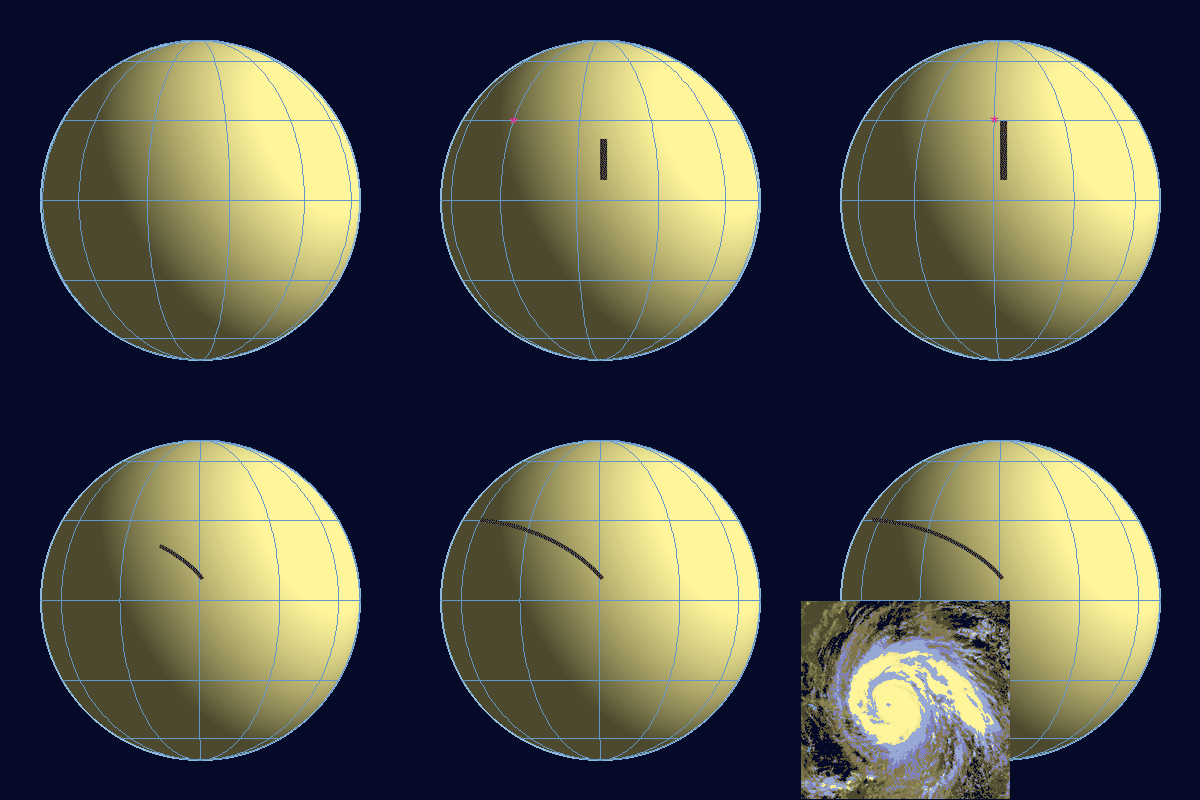
All those exclamation points sting when they strike home. “It did feel funny. All the sources I checked said Coriolis skews travel to the right in the northern hemisphere but I worked hard for hours on that video and it clearly shows ‘left‘.”

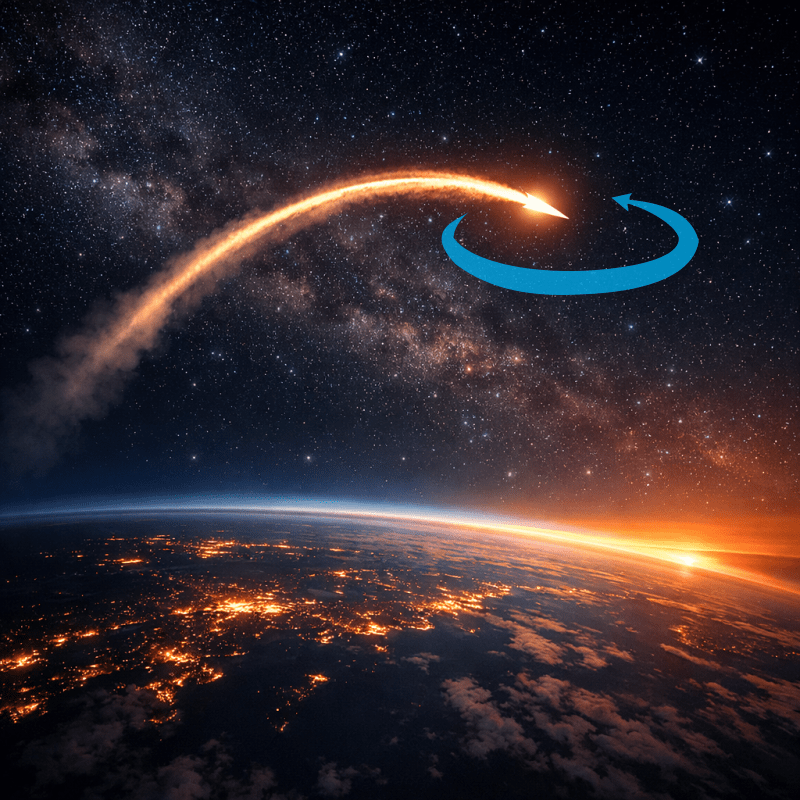
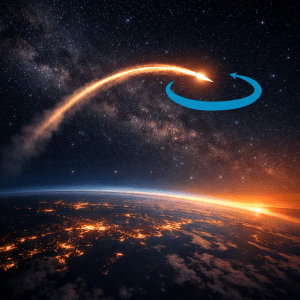
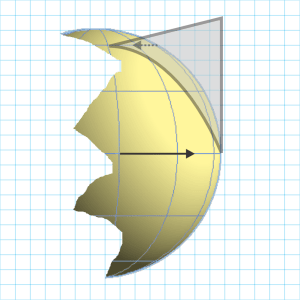
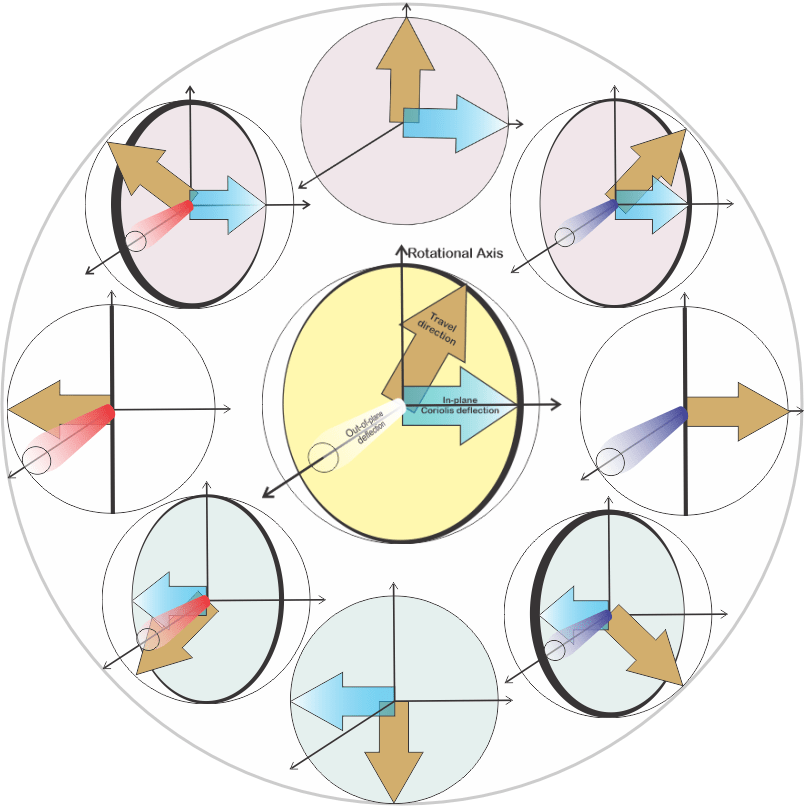
<sniff> “Stupid waste of time, chump! That video doesn’t show Coriolis.” <she grabs one of Cal’s graph-paper napkins and starts sketching> “Your balloon or whatever isn’t traveling north along Earth’s surface. It’s going out into space. That dark line tracks the thing’s shadow, or it would if you had the Sun behind it instead of off to the side. It has nothing at all to do with the cloud stream at the top of the hurricane and by the way those winds in the picture are outward, not inward as you’d’ve known if you’d’ve thought about for even a moment, blockhead! Here, look at a sideways view.”

“You’re saying my balloon’s not following the surface, it’s vectored away from the surface parallel to the north‑south axis. Also that the shadow points that I plotted on Earth trend westward only because the Earth turns west‑to‑east underneath the balloon. … Okay, I can see that. Goes so high up I guess it can’t be a balloon, huh?”

“Don’t try to deflect the conversation, nitwit. Figure out what you got wrong and put up a correction post that gives a proper account of Coriolis. Sorry, Cal, I’ll need my coffee in a sippy‑cup. Gotta go revise my lesson plan, again.”

She grabs her caffeine to‑go, flings me a final “Dolt! ” and storms out the door trailing a cloud of grumbles.

Vinnie’s open-mouthed. “Geez, Sy, she does have a temper.”

“You know it, Vinnie. Fortunately she saves it up for deserving occasions but don’t ever get her started on politics. So let’s see, what part of what I posted did I get right?”

“Well, there’s the part about Helsinki’s rotation around the Earth runs fewer kilometers per hour than Quito’s. That’s just fact, can’t argue with it.”

“Yeah, Mr Moire, and there’s Conservation of Momentum.”

“Right, Jeremy.” Synapses connect in my head. “Got it! Vinnie, what’s the rule between speed and orbit size?”

“The closer the faster. The Moon’s a quarter‑million miles away, takes a month to go round the Earth; the ESS is 250 miles up, circles us every 90 minutes. If you’re in some orbit and wanna go lower, you gotta speed up. Took me an hour to convince Larry that’s the way it works. He was all about centrifugal force forcing you outward, but if you want to get deeper in the gravity well you need the extra speed to balance the extra gravity.”

“That’s the rule for space orbits, alright, but things work exactly the opposite for travel on the surface of a rotating sphere. Gravity pulls centerward with the same strength everywhere so gravity’s not what balances the centrifugal force.”

“What does?”

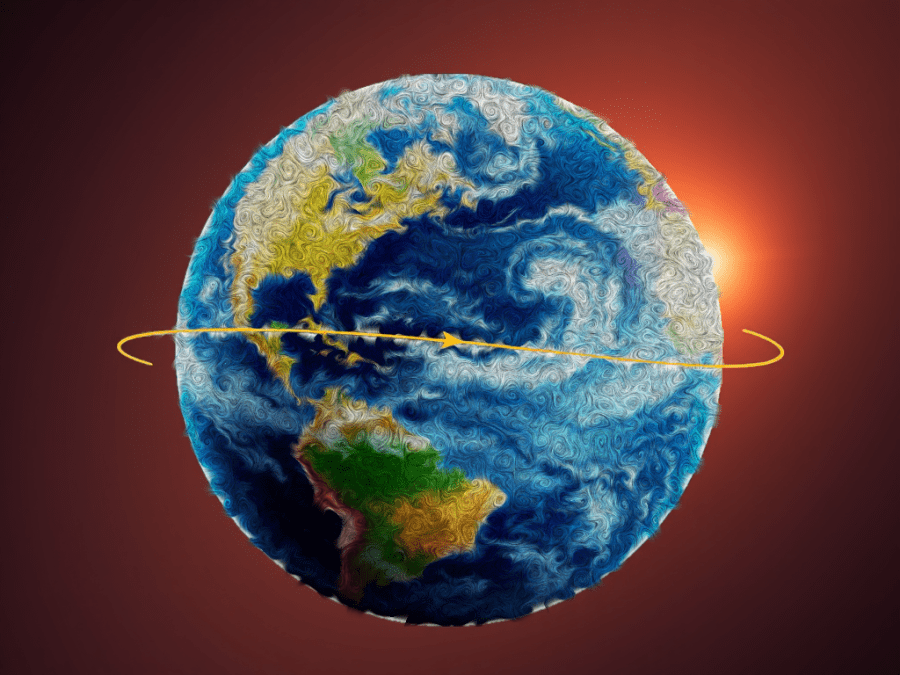
“Geometry. In space orbits, velocity and kinetic energy increase toward the core. On a sphere’s surface, the highest velocity is farthest away from the rotational axis, at the equator. Velocity falls off to zero at both poles. Every latitude has its characteristic velocity and kinetic energy. Suppose you’re loose on Earth’s northern hemisphere and moving east too fast for your latitude. You’ll drift southward, away from the axis, until you hit a latitude that matches your speed. Meanwhile, because you’re moving east the landscape will flow westward beneath you. The blend is the Coriolis Effect.”

“So if I’m slower than my latitude I drift north and Coriolis sends me east?”

“Cathleen would agree, Jeremy.”

~ Rich Olcott

When It’s Not The Same Frame – Never Mind

  • Author‘s note — Please ignore everything below the separator line. It’s bogus. No excuses, it’s just wrong. I intend to embarrass Vinnie and Sy just as soon as I get my head straight. My apologies to every reader, especially teachers, that I’ve confused.

“Hey, Sy, I couldn’t help overhearing—”

<chuckle> “Of course not, Cal. Overhearing what?”

“When you said Quito goes round the world twice as fast as Helsinki. That can’t be true! Things would collide and we’d get all kinds of earthquakes and stuff.”

“Well, sure, Cal, if those two airports moved relative to each other. But they don’t, they’re stuck 10750 kilometers apart just like they’ve always been. I hated flying that route. Mountains to dodge at both ends, in between there’s bad weather a lot of the time and no place good to set down if something goes wrong. … Wait — different speeds — it’s frames again, ain’t it, Sy?”

“Exactly, Vinnie, even though it’s not black holes for a change. Relative to an inertial frame on the Earth’s surface, the Earth itself doesn’t move and neither does either city. Relative to a Sun‑centered frame, though, the Earth spins on its axis once every 24 hours. In the Sun’s frame, Quito on Earth’s 40‑thousand kilometer Equator does 1666 kilometers per hour. Helsinki’s at 60° North. Its circle around the spin axis is only 20 thousand kilometers so its linear speed is 833 kilometers per hour even though it does the same 15 degrees per hour that Quito does.”

“Hi, Mr Moire. Welcome back. I couldn’t help overhearing—”

<chuckle> “Of course not, Jeremy. Overhearing what?”

“You talking about places on Earth moving different speeds. We just studied about that in Dr O’Meara’s planet science class but it’s still loose in my head. It has to do with why storms go counterclockwise, right?”

“It has everything to do with that, except the counterclockwise storms are only in the northern hemisphere. Southern hemisphere storms rotate the other way.”


“I got this, Sy. Bring up that movie you got on Old Reliable, the one that shows the northern hemisphere. Yeah, that one. Jeremy, some guy in a balloon is the dark line on his way from Kansas to the North Pole to meet Santa. In his frame the earth is moving left‑to‑right relative to his northbound course. See how the red star’s moving?”

“Yeah, it’s moving towards sunrise so his movie’s got the rotation right. Why Kansas?”

“‘Cause he’s got a good long shot over flatlands before any mountains or big lakes get in the way, okay? So, the other section of Sy’s movie is like it was shot from a satellite in geostationary orbit. In its frame the Earth is standing still, but the balloon guy’s swerving to his left which is west. Also counterclockwise.”

“Mmm, okay. So you’re saying that in our earthbound frame we see northerly winds getting twisted to their left which is west but it’s really the Earth turning under the atmosphere and that’s why hurricanes turn the way they do.”

“There are other ways to analyze it, guys.”

“Like what, Sy?”

“Let’s get back to Quito and Helsinki. In the northern hemisphere the latitude lines make shorter circles as you go north so your distance traveled per day gets smaller.”

“Makes sense, yeah.”

“Right. Your balloon guy’s at rest somewhere in the Earth’s frame before he starts his trip so the satellite sees him traveling eastward at say 1200 kilometers per hour. The atmosphere around him is doing about the same. Suppose he suddenly moves a few hundred kilometers north where the atmosphere’s moving significantly slower but he still has his original eastward momentum. What happens?”

“He gets slowed down.”

“Why?”

“Drag from the slower air. He dumps some of his momentum to the air molecules.”

“Conservation of Momentum does apply, Vinnie. That’s an explanation I see a lot in the pop‑sci press, but I’m not happy with it. An astronaut in a shuttlecraft going point‑to‑point across the airless Moon would see the same between‑frames contrast.”

“Oh! Newton’s First Law says you can’t change momentum unless an external force acts on you. So that’s the Coriolis Force, Mr Moire?”

“It’s related, Jeremy. Gravity restricts planet‑bound travelers to surface motion. Geometry and the force of gravity give that westward push in the planet’s frame to northbound objects in the northern hemisphere. The balloon guy and the astronaut don’t observe the Coriolis Effect unless they look out the window.”

~ Rich Olcott

When It’s Not The Same Frame

  • Author‘s note — Please ignore everything below the separator line. It’s bogus. No excuses, it’s just wrong. I intend to embarrass Vinnie and Sy just as soon as I get my head straight. My apologies to every reader, especially teachers, that I’ve confused.

“Hey, Sy, I couldn’t help overhearing—”

<chuckle> “Of course not, Cal. Overhearing what?”

“When you said Quito goes round the world twice as fast as Helsinki. That can’t be true! Things would collide and we’d get all kinds of earthquakes and stuff.”

“Well, sure, Cal, if those two airports moved relative to each other. But they don’t, they’re stuck 10750 kilometers apart just like they’ve always been. I hated flying that route. Mountains to dodge at both ends, in between there’s bad weather a lot of the time and no place good to set down if something goes wrong. … Wait — different speeds — it’s frames again, ain’t it, Sy?”

“Exactly, Vinnie, even though it’s not black holes for a change. Relative to an inertial frame on the Earth’s surface, the Earth itself doesn’t move and neither does either city. Relative to a Sun‑centered frame, though, the Earth spins on its axis once every 24 hours. In the Sun’s frame, Quito on Earth’s 40‑thousand kilometer Equator does 1666 kilometers per hour. Helsinki’s at 60° North. Its circle around the spin axis is only 20 thousand kilometers so its linear speed is 833 kilometers per hour even though it does the same 15 degrees per hour that Quito does.”

“Hi, Mr Moire. Welcome back. I couldn’t help overhearing—”

<chuckle> “Of course not, Jeremy. Overhearing what?”

“You talking about places on Earth moving different speeds. We just studied about that in Dr O’Meara’s planet science class but it’s still loose in my head. It has to do with why storms go counterclockwise, right?”

“It has everything to do with that, except the counterclockwise storms are only in the northern hemisphere. Southern hemisphere storms rotate the other way.”


“I got this, Sy. Bring up that movie you got on Old Reliable, the one that shows the northern hemisphere. Yeah, that one. Jeremy, some guy in a balloon is the dark line on his way from Kansas to the North Pole to meet Santa. In his frame the earth is moving left‑to‑right relative to his northbound course. See how the red star’s moving?”

“Yeah, it’s moving towards sunrise so his movie’s got the rotation right. Why Kansas?”

“‘Cause he’s got a good long shot over flatlands before any mountains or big lakes get in the way, okay? So, the other section of Sy’s movie is like it was shot from a satellite in geostationary orbit. In its frame the Earth is standing still, but the balloon guy’s swerving to his left which is west. Also counterclockwise.”

“Mmm, okay. So you’re saying that in our earthbound frame we see northerly winds getting twisted to their left which is west but it’s really the Earth turning under the atmosphere and that’s why hurricanes turn the way they do.”

“There are other ways to analyze it, guys.”

“Like what, Sy?”

“Let’s get back to Quito and Helsinki. In the northern hemisphere the latitude lines make shorter circles as you go north so your distance traveled per day gets smaller.”

“Makes sense, yeah.”

“Right. Your balloon guy’s at rest somewhere in the Earth’s frame before he starts his trip so the satellite sees him traveling eastward at say 1200 kilometers per hour. The atmosphere around him is doing about the same. Suppose he suddenly moves a few hundred kilometers north where the atmosphere’s moving significantly slower but he still has his original eastward momentum. What happens?”

“He gets slowed down.”

“Why?”

“Drag from the slower air. He dumps some of his momentum to the air molecules.”

“Conservation of Momentum does apply, Vinnie. That’s an explanation I see a lot in the pop‑sci press, but I’m not happy with it. An astronaut in a shuttlecraft going point‑to‑point across the airless Moon would see the same between‑frames contrast.”

“Oh! Newton’s First Law says you can’t change momentum unless an external force acts on you. So that’s the Coriolis Force, Mr Moire?”

“It’s related, Jeremy. Gravity restricts planet‑bound travelers to surface motion. Geometry and the force of gravity give that westward push in the planet’s frame to northbound objects in the northern hemisphere. The balloon guy and the astronaut don’t observe the Coriolis Effect unless they look out the window.”

~ Rich Olcott

It’s All About The Coupling

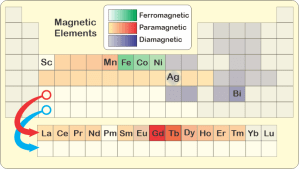
The game‘s over but there’s still pizza on the table so Eddie picks up the conversation. “So if gadolinoleum has even more unpaired electrons than iron, how come it’s not ferromagnetic like iron is?”

Vinnie’s tidying up the chips he just won. “I bet I know part of it, Eddie. Sy and me, we talked about magnetic domains some years ago. If I remember right, each iron atom in a chunk is a tiny little magnet, which I guess is the fault of its five unpaired electrons, but usually the atom magnets are pointing in all different directions so they all average out and the whole chunk doesn’t have a field. If you stroke the chunk with a magnet, that collects the little magnets into domains and the whole thing gets magnetic. How come gadomonium” <winks at Eddie, Eddie winks back> “doesn’t play the domain game, Susan?”

“It’s gadolinium, boys, please. As to the why, part’s at the atom level and part’s higher up. My lab neighbor Tammy schooled me on rare earth magnetism just last week. She does high‑temperature solid state chemistry with lanthanide‑containing materials. Anyway, she says it’s all about coupling.”

“I hope she told you more than that.”

“She did. Say you’ve got a single gadolinium atom floating in space. Its environment is spherically symmetrical, no special direction to organize the wave‑orbitals hosting unpaired charges. Now turn on a magnetic field to tell the atom which way is up, call that the z‑axis. The atom’s wave‑orbital with zero angular momentum orients along z. Six more wave‑orbitals with non‑zero angular momentum spin one way or the other at various angles to the z‑axis. Those charges in motion build the atom’s personal magnetic field.”

“But we’re on Earth, not in space.”

“Bear with me. First, as a chemist I must say that most of the transition and lanthanide elements happily lose two electrons so in general we’re dealing with ions. Before you ask, Vinnie, that goes even for metals where the ions float in an electron sea. When Tammy said ‘coupling’ she was talking about how strongly one ion feels the neighboring fields. Iron and other ferromagnetic materials have a strong coupling, much stronger than the paramagnetics do.”

“Why’s the ferro- coupling so much stronger?”

“Two effects. You can read both of them right off the Periodic Table. Physical size, for one. Each row down in the table represents one electronic shell which takes up space. The atom or ion in any row is bigger than the ones above it. Yes, the heavy elements have more nuclear charge to pull electronic charge close, but shielding from their completed lower shells lets the outer charge cloud expand. Tammy told me that gadolinium’s ions are about 20% wider than iron’s.”

“Makes sense — you make the ions get further apart, they won’t connect so good. What’s the other effect?”

“It’s about how each orbital distributes its charge. There are tradeoffs between shell number, angular momentum and distance from the nucleus. Unpaired charge concentration in gadolinium’s high‑momentum 4f‑orbitals on the average stays inside of all its 3‑shell waves. The outermost charge shelters the unpaired waves inside it. That weakens magnetic coupling with unpaired charge in neighboring ions. Bottom line — gadolinium and its cousins are paramagnetic because they’re bigger and less sensitive than ferromagnetic iron is.”

“Then how come rare earth supermagnets the Chinese make are better than the cheapie ironic kinds we can make here?”

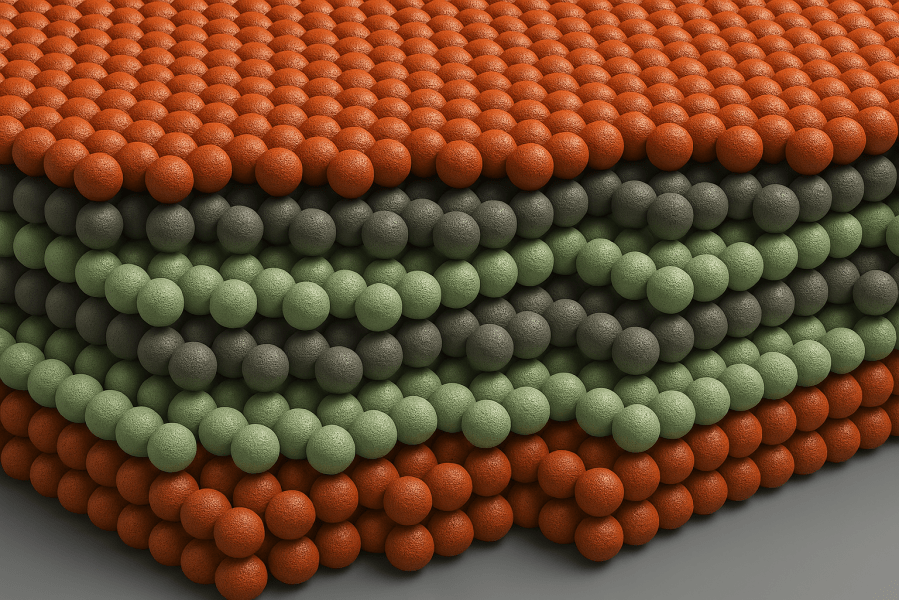
“The key is getting the right atoms into the right places in a crystalline solid. Neodymium magnets, for instance, have clusters of iron atoms around each lanthanide. The cluster arrangement aligns everyone’s z‑axes letting the unpaired charges gang up big‑time. You find materials like that mostly by luck and persistence. Tammy’s best samples are multi‑element oxides that arrange themselves in planar layers. Pick a component just 1% off the ideal size or cook your mixture with the wrong temperature sequence and the structure has completely different properties. Chinese scientists worked decades to perfect their recipes. USA chose to starve research in that area.”

~ Rich Olcott

Flipping An Edge Case

“Why’s the Ag box look weird in your chart, Susan?”

“That’s silver, Eddie. It’s an edge case. The pure metal’s diamagnetic. If you alloy silver with even a small amount of iron, the mixture is paramagnetic. How that works isn’t my field. Sy, it’s your turn to bet and explain.”

I match Eddie’s bet (the hand’s not over). “It’s magnetism and angular momentum and how atoms work, and there are parts I can’t explain. Even Feynman couldn’t explain some of it. Vinnie, what do you remember about electromagnetic waves?”

“Electric part pushes electrons up and down, magnetic part twists ’em sideways.”

“Good enough, but as Newton said, action begets reaction. Two centuries ago, Ørsted discovered that electrons moving along a wire create a magnetic field. Moving charges always do that. The effect doesn’t even depend on wires — auroras, fusion reactor and solar plasmas display all sorts of magnetic phenomena.”

“You said it’s about how atoms work.”

“Yes, I did. Atoms don’t follow Newton’s rules because electrons aren’t bouncing balls like those school‑book pictures show. An electron’s only a particle when it hits something and stops; otherwise it’s a wave. The moving wave carries charge so it generates a magnetic field proportional to the wave’s momentum. With me?”

“Keep going.”

“That picture’s fine for a wave traveling through space, but in an atom all the charge waves circle the nucleus. Linear momentum in open space becomes angular momentum around the core. If every wave in an atom went in the same direction it’d look like an electron donut generating a good strong dipolar magnetic field coming up through the hole.”

“You said ‘if’.”

“Yes, because they don’t do that. I’m way over‑simplifying here but you can think of the waves pairing up, two single‑electron waves going in opposite directions.”

“If they do that, the magnetism cancels.”

“Mm‑hm. Paired‑up configurations are almost always the energy‑preferred ones. An external magnetic field has trouble penetrating those structures. They push the field away so we classify them as diamagnetic. The gray elements in Susan’s chart are almost exclusively in paired‑up configurations, whether as pure elements or in compounds.”

“Okay, so what about all those paramagnetic elements?”

“Here’s where we get into atom structure. An atom’s electron cloud is described by spherical harmonic modes we call orbitals, with different energy levels and different amounts of angular momentum — more complex shapes have more momentum. Any orbital hosting an unpaired charge has uncanceled angular momentum. Two kinds of angular momentum, actually — orbital momentum and spin momentum.”

“Wait, how can a wave spin?”

“Hard to visualize, right? Experiments show that an electron carries a dipolar magnetic field just like a spinning charge nubbin would. That’s the part that Feynman couldn’t explain without math. A charge wave with spin and orbital angular momentum is charge in motion; it generates a magnetic field just like current through a wire does. The math makes good predictions but it’s not something that everyday experience prepares us for. Anyway, the green and yellow‑orange‑ish elements feature unpaired electrons in high‑momentum orbitals buried deep in the atom’s charge cloud.”

“So what?”

“So when an external magnetic field comes along, the atom’s unpaired electrons join the party. They orient their fields parallel to the external field, in effect allowing it to penetrate. That qualifies the atom as paramagnetic. More unpaired electrons means stronger interaction, which is why iron goes beyond paramagnetic to ferromagnetic.”

“How does iron have so many?”

“Iron’s halfway across its row of ten transition metals—”

“I know where you’re going with this, Sy. It’ll help to say that these elements tend to lose their outer electrons. Scandium over on the left ionizes to Sc3+ and has zero d‑electrons. Then you add one electron in a d orbital for each move to the right.”

“Thanks, Susan. Count ’em off, Vinnie. Five steps over to iron, five added d‑electrons, all unpaired. Gadolinium, down in the lanthanides, beats that with seven half‑filled f‑orbitals. That’s where the strength in rare earth magnets arises.”

“So unpaired electrons from iron flip alloyed silver paramagnetic?”

“Vinnie wins this pot.”

~ Rich Olcott

A Cosmological Horse Race

A crisp Fall day, perfect for a brisk walk around the park. I see why the geese are huddled at the center of the lake — Mr Feder, not their best friend, is on patrol again. Then he spots me. “Hey, Moire, I gotta question!”

“Of course you do, Mr Feder. What is it?”

“Some guy on TV said Einstein proved gravity goes at the speed of light and if the Sun suddenly went away it’d take eight minutes before we went flying off into space. Did Einstein really say that? Why’d he say that? Was the TV guy right? And what would us flying across space feel like?”

“I’ll say this, Mr Feder, you’re true to form. Let’s see… Einstein didn’t quite prove it, the TV fellow was right, and we’d notice being cold and in the dark well before we’d notice we’d left orbit. As to why, that’s a longer story. Walk along with me.”

“Okay, but not too fast. What’s not quite about Einstein’s proving?”

“Physicists like proofs that use dependable mathematical methods to get from experimentally-tested principles, like conservation of energy, to some result they can trust. We’ve been that way since Galileo used experiments to overturn Aristotle’s pure‑thought methodology. When Einstein linked gravity to light the linkage was more like poetry. Beautiful poetry, though.”

“What’s so beautiful about something like that?”

“All the rhymes, Mr Feder, all the rhymes. Both gravity and light get less intense with the square of the distance. Gravity and light have the same kinds of symmetries—”

“What the heck does that mean?”

“If an object or system has symmetry, you can execute certain operations on it yet make no apparent difference. Rotate a square by 90° and it looks just the same. Gravity and light both have spherical symmetry. At a given distance from a source, the field intensity’s the same no matter what direction you are from the source. Because of other symmetries they both obey conservation of momentum and conservation of energy. In the late 1890s researchers found Lorentz symmetry in Maxwell’s equations governing light’s behavior.”

“You’re gonna have to explain that Lorentz thing.”

Lorentz symmetry has to do with phenomena an observer sees near an object when their speed relative to the object approaches some threshold. Einstein’s Special Relativity theory predicted that gravity would also have Lorentz symmetry. Observations showed he was right.”

“So they both do Lorentz stuff. That makes them the same?”

“Oh, no, completely different physics but they share the same underlying structure. Maxwell’s equations say that light’s threshold is lightspeed.”

“Gravity does lightspeed, too, I suppose.”

“There were arguments about that. Einstein said beauty demands that both use the same threshold. Other people said, ‘Prove it.’ The strongest argument in his favor at the time was rough, indirect, complicated, and had to do with fine details of Earth’s orbit around the Sun. Half a century later pulsar timing data gave us an improved measurement, still indirect and complicated. This one showed gravity’s threshold to be with 0.2% of lightspeed.”

“Anything direct like I could understand it?”

“How about a straight‑up horse race? In 2017, the LIGO facility picked up a gravitational signal that came in at the same time that optical and gamma ray observatories recorded pulses from the same source, a colliding pair of neutron stars in a galaxy 130 million lightyears away. A long track, right?”

“Waves, not horses, but how far apart were the signals?”

“Close enough that the measured speed of gravity is within 10–15 of the speed of light.”

“A photo-finish.”

“Nice pun, Mr Feder. We’re about 8½ light-minutes away from the Sun so we’re also 8½ gravity-minutes from the Sun. As the TV announcer said, if the Sun were to suddenly dematerialize then Earth would lose the Sun’s orbital attraction 8½ minutes later. We as individuals wouldn’t go floating off into space, though. Earth’s gravity would still hold us close as the whole darkened, cooling planet leaves orbit and heads outward.”

“I like it better staying close to home.”

~ Rich Olcott
A No-Charge Transaction

I ain’t done yet, Sy. I got another reason for Dark Matter being made of faster‑then‑light tachyons.”

“I’m still listening, Vinnie.”

“Dark Matter gotta be electrically neutral, right, otherwise it’d do stuff with light and that doesn’t happen. I say tachyons gotta be neutral.”

“Why so?”

“Stands to reason. Suppose tachyons started off as charged particles. The electric force pushes and pulls on charges hugely stronger than gravity pulls—”

“1036 times stronger at any given distance.”

“Yeah, so right off the bat charged tachyons either pair up real quick or they fly away from the slower‑than‑light bradyon neighborhood leaving only neutral tachyons behind for us bradyon slowpokes to look at.”

“But we’ve got un‑neutral bradyon matter all around us — electrons trapped in Earth’s Van Allen Belt and Jupiter’s radiation belts, for example, and positive and negative plasma ions in the solar wind. Couldn’t your neutral tachyons get ionized?”

“Probably not much. Remember, tachyon particles whiz past each other too fast to collect into a star and do fusion stuff so there’s nobody to generate tachyonic super‑high‑energy radiation that makes tachyon ions. No ionized winds either. If a neutral tachyon collides with even a high-energy bradyon, the tachyon carries so much kinetic energy that the bradyon takes the damage rather than ionize the tachyon. Dark Matter and neutral tachyons both don’t do electromagnetic stuff so Dark Matter’s made of tachyons.”

“Ingenious, but you missed something way back in your initial assumptions.”

“Which assumption? Show me.”

“You assumed that tachyon mass works the same way that bradyon mass does. The math says it doesn’t.” <grabbing scratch paper for scribbling> “Whoa, don’t panic, just two simple equations. The first relates an object’s total energy E to its rest mass m and its momentum p and lightspeed c.”

E² = (mc²)² + (pc)²

“I recognize the mc² part, that’s from Einstein’s Equation, but what’s the second piece and why square everything again?”

“The keyword is rest mass.”

“Geez, it’s frames again?”

“Mm‑hm. The (mc²)² term is about mass‑energy strictly within the object’s own inertial frame where its momentum is zero. Einstein’s famous E=mc² covers that special case. The (pc)² term is about the object’s kinetic energy relative to some other‑frame observer with relative momentum p. When kinetic energy is comparable to rest‑mass energy you’re in relativity territory and can’t just add the two together. The sum‑of‑squares form makes the arithmetic work when two observers compare notes. Can I go on?”

“I’m still waitin’ to hear about tachyons.”

“Almost there. If we start with that equation, expand momentum as mass times velocity and re‑arrange a little, you get this formula

E = mc² / √(1 – v²/c²)

The numerator is rest‑mass energy. The v²/c² measures relative kinetic energy. The Lorentz factor down in the denominator accounts for that. See, when velocity is zero the factor is 1.0 and you’ve got Einstein’s special case.”

“Give me a minute. … Okay. But when the velocity gets up to lightspeed the E number gets weird.”

“Which is why c is the upper threshold for bradyons. As the velocity relative to an observer approaches c, the Lorentz factor approaches zero, the fraction goes to infinity and so does the object’s energy that the observer measures.”

“Okay, here’s where the tachyons come in ’cause their v is bigger than c. … Wait, now the equation’s got the square root of a negative number. You can’t do that! What does that even mean?”

“It’s legal, when you’re careful, but interpretation gets tricky. A tachyon’s Lorentz factor contains √(–1) which makes it an imaginary number. However, we know that the calculated energy has to be a real number. That can only be true if the tachyon’s mass is also an imaginary number, because i/i=1.”

“What makes imaginary energy worse than imaginary mass?”

“Because energy’s always conserved. Real energy stays that way. Imaginary mass makes no sense in Newton’s physics but in quantum theory imaginary mass is simply unstable like a pencil balanced on its point. The least little jiggle and the tachyon shatters into real particles with real kinetic energy to burn. Tachyons disintegrating may have powered the Universe’s cosmic inflation right after the Big Bang — but they’re all gone now.”

“Another lovely theory shot down.”

~ Rich Olcott