
<bzzzt, bzzzt> “Who is this and how did you get this number?”
“Morning, Walt. It’s Sy Moire. Does hitting ‘Reply’ to your entry on my phone log count as spycraft?”
“Drat, another burner phone to trash. Oh well. Why the call?”
“Some history for your neutronium question, may make a difference.”
“Good difference or bad difference?”
“Depends on how you slant it, I suppose. The good news is that detecting that Earth‑threatening lump of neutronium would be easier than I thought. The bad news is that detecting it would be easier than I thought.”
“Forward and backward in the same statement. Unravel that.”
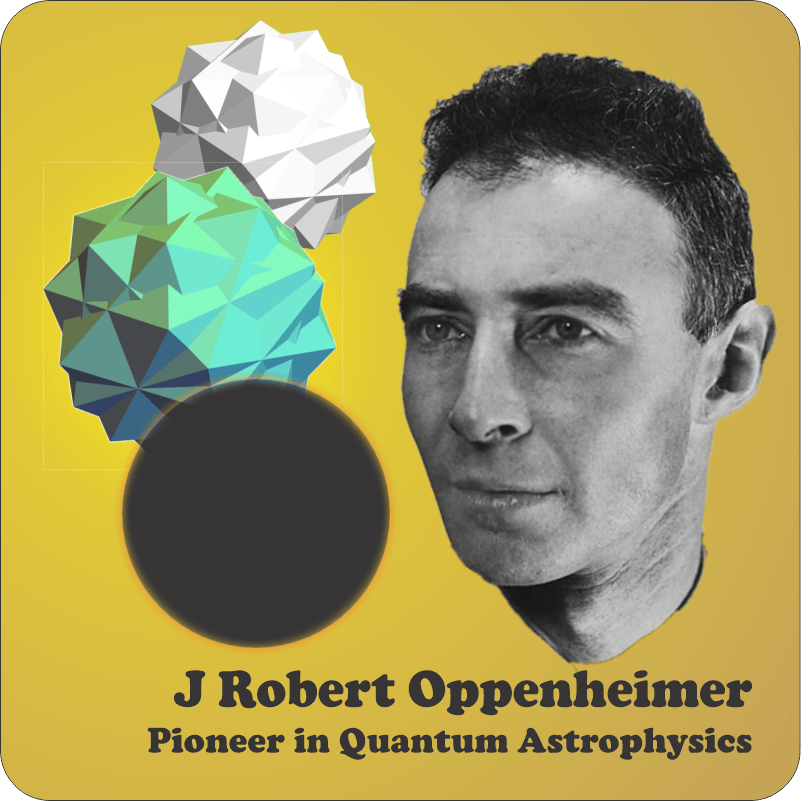
“It all goes back to Oppenheimer—”
“J Robert, the guy who ran the Manhattan Project?”
“The same, except before that he did theoretical Physics, not project management. Probably the most prominent physicist of the 1930s. He was active and influential in everything from molecular quantum mechanics and quantum field theory to astrophysics. He knew pretty much everyone who counted; everyone else knew of him. That made him a natural choice as a recruiter for the Project. I think many people were surprised when he turned out to be a good administrator.”
“Good for him and us. Why drag him into this?”
“He showed how neutron stars and black holes could happen. We’d known since 1915 that black holes were implicit in Einstein’s equations. Einstein himself didn’t think the Universe would allow matter to be that dense. In 1939 Oppenheimer showed how a star’s collapse could compress matter enough for the job. Actually, black holes were the easy part.”
“How could that be easy?”
“A star’s outer layers are supported by thermal pressure from the gas inside, right? When there’s not enough fuel to supply the heat, those outer layers come smashing inward like a roof when you knock out a load‑bearing wall. A big‑enough star would have plenty of gravitational potential energy to crush its core into black‑hole mode. Oppenheimer’s real challenge was explaining why the fall stopped partway for a smaller star. He used a tip from Fermi.”
“Enrico Fermi, the guy who built the nuclear reactor under the football field?”
“The same, except it wasn’t under the field, it was under the bleacher seats, but that’s another story. Anyway, Fermi had applied Pauli’s exclusion principle—”
“Out from the weeds, please.”
“Sorry. A couple of years prior, Fermi had worked out how a gas of quantum particles would behave under compression.”
“We’re talking electron or neutron gases?”
“Those among others. Squeeze a sparse quantum gas and measure the pressure it exerts at each decrease in volume. Pressure times volume is energy. For normal gases, pressure change times volume change at constant temperature is essentially constant. With quantum gases there’s a quantum‑limit pressure where the ΔP×ΔV energy goes nuts regardless of temperature. You need to input drastic amounts of energy to achieve even a small volume decrease. Technically, the limit’s called degeneracy pressure but I’d avoid that term in your report.”
“Because negative electron repels negative electron, naturally.”
“Nope, this is completely quantum, nothing to do with charge. It applies to neutrons just like it does to electrons although the limits are different. Try to cram too many quantum particles into a given volume and something has to give.”
“I see where you’re going. Does that energy limit depend on particle mass?”
“Indeed. Heavier particles have a higher limit.”
“Let me guess. White dwarf stars collapse to the electron limit, neutron stars to the neutron limit, pressure crushing beyond that makes a black hole. That’s what Oppenheimer calculated?”
“Mm‑hm. Better yet, he calculated minimum mass for each object type. That’s where the good‑news/bad‑news comes in. You need a lot of gravitational pressure to maintain a stable neutronium object. Below about a tenth of a solar mass, BLOOEY! If your nasty nova were to fling a too‑small chunk of neutronium at us, the chunk would disintegrate long before it could get this far.”
“So the good‑bad news is, a mass of neutronium could only get near us if it was more than a tenth of the Sun’s mass. Anything that heavy would make noticeable changes to planetary orbits long before we could see it. Bye.” <click>
~ Rich Olcott