Gravity and other fictitious forces

In this post I wrote, “gravitational force is how we we perceive spatial curvature.”
Here’s another claim — “Gravity is like centrifugal force, because they’re both fictitious.”   Outrageous, right?  I mean, I can feel gravity pulling down on me now.  How can it be fictional?
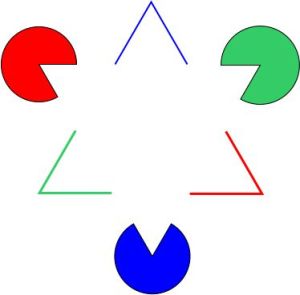
Fictitious triangle
A fictitious triangle

“Fictitious,” not “fictional,” and there’s a difference.  “Fictional” doesn’t exist, but a fictitious force is one that, to put it non-technically, depends on how you look at it.

Newton started it, of course.  From our 21st Century perspective, it’s hard to recognize the ground-breaking impact of his equation F=a.  Actually, it’s less a discovery than a set of definitions.  Its only term that can be measured directly is a, the acceleration, which Newton defined as any change from rest or constant-speed straight-line motion.  For instance, car buffs know that if a vehicle covers a one-mile half-mile (see comments) track in 60 seconds from a standing start, then its final speed is 60 mph (“zero to sixty in sixty”).  Furthermore, we can calculate that it achieved a sustained acceleration of 1.47 ft/sec2.

Both F and m, force and mass, were essentially invented by Newton and they’re defined in terms of each other.  Short of counting atoms (which Newton didn’t know about), the only routes to measuring a mass boil down to

  • compare it to another mass (for instance, in a two-pan balance), or
  • quantify how its motion is influenced by a known amount of force.

Conversely, we evaluate a force by comparing it to a known force or by measuring its effect on a known mass.

Once the F=a. equation was on the table, whenever a physicist noticed an acceleration they were duty-bound to look for the corresponding force.  An arrow leaps from the bow?  Force stored as tension in the bowstring.  A lodestone deflects a compass needle?  Magnetic force.  Objects accelerate as they fall?  Newton identified that force, called it “gravity,” and showed how to calculate it and how to apply it to planets as well as apples.  It was Newton who pointed out that weight is a measure of gravity’s force on a given mass.

Incidentally, to this day the least accurately known physical constant is Newton’s G, the Universal Gravitational Constant in his equation F=G·m1·m2/r2.  We can “weigh” planets with respect to each other and to the Sun, but without an independently-determined accurate mass for some body in the Solar System we can only estimate G.  We’ll have a better value when we can see how much rocket fuel it takes to push an asteroid around.
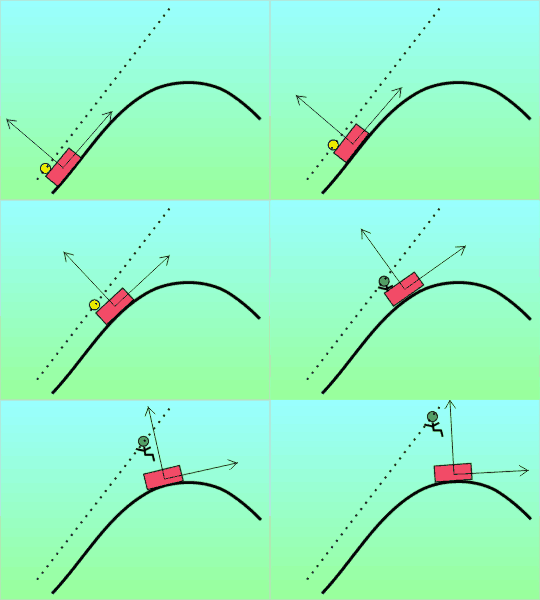
CoasterBut there are other accelerations that aren’t so easily accounted for.  Ever ride in a car going around a curve and find yourself almost flung out of your seat?  This little guy wasn’t wearing his seat belt and look what happened.  The car accelerated because changing direction is an acceleration due to a lateral force.  But the guy followed Newton’s First Law and just kept going in a straight line.  Did he accelerate?

This is one of those “depends on how you look at it” cases.  From a frame of reference locked to the car (arrows), he was accelerated outwards by a centrifugal force that wasn’t countered by centripetal force from his seat belt.  However, from an earthbound frame of reference he flew in a straight line and experienced no force at all.
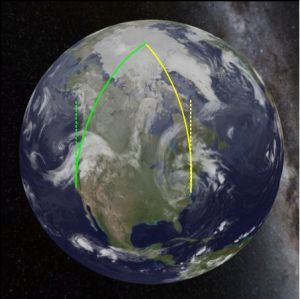
Side forceSuppose you’re investigating an object’s motion that appears to arise from a new force you’d like to dub “heterofugal.”  If you can find a different frame of reference (one not attached to the object) or otherwise explain the motion without invoking the “new force,” then heterofugalism is a fictitious force.

Centrifugal and centripetal forces are fictitious.  The  “force” “accelerating” one plane towards another as they both fly to the North Pole in this tale is actually geometrical and thus also fictitious   So is gravity.

In this post you’ll find a demonstration of gravity’s effect on the space around it.  Just as a sphere’s meridians give the effect of a fictitious lateral force as they draw together near its poles, the compressive curvature of space near a mass gives the effect of a force drawing other masses inward.

~~ Rich Olcott

What’s that funnel about, really?

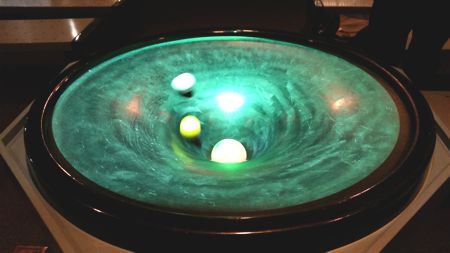
If you’ve ever watched or read a space opera (oh yes, you have), you know about the gravity well that a spacecraft has to climb out of when leaving a planet.  Every time I see the Museum’s gravity well model (photo below), I’m reminded of all the answers the guy gave to, “Johnny, what can you make of this?

The model’s a great visitor-attracter with those “planets” whizzing around the “Sun,” but this one exhibit really represents several distinct concepts.   For some of them it’s not quite the right shape.DMNS gravity well

The simplest concept is geometrical.  “Down” is the direction you move when gravity’s pulling on you.

HS cone
Gravitational potential energy change
for small height differences

A gravity well model for that concept would be just a straight line between you and the neighborhood’s most intense gravity source.

You learned the second concept in high school physics class.  Any object has gravitational potential energy that measures the amount of energy it would give up on falling.  Your teacher probably showed you the equation GPE = m·g·h, where m is the mass of the object, h is its height above ground level, and g is a constant you may have determined in a lab experiment.

If the width of the gravity well model at a given height represents GPE at that level, the model is a simple straight-sided cone.

Newton energy cone
Gravitational potential energy change
for large height differences
The h indicates
an approximately linear range
where the HS equation could apply.

But of course it’s not that simple.  Newton’s Law of Gravity says that the potential energy at any height r away from the planet’s center is proportional to 1/r.

Hmm… that looks different from the “proportional to h” equation.  Which is right?

Both equations are valid, but over different distance scales.  The HS teachers didn’t quite lie to you, but they didn’t give you the complete picture either.  Your classroom was about 4000 miles (21,120,000 feet) from Earth’s center, whereas the usual experiments involve height differences of at most a dozen feet.  Even the 20-foot drop from a second-story window is less than a millionth of the way down to Earth’s center.

Check my numbers:

Height h 1/(r+h)
× 108
Difference in 1/(r+h)
× 1014
0 4.734,848,484 0
20 4.734,844,001 4.48
40 4.734,839,517 8.97
60 4.734,835,033 13.45
80 4.734,830,549 17.93
100 4.734,826,066 22.42

rh lineSure enough, that’s a straight line (see the chart).  Reminds me of how Newton’s Law of Gravity is valid except at very short distances.  The HS Law of Gravity works fine for small spans but when the distances get big we have to use Newton’s equation.

We’re not done yet. That curvy funnel-shaped gravity well model could represent the force of gravity rather than its potential energy.  Newton told us that the force goes as 1/r2 so it decreases much more rapidly than the potential energy does as you get further away.  The gravity force well has a correspondingly sharper curve to it than the gravity energy well.

Newton force cone
The force of gravity
or an embedding diagram

The funnel model could also represent the total energy required to get a real spacecraft off the surface and up into space.  Depending on which sci-fi gimmickry is in play, the energy may come from a chemical or ion rocket, an electromagnetic railgun, or even a tractor beam from some mothership way up there.

No matter the technology, the theoretical energy requirement to get to a given height is the same.  In practice, however, each technology is optimal for some situations but forbiddingly inefficient in others.  Thus, each technology’s funnel  has its own shape and that shape will change depending on the setting.

In modern physics, the funnel model could also represent Einstein’s theory of how a mass “bends” the space around it.  (Take a look at this post, which is about how mass curves space by changing the local distance scale.)  Cosmologists describe the resulting “shapes” with embedding diagrams that are essentially 2D pictures of 3D (or 4D) contour plots.  The contours are closest together where space is most compressed, just as lines showing a steep hillside on a landscape contour map are close together.

The ED around a non-spinning object looks just like the force model picture above.  No surprise — gravitational force is how we we perceive spatial curvature.

~~ Rich Olcott

A Summertime Slice of π

So you think you’re standing still?  Let’s run some circles, all variations on the theme of 2πR…

Circles in circles
The Earth rotates on its axis,
as it and the moon revolve around their barycenter,
as the barycenter revolves around the Sun.
Not to scale, of course.

The Earth’s radius is 4,000 miles and it completes one rotation every 24 hours.  Its circumference at the Equator (2πR) is 25,000 miles, so if you’re reading this in Ecuador you’re doing 25000/24 = 1041 miles per hour.

I’m writing this in Denver, at 39.75oN, where the circumference perpendicular to the axis of rotation is only 19,200 miles.  Sitting here I’m circling the Earth at 800 miles per hour.  But that’s not all.

The Earth and the Moon both revolve around their common center of gravity (their barycenter).  The barycenter is inside the Earth, offset from its center by 2881 miles.  The center of the Earth runs a circle around the barycenter once every month (27.3 days), at a relatively piddly 27.6 miles per hour.  But that’s not all.

Circles in circles
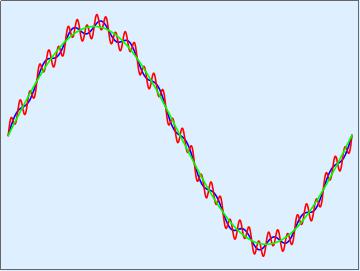
One year of Denver’s distance from Sag A*,
the black hole at the center of the Milky Way.
The green curve is our orbit around the Sun.
The blue curve adds in the monthly wobble
as we revolve around the barycenter.
The red curve includes our daily rotation. (Should be 365 cycles but I used artistic license to cut that down to 36. Besides, the vertical scale’s all wrong. Sue me.)

Earth’s orbit is (nearly) a circle.  The orbit’s radius is 93 million miles so its circumference is 584 million miles.  If you ran that many miles in a year you’d have to hit a pace of 66,600 miles per hour (no rest stops).  But that’s not all.

The Sun’s not just standing still all alone in space.  It’s part of the Milky Way Galaxy, which rotates once per 230 million years.  The Sun is about 26,000 light-years (152.8 quadrillion miles) from the center of the galaxy, so in one cycle it travels some 960 quadrillion miles.  That’s a rate of 476,000 miles per hour.  But that’s not all.

The Milky Way is one of about 50 galaxies in the Local Group.  The galaxies move with respect to each other and the whole assembly undoubtedly rotates.  Unfortunately, the astronomers are just now devising technology that can measure all that motion.  Expect large numbers for the net speeds when they figure them out.  But that’s not all.

The entire Local Group is flying towards a point in the constellation Centaurus.  Our flight speed has been measured at about 1,430,000 miles per hour.  The astronomers think the flight is linear, but on a larger scale it may be part of yet another rotation.

Feeling a bit dizzy?  Have a frosty glass of iced tea with your delicious π and just let the Earth spin along.

~~ Rich Olcott

A Little Summertime Monkey Business

Surely you’ve heard of The Infinite Monkey Theorem.  You probably don’t believe it.  No way could that monkey accidentally type out anything meaningful, much less the complete works of Shakespeare.  Well…

Home libraryIn several of his Discworld books, author Terry Pratchett featured something called Library-space, L-space for short.  It’s defined as “a dimension that connects every library and book depository in the universe.  L-Space is portrayed as a natural outgrowth of the fact that knowledge = power = energy = matter = mass and mass warps space, and therefore, libraries in the Discworld universe are a very dangerous place indeed for the unprepared”.

Somewhere, Pratchett wrote that L-space contains all the books that have been written, all those that will be written, and all those that would have been written but the author thought better of it.  Well, how big is L-space?

To over-estimate, suppose L-space contains a billion (109) books, each book is 500 pages long, each page contains 4000 characters, and the characters are chosen from an “alphabet” of 500 marks (upper- and lower-case letters, numbers and punctuation marks, all in normal, bold and italic forms in a several different fonts).  One book would then contain two million marks.

Now, how many possible books are there, including ‘impossible’ character combinations like “zqzqzqzq”?  We can construct a “possible” book by choosing some random one of the 500 marks as the first character, the same or a different one as the second character (500×500 = 5002 = 250,000 possibilities so far) and so on, until we’ve built (or our monkey has typed) a two-million-character book.  It could be a book that contains nothing but a string of a million copies of “zq” — but that’s OK, it’s still a possible book.  So is the book that contains all the works of Shakespeare and so is a typo version that inconsistently misspells “Romeo.”

On this basis there are some 5002,000,000 = 105,397,940 different possible books.  L-space with only a billion books is thus very small indeed compared to the number of possible books.  Put another way, the set of all possible books (which we can call B-space) could hold 105,397,931 versions of the L-space that initially seemed so immense.

Note that there are two distinct operations involved in the Monkey Theorem’s process

  1. Generate a string of characters, and
  2. Identify a meaningful substring within that.

The monkey* has no clue what it’s typing.  Any given random string might or might not be intelligible to someone who reads English, or German, or Cherokee.  The string might be a computer program in FORTRAN or JavaScript, or maybe a sequence of DNA icons for a gene mutation that makes green hair — or it (probably) would have no valid interpretation in any context.

The monkey doesn’t care, it’s just typing.

In the  second step of the process someone has to recognize Macbeth or The Tempest buried in all the nonsense.  If we were walking through the stacks of B-space and pulled a book off the shelf, what are the odds that the book we grabbed belongs to L-space?

The answer is one in 105,397,931.  That’s a very small probability, BUT IT’S NOT ZERO.  By construction, we’re guaranteed that all the L-space books are in B-space – but we have a vanishingly small chance of finding one of them.

Now for our extremely patient monkey who has been typing for a really, really long time.  It’s been at it long enough to produce many, many copies of B-space.  After all, even 105,397,940 is a very small number compared to infinity.

The core of the Infinite Monkey Theorem is that with so much opportunity for duplication, we are guaranteed that there exists at least one complete and perfect copy of B-space and so at least one good copy of L-space and so at least one good copy of all the works of Shakespeare.  Also there’s at least one copy of “zqzqzqzq”.

The challenge is in laying hands on that one good copy.  From a physicist’s perspective, it’s such a low-probability event that it can be ignored.  On the other hand, the probability of Life arising on Earth was pretty low, too, but I’m glad it happened.

~~ Rich Olcott

* – I had a great “Monkeys typing” graphic, but they were chimps.  Pratchett’s Diskworld Librarian would object, quite firmly, because apes aren’t monkeys.

** – I also had a pretty good “feature image,” a collage of many different monkey faces, but it seems at least one of them has a copyright lawyer.  Now the feature image is a picture of my library prior to the down-sizing.