Swinging into Physics

A gorgeous Spring day, perfect for taking my 7-year-old niece to the park. We politely say “Hello” to the geese and then head to the playground. Of course she runs straight to the swing set. “Help me onto the high one, Uncle Sy!”

“Why that one, Teena? Your feet won’t reach the ground and you won’t be able to kick the ground to get going.”

“The high one goes faster,”

“How do you know that?”

“I saw some kids have races and the kid on the high swing always did more back-and-forths. Sometimes it was a big kid, sometimes a little kid but they always went faster.”

“Good observing, Sweetie. OK, upsy-daisy — there you are.”

“Now give me pushes.”

“I’m not doing all the work. Tell you what, I’ll give you a start-up shove and then you pump to keep swinging.”

“But I don’t know how!”

“When you’re going forward, lean way back and put your feet up as high as you can. Then when you’re going backward, do the opposite — lean forward and bend your knees way back. Now <hnnnhh!> try it.

<creak … creak> “Hey, I’m doing it! Wheee!”

<creak> “Good job, you’re an expert now.”

“How’s it work, Uncle Sy?”

“It’s a dance between kinetic energy, potential energy and momentum.”

“I’m just a little kid, Uncle Sy, I don’t know what any of those things are.”

“Mmm… Energy is what makes things move or change. You know your toy robot? What happens when its batteries run down?”

“It stops working, silly, until Mommie puts its battery in the charger overnight and then it works again.”

“Right. Your robot needs energy to move. The charger stores energy in the battery. Stored energy is called potential which is like ‘maybe,’ because it’s not actually making something happen. When the robot gets its full-up battery back and you press its GO button, the robot can move around and that’s kinetic energy. ‘Kinetic’ is another word for ‘moving.'”

“So when I’m running around that’s kinetic energy and when I get tired and fall asleep I’m recharging my potential energy?”

“Exactly. You’re almost as smart as your Mommie.”

“An’ when I’m on the swing and it’s moving, that’s kinetic.”

“You’ve got part of it. Watch what’s happening while you swing. Are you always moving?”

<creak … creak> “Ye-e—no! Between when I swing up and when I come down, I stop for just a teeny moment at the top. And I stop again between backing up and going forward. Is that when I’m potential?”

“Sort of, except it’s not you, it’s your swinging-energy that’s all potential at the top. Away from the top you turn potential energy into kinetic energy, going faster and faster until you’re at the bottom. That’s when you go fastest because all your potential energy has become kinetic energy. As you move up from the bottom you slow down because you’re turning your kinetic energy back into potential energy.”

<creak> “Back and forth, potential to kinetic to potential, <creak> over and over. Wheee! Mommie would say I’m recycling!”

“Yes, she would.”

<creak> “Hey, Uncle Sy, how come I don’t stop at the bottom when I’m all out of potential?”

“Ah. What’s your favorite kind of word?”

M-words! I love M-words! Like ‘murmuration‘ and ‘marbles.'”

“Well, I’ve got another one for you — momentum.”

“Oh, that’s yummy — mmmo-MMMENN-tummmm. What’s it mean?”

“It’s about how things that are moving in a straight line keep moving along that line unless something else interferes. Or something that’s standing still will just stay there until something gives it momentum. When we first sat you in the swing you didn’t go anywhere, did you?”

“No, ’cause my toes don’t reach down to the ground and I can’t kick to get myself started.”

“That would have been one way to get some momentum going. When I gave you that push, that’s another way.”

“Or I could wear a jet-pack like Tony Stark. Boy, that’d give me a LOT of momentum!”

“Way too much. You’d wrap the swing ropes round the bar and you’d be stuck up there. Anyway, when you swing past the bottom, momentum is what keeps you going upward.”

“Yay, momentum!” <creak>

~~ Rich Olcott
Three Shades of Dark

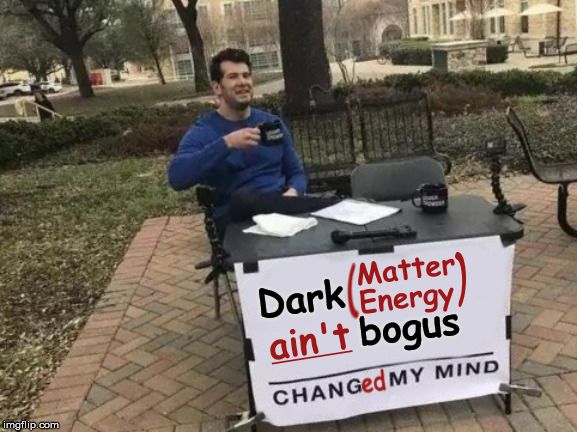
The guy’s got class, I’ll give him that. Astronomer-in-training Jim and Physicist-in-training Newt met his challenges so Change-me Charlie amiably updates his sign.

But he’s not done. “If dark matter’s a thing, how’s it different from dark energy? Mass and energy are the same thing, right, so dark energy’s gotta be just another kind of dark matter. Maybe dark energy’s what happens when real matter that fell into a black hole gets squeezed so hard its energy turns inside out.”

Jim and Newt just look at each other. Even Cap’n Mike’s boggled. Someone has to start somewhere so I speak up. “You’re comparing apples, cabbages and fruitcake. Yeah, all three are food except maybe for fruitcake, but they’re grossly different. Same thing for black holes, dark matter and dark energy — we can’t see any of them directly but they’re grossly different.”

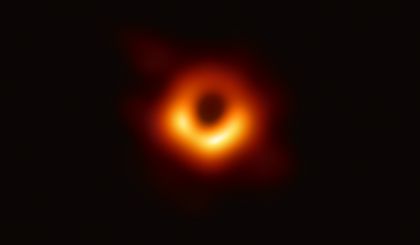
EHT's image of the black hole at the center of the Messier 87 galaxy
Black hole and accretion disk, image by the Event Horizon Telescope Collaboration

Vinnie’s been listening off to one side but black holes are one of his hobbies. “A black hole’s dark ’cause its singularity’s buried inside its event horizon. Whatever’s outside and somehow gets past the horizon is doomed to fall towards the singularity inside. The singularity itself might be burn-your-eyes bright but who knows, ’cause the photons’re trapped. The accretion disk is really the only lit-up thing showing in that new EHT picture. The black in the middle is the shadow of the horizon, not the hole.”

Jim picks up the tale. “Dark matter’s dark because it doesn’t care about electromagnetism and vice-versa. Light’s an electromagnetic wave — it starts when a charged particle wobbles and it finishes by wobbling another charged particle. Normal matter’s all charged particles — negative electrons and positive nuclei — so normal matter and light have a lot to say to each other. Dark matter, whatever it is, doesn’t have electrical charges so it doesn’t do light at all.”

“Couldn’t a black hole have dark matter in it?”

“From what little we know about dark matter or the inside of a black hole, I see no reason it couldn’t.”

“How about normal matter falls in and the squeezing cooks it, mashes the pluses and minuses together and that’s what makes dark matter?”

“Great idea with a few things wrong with it. The dark matter we’ve found mostly exists in enormous spherical shells surrounding normal-matter galaxies. Your compressed dark matter is in the wrong place. It can’t escape from the black hole’s gravity field, much less get all the way out to those shells. Even if it did escape, decompression would let it revert to normal matter. Besides, we know from element abundance data that there can’t ever have been enough normal matter in the Universe to account for all the dark matter.”

Newt’s been waiting for a chance to cut in. “Dark energy’s dark, too, but it works in the opposite direction from the other two. Gravity from normal matter, black holes or otherwise, pulls things together. So does gravity from dark matter which is how we even learned that it exists. Dark energy’s negative pressure pulls things apart.”

“Could dark energy pull apart a black hole or dark matter?”

Big Cap’n Mike barges in. “Depends on if dark matter’s particles. Particles are localized and if they’re small enough they do quantum stuff. If that’s what dark matter is, dark energy can move the particles apart. My theory is dark matter’s just ripples across large volumes of space so dark energy can change how dark matter’s spread around but it can’t break it into pieces.”

Vinnie stands up for his hobby. “Dark energy can move black holes around, heck it moves galaxies, but like Sy showed us with Old Reliable it’s way too weak to break up black holes. They’re here for the duration.”

Newt pops him one. “The duration of what?”

“Like, forever.”

“Sorry, Hawking showed that black holes evaporate. Really slowly and the big ones slower than the little ones and the temperature of the Universe has to cool down a bit more before that starts to get significant, but not even the black holes are forever.”

“How long we got?”

“Something like 10106 years.”

“That won’t be dark energy’s fault, though.”

~~ Rich Olcott

Dark Shadows

Change-me Charlie’s still badgering Astronomer-in-training Jim and Physicist-in-training Newt about “Dark Stuff,” though he’s switched his target from dark matter to dark energy. “OK, the expansion of the Universe is speeding up. How does dark energy do that?”

Jim steps up to bat. “At this point dark energy’s just a name. We frankly have no idea what the name represents, although it seems appropriate.”

“Why’s that?”

“Gravity pulls things together, right, and we have evidence that galaxies are flying away from each other. When you pick something up your muscles give it gravitational potential energy that becomes kinetic energy when you let go and it drops. In space, a galaxy moving away from its neighbors gains gravitational potential energy relative to them. If the Energy Conservation Law holds, that energy has to come from somewhere. ‘Dark energy’ is what we call the somewhere, but naming something and understanding it are two different things.”

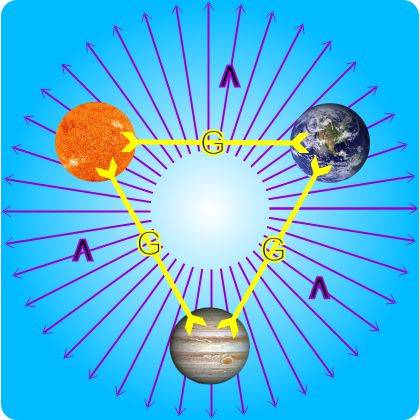
Newt chips in. “Einstein came at it from a different direction. His General Relativity field equations contained two numbers for observation to fill in — G, Newton’s gravitational constant, and lambda (Λ), which we now call the Cosmological Constant. Lambda measures the energy density of empty space. The equations say the balance between lambda and gravity controls whether the Universe expands, contracts or stays static. Lambda‘s just a little bit positive so the universe is expanding.”

“Same conclusion, different name. Neither one says where the energy comes from.”

That’s my cue. “True, but Einstein’s work goes deeper. Newtonian physics maps the Universe onto a stable grid of straight lines. In General Relativity those lines are deformed and twisted under the influence of massive objects. Vinnie and I talked about how gravity’s a fictitious force arising from that deformation. Like John Wheeler said, ‘Mass tells space-time how to curve, and space-time tells mass how to move.’ Anyway, when you throw dark energy’s lambda into the mix, the grid lines themselves go into motion. Dark energy torques the spacetime fabric that pulls galaxies together.”

“So dark energy pulls things apart by spreading out the grid they’re built on? If that’s so how come I’m still in one piece?”

“Nothing personal, but you’re too small and dense to notice. So am I, so is the Earth.”

“Why should that make a difference?”

“Time for a thought experiment. Think of the Sun. The atoms inside its surface are trying to get out, right? What’s holding them in?”

“The Sun’s gravity.”

“Just like pressure on the skin of a balloon. In either case, as long as things are stable the pressure on an enclosing real or mathematical surface rises and falls with the amount of enclosed energy density and it doesn’t matter which we talk about. Energy density’s easier to think about. With me so far?”

“I guess.”

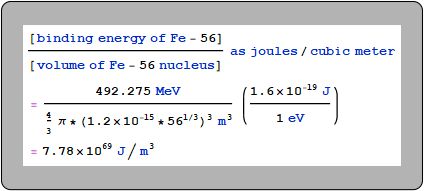
“Let’s run a few horseback numbers on Old Reliable here. Start with protons and neutrons trying to leave an atomic nucleus. Here’s the total binding energy of an iron-56 nucleus divided by its volume…”

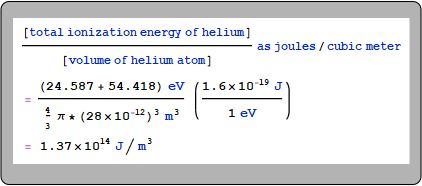
“… so the nuclear particles would fly apart except for the inward pressure exerted by the nuclear forces. Now we’ll go up a level and consider electrons trying to leave a helium atom. They’re held in by the electromagnetic force…”

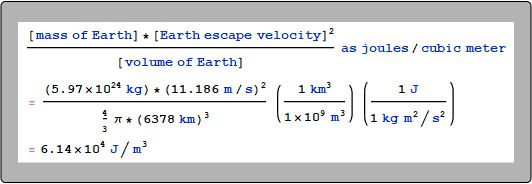
“Still a lot of inward pressure but less than nuclear by fifty-five powers of ten. Gravity next. That’s what keeps us from flying off into space. I’ll use Earth’s escape velocity to cheat-quantify it…”

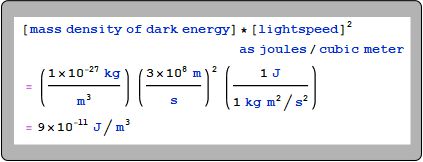
“Ten billion times weaker than the electromagnetism that holds our atoms and molecules together. Dark energy’s mass density is estimated to be about 10-27 kilograms per cubic meter. I’ll use that and Einstein’s E=mc2to calculate its pull-us-apart pressure.”

“A quintillion times weaker still.”

“So what you’re saying is, dark energy tries to pull everything apart by stretching out that spacetime grid, but it’s too weak to actually do anything to stuff that’s held together by gravity, electromagnetism or the two nuclear forces.”

“Mostly. Nuclear forces are short-range so distance doesn’t matter. Gravity and electromagnetism get weaker with the square of the distance. Dark energy only gets competitive working on objects that are separated much further than even neighboring galaxies. You’re not gonna get pulled apart.”

~~ Rich Olcott

Dark Horizon

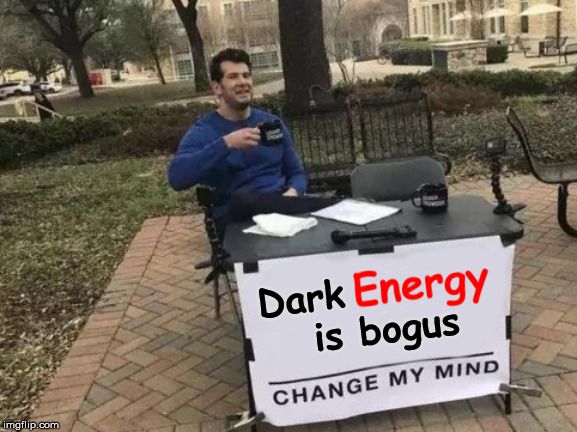
Charlie's table sign says "Dark Energy is bogus"

Change-me Charlie attacks his sign with a rag and a marker, rubbing out “Matter” and writing in “Energy.” Turns out his sign is a roll-up dry-erase display and he can update it on site. Cool. I guess with his rotating-topic strategy he needs that. “OK, maybe dark matter’s a thing, but dark energy ain’t. No evidence, someone just made that one up to get famous!”

And of course Physicist-in-training Newt comes back at him. “Lots of evidence. You know about the Universe expanding?”

“Prove it.” At least he’s consistent.

<sigh> “You know how no two snowflakes are exactly alike but they can come close? It applies to stars, too. Stars are fairly simple in a complicated way. If you tell me a star’s mass, age and how much iron it has, I can do a pretty good job of computing how bright it is, how hot it is, its past and future life history, all sort of things. As many stars as there are, we’re pretty much guaranteed that there’s a bunch of them with very similar fundamentals.”

“So?”

“So when a star undergoes a major change like becoming a white dwarf or a neutron star or switching from hydrogen fusion to burning something else, any other star that has the same fundamentals will behave pretty much the same way. They’d all flare with about the same luminosity, pulsate with about the same frequency —”

“Wait. Pulsate?”

“Yeah. You’ve seen campfires where one bit of flame coming out of a hotspot flares up and dies back and flares up and dies back and you get this pulsation —”

“Yeah. I figured that happens with a sappy log where the heat gasifies a little sap then the spot cools off when outside air gets pulled in then the cycle goes again.”

“That could be how it works, depending. Anyhow, a star in the verge of mode change can go through the same kind of process — burn one kind of atom in the core until heat expansion pushes fuel up out of the fusion zone; that cools things down until fuel floods back in and off we go again. The point is, that kind of behavior isn’t unique to a single star. We’ve known about variable stars for two centuries, but it wasn’t until 1908 that Henrietta Swan Leavitt told us how to determine a particular kind of variable star’s luminosity from its pulsation frequency.”

“Who cares?”

“Edwin Hubble cared. Brightness dies off with the distance squared. If you compare the star’s intrinsic luminosity with how bright the star appears here on Earth, it’s simple to calculate how far away the star is. Hubble did that for a couple dozen galaxies and showed they had to be far outside the Milky Way. He plotted red-shift velocity data against those distances and found that the farther away a galaxy is from us, the faster it’s flying away even further.”

“A couple dozen galaxies ain’t much.”

“That was for starters. Since the 1930s we’ve built a whole series of ‘standard candles,’ different kinds of objects whose luminosities we can convert to distances out to 400 million lightyears. They all agree that the Universe is expanding.”

“Well, you gotta expect that, everything going ballistic from the Big Bang.”

“They don’t go the steady speed you’re thinking. As we got better at making really long-distance measurements, we learned that the expansion is accelerating.”

“Wait. I remember my high-school physics. If there’s an acceleration, there’s gotta be a force pushing it. Especially if it’s fighting the force of gravity.”

“Well there you go. Energy is force times distance and you’ve just identified dark energy. But standard candles aren’t the only kind of evidence.”

“There’s more?”

“Sure — ‘standard sirens‘ and ‘standard rulers.’ The sirens are events that generate gravitational waves we pick up with LIGO facilities. The shape and amplitude of the LIGO signals tell us how far away the source was — and that information is completely immune to electromagnetic distortions.”

“And the rulers?”

“They’re objects, like spiral galaxies and intergalactic voids, that we have independent methods for connecting apparent size to distance.”

“And the candles and rulers and sirens all agree that acceleration and dark energy are real?”

“Yessir.”

~~ Rich Olcott