Beyond The Shadow of A…?

“Alright, Vinnie, what’s the rest of it?”

“The rest of what, Sy?”

“You wouldn’t have hauled that kid’s toy into Al’s shop here just to play spitballs with it. You’re building up to something and what is it?”

“My black hole hobby, Sy. The things’re just a few miles wide but pack more mass than the Sun. A couple of my magazines say they give off jets top and bottom because of how they spin. That just don’t fit. The stuff ought to come straight out to the sides like the paper wads did.”

“Well, umm… Ah. You know the planet Saturn.”

“Sure.”

“Are its rings part of the planet?”

“No, of course not, they go around it. I even seen an article about how the rings probably came from a couple of collided moons and how water from the Enceladus moon may be part of the outside ring. Only thing Saturn does for the rings is supply gravity to keep ’em there.”

“But our eyes see planet and rings together as a single dot of light in the sky. As far as the rest of the Solar System cares, Saturn consists of that big cloudy ball of hydrogen and the rings and all 82 of its moons, so far. Once you get a few light-seconds away, the whole collection acts as a simple point-source of gravitational attraction.”

“I see where you’re going. You’re gonna say a black hole’s more than just its event horizon and whatever it’s hiding inside there.”

“Yup. That ‘few miles wide’ — I could make a case that you’re off by trillions. A black hole’s a complicated beast when we look at it close up.”
“How can you look at a thing like that close up?”

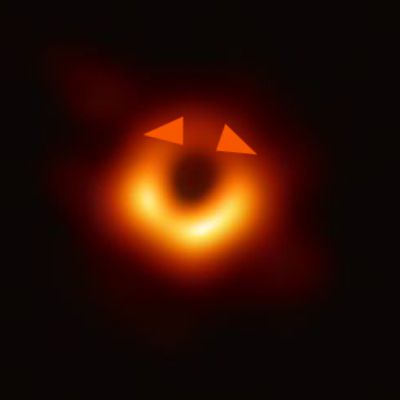
“Math, mostly, but the observations are getting better. Have you seen the Event Horizon Telescope’s orange ring picture?”

“You mean the one that Al messed with and posted for Hallowe’en? It’s over there behind his cash register. What’s it about, anyway?”

“It’s an image of M87*, the super-massive black hole at the center of the M87 galaxy. Not the event horizon itself, of course, that’s black. The orange portion actually represents millimeter-radio waves that escape from the accretion disk circling the event horizon. The innermost part of the disk is rotating around the hole at near-lightspeed. The arc at the bottom is brighter because that’s the part coming toward us. The photons get a little extra boost from Special Relativity.”

Frames again?”

“With black holes it’s always frames. You’ll love this. From the shell’s perspective, it spits out the same number of photons per second in every direction. From our perspective, time is stretched on the side rotating away from us so there’s fewer photons per one of our seconds and it’s dimmer. In the same amount of our time the side coming toward us emits more photons so it’s brighter. Neat demonstration, eh?”

“Cute. So the inner black part’s the hole ’cause it can’t give off light, right?”

“Not quite. That’s a shadow. Not a shadow of the event horizon itself, mind you, but of the photon sphere. That’s a shell about 1½ times the width of the event horizon. Any photon that passes exactly tangent to the sphere is doomed to orbit there forever. If the photon’s path is the slightest bit inward from that, the poor particle heads inward towards whatever’s in the center. The remaining photons travel paths that look bent to a distant observer, but the point is that they keep going and eventually someone like us could see them.”

“The shadow and the accretion disk, that’s what the EHT saw?”

“Not exactly.”

“There’s more?”

“Yeah. M87* is a spinning black hole, which is more complicated than one that’s sitting still. Wrapped around the photon sphere there’s an ergosphere, as much as three times wider than the event horizon except it’s pumpkin-shaped. The ergosphere’s widest at the rotational equator, but it closes in to meet the event horizon at the two poles. Anything bigger than a photon that crosses its boundary is condemned to join the spin parade, forever rotating in sync with the object’s spin.”

“When are you gonna get to the jets, Sy?”

~~ Rich Olcott

The Top Choice

Al grabs me as I step into his coffee shop. “Sy, ya gotta stop Vinnie, he’s using up paper napkins again, and he’s making a mess!”

Sure enough, there’s Vinnie at his usual table by the door. He’s got a kid’s top, a big one, spinning on a little stand. He’s methodically dropping crumpled-up paper wads onto it and watching them fly off onto the floor. “Hey, Vinnie, what’s the project?”

“Hi, Sy. I’m trying to figure how come these paper balls are doing a circle but when they fly off they always go in a straight line, at least at first. They got going-around momentum, right, so how come they don’t make a spiral like stars in a galaxy?”

Astronomy professor Cathleen’s standing in the scone line. She never misses an opportunity to correct a misconception. “Galaxy stars don’t spray out of the center in a spiral, Vinnie. Like planets going around a star, stars generally follow elliptical orbits around the galactic center. A star that’s between spiral arms now could be buried in one ten million years from now. The spiral arms appear because of how the orbits work. One theory is that the innermost star orbits rotate their ellipse axes more quickly than the outer ones and the spirals form where the ellipses pile up. Other theories have to do with increased star formation or increased gravitational attraction within the pile-up regions. Probably all three contribute to the structures. Anyhow, spirals don’t form from the center outward.”

My cue for some physics. “What happens in a galaxy is controlled by gravity, Vinnie, and gravity doesn’t enter into what you’re doing. Except for all that paper falling onto Al’s floor. There’s no in-plane gravitational or electromagnetic attraction in play when your paper wads leave the toy. Newton would say there’s no force acting to make them follow anything other than straight lines once they break free.”

“What about momentum? They’ve got going-around momentum, right, shouldn’t that keep them moving spirally?”

I haul out Old Reliable for a diagram. “Thing is, your ‘going-around momentum,’ also known as ‘angular momentum,’ doesn’t exist. Calm down, Vinnie, I mean it’s a ‘fictitious force‘ that depends on how you look at it.”

“Is this gonna be frames again?”

“Yup. Frames are one of our most important analytical tools in Physics. Here’s your toy and just for grins I’ve got it going around counterclockwise. That little white circle is one of your paper wads. In the room’s frame that wad in its path is constantly converting linear momentum between the x-direction and the y-direction, right?”

“East-West to North-South and back, yeah, I get that.”

“Such a mess to calculate. Let’s make it easier. Switch to the perspective of a frame locked to the toy. In that frame the wad can move in two directions. It can fly away along the radial direction I’ve called r, or it can ride along sideways in the s-direction.”

“So why hasn’t it flown away?”

“Because you put some spit on it to make it stick — don’t deny it, I saw you. While it’s stuck, does it travel in the r direction?”

“Nope, only in the s direction. Which should make it spiral like I said.”

“I’m not done yet. One of Newton’s major innovations was the idea of infinitesimal changes, also known as little-bits. The s-direction is straight, not curved, but it shifts around little-bit by little-bit as the top rotates. Newton’s Laws say force is required to alter momentum. What force influences the wad’s s-momentum?”

“Umm … that line you’ve marked c.”

“Which is the your spit’s adhesive force between the paper and the top. The wad stays stuck until the spit dries out and no more adhesion so no more c-force. Then what happens?”

“It flies off.”

“In which direction?”

“Huh! In the r-direction.”

“And in a straight line, just like Newton said. What you called ‘going-around momentum’ becomes ‘radial momentum’ and there’s no spiraling, right?”

“I guess you’re right, but I miss spirals.”

Al comes over with a broom. “Now that’s settled, Vinnie, clean up!”

~~ Rich Olcott

  • Thanks for the question, Jen Keeler. Stay tuned.

Never Chuck Muck at A Duck

Mr Richard Feder of Fort Lee NJ is in terrible shape. Barely halfway into our walk around the park’s lake, he flops onto a bench to catch his breath. The geese look on unsympathetically. “<puff, puff> I got another question, Moire. <wheeze> Why is water wet?”

He’s just trying to make conversation while his heart slows down but I take him up on it. “Depends on what you mean by ‘wet‘ — that’s a slippery word, can be a verb or an adjective or a noun. If you wet something, you’ve got a wet something. If there’s wet weather you go out in the wet. If you live in a wet jurisdiction you can buy liquor if you’re old enough. You can even have wet and dry molecules. Which are you asking about?”

That’s gotten him thinking, always a good sign. “Let’s start with the verb thing. Seems like that’s the key to the others.”

“So we’re asking, ‘Does water wet?‘ The answer is, ‘Sometimes,‘ and that’s where things get interesting. That duck over there, diving for something on the bottom, but when it comes back up again the water rolls off it like –“

“Don’t say it — ‘like water off a duck’s back‘ — yeah, I know, but I’m sweating over here and that ain’t rolling off. Why the difference?”

“Blame it on the Herence twins, Co and Addie.”

“Come again?”

“A little joke, has to do with two aspects of stickiness. Adherence is … you know adhesive tape?”

“Adhe — you playin’ word games, Moire?”

“No, really, adhesive and adherence are both about sticking together things that are chemically different, like skin and tape. Coherence is about stickiness between things that are chemically similar, like sweat and skin.”

“What makes things ‘chemically similar’?”

“Polarity. I don’t want to get into the weeds here –“

“Better not, the ground’s squishy over there.”

“– but there are certain pairs of atoms, like oxygen and hydrogen, where one atom pulls a small amount of electron charge away from the other and you wind up with part of a molecule being plus-ish and another part being minus-ish. That makes the molecule polar. Other pairings, like carbon and hydrogen, are more evenly matched. You don’t get charge separation from them and we call that being non-polar. Charge variation in polar molecules forces them to cluster together positive-to-negative. The electrostatic gang crowds out any nearby non-polar molecules.”

“What’s all that got to do with wetting?”

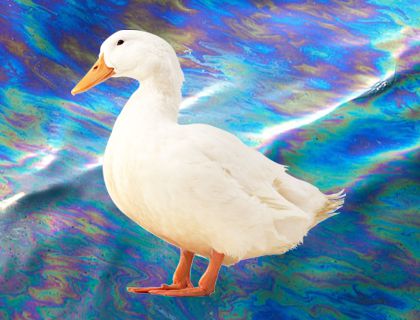
“Water’s all oxygen and hydrogen and quite polar. Water coheres to itself. If it didn’t you’d get rain-smear instead of raindrops. It also adheres to polar materials like skin and hair and bricks, so raindrops wet them. But it doesn’t adhere to non-polar materials like oil and wax. Duck feathers are oily so they shed water.”

“So that’s why the duck doesn’t get wet!”

“Not unless you throw detergent on him, like they have to do with waterfowl after an oil spill. Detergent molecules have a polar end and a non-polar end so they can bridge the electro divide. Rubbing detergent into a dirty bird’s sludgy oil coating lets water sink into the mess and break it up so you can rinse it off. The problem is that the detergent also washes off the good duck oil. If you let a washed-off duck go swimming too soon after his bath the poor thing will sink. You have to give him time to dry off and replenish his natural feather-oil.”

“Hey, you said ‘wet-and-dry molecules.’ How can they be both?”

“Because they’re really big, thousands of atoms if they’re proteins, even bigger for other kinds of polymers. Anything that large can have patches that are polar and other patches that are oily. In fact, patchwise polarity is critical to how proteins get their 3-D structure and do their jobs. A growing protein strand wobbles around like a spring-toy puzzle until positive bits match up with negative bits and oily meets up with oily. Probably water molecules sneak into the polar parts, too. The configuration’s only locked down when everything fits.”

“So water’s wet because water wets water. Hah!”

~~ Rich Olcott

  • Thanks to Museum visitor Jessie for asking this question.

Eyes on The Size

An excellent Fall day, perfect for a brisk walk around the park’s goose-governed lake. Suddenly there’s a goose-like yawp behind me. “Hey Moire, wait up, I got a question!”

“Afternoon, Mr Feder. What’s your question today?”

“You know how the Moon’s huge just after it gets over the horizon but then it gets small? How do they make it do that?”

“Well, ‘they’ is you, Mr Feder, except that nothing physically changes.”

“Whaddaya mean, I seen it change size every time there’s a full moon.”

“That’s what it looks like, but think it through. We’re here in the Midwest, two hours away from your folks back home in Fort Lee. Back when you lived there, did the Moon ever suddenly grow and then shrink when it was two hours up into the sky?”

“Um, no, just at the horizon. So you’re saying it’s one of them optical delusions?”

“Something like that. Here, I’ve got a video on Old Reliable. See how the disk stays the same size but it looks bigger in comparison to the railroad tracks? Your brain expects the tracks to be parallel lines despite the perspective, right, so it compensates by thinking the Moon must be wider when it’s next to them. In the real world you’ve looking at the Moon past trees or buildings, but the false perspective principle applies whether the horizon’s relatively close or far away.”

“Whaddaya mean, close or far horizon? It’s the edge of how far I can see and that’s always the same.”

“Oh, hardly, Mr Feder. You ever visit the Empire State Building’s observation deck?”

“Sure.”

“How about deep-sea fishing, out of sight of land?”

“Aw, that’s a blast, when you hook one of those big guys and you’re –“

“I’m sure you enjoyed it, but did you look around while you were waiting for a strike?”

“Yeah, nothin’ else to do but yammer and drink beer.”

“Mm-hm. So could you see as far from the boat’s deck as you could from the building’s deck?”

“Hey, you’re right. A lot farther from high up. They say on a clear day you can see 80 miles from the Empire State Building — nowhere near that from the boat, believe me. ‘S why they put those decks up there, I guess. How far up do I gotta be to see the whole world, I wonder.”

“Quick answer is, infinitely far away.”

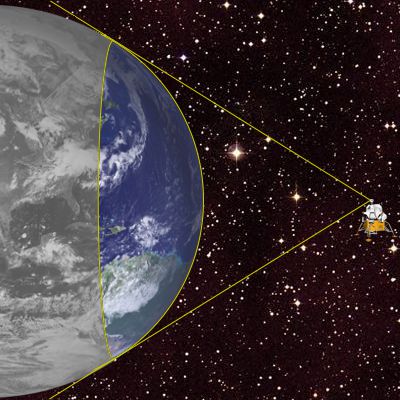
“Wait, those astronauts got that ‘Blue Marble’ picture from the Moon and it showed the whole day side.”

“Take a closer look someday. It shows Antarctica but essentially nothing north of the 45th parallel. The limit’s set by the points on the planet where lines from your eye just graze the planet’s surface. The astronauts in this LEM, for instance, are about an Earth-radius away. They’d be able to see the Atlantic Ocean and a little bit of Brazil, but neither of the poles and no part of the USA.”

“Gimme a sec … yeah, I see how that works. So that ‘how high up you are‘ thing keeps going all the way out into space. There’s probably some complicated formula for it, right?”

“Not that complicated, just d=(h²+2Rh), where h is your height above the surface and R is the radius of the planet you’re looking at. Plug in the numbers and d gives you your distance to the horizon. For that LEM, for example, h is one Earth radius and R is one radius, so those straight lines are 3=1.73 Earth radii long.”

“How about the line on top of the ocean?”

“That’s a little more complicated.” <more tapping on Old Reliable> “Says here that line stretches exactly one-third of the Earth’s circumference.”

“You can do that with other planets?”

“Sure. Mars, for instance. It has the tallest volcano in the Solar System, Olympus Mons. Depending on where you’re measuring from it’s about 22 kilometers high. I’ll put that into the formula with Mars’ radius, 3389 kilometers, and … OK, if you’re standing on top, your horizon is 387 kilometers away. That’s like looking halfway across France. Mars’ big canyon Vallis Marinaris has 7-kilometer cliffs. There are places where the opposite wall is way beyond the cliff-top’s 96-mile horizon.”

“That beats the Empire State Building.”

~~ Rich Olcott