A Turn to The Urn

Working under social distancing rules, Al’s selling coffee from a drive-up cart in front of his shop — urns, paper cups, everything at arms length. No cash register, credit or debit transactions only. “Give me my usual, Al. I miss the mugs; your brews just don’t taste the same in paper.”

“I know, Sy, but what can you do? Say, I’ve been reading your stuff with the sort‑of overlaps between Physics and Economics. Beyond your usual orbital? <heh, heh>”

“Very funny, Al. Yeah, a little, but it’s giving me some new perspectives on old ground.”

“Oh, yeah? What’s next?”

“Fluid mechanics, for instance. Ever notice how many money terms relate to water? ‘Cash flow,’ of course, but there’s also ‘liquidity,’ ‘frozen assets,’ ‘drowning in debt,’ a long list, so I decided to chase that metaphor, see how well it holds up. There’s a lot of Physics on your coffee cart, for instance.”

“Well, it’s heavy, I’ll tell you that.”

“Sure, but how about that glass tube that tells you how full the urn is? The Egyptians were using the principle thousands of years ago but Pascal put it on a firm theoretical basis before Newton got a chance to.”

“There’s theory in that thing?”

“Sure. There’s a pipe from the urn to the little tube, right, so all the liquid is connected. Pascal proved that the pressure on every little packet of fluid anywhere in a connected system has to be the same, otherwise fluid would flow to wherever the pressure is least and even things out. Pressure at the bottom of any skinny vertical column comes from atmospheric pressure plus the pull of gravity on the liquid in that column. It takes 33 feet of water to balance normal atmospheric pressure. For columns the size of your urn gravity’s contribution is less than 3% of atmospheric so the atmosphere rules. Pressure on the tube is the same as pressure on the urn so the two have to be at the same height. When the urn’s low, the tube’s low because Physics.”

“Cool, though when you look at it that way it seems obvious.”

“The good explanations often are. It takes a Pascal or a Newton to make it obvious.”

“So what’s this got to do with Economics?”

“Pascal’s principle supplied a fundamental assumption about how market‑based systems are supposed to work. Not with water, but with money — and instead of pressure there’s profit potential. The idea is that just like water will flow everywhere in a connected system until the pressure is equalized, money will flow everywhere in an economy until no‑one thinks they can make more profit in one place than in another. It’s more complicated than your coffee urn, though.”

“I expect so — lots more opportunities.”

“Well, yes, but the force‑equivalent is more complicated, too. Gravity and atmospheric pressure both exert force in the same direction. When you’re considering an investment, what do you think about?”

“The net profit, of course — how much I could make against what it’ll cost me to get in.”

“How about risk?”

“Three guesses why I’m doing this no-cash. I know what you mean though — like what if this electric cord overheats and burns the place down. Not likely, I checked the wire gauge and the circuit box.”

“Good strategy — look at all the things that can go wrong and address what you can control. But there’s uncontrolables, right? From an Economics perspective, you need to put each risk in money terms. Take the likelihood that something bad will happen, multiply by the monetary loss if it does happen and you get monetary risk you’ve got to figure against that expected net profit. My point is that the Economics version of Pascal’s principle has to take account of forces that pull money towards an investment option AND forces that push money away.”

“Two-way stretch, huh?”

“Absolutely. Take a look at a stock or bond prospectus some day. You’ll see risk categories you’ve never even heard of. Bond analysts have a field day with that kind of stuff. Their job is to calculate likely growth and cash yield against likely risk and come up with a price.”

“Risky business.”

“Always the joker, Al.”

~~ Rich Olcott

Something of Interest

“OK, Sy, I get how money is sorta like Physics ‘energy‘ except you can’t create energy but you can create money. And I get how Economics ‘velocity of money‘ and Physics ‘velocity don’t have much to do with each other. Your ‘Money Physics‘ phrase doesn’t make much sense unless you’ve got something with more overlap than that.”

“You’re a tough man, Vinnie. How about the word ‘exponential‘?”

“Means something goes up really fast. What about it?”

“Well, first off that’s not really what it means and that’s one of my personal peeves, thank you very much. Yes, quantities can increase exponentially, but not necessarily rapidly, and they can also decrease exponentially, either fast or slow. It’s a math thing.”

“Alright, I got myself into this. You’re gonna tell me how that works and it probably involves equations.”

“You made the phone call, I’m just sitting here, but you’re good, no equations just arithmetic. Ten times ten’s a hundred, right, and you can write that either 10×10 or 10², OK? The little two is the exponent, tells you how many factors to multiply together.”

“And 10 with a little three makes a thousand and ten with a little … six makes a million. See, it goes up really fast.”

“Depends on what the base number is. I’ve sent a tabulation to your phone…”

Exp’t 10 2 99% 100% 101%
2 100 4 98.01% 100% 102.01%
3 1 000 8 97.03% 100% 103.03%
4 10 000 16 96.06% 100% 104.06%
5 100 000 32 95.10% 100% 105.10%
6 1 000 000 64 94.15% 100% 106.15%
7 10 000 000 128 93.21% 100% 107.21%

“What’s all that?”

“Well, the top-row headers are just numbers I multiplied by themselves according to some exponents, and the first column is the series of exponents I used. Like we said, 10² is a hundred and so on down the second column. Number 2 multiplied by itself according to the same exponents gave me the third column and you see the products don’t grow anywhere near as fast. Do you see how the growth rate depends on the number that’s being multiplied and re‑multiplied?”

“No problem. What about the other columns?”

“Start with the fifth column. What’s 100% of 100%?”

“All of it.”

“And 100% of 100% of 100%?”

“I get it — no change no matter the exponent.”

“Absolutely. Now compare that to the 99% and 101% columns that give you the effect of a 1% growth factor. As you’d expect, very little change in either one, but there’s a lesson in the 99% column. It’s exponential by definition, but the results go down, not up. By the way, both of those are such small factors that the results are practically linear. You need to get beyond 15% factors for visible curvature in the usual graphs.”

“OK, so exponential says some arithmetic factor gets applied again and again. What’s that got to do with Physics or Economics?”

“Ever since Newton, Physics has been the study of change, all different kinds. Gradually we’ve built up a catalog of change patterns. Newton pointed out the simplest one in his first Law of Motion — constant velocity, say in meters per second. Plot cumulative distance moved against time and you get a rising straight line. His Second Law implies another simple pattern, constant acceleration. That’s one where velocity’s line rises linearly but distance goes up as the square of the time traveled. But Newton never tackled another very simple, very common pattern.”

“I thought Newton did everything.”

“Not the case. He was an amazing geometer, but to handle this pattern you need algebraic tools like the ones Leibniz was developing. Newton would rather have dunked his arm in boiling rancid skunk oil than do that. It took another century or so until the Bernoulis and Euler beat that problem into the ground.”

“So what’s the simple pattern?”

“Suppose instead of a quantity increasing by some absolute number of thingies per second, it increases by some constant percentage. That’s uncommon in the kinds of mechanical phenomena that Newton studied but it does happen. Say you’re a baby planet in the middle of a dust cloud. Get 15% bigger, you’re 15% better at attracting even more dust. Biological things do that a lot — the more bugs or bacteria you’ve got, the faster they multiply and that’s usually at a constant percentage-per-time rate. Exponential growth in a nutshell.”

“Planets, bugs, what’s that got to do with Economics?”

“Ever hear of ‘compound interest‘?”

“Low rates on bank accounts, high rates on credit cards, compounded. Gotcha.”

“Inflation does compounding, too.”

~~ Rich Olcott

The Solid Gold Bath Towel

“C’mon, Sy, I heard weaseling there — ‘velocity‑based thinking‘ ain’t the same as velocity numbers.”

“Guilty as charged, Vinnie. The centuries-old ‘velocity of money‘ notion has been superceded for a half-century, but the theory’s still useful in the right circumstances. It’s like Newton’s Law of Gravity that way, except we’ve been drifting away from Newton for a full century.”

“What, gravity doesn’t work any more?”

“Sure it does, and most places the force is exactly what Newton said it should be — proportional to the mass divided by the distance. But it goes wrong when the mass‑to‑distance ratio gets huge, say close to a star or a black hole. That’s when we move up to Einstein’s theory. It includes Newton’s Law as a special case but it covers the high-ratio cases more exactly and accounts for more phenomena.”

“Just for grins, how about when the ratio is tiny?”

“We don’t know. Some cosmologists have suggested that’s what dark energy is about. Maybe when galaxies get really far apart, they’re not attracted to each other quite as much as Newton’s Law says.”

“I suppose the money theories have problems at high and low velocities?”

“That’s one pair of problems. Money velocity is proportional to nominal traffic divided by money supply. Suppose an average currency unit changes hands thousands of times a day. That says people don’t have confidence that money will buy as much tomorrow as it could today. They’ve got hyperinflation.”

“Ah, and at the low end it’d be like me putting Eddie’s autographed $20 in a frame on my wall. No spend, no traffic, zero velocity.”

“Right, but for the economy it’d be everyone putting all their money under their mattresses. Money that’s frozen in place doesn’t do anything except maybe make someone feel good. It’s like water in a stream, it has to be flowing to be useful in generating power.”

“Wait, you used a word back there, ‘nominal.’ What’s that about?”

“Good ears. It points up another important distinction between Physics and Economics. Suppose you’re engineering a mill at that stream and you measure water flow in cubic meters per second. Kinetic energy is mass times velocity squared and power is energy per unit time. If you know water’s density in kilograms per cubic meter you can calculate the stream’s available water power. Density is key to finding mass from volume when volume’s easy to measure, or volume from easily‑measured mass.”

“OK, so what’s that got to do with ‘nominal‘?”

“In economic situations, money is easy to measure — it’s just the price paid — but value is a puzzle. In fact, people say that understanding the linkage between price and value is the central problem of Economics. There’s a huge number of theories out there, with good counter-examples for every one of them. For example, consider the solid gold bath towel.”

“What a stupid idea. Thing like that couldn’t dry you off in the desert.”

“True, but it’s made out of a rare material and some people think rarity makes value. In the right setting it’d be beautiful and there are certainly people who think beauty makes value. A lot of person‑time would be required to create it and some people think labor input is what makes value. The people who think utility makes value would give that towel very low marks. Of course, if you’ve already got plenty of bath towels you’re not about to buy another one so you don’t care.”

“So how do they decide what its price should be?”

“Depends on where you are. Many countries use a supply‑demand auction system that measures value by what people are willing to pay. Planned‑economy countries set prices by government edict. Other countries use a mixed system where the government sets prices for certain commodities like bread and fuel but everything else is subject to haggling. Whatever system’s in use, ‘nominal‘ traffic is the total of all transaction prices and that’s supposed to measure value.”

“Velocity’s supposed to be money supply divided into value flow but we can’t use value so we fake it with money flow?”

“You got it. Then the government tries to manage the money supply so velocity’s in a sweet spot.”

“Sounds rickety.”

“Yup.”

~~ Rich Olcott

The Flight of George’s Dollar

<chirp, chirp> “Moire here.”

“Hi, Sy, it’s Vinnie. Eddie just dropped off my pizza order —”

“What did you get?”

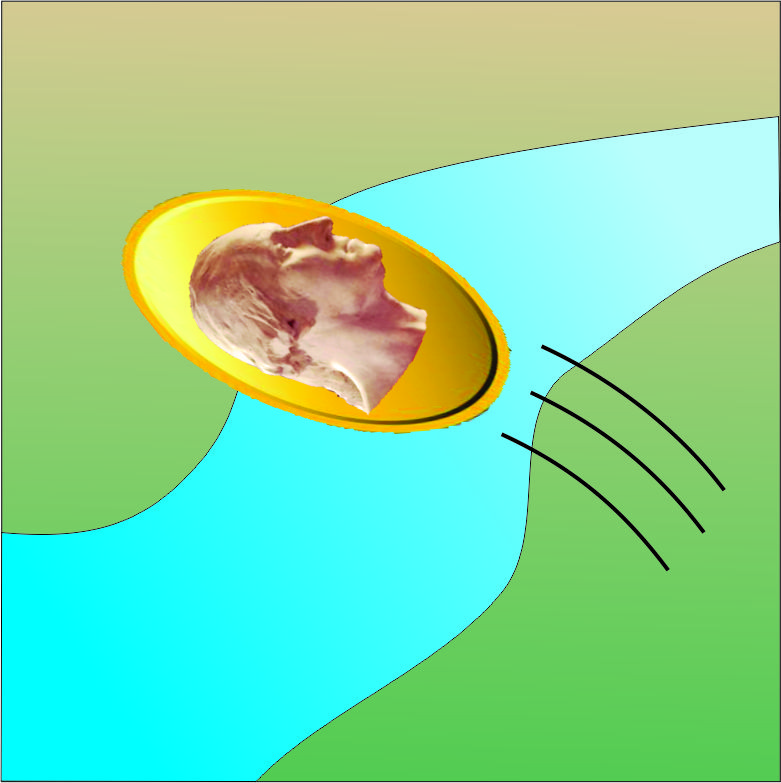
“My usual, large with extra pepperoni. Anyhow, Eddie said you guys were talking about Money Physics which has me curious. I don’t suppose it’s about how young George Washington couldn’t have thrown that silver dollar across the Potomac.”

“It couldn’t have been a US dollar because they didn’t exist yet and it couldn’t have been the Potomac because it’s a mile wide and probably nothing of the sort happened anyway. You’re right, though. What I’m calling Money Physics is about the parallels and differences between Economics and Newtonian Physics. Remember that $20 bill your dice‑playing won from Eddie a while ago and he signed it?”

“Yeah, that was fun. I was hot that night.”

“Well, the other day I used that very same bill to pay Eddie for pizza.”

“How’d you get it?”

“We figured you used the bill to pay down your tab at Al’s —”

“That’s right.”

“And he used it to buy some old astronomy magazines from me. I paid it to Eddie to complete the circle. ‘Whoa,’ I thought. ‘The velocity of money, like in Economics.”

“There’s a word I know from flight school. Velocity’s a vector, combines speed and direction. Speed would be how quick money changes hands, of course, but how do you attach a direction to that and what do you figure from the vectors?”

“Their equivalent to speed isn’t what you think it is and there’s no notion of direction. The ghost that’s left is the concept that ‘velocity of money‘ should describe how often a unit of currency is reused. The problems start popping up when you try to measure that. Economists grew up thinking about first‑purchase productivity so their metrics exclude a lot of what we’d consider economic activity. That traveling $20, for instance. How many transactions would you say it went through?”

“Eddie to me to Al to you to Eddie. Four.”

“Sorry, the productivity right answer is one. Eddie didn’t buy anything from you when he lost those bets. Your debt to Al was already outstanding. Al bought used goods from me. The only transaction that counts in the productivity calculation was my paying for what came fresh from Eddie’s pizza oven.”

“Dice games don’t count? How about bank fees or talking to my lawyer, stuff like that?”

“Oh, there’s lots of controversial questions, especially in view of our economy turning from mostly farm and manufacturing to mostly services and now we’re paying attention to environmental costs. ‘Reuse, repurpose, recycle‘ doesn’t enter into the productivity equation, and neither does installing a pollution control system except for the initial purchase price. Do you own stock, maybe in a pension plan?”

“Not as much as I’d like, especially recently.”

“I know the feeling. When you bought your shares, the brokerage fee counted as services but economists argue about the cost of the shares themselves. There are loads of what-abouts like that. Bottom line is that trying to track money movement at the transaction level just doesn’t work.”

“So what did they do?”

“Fell back to country-level aggregate numbers which are very rough by Physics standards. Add up the total economic traffic in dollars, divide by the size of the money supply, that’s the number of times an average dollar must have changed hands, OK?”

“Gimme a sec … that sounds right.”

“So how do you evaluate each part of the fraction? Some people measure economic activity indirectly by summing up transactions, maybe by looking at sales tax revenue data. That’s the spend side. Or you could look at the income side using payroll or income tax data and supposing that people spend everything they pull in. It’s not a hard think to find holes in both of those, but suppose you come up with a number somehow. That gets divided by the money supply, which we understand a little better but not much. Do the arithmetic and you have a dollars-to-dollars ratio, not somethings-per-time. No physicist would call that a velocity, but what can you do?”

“You got me, but who cares?”

“The Fed cares, because velocity‑based thinking helps drive their policy decisions.”

~~ Rich Olcott

Unless We’re All In This, Together

I wrote the italicized text for another forum, but I’m reposting it here because my head and heart and the times demand it…


We’ll soon be in the month of our national Independence Day so it’s appropriate to point out that we’re living in an Age of Heroes.  We’ve had heroes all along, of course — the Founding Fathers and Mothers, the military who defend the country we’ve built, the first responders who run toward danger to protect the rest of us. 

Less lauded but still crucial is another group of heroes – parents, teachers, caregivers and others who take on responsibility for nurturing and supporting people who for whatever reason can’t handle the challenge themselves.  These heroes may not risk bodily damage but the emotional toll can be devastating.  It says something positive for our society that we have so many in this group.

But in the past few months we’ve come to recognize yet another category of heroism.  From maintenance and transportation staff to the entire farm‑to‑table supply chain workforce, these people have quietly continued their tasks in the face of COVID‑19, with or without protective measures in place.  Without their brave efforts our cities and economy would have been weakened far more than they have been. 

Those three categories together comprise a significant fraction of our population.  In my opinion, there’s a lesson there that our country has been too slow to learn.  Humans got where we are because we’re a societal species.  The Western Frontier closed a century ago.  Even the legendarily reclusive “mountain men” had to come into town occasionally for medical care or supplies they just couldn’t produce on their own.  In the past few months, our distress with social distancing and our burgeoning activity on social media highlight just how much we want/need to interact with other people.

Like it or not, we are all part of society.  Moreover, the smooth functioning of our society depends on our collaboration.  I’m not arguing an absolutist position here – cooperation leaves plenty of room for competition and individual liberty (how best to organize the economy is a separate discussion).  But I do think we need official and explicit recognition of the fact that what I do affects you and what you do affects me.

Here’s my modest proposal – let’s rename the Fourth of July as National Interdependence Day.


Part of being societal, of course, is the impulse to protect those about us. That’s why many of those on the Thin Blue Line got into the force and I’m grateful and more than a little awed. But as we’ve seen, some of them don’t live up to what’s expected of them.

“There’s some bad apples in every barrel,” has been said too often. The question is, why are they still there? The line officers know better than anyone else the characters of their peers. Can’t they get rid of the bad apples themselves?

The most common defense I’ve heard from my LEO friends has been along the lines of, “Out there we can only survive if we know we have each other’s backs. If I write up a complaint and if the higher-ups don’t desk or boot the guy, he’ll look the other way the next time something goes down when we’re on the street together.” That culture must change, for the sake of the good cops and the rest of us.

There are some indications that the no-snitch attitude may be changing as the unions and PD administrators and prosecutors realize that bad cops directly contribute to the deadly conditions the rest have to work under. I sure hope so.

In closing, I highly recommend this thought piece from Trevor Noah, who is far more than a comedian. Please do listen through to the end. Then think about it. Then do something.

~~ Rich Olcott