Avoiding A Big Bang

<fffshwwPOP!!> … <thump!> “Ow!”

That white satin dress, that molten‑silver voice. “Anne? Is that you? Are you OK?”

“Yeah, Sy, it’s me. I’m all right … I think.”

“What happened? Where’ve you been all year? Or considering it’s you I should ask, when’ve you been?”

“You know the line between history and archaeology?”

“Whether or not there was writing?”

“Sort of. Anyway, I’ve crossed it dozens of times. You wouldn’t believe some of the things I’ve seen. The professionals sure wouldn’t.”

“Wait, does the dress go with you? White satin wasn’t a thing centuries ago.”

“Oh, it changes like camouflage when I travel. That’s one reason I like this era — white satin’s so much nicer than muddy homespun or deerskins, mmm?”

“Mm‑hmmm. I suppose that’s why the dress didn’t get messed up when you erupted here. What led to that, anyway?”

“I don’t know. It probably had something to do with me experimenting with my ‘pushing’ superpower, going for a direction I hadn’t tried before. I’ve always known that front‑and‑back ‘pushing’ moves me forward or backward in time. You helped me understand that a ‘push’ to the side shifts me between alternate Universes at different probability levels. ‘Pushing’ up or down changes my size. Well, this morning I figured out a different direction to ‘push’ and that was weird.”

“You’ve described all three normal directions of space, so a new one would have to be weird.”

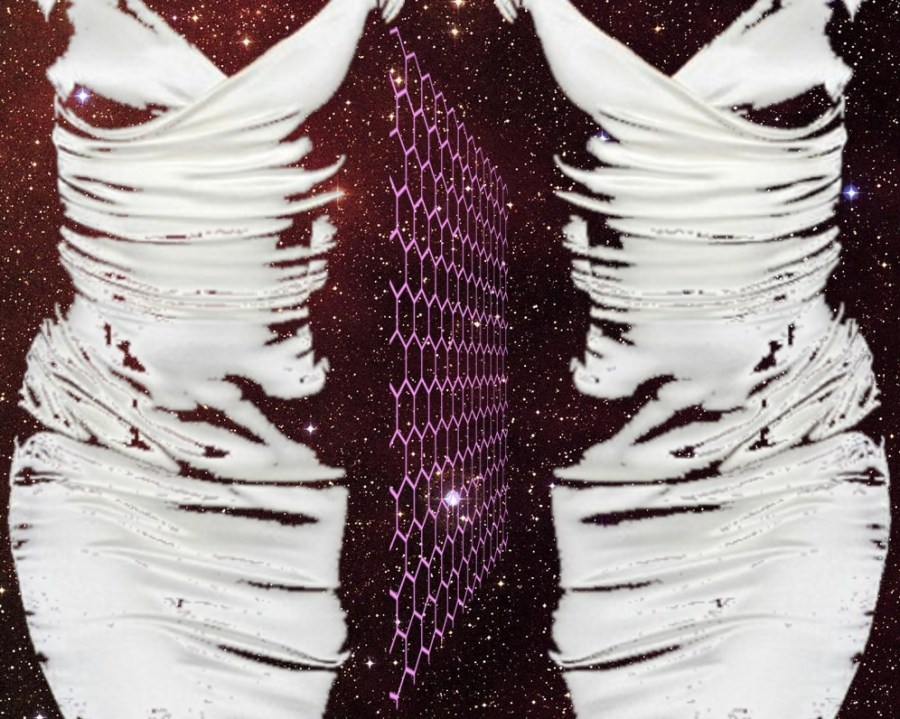
“I know what that direction feels like even if I can’t describe it. What was weird is what happened when I tried ‘pushing’ there. Things came into focus a little slowly. That may be what saved me. What I saw in front of me was … me. Dress, hair, everything, reflected left‑to‑right like looking in a mirror but our movements were a little different. Things were sharpening up and suddenly this sheet of fire flared between us and it blew me … here, to your office. What was all that about, Sy?”

“A couple of questions first. That sheet of fire — did it have a color or was it pure white?”

“Not white, more of a bright blue-violet.”

“And did it start like <snap> or were there preliminary sparkles?”

“Umm .. yes, there were sparkles! In fact I was already ‘pushing’ away when the bad flare‑up started. How did you know?”

“Just following a train of thought. I’m hypothesizing here, but I think you just barely escaped blowing the Earth apart.”

“WHAAATT!!?!”

“It all goes back to the Big Bang and our belief that physical phenomena have fundamental symmetries. Back in the Universe’s first few skillionths of a second the energy density was so high that the electromagnetic and nuclear forces were symmetry‑related. Any twitch in the chaotic unified force field was equally likely to become a proton or an anti‑proton, matter or anti‑matter. So why is anti‑matter so rare in our Universe?”

“Maybe the matter atoms just wiped out all the anti‑matter.”

“Uh‑uh. By symmetry, there should have been exactly as much of each sort. If the wipe‑out had happened there wouldn’t have been enough matter left over to make a single galaxy, much less billions of them. But here we are. Explaining that is one of the biggest challenges in cosmology.”

“You say ‘symmetry‘ like that’s a sacred principle.”

“I wouldn’t say ‘sacred‘ but the most accurate physical theory we know of is based on the product of Charge, Parity and Time symmetries being constant in our Universe. If you take a normal atom and somehow reverse both its charge and spin to get an anti‑matter atom, the symmetries say that the reversed atom must travel backward in time. From an outsider’s perspective it’d be like the original atom and the anti‑atom rush together, annihilate each other and release the enormous amount of energy that accomplished the reversal. Anne, I think you almost ‘pushed’ yourself into an anti‑Universe with a reversed CPT symmetry.”

“Those blue-violet flashes…”

“…were atoms from the air you carried with you, colliding with anti‑atoms in your anti‑twin’s air. Good thing those micro‑collisions released enough energy to get you back here before…”

“…I touched anti‑Anne or even breathed! <shiver> That would have been…”

“…BLOOEY!”

“This is nicer, mmm?”

~~ Rich Olcott

4 Tips 4 A Young Scientist

From: Robin Feder <rjfeder@fortleenj.com>
To: Sy Moire <sy@moirestudies.com>
Subj: Questions

Dear Mr. Moire, I am a High School student who has a crazy theory about dark matter. I get bored often and do not learn as much as I think most believe I should in science class. I was thinking about dark matter and how it reacts oppositely of how we expect it to. We expect it to probably not follow “normal” physics. This got me thinking about other impossible things the human mind has thought of. One of them caught my mind–absolute zero. The logic connected itself in my mind and later that day I typed up a doc just to keep my ideas. I played with it and the more I thought about it the evidence started to overlap. I have finally found an end to the theory. I am now ready to send this theory with some scientists who actually have the expertise to critique me. Please give me your thoughts as I of course am not fully confident in it. I have a lot of information that I can’t fit in one email so this is all for now. Hope to improve it. Sincerely, Robin Feder


From: Sy Moire <sy@moirestudies.com>
To: Robin Feder <rjfeder@fortleenj.com>

Subj: Re: Questions

My best to your Dad, Robin, you take after him and I’m glad you’re thinking about science. I hear you about the boring classes often feel that way if the other kids don’t pick things up as quickly as you do. Maybe your teachers can point you to supplementary materials that’ll perk up your interest.

Before we get into your topics I’ll give you some tips that may help your future. The first is, keep an idea notebook. It could be a physical book you keep in your pocket or it could be a directory of files on your phone or computer, doesn’t matter. What does matter is that you record all your ideas as they occur to you so you don’t forget one that might become important later on. In science and other fields, ideas are your stock in trade so you want to preserve your inventory. That absolute‑zero doc is a good start.

Second tip is, after you’ve written down an idea, take a long look at it and ask yourself, “How could I disprove this?” and write that down, too. The essence of science is that it relies more on disproving things than proving them. Get into the habit of thinking about disproof — it’s a powerful way of filtering out incorrect thinking. Works better in some areas than others but in general there’s forward progress.

The reason I highlighted “after” up there is that the first thought, even if it’s wrong, often leads to second and third thoughts that are better. If you discard ideas too quickly you limit yourself. Think of it as an ongoing one‑person brainstorming session. So write first, maybe cross off later, OK?

Third tip is, read up on what your idea is about. A lot. Every field of study has its own “language,” a set of words and concepts that people in the field generally understand. You need to have some command of those if you’re going to ask them clear questions about your idea.

That’s for two reasons. The most important is that using the correct terminology speeds up communication — neither you nor they will have to stop and explain a term or concept. But in addition, if you use the words and concepts properly that tells your conversation partner that you respect their time enough to have done your initial reading.

Fourth tip is where to look for that initial reading. Most textbooks, even shiny freshly-printed ones, are decades behind the current research frontiers. You need to go deeper. You’ll Google your topic, of course, to find popular science articles. Here’s another path to more recent work. Start at a good Wikipedia article. Follow the links to its key recent footnotes and Google the names of the paper’s authors. Many of them will have blogs that they write for a student audience. Follow those blogs.

Looking forward to reading those two files.

Regards,
Sy Moire.

~~ Rich Olcott

Free Energy, or Not

From: Richard Feder <rmfeder@fortleenj.com>
To: Sy Moire <sy@moirestudies.com>
Subj: Questions

What’s this about “free energy”? Is that energy that’s free to move around anywhere? Or maybe the vacuum energy that this guy said is in the vacuum of space that will transform the earth into a wonderful world of everything for free for everybody forever once we figure out how to handle the force fields and pull energy out of them?


From: Sy Moire <sy@moirestudies.com>
To: Richard Feder <rmfeder@fortleenj.com>

Subj: Re: Questions

Well, Mr Feder, as usual you have a lot of questions all rolled up together. I’ll try to take one at a time.

It’s clear you already know that to make something happen you need energy. Not a very substantial definition, but then energy is an abstract thing it took humanity a couple of hundred years to get our minds around and we’re still learning.

Physics has several more formal definitions for “energy,” all clustered around the ability to exert force to move something and/or heat something up. The “and/or” is the kicker, because it turns out you can’t do just the moving. As one statement of the Second Law of Thermodynamics puts it, “There are no perfectly efficient processes.”

For example, when your car’s engine burns a few drops of gasoline in the cylinder, the liquid becomes a 22000‑times larger volume of hot gas that pushes the piston down in its power stroke to move the car forward. In the process, though, the engine heats up (wasted energy), gases exiting the cylinder are much hotter than air temperature (more wasted energy) and there’s friction‑generated heat all through the drive train (even more waste). Improving the drive train’s lubrication can reduce friction, but there’s no way to stop energy loss into heated-up combustion product molecules.

Two hundred years of effort haven’t uncovered a usable loophole in the Second Law. However, we have been able to quantify it. Especially for practically important chemical reactions, like burning gasoline, scientists can calculate how much energy the reaction product molecules will retain as heat. The energy available to do work is what’s left.

For historical reasons, the “available to do work” part is called “free energy.” Not free like running about like ball lightning, but free in the sense of not being bound up in jiggling heated‑up molecules.

Vacuum energy is just the opposite of free — it’s bound up in the structure of space itself. We’ve known for a century that atoms waggle back and forth within their molecules. Those vibrations give rise to the infrared spectra we use for remote temperature sensing and for studying planetary atmospheres. One of the basic results of quantum mechanics is that there’s a minimum amount of motion, called zero‑point vibration, that would persist even if the molecule were frozen to absolute zero temperature.

There are other kinds of zero‑point motion. We know of two phenomena, the Casimir effect and the Lamb shift, that can be explained by assuming that the electric field and other force fields “vibrate” at the ultramicroscopic scale even in the absence of matter. Not vibrations like going up and down, but like getting more and less intense. It’s possible that the same “vibrations” spark radioactive decay and some kinds of light emission.

Visualize space being marked off with a mesh of cubes. In each cube one or more fields more‑or‑less periodically intensify and then relax. The variation strength and timing are unpredictable. Neighboring squares may or may not sync up and that’s unpredictable, too.

The activity is all governed by yet another Heisenberg’s Uncertainty Principle trade‑off. The stronger the intensification, the less certain we can be about when or where the next one will happen.

What we can say is that whether you look at a large volume of space (even an atom is ultramicroscopicly huge) or a long period of time (a second might as well be a millennium), on the average the intensity is zero. All our energy‑using techniques involve channeling energy from a high‑potential source to a low‑potential sink. Vacuum energy sources are everywhere but so are the sinks and they all flit around. Catching lightning in a jar was easy by comparison.

Regards,
Sy Moire.

~~ Rich Olcott

Question Time

Cathleen unmutes her mic. “Before we wrap up this online Crazy Theories contest with voting for the virtual Ceremonial Broom, I’ve got a few questions here in the chat box. The first question is for Kareem. ‘How about negative evidence for a pre-mammal civilization? Played-out mines, things like that.‘ Kareem, over to you.”

“Thanks. Good question but you’re thinking way too short a time period. Sixty‑six million years is plenty of time to erode the mountain a mine was burrowing into and take the mining apparatus with it.

“Here’s a different kind of negative evidence I did consider. We’re extracting coal now that had been laid down in the Carboniferous Era 300 million years ago. At first, I thought I’d proved no dinosaurs were smart enough to dig up coal because it’s still around where we can mine it. But on second thought I realized that sixty-six million years is enough time for geological upthrust and folding to expose coal seams that would have been too deeply buried for mining dinosaurs to get at. So like the Silurian Hypothesis authors said, no conclusions can be drawn.”

“Nice response, Kareem. Jim, this one’s for you. ‘You said our observable universe is 93 billion lightyears across, but I’ve heard over and over that the Universe is 14 billion years old. Did our observable universe expand faster than the speed of light?‘”

“That’s a deep space question, pun intended. The answer goes to what we mean when we say that the Hubble Flow expands the Universe. Like good Newtonian physicists, we’re used to thinking of space as an enormous sheet of graph paper. We visualize statements like, ‘distant galaxies are fleeing away from us‘ as us sitting at one spot on the graph paper and those other galaxies moving like fireworks across an unchanging grid.

“But that’s not the proper post-Einstein way to look at the situation. What’s going on is that we’re at our spot on the graph paper and each distant galaxy is at its spot, but the Hubble Flow stretches the graph paper. Suppose some star at the edge of our observable universe sent out a photon 13.7 billion years ago. That photon has been headed towards us at a steady 300000 kilometers per second ever since and it finally reached an Earth telescope last night. But in the meantime, the graph paper stretched underneath the photon until space between us and its home galaxy widened by a factor of 3.4.

“By the way, it’s a factor of 3.4 instead of 6.8 because the 93 billion lightyear distance is the diameter of our observable universe sphere, and the photon’s 13.7 billion lightyear trip is that sphere’s radius.

“Mmm, one more point — The Hubble Flow rate depends on distance and it’s really slow on the human‑life timescale. The current value of the Hubble Constant says that a point that’s 3×10¹⁹ kilometers away from us is receding at about 70 kilometers per second. To put that in perspective, Hubble Flow is stretching the Moon away from us by 3000 atom‑widths per year, or about 1/1300 the rate at which the Moon is receding because of tidal friction.”

“Nice calculation, Jim. Our final question is for Amanda. ‘Could I get to one of the other quantum tracks if I dove into a black hole and went through the singularity?‘”

“I wouldn’t want to try that but let’s think about it. Near the structure’s center gravitational intensity compresses mass-energy beyond the point that the words ‘particle’ and ‘quantum’ have meaning. All you’ve got is fields fluctuating wildly in every direction of spacetime. No sign posts, no way to navigate, you wouldn’t be able to choose an exit quantum track. But you wouldn’t be able to exit anyway because in that region the arrow of time points inward. Not a sci‑fi story with a happy ending.”

“<whew> Alright, folks, time to vote. Who presented the craziest theory? All those in favor of Kareem, click on your ‘hand’ icon. … OK. Now those voting for Jim? … OK. Now those voting for Amanda? … How ’bout that, it’s a tie. I guess for each of you there’s a parallel universe where you won the virtual Ceremonial Broom. Congratulations to all and thanks for such an interesting evening. Good night, everyone.”

~~ Rich Olcott

Too Many Schrödingers

Cathleen takes back control of the conference software. “Thanks, Jim. OK, the final contestant in our online Crazy Theories contest is the winner of our last face-to-face event where she told us why Spock and horseshoe crabs both have green blood. You’re up, Amanda.”

“Thanks, and hello out there. I can’t believe Jim and I are both talking about parallel universes. It’s almost like we’re thinking in parallel, right?”

<Jim’s mic is muted so he makes gagging motions>

“We need some prep work before I can talk about the Multiverse. I’m gonna start with this heat map of North America at a particular time. Hot in the Texas panhandle, cool in British Columbia, no surprise. You can do a lot with a heat map — pick a latitude and longitude, it tells you the relative temperature. Do some arithmetic on the all numbers and you can get average temperature, highs and lows, front strength in degrees per mile, lots of stuff like that.

“You build this kind of map by doing a lot of individual measurements. If you’re lucky you can summarize those measurements with a function, a compact mathematical expression that does the same job — pick a latitude and longitude, it tells you the value. Three nice things about functions — they take up a lot less space than a map, you can use straightforward mathematical operations on them so getting statistics is less work than with a map, and you can form superpositions by adding functions together.”

Cathleen interrupts. “Amanda, there’s a question in the chat box. ‘Can you give an example of superposition?’

“Sure. You can superpose simple sine‑wave functions to describe chords for sound waves or blended colors for light waves, for instance.

“Now when we get to really small‑scale thingies, we need quantum calculations. The question is, what do quantum calculations tell us? That’s been argued about for a hundred years because the values they generate are iffy superpositions. Twenty percent of this, eighty percent of that. Everybody’s heard of that poor cat in Schrödinger’s box.

“Many researchers say the quantum values are relative probabilities for observing different results in an experiment — but most of them carefully avoid worrying about why the answers aren’t always the same. Einstein wanted to know what Bohr was averaging over to get his averages. Bohr said it doesn’t matter, the percentages are the only things we can know about the system and it’s useless to speculate further.

“Hugh Everett thought bigger. He suggested that the correct quantum function for an observation should include experiment and experimenter. He took that a step further by showing that a proper quantum function would need to include anyone watching the experimenter and so on. In fact, he proposed, maybe there’s just one quantum function for the entire Universe. That would have some interesting implications.

“Remember Schrödinger’s catbox with two possible experimental results? Everett would say that his universal quantum function contains a superposition of two component sub-functions — happy Schrödinger with a live kitty and sad Schrödinger with a disposal problem. Each Schrödinger would be quite certain that he’d seen the definite result of a purely random operation. Two Schrödingers in parallel universes going forward.

“But in fact there’d be way more than two. When Schrödinger’s eye absorbs a photon, or maybe doesn’t, that generates another pair of universes. So do the quantum events that occur as his nerve cells fire, or don’t. Each Schrödinger moves into the future embedded in a dense bundle of parallel universes.”

Cathleen interrupts. “Another question. ‘What about conservation of mass?‘”

“Good question, whoever asked that. Everett doesn’t address that explicitly in his thesis, but I think he assumed the usual superposition math. That always includes a fix‑up step so that the sum of all the pieces adds up to unity. Half a Schrödinger mass on one track and half on the other. Even as each of them splits again and again and again the total is still only one Schrödinger‑mass. There’s other interpretation — each Schrödinger’s universe would be independent of the others so there’s no summing‑up to generate a conservation‑of‑mass problem. Your choice.

“Everett traded quantum weirdness for a weird Universe. Not much of a trade-off, I think.”

~~ Rich Olcott