The Tale of A Nail

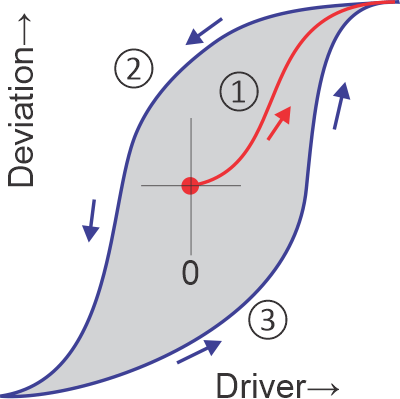
“Wait, Sy, let me get my head around that hysteresis loop diagram. You got my iron nail starting at that red dot because it’s not magnetized yet so that’s zero on the up‑down magnetism deviation scale, right? And it’s also zero on the left‑right driver scale because we’re not laying a magnetic field on it.”

“Yup, that’s the starting point, Vinnie.”

“OK, then we turn on the outside field and if it’s strong enough the nail gets magnetic, too, and so we travel up the red line. But the line’s not straight, it’s bendy. Why ain’t it straight?”

“To keep this specific, I’ll stick to the current theory for magnetization of iron. At point zero the individual iron atoms have their personal magnetic fields in completely random orientations. What we measure outside the nail is the average of all of that, which nets out to zero. Now we turn on the external magnetic field a little bit at a time so we can measure the effect. You remember we said that the iron atoms in a magnet are organized in domains.”

“Sure. I don’t forget easy.”

“I’ve noticed. OK, that upward bend at the beginning is slow increase in the nail’s magnetization while those domains are forming up. First a few atoms in one small area orient their local fields relative to the external field. Their combined field influences neighboring atoms to join in. The process is called nucleation because those first few atoms form the nucleus of a domain. The nucleus gains strength by recruiting more atoms, making it an even stronger recruiter. The red line rises exponentially until there aren’t any more unrecruited atoms.”

“That’s the end of the upward bend, huh?”

“Mm-hm, now we enter the linear phase and a different magnetization process. Energy in the external field feeds the domains pointed parallel to it at the expense of domains at a different angle. Domain growth is roughly linear with applied field strength. That line would like to stay straight but nothing goes on forever except maybe the Universe. Sooner or later the domains start running out of room to grow into. Increasing the driver strength doesn’t produce any further effect and we say that the nail’s magnetic field is saturated.”

“That makes sense. Let’s see if I can figure the blue loop from where the head end is north. The number 2 arrow says that if we dial down the driver, that’s the outside field and we’re moving to the left, when we get to zero the deviation, that’s the nail’s field, is still going strong and we got a permanent magnet. If we adjust the outside field leftward beyond zero that kills off the nail’s field … Hey, so the backward domains are eating the forward ones, right?”

“Probably. Depends on the material. Not good to ride the theory too far without checking the experimental data but that’d be my guess.”

“OK, so we drive those little domains until they saturate with the head end south. When we dial down the driver’s field backward strength we move to the right and the nail climbs the number 3 curve. The driver field returns to zero but the nail’s still a backward permanent magnet. We push the driver and the nail to forward saturation again and we can go loop‑de‑loop. But we never go through the red dot again — either the nail’s a permanent magnet when the driver’s zero or it not a magnet while the driver’s strong but they’re never both zero again.”

“Unless we scramble all the domains by heating the nail white-hot and letting it cool away from any external fields.”

“You know what’s missing from that picture, Sy?”

I’d wondered if he’d spot it. “I’ll bite. What?”

“Numbers. Up‑down is how strong the magnet is, right, but I know my knife‑holder magnets are a lot stronger than my calendar marker magnets. And the side‑to‑side part is about how well the stuff holds its magnetism. What’s the theory that puts numbers on the graph?”

“Sorry to tell you this given your math aversion, Vinnie, but the numbers are buried in big, thick books with equations in them. Pictures can only get you so far.”

~~ Rich Olcott

The Hysterical Penguin

“Sy, you said that hysteresis researchers filled in two of Newton’s Physics gaps. OK, I get that he couldn’t do atomic stuff ’cause atoms hadn’t been discovered yet. What’s the other one?”

Proposition XI, Problem VI
from Book I of Newton’s Principia

“Non‑linearity.”

“You’re gonna have to explain that.”

“It’s a math thing. I know you don’t go for equations, so here’s a picture to get you started on how Newton solved problems. Look at all familiar?”

“Whoa, looks like something toward the end of my Geometry class.”

“Exactly. Newton was trained as a geometer and he was good at it. His general strategy was to translate a physical system to a geometrical structure and then work out its properties as a series of geometric proofs. The good news was that he proved a lot of things that started us on the way to quantitative science. The bad news was that his proofs were hard to extend to situations where the geometry wasn’t so easy.”

“That’s easy?”

“For Newton, maybe it was. Who knows? Anyway, the toolkit they gave you in Geometry class was what Newton had to work with — logic, straight lines and some special curves like ellipses and parabolas whose properties had been studied since Euclid, all on a flat plane. Nearly everything depended on finding proportionalities between different distances or areas — this line is twice that one but equal to a third, that sort of thing. Proportionality like that is built into equations like here+(velocity×time)=there. See how distance traveled is proportional to time? The equation plots as a straight line, which is why it’s called a linear equation.”

“So what’s non‑linear look like — all wiggle‑waggle?”

“Not necessarily. Things can vary smoothly along curves that aren’t those classical ones. Newton’s methods are blocked on those but Leibniz’s algebra‑based calculus isn’t. That’s why it won out with people who needed answers. What’s important here is that Newton’s lines can’t describe everything. Mmm… where does a straight line end?”

“Either at a T or never. Same thing for a parabola. Hey, ellipses don’t really end, either.”

“Mm-hm. Newton’s lines either stop abruptly or they continue forever. They don’t grow or peter out exponentially like things in real life do. Suppose something’s velocity changes, for instance.”

“That’s acceleration. I like accelerating.”

“So true, I’ve experienced your driving. But even you don’t accelerate at a constant rate. You go heavy or light or maybe brake, whatever, and our speed goes up or down depending. The only way Newton’s geometry can handle variable acceleration is to break it into mostly‑constant pieces and work one piece at a time. Come to think of it, that may be where he got the idea for his fluxions method for calculus. Fortunately for him, some things like planets and artillery shells move pretty close to what his methods predict. Unfortunately, things like disease epidemics and economies don’t, which is why people are interested in non‑linearity.”

“So what do these hysteresis guys do about it?”

“Mostly algebraic calculus or computer approximations. But there wasn’t just one group of hysteresis guys, there was a bunch of groups, each looking at different phenomena where history makes a difference. Each group had their own method of attack.”

“Like your elephant thing with Anne, lots of notions about entropy.”

Typical hysteresis loop
Red — initial evolution
Blue — subsequent changes

“How’d you find out about that?”

You wrote those posts, Sy, about three years ago.”

“Oh, that’s right. Talk about history. Anyway, it took decades for the ecologists, epidemiologists, civil engineers and several kinds of physicist to realize that they all have systems that behave similarly when driven by a stressor. Starting at some neutral situation, the system evolves in the driver’s direction to some maximum deviation where increased stress has no further effect. When the stress is relieved, the system may stick temporarily at the strained position. When it does evolve away from there, maybe a reverse driver is needed to force a return to the starting situation. In fact, if the forward and reverse drivers are applied repeatedly the system may never get back to the initial unstressed position.”

“Like that iron nail. Not magnetic, then magnetic, then reversed.”

~~ Rich Olcott

Hysteria

<chirp, chirp> “Moire here.”

“Hi, Sy, it’s Vinnie again. Hey, I just heard something on NPR I wanted to check with you on.”

“What’s that?”

“They said that even with the vaccine and all, it’s gonna take years for us to get back to normal ’cause the economy’s hysterical. Does that mean it’s cryin’‑funny or just cryin’? Neither one seems to fit.”

“You’re right about the no‑fit. Hmm… Ah! Could the word have been ‘hysteresis‘?”

“Somethin’ like that. What’s it about?”

“It’s an old Physics word that’s been picked up by other fields. Not misused as badly as ‘quantum,’ thank goodness, but still. The word itself gives you a clue. Do you hear the ‘history‘ in there?”

“Hysteresis, history … cute. So it’s about history?”

“Yup. The classic case is magnetism. Take an iron nail, for instance. The nail might already be magnetized strongly enough to pick up a paper clip. If it can, you can erase the magnetism by heating the nail white‑hot. If the nail’s not magnetic you may be able to magnetize it by giving it a few hammer‑whacks while it’s pointed north‑south, parallel to Earth’s magnetic field. Things get more interesting if we get quantitative. A strong‑enough magnetic field will induce magnetism in that nail no matter what direction it’s pointed. Reverse that field’s direction and the nail stays magnetized, only less so. It takes a stronger reverse field to demagnetize the nail than it took to magnetize it in the first place. See how the history makes a difference?”

“Yeah, for some things.”

“And that’s the point. Some of a system’s properties are as fixed as the nail’s weight or chemical composition. However, it may have other properties we can’t understand without knowing the history. Usually we can’t even predict them without looking at deeper structures. Hysteresis highlights two more gaps in Newton’s Physics. As usual he’s got a good excuse because many history‑dependent phenomena couldn’t even be detected with 17th‑Century technology. We couldn’t produce controllable magnetic fields until the 19th Century, when Oersted and Ampere studied magnetism and electricity. We didn’t understand magnetic hysteresis until the 20th Century.”

“Haw! You’re talking history of history. Anyway, to me it looks like what’s going on is that the strong field gets the magnetic atoms in there to all point the same way and heat undoes that by shaking them up to point random‑like.”

“What about the reversing field?”

“Maybe it points some of the atoms in the other direction and that makes the nail less and less magnetic until the field is strong enough to point everything backwards.”

“Close enough. The real story is that the atoms, iron in this case, are organized in groups called domains. The direction‑switching happens at the domain level — battalions of magnetically aligned atoms — but we had no way to know that until 20th‑Century microscopy came along.”

“So it takes ’em a while to get rearranged, huh?”

“Mmm, that’d be rate-dependent hysteresis, where the difference between forward and backward virtually disappears if you go slow enough. Think about putting your hand slowly into a tub of water versus splashing in there. Slow in, slow out reverses pretty well, but if you splash the water’s in turmoil for quite a long time. Magnetic hysteresis, though, doesn’t care about speed except in the extreme case. It’s purely controlled by the strength of the applied field.”

“I’m thinking about that poor frog.”

‘You would go there, wouldn’t you? Yeah, the legendary frog in slowly heating water would be another history dependency but it’s a different kind. The nail’s magnetism only depends on atoms standing in alignment. A frog is a highly organized system, lots of subsystems that all have to work together. Warming water adds energy that will speed up some subsystems more than others. If Froggy exits the pot before things desynchronize too far then it can recover its original lively state. If it’s trapped in there you’ve got frog soup. By the way, it’s a myth that the frog won’t try to hop out if you warm the water slowly. Frogs move to someplace cool if they get hotter than their personal threshold temperature.”

“Frogs are smarter than legends, huh?”

~~ Rich Olcott

‘Twixt A Rock And A Vortex

A chilly late December walk in the park and there’s Vinnie on a lakeside bench, staring at the geese and looking morose. “Hi, Vinnie, why so down on such a bright day?”

“Hi, Sy. I guess you ain’t heard. Frankie’s got the ‘rona.”

Frankie??!? The guys got the constitution of an ox. I don’t think he’s ever been sick in his life.”

“Probably not. Remember when that bug going around last January had everyone coughing for a week? Passed him right by. This time’s different. Three days after he showed a fever, bang, he’s in the hospital.”

“Wow. How’s Emma?”

“She had it first — a week of headaches and coughing. She’s OK now but worried sick. Hospital won’t let her in to see him, of course, which is a good thing I suppose so she can stay home with the kids and their schoolwork.”

“Bummer. We knew it was coming but…”

“Yeah. Makes a difference when it’s someone you know. Hey, do me a favor — throw some science at me, get my mind off this for a while.”

“That’s a big assignment, considering. Let’s see … patient, pandemic … Ah! E pluribus unum and back again.”

“Come again?”

“One of the gaps that stand between Physics and being an exact science.”

“I thought Physics was exact.”

“Good to fifteen decimal places in a few special experiments, but hardly exact. There’s many a slip ‘twixt theory and practice. One of the slips is the gap between kinematic physics, about how separate objects interact, and continuum physics, where you’re looking at one big thing.”

“This is sounding like that Loschmidt guy again.”

“It’s related but bigger. Newton worked on both sides of this one. On the kinematics side there’s billiard balls and planets and such. Assuming no frictional energy loss, Newton’s Three Laws and his Law of Gravity let us calculate exact predictions for their future trajectories … unless you’ve got more than three objects in play. It’s mathematically impossible to write exact predictions for four or more objects unless they start in one of a few special configurations. Newton didn’t do atoms, no surprise, but his work led to Schrödinger’s equation for an exact description of single electron, single nucleus systems. Anything more complicated, all we can do is approximate.”

“Computers. They do a lot with computers.”

“True, but that’s still approximating. Time‑step by time‑step and you never know what might sneak in or out between steps.”

“What’s ‘continuum‘ about then? Q on Star trek?”

“Hardly, we’re talking predictability here. Q’s thing is unpredictability. A physics continuum is a solid or fluid with no relevant internal structure, just an unbroken mass from one edge to the other. Newton showed how to analyze a continuum’s smooth churning by considering the forces that act on an imaginary isolated packet of stuff at various points in there. He basically invented the idea of viscosity as a way to account for friction between a fluid and the walls of the pipe it’s flowing through.”

“Smooth churning, eh? I see a problem.”

“What’s that?”

“The eddies and whirlpools I see when I row — not smooth.”

“Good point. In fact, that’s the point I was getting to. We can use extensions of Newton’s technique to handle a single well‑behaved whirlpool, but in real life big whirlpools throw off smaller ones and they spawn eddies and mini‑vortices and so on, all the way down to atom level. That turns out to be another intractable calculation, just as impossible as the many‑body particle mechanics problem.”

“Ah‑hah! That’s the gap! Newton just did the simple stuff at both ends, stayed away from the middle where things get complicated.”

“Exactly. To his credit, though, he pointed the way for the rest of us.”

“So how can you handle the middle?”

“The same thing that quantum mechanics does — use statistics. That’s if the math expressions are average‑able which sometimes they’re not, and if statistical numbers are good enough for why you’re doing the calculation. Not good enough for weather prediction, for instance — climate is about averages but weather needs specifics.”

“Yeah, like it’s just started to snow which I wasn’t expecting. I’m heading home. See ya, Sy.”

“See ya, Vinnie. … Frankie. … Geez.

~~ Rich Olcott