Several Big Sloshes

“I call distraction, Sy. You were going to explain how come the Moon’s drifting away from us but you got us into radians and stuff. What’s that got to do with the Moon flying away by dragging a big wave around the Earth?”

“It’s not dragging a localized bulge of water like you’re thinking, Vinnie, nothing like that wave on Miller’s Planet. For that matter, the Miller’s Planet wave had a sharply‑rising front which also doesn’t look like the textbook tidal bulge.”

“There’s a textbook on this stuff?”

“Many, Al. Heavy-duty people have spent a lot of time on tides. Think about all the military and commercial navies that depend on boats being able to leave port and dock on schedule.”

“And not run aground <heh heh>”

“Well, yes, Vinnie. Anyhow, like a lot of pre‑computer Physics, that work was based on a simplified ideal system — a moon orbiting a smooth planet with a world‑covering ocean. Water’s drawn horizontally towards the sub‑lunar points making an egg‑shaped surface and everything’s neat.”

“Probably nothing like real life.”

“Of course. Here’s a video I built from satellite altimetry data. The grey dot is roughly the point underneath the Moon as that day progressed. The red‑to‑blue height scale’s in meters.. Not as neat as theory, is it?”

“Wow, that’s a mess. Looks like the Moon’s pulling water along the Canada‑Alaska coast okay, and the western Pacific starts to get a dome going. But the water never catches up before the Moon’s gone.”

“Hey, Vinnie, look how the tides just go round and round New Zealand. And what’s that, Hudson Bay, it’s a pinwheel.”

“Yeah, and in between Africa and Madagascar it’s completely out of phase from what it oughta be.”

“What you’re looking at is slosh. Once again, reality overwhelms a pretty theory. Each basin has its own preferred set of oscillations. None of them match up with the Moon. But the other thing — “

“Tiny numbers. Everything’s like less than a couple meters, not not a big bulge at all.”

“Bingo, Vinnie. Against Earth’s 6.4‑million‑meter radius, those small chaotic sloshes don’t make for effective energy transfer driving the Moon away from us. That theory’s toast.”

“So what’s doing it?”

“There’s two theories that I know of, and they’re probably both right. The first one is Earth tides — that bump you think of as traveling around the planet, but the bump is rock instead of water.”

“That can’t be a big effect. Rocks don’t bend.”

“On a planetary scale they’re not as solid as you think, Vinnie. The rock crust is brittle and really thin, less than half a percent of Earth’s radius. It floats on molten outer mantle which has the fluidity of tapioca pudding. When that structure gives under stress the crust layer cracks. The seismologists and GPS techs have measured surface motion all over the world. When they analyze the maps, the lunar component accounts for up to a meter of coordinated vertical daily movement. Figure the whole Earth is continually being squeezed and pulled to that extent and you’ve got a lot of energy being expended every 24 hours.”

“How about the other theory?”
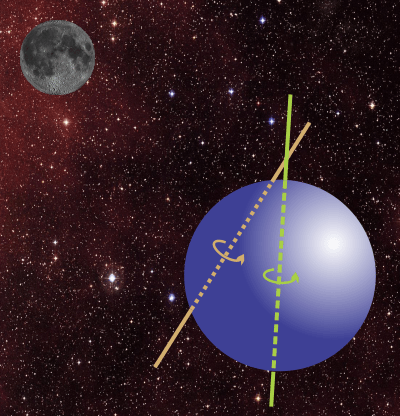
“There’s no direct evidence, so far as I know, but it seems reasonable on physical grounds. We’ve got two gyrations going on here, right? The Moon is on a 29½‑day orbit while the Earth rotates about thirty times faster. But the two motions use different frames. The Earth’s spin axis runs through the geometric center of the planet and tilts 23° from its orbit axis. Meanwhile the whole Earth‑Moon system rotates about its barycenter, their common center of gravity, which stays inside the Earth about ¾ of the way moonward from the Earth’s middle. That rotation is about 5° away from Earth’s orbit’s axis. Imagine a molten blob near the barycenter, happily following the Moon in the Earth-Moon frame, but the rest of the planet is saying, ‘No, no, you’re supposed to be moving hundreds of miles an hour in a different direction!‘ If the blob’s the least bit lighter or heavier than its neighbor blobs, inertial forces expend energy to kick it out of there.”

“So we got two ways to transfer energy steady-like.”

“I think so.”

~~ Rich Olcott
Here’s a Different Angle

“OK, Sy, so there’s a bulge on the Moon’s side of the Earth and the Earth rotates but the bulge doesn’t and that makes the Moon’s orbit just a little bigger and you’ve figured out that the energy it took to lift the Moon raised Earth’s temperature by a gazillionth of a degree, I got all that, but you still haven’t told Al and me how the lifting works.”

“You wouldn’t accept it if I just said, ‘The Moon lifts itself by its bootstraps,’ would you?”

“Not for a minute.”

“And you don’t like equations. <sigh> OK, Al, pass over some of those paper napkins.”

“Aw geez, Sy.”

“You guys asked the question and this’ll take diagrams, Al. Ante up. … Thanks. OK, remember the time Cathleen and I caught Vinnie here at Al’s shop playing with a top?”

“Yeah, and he was spraying paper wads all over the place.”

“I wasn’t either, Al, it was the top sending them out with centri–…, some force I can never remember whether it’s centrifugal or centripetal.”

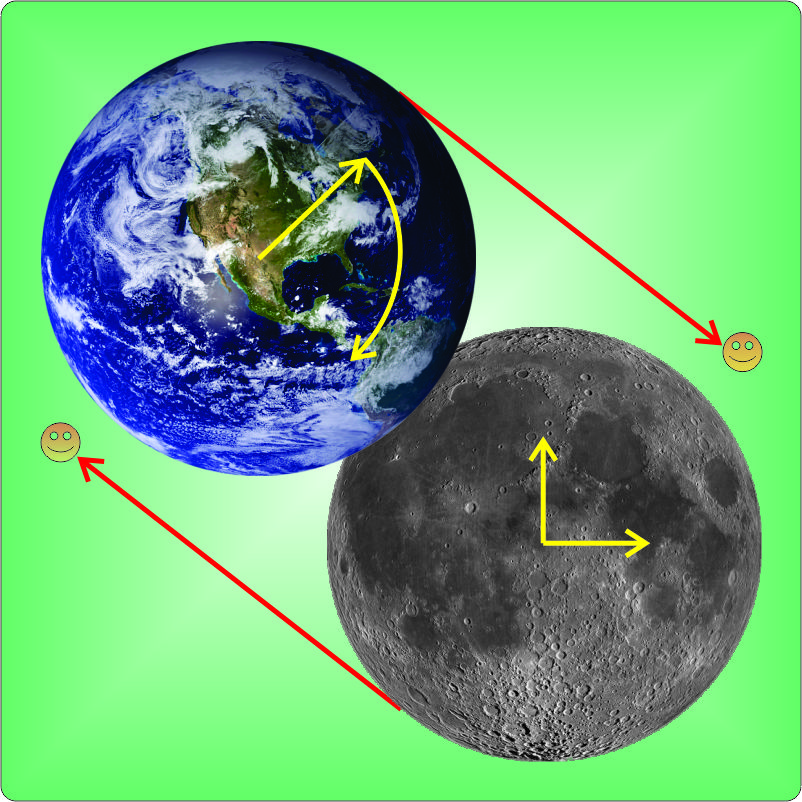
“Centrifugal, Vinnie, –fugal– like fugitive, outward‑escaping force. It’s one of those ‘depends on how you look at itfictitious forces. From where you were sitting, the wads looked like they were flying outward perpendicular to the top’s circle. From a wad’s point of view, it flew in a straight line tangent to the circle. It’s like we have two languages, Room and Rotor. They describe the same phenomena but from different perspectives.”

“Hey, it’s frames again, ain’t it?”

“Newton’s inertial frames? Sort‑of but not quite. Newton’s First Law only holds in the Room frame — no acceleration, motion is measured by distance, objects at rest stay put. Any other object moves in a straight line unless its momentum is changed by a force. You can tackle a problem by considering momentum and force components along separate X and Y axes. Both X and Y components work the same way — push twice as hard in either direction, get twice the acceleration in that direction. Nice rules that the Rotor frame doesn’t play by.”

“I guess not. The middle’s the only place an object can stay put, right?”

“Exactly, Al. Everything else looks like it’s affected by weird, constantly‑varying forces that’re hard to describe in X‑Y terms.”

“So that breaks Newton’s physics?”

“Of course not. We just have to adapt his F=m·a equation (sorry, Vinnie!) to Rotor conditions. For small movements we wind up with two equations. In the strict radial direction it’s still F=m·a where m is mass like we know it, a is acceleration outward or inward, and F is centrifugal or centripetal, depending. Easy. Perpendicular to ‘radial‘ we’ve got ‘angular.’ Things look different there because in that direction motion’s measured by angle but Newton’s Laws are all about distances — speed is distance per time, acceleration is speed change per time and so forth.”

“So what do you do?”

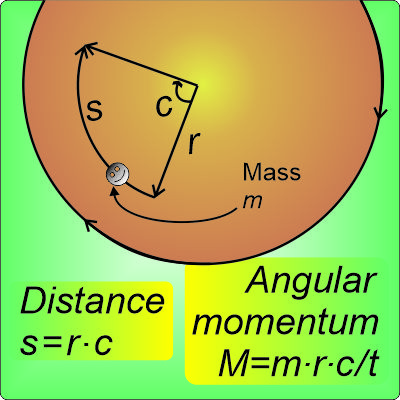
“Use arc length. Distance along an arc is proportional to the angle, and it’s also proportional to the radius of the arc, so just multiply them together.”

“What, like a 45° bend around a 2-foot radius takes 90 feet? That’s just wrong!”

“No question, Al. You have to measure the angle in the right units. Remember the formula for a circle’s circumference?”

“Sure, it’s 2πr.”

“Which tells you that a full turn’s length is times the radius. We can bridge from angle to arc length using rotational units so that a full turn, 360°, is units. We’ll call that unit a radian. Half a circle is π radians. Your 45° angle in radians is π/4 or about ¾ of a radian. You’d need about (¾)×(2) or 1½ feet of whatever to get 45° along that 2-foot arc. Make sense?”

“Gimme a sec … OK, I’m with you.”

“Great. So if angular distance is radius times angle, then angular momentum which is mass times distance per time becomes mass times radius times angle per time.”

“”Hold on, Sy … so if I double the mass I double the momentum just like always, but if something’s spinning I could also double the angular momentum by doubling the radius or spinning it twice as fast?”

“Couldn’t have put it better myself, Vinnie.”

~~ Rich Olcott

Two Against One, And It’s Not Even Close


On a brisk walk across campus when I hear Vinnie yell from Al’s coffee shop. “Hey! Sy! Me and Al got this argument going you gotta settle.”

“Happy to be a peacemaker, but it’ll cost you a mug of Al’s coffee and a strawberry scone.”

“Coffee’s no charge, Sy, but the scone goes on Vinnie’s tab. What’s your pleasure?”

“It’s morning, Al, time for black mud. What’s the argument, Vinnie?”

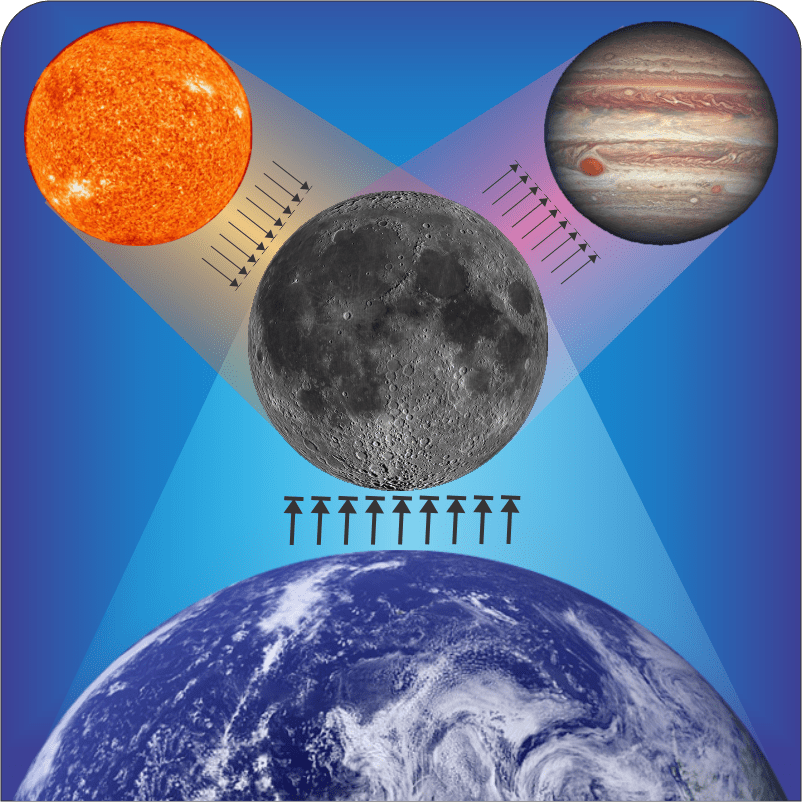
“Al read in one of his astronomy magazines that the Moon’s drifting away from us. Is that true, and if it is, how’s it happen? Al thinks Jupiter’s gravity’s lifting it but I think it’s because of Solar winds pushing it. So which is it?”

“Here you go, Sy, straight from the bottom of the pot.”

“Perfect, Al, thanks. Yes, it’s true. The drift rate is about 1¼ nanometers per second, 1½ inches per year. As to your argument, you’re both wrong.”

“Huh?”
 ”Aw, c’mon!”

“Al, let’s put some numbers to your hypothesis. <pulling out Old Reliable and screen‑tapping> I’m going to compare Jupiter’s pull on the Moon to Earth’s when the two planets are closest together. OK?”

“I suppose.”

“Alright. Newton’s Law tells us the pull is proportional to the mass. Jupiter’s mass is about 320 times Earth, which is pretty impressive, right? But the attraction drops with the square of the distance. The Moon is 1¼ lightseconds from Earth. At closest approach, Jupiter is almost 2100 lightseconds away, 1680 times further than the Moon. We need to divide the 320 mass factor by a 1680‑squared distance factor and that makes <key taps> Jupiter’s pull on the Moon is only 0.011 percent of Earth’s. It’ll be <taps> half that when Jupiter’s on the other side of the Sun. Not much competition, eh?”

“Yeah, but a little bit at a time, it adds up.”

“We’re not done yet. The Moon feels the big guy’s pull on both sides of its orbit around Earth. On the side where the Moon’s moving away from Jupiter, you’re right, Jupiter’s gravity slows the Moon down, a little. But on the moving-toward-Jupiter side, the motion’s sped up. Put it all together, Jupiter’s teeny pull cancels itself out over every month’s orbiting.”

“Gotcha, Al. So what about my theory, Sy?”

“Basically the same logic, Vinnie. The Solar wind varies, thanks to the Sun’s variable activity, but satellite measurements put its pressure somewhere around a nanopascal, a nanonewton per square meter. Multiply that by the Moon’s cross‑sectional area and we get <tap, tap> a bit less than ten thousand newtons of force on the Moon. Meanwhile, Newton’s Law says the Earth’s pull on the Moon comes to <tapping>
  G×(Earth’s mass)×(Moon’s mass)/(Earth-Moon distance)²
and that comes to 2×10¹¹ newtons. Earth wins by a 107‑fold landslide. Anyway, the pressure slows the Moon for only half of each month and speeds it up the other half so we’ve got another cancellation going on.”

“So what is it then?”
 ”So what is it then?”

“Tides. Not just ocean tides, rock tides in Earth’s fluid outer mantle. Earth bulges, just a bit, toward the Moon. But Earth also rotates, so the bulge circles the planet every day.”

“Reminds me of the wave in the Interstellar movie, but why don’t we see it?”

“The movie’s wave was hundreds of times higher than ours, Al. It was water, not rock, and the wave‑raiser was a huge black hole close by the planet. The Moon’s tidal pull on Earth produces only a one‑meter variation on a 6,400,000‑meter radius. Not a big deal to us. Of course, it makes a lot of difference to the material that’s being kneaded up and down. There’s a lot of friction in those layers.”

“Friction makes heat, Sy. Rock tides oughta heat up the planet, right?”

“Sure, Vinnie, the process does generate heat. Force times distance equals energy. Raising the Moon by 1¼ nanometers per second against a force of 2×10²¹ newtons gives us <taping furiously> an energy transfer rate of 4×10‑23 joules per second per kilogram of Earth’s 6×1024‑kilogram mass. It takes about a thousand joules to heat a kilogram of rock by one kelvin so we’re looking at a temperature rise near 10‑27 kelvins per second. Not significant.”

“No blaming climate change on the Moon, huh?”

~~ Rich Olcott

Moon Shot

<chirp, chirp> “Moire here.”

“Hi, Mr Moire, it’s Jeremy. Hey, I’ve been reading through some old science fiction stories and I ran across some numbers that just don’t look right.”

“Science fiction can be pretty clunky. Some Editors let their authors play fast and loose on purpose, just to generate Letters to The Editor. Which author and what story?”

“This is Heinlein, Mr Moire. I know his ideas about conditions on Mars and Venus were way off but that was before we had robot missions that could go there and look. When he writes about space navigation, though, he’s always so specific it looks like he’d actually done the calculations.”

“OK, which story and what numbers?”

“This one’s called, let me check, Gentlemen, Be Seated. It’s about these guys who get trapped in a tunnel on the Moon and there’s a leak letting air out of the tunnel so they seal the leak when one of the guys —”

“I know the story, Jeremy. I’ve always wondered if it was Heinlein or his Editor who got cute with the title. Anyway, which numbers bothered you?”

“I kinda thought the title came first. Anyway, everybody knows that the Earth’s gravity is six times the Moon’s, but he says that the Earth’s mass is eighty times the Moon’s and that’s why the Earth raises tides on the Moon except they’re rock tides, not water tides, and the movement makes moonquakes and one of them might have caused the leak. So why isn’t the Earth’s gravity eighty times the Moon’s, not six?”

“Read me the sentence about eighty.”

“Umm … here it is, ‘Remember, the Earth is eighty times the mass of the Moon, so the tidal stresses here are eighty times as great as the Moon’s effect on Earth tides.‘ I checked the masses in Wikipedia and eighty is about right.”

“I hadn’t realized the ratio was that large, I mean that the Moon is that small. One point for Heinlein. Anyway, you’re comparing north and east. The eighty and the six both have to do with gravity but they’re pointing in different directions.”

“Huh? I thought gravity’s pull was always toward the center.”

“It is, but it makes a difference where you are and which center you’re thinking about. You’re standing on the Earth so the closest center to you is Earth’s and most of the gravity you feel is the one-gravity pull from there. Suppose you’re standing on the Moon —”

“One-sixth, I know, Mr Moire, but why isn’t it one‑eightieth?”

“Because on the Moon you’re a lot closer to the center of the Moon than you were to the center of the Earth back on Earth. Let’s put some numbers to it. Got a calculator handy?”

“Got my cellphone.”

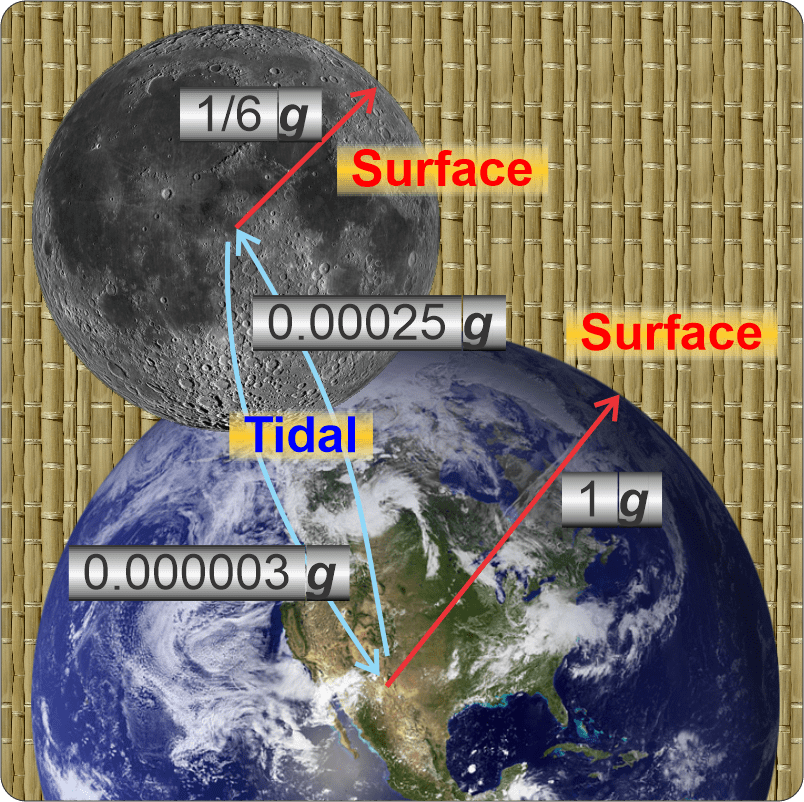
“Duh. OK, Newton showed us that an object’s gravitational force is proportional to the object’s mass divided by the square of the distance to the center. Earth’s radius is about 4000 miles and the Moon’s is about a quarter of that, so take the mass as 1/80 and divide by 1/4 squared. What do you get?”

“Uhh … 0.2 gravities.”

“One-fifth g. Close enough to one-sixth. If we used accurate numbers we’d be even closer. See how distance makes a difference?”

“Mm-hm. What about Heinlein’s tidal stuff?”

“Ah, now that’s looking in the other direction, where the distance is a lot bigger. Earth-to-Moon is about 250,000 miles. Standing on the Moon, you’d feel Earth’s one‑g gravity diminished by a factor of 4000/250000 squared. What’s that come to?”

“Umm… the distance factor is (4000/250000)² … I get 250 microgravities. Not much. Heinlein made a good bet with his characters deciding that the leak was caused by a nearby rocket crash instead of a moonquake.”

“How about Heinlein’s remark about the Moon’s effect on Earth?”

“Same distance but one eightieth the mass so I divide by 80 — three microgravities. Wow! That can’t possibly be strong enough to raise tides here.”

“It isn’t, though that’s the popular idea. What really happens is that the Moon’s field pulls water sideways from all directions towards the sub‑Lunar point. Sideways motion doesn’t fight Earth’s gravity, it just makes the water pile up in the center.”

“Hah, piled-up water. Weird. Well, I feel better about Heinlein now.”

~~ Rich Olcott

Getting over The Hill

“You guys want refills? You look like you’re gonna be here a while.”

“Yes, thanks, Al. Your lattes are sooo good. And can we have some more paper napkins?”

“Sure, but don’t let ’em blow away or nothin’, OK? I hate havin’ to pick up the place.”

“They’ll stay put. Just a half-cup of mud for me, thanks.”

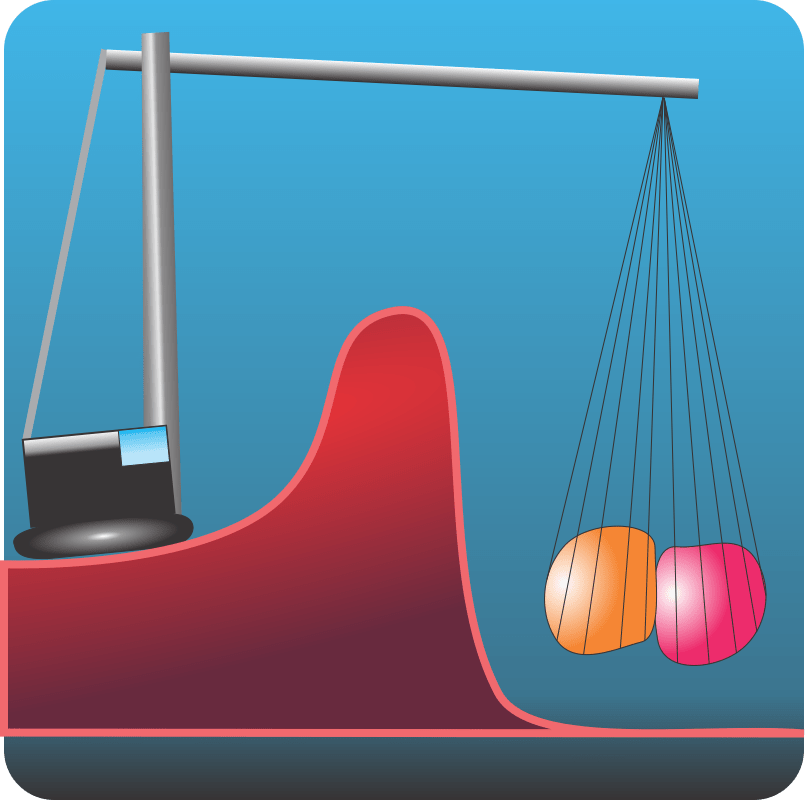
The Spring breeze has picked up a little so we hitch our chairs closer together. Susan reaches for a paper napkin, draws a curve. “Here’s another pattern you haven’t featured yet, Sy. It’s in every chemist’s mind when they think about reactions.”

“OK, I suppose this is molecules A and B on one side of some sort of wall and molecule C on the other.”

“It’ll be clearer if I label the axes. It’s a reaction between A and B to make C. The horizontal axis isn’t a distance, it’s a measure of the reaction’s progress toward completion. Beginning molecules to the left, completed reaction to the right, transition in the middle, see? The vertical axis is energy. We say the reaction is energetically favored because C is lower than A and B separately.”

“Then what’s the wall?”

“We call it the barrier. It’s some additional dollop of energy that allows the reaction happen. Maybe A or B have to be reconfigured before they can form an A~B transition state. That’s common in carbon chemistry, for instance. Carbon usually has four bonds, but you can get five‑bonded transition states. They usually don’t last very long, though.”

“Right, carbon and its neighbors prefer the tetrahedral shape. Five‑bonded carbon distorts the stable electron clouds. Heat energy shoves things into position, I suppose.”

“Often but hardly always. Especially for large molecules, heat’s more likely to jostle things out of position than put them together. That’s what cooking does.”

“The curve reminds me of particle accelerator physics, except it takes way more energy to overcome nuclear forces when you mash sub‑atomic thingies together.”

“Oh, yes, very similar in terms of that general picture — except that the C side could be multiple emitted particles.”

“So your sketch covers a processes everywhere, not just Chemistry. They all have different barrier profiles, then?”

“Of course. My drawing was just to give you the idea. Some barriers are high, some are low, either side may rise or fall exponentially or by some power of the distance, some are lumpy, it all depends. Some are even flat.”

“Flat, like no resistance at all?”

“Oh, yes. Hypergolic rocket fuel pairs ignite spontaneously when they mix. Water and alkali metals make flames — have you seen that video of metallic sodium dumped into a lake and exploding like mad? Awesome!”

“I can imagine, or maybe not. If heat energy doesn’t get molecules over that barrier, what does?”

“Catalysts, mostly. Some do their thing by capturing the reactants in adjacent sites, maybe doing a little geometry jiggling while they’re at it. Some play games with the electron states of one or both reactants. Anyhow, what they accomplish is speeding up a reaction by replacing the original barrier with one or more lower ones.”

“Wait, reaction speed depends on the barrier height? I’d expect either go or no‑go.”

“No, it’s usually more complicated than that. Umm … visualize tossing a Slinky toy into the air. Your toss gives it energy. Part of the energy goes into lifting it against Earth’s gravity, part into spinning motion and part into crazy wiggles and jangling, right? But if you toss just right, maybe half of the energy goes into just stretching it out. Now suppose there’s a weak spot somewhere along the spring. Most of your tosses won’t mess with the spot, but a pure stretch toss might have enough energy to break it apart.”

“Gotcha, the transition barrier might be a probability thing depending on how the energy’s distributed within A and B. Betcha tunneling can play a part, too.”

“Mm? Oh, of course, you’re a Physics guy so you know quantum. Yes, some reactions depend upon electrons or hydrogen atoms tunneling through a barrier, but hardly ever anything larger than that. Whoops, I’m due back at the lab. See ya.”

<inaudible> “Oh, I hope so.”

~~ Rich Olcott