Significant Twinkles

Cathleen’s got a bit of fire in her eye. “Good exposition, Jeremy, but only just barely on‑assignment. You squeezed in your exoplanet search material at the very end. <sigh> Okay, for our next presentation we have two of our freshmen, Madison and C‑J.”

“Hello, everybody, I’m Madison. I fell in love with Science while watching Nova and Star Trek with my family. Doctor O’Meara’s Astronomy class is my first step into the real thing. C‑J?”

“Hi, I’m C‑J, like she said. What started me on Astronomy was just looking at the night sky. My family’s ranch is officially in dark sky country, but really it’s so not dark. Jeremy’s also from the High Plateau and we got to talking. We see a gazillion stars up there, probably more stars than the Greeks did because they were looking up through humid sea-level air. On a still night our dry air’s so clear you can read by the light of those stars. I want to know what’s up there.”

“Me, too, but I’m even more interested in who‘s up there living on some exoplanet somewhere. How do we find them? We’ve just heard about spectroscopy and astrometry. C‑J and I will be talking about photometry, measuring the total light from something. You can use it even with light sources that are too dim to pick out a spectrum. Photometry is especially useful for finding transits.”

“A transit is basically an eclipse, an exoplanet getting between us and its star—”

“Like the one we had in 2017. It was so awesome when that happened. All the bird and bug noises hushed and the corona showed all around where the Sun was hiding. I was only 12 then but it changed my Universe when they showed us on TV how the Moon is exactly the right size and distance to cover the Sun.”

“Incredible coincidence, right? Almost exactly 100% occultation. If the Moon were much bigger or closer to us we’d never see the corona’s complicated structure. We wouldn’t have that evidence and we’d know so much less about how the Sun works. But even with JWST technology we can’t get near that much detail from other stars.”

“Think of trying to read a blog post on your computer, but your only tool is a light meter that gives you one number for the whole screen. Our nearest star, Alpha Centauri, is 20% larger than our Sun but it’s 4.3 lightyears away. I worked out that at that distance its image would be about 8½ milliarcseconds across. C‑J found that JWST’s cameras can’t resolve details any finer than 8 times that. All we can see of that star or any star is the light the whole system gives off.”

“So here’s where we’re going. We can’t see exoplanets because they’re way too small and too far away, but if an exoplanet transits a star we’re studying, it’ll block some of the light. The question is, how much, and the answer is, not very. Exoplanets block starlight according to their silhouette area. Jupiter’s diameter is about a tenth the Sun’s so it’s area is 1% of the Sun’s. When Jupiter transits the Sun‑‑‑”

“From the viewpoint of some other solar system, of course—”

“Doesn’t matter. Jupiter could get in between the Sun and Saturn; the arithmetic works out the same. The maximum fraction of light Jupiter could block would be its area against the Sun’s area and that’s still 1%.”

“Well, it does matter, because of perspective. If size was the only variable, the Moon is so much smaller than the Sun we’d never see a total eclipse. The star‑planet distance has to be much smaller than the star‑us distance, okay?”

“Alright, but that’s always the way with exoplanets. Even with a big planet and a small star, we don’t expect to measure more than a few percent change. You need really good photometry to even detect that.”

“And really good conditions. Everyone knows how atmospheric turbulence makes star images twinkle—”

“Can’t get 1% accuracy on an image that’s flickering by 50%—”

“And that’s why we had to get stable observatories outside the atmosphere before we could find exoplanets photometrically.”
~~ Rich Olcott

Astrometers Are Wobble-Watchers

letter A Hi, Sy, what’s going on in Cathleen’s seminar?

You were right, Al.
It’s about exoplanets and how to find them.
Jeremy’s pitching astrometry.
That’s about measuring star locations in the sky.
I’ll fill you in later.

“So that’s my cultural colonialism rant, thanks for listening. On to the real presentation. Maria showed us how to look for exoplanets when they wobble along our line of sight. But what if they wobble perpendicular to that? Careful measurement should show that, right? The ancients thought that holy forces had permanently set the positions of all the stars except for the planets so they didn’t measure that close. Tycho Brahe took meticulous measurements with room‑sized instruments—”

<voice from the back> “Room‑sized? What difference does that make?”

“What if I told you that two stars are 3 millimeters apart in the sky?”

<another voice> “How far out’s your ruler? Sky stuff, you need to talk angles because that’s all you got.”

“Well there you go. That’s why Tycho went for maximum angle‑measuring accuracy. He built a sextant with a 5‑foot radius. He used an entire north‑south wall as a quadrant. His primary instrument was an armillary sphere three yards across.”

<first voice again> “Wait, a sphere, like a big bubble? Why north‑south? What’s a quadrant?”

  • I give him a nudge. “He’s just a kid, Mr Feder. Be nice. One question at a time.”
  • “But I got so many!”

“Think about Tycho’s goal. Like astrometers before him, he wanted to build an accurate map of the heavens. Native Americans a thousand years or more ago carved free‑hand star maps on cave ceilings and turtle shells. Tycho followed the Arabic and Chinese quantitative mapping traditions. There’s two ways to do that. One is to measure and map the visual angles between many pairs of stars. That strategy fails quickly because errors accumulate. Four or five steps along the way you’re plotting the same star in two different locations.”

<Feder’s voice again> “There’s a better way?”

“Yessir. Measure and map each star relative to a standard coordinate system. If your system’s a good one, errors tend to average out. The latitude‑longitude system works well for locating places on Earth. Two thousand years ago the Babylonians used something similar for places in the crystal sphere they thought supported the stars above us. Where the equinoctial Sun rose on the horizon was a special direction. Their buildings celebrated it. Starting from that direction the horizontal angle to a star was its longitude. The star’s latitude was its angle up from the horizon towards the zenith straight above. But those map coordinates don’t work for another part of the world. Astrometers needed something better.”

<Feder again> “So what did they do already?”

“They may or may not have believed the Earth itself is round, but they recognized the Pole Star’s steady position that the rest of the sky revolved around. They also noticed that as each month went by the constellations played ring‑a‑rosie in a plane perpendicular to the north‑south axis. Call that the Plane of The Ecliptic. Pick a star, measure its angle away from the Ecliptic and you’ve got an ecliptic latitude. Measure its angle around the Ecliptic away from a reference star and you’ve got a ecliptic longitude. Tycho’s instruments were designed to measure star coordinates. His quadrant was a 90° bronze arc he embedded in that north‑south wall, let him measure a star’s latitude as it crossed his meridian. His ‘Sphere’ was simply a pair of calibrated metal rings on a gimbal mounting so he could point to target and reference stars and measure the angle between them. If his calibration used degree markings they’d be about 25 millimeters apart. His work was the best of his time but the limit of his accuracy was a few dozen arcseconds.”

“Is that bad?”

“It is if you’re looking for exoplanets by watching for stellar wobble. Maria’s Jupiter example showed the Sun wobbling by 1½ million kilometers. I worked this example with a bigger wobble and a star that would be mid‑range for most of our constellations. Best case, we’d see its image jiggling by about 90 microarcseconds. Tycho’s instruments weren’t good enough for wobbles.”

~~ Rich Olcott

The Stars from A Different Viewpoint

“Thank you, Maria, nice job showing us why the Doppler method had such a hard time finding exoplanets. Next up, Jeremy. You’re not going to talk about black holes, are you?”

“No, ma’am, my subject today is astrometry, but that’s useful for both exoplanets and black holes. I have to be careful when I say the word because it sounds so much like astronomy but they’re different things. It helped when I looked the words up. Turns out that ‘astronomy‘ means ‘naming stars‘ but ‘astrometry‘ means ‘measuring‘ them. Not weighing one or any of that, just measuring accurately where that star is in the sky at a certain moment. Everyone on Earth has the sky above. In the days before city life and city lights brought their eyes down, cultures all over the world were doing astronomy and astrometry. Professional astronomers generally use Greek and Arabic names, but that’s Eurocentrism and it got silly.”

<voice from the back> “Like how?”

“The Greeks couldn’t name constellations in the southern hemisphere’s skies because they never saw those stars. Polynesian navigators and Indigenous Australians saw them. Those cultures had their own perfectly good constellations. Did official Astronomy ask any of those people? Of course not, so we’ve got contrived designations like The Microscope and The Air Pump. Some of you know that I’m doing a research project with Professor Begaye to correlate constellations from different cultures. I’ve found some surprises.”

<voice from the back> “Like what?”

“Practically everyone in the northern hemisphere has a special image for the Pole Star and the stars close to it. Europeans picked out Ursa Minor, the Little Bear. For us Navajos the same stars make up The Northern Fire in the sky’s dome like the fire in our traditional domed hogan homes. Staying close to the Northern Fire we see two human figures, a woman and a man. One surprise for me was that the woman’s most prominent stars are the same ones the Greeks chose for Cassiopeia, also a female. The man’s image includes many of the same stars that Europeans call Ursa Major, the Big Bear. Did you know that the word ‘Artic‘ comes from the Greek word ‘arktos‘ which means ‘bear‘? Anyway, further out there’s a winter constellation containing three bright stars in a straight line plus a few more that could be shoulders and knees.”

<voice from the back> “Orion!”

“Mm-hm. We have almost exactly the same constellation. It’s also a hunter, except that the Greeks picture the three stars as his belt and we say it’s the quiver for his arrows. Right in front of the hunter are—”

<voice from the back> “The Pleaides!”

“But for us they’re Dilyehe, the Planting Stars. When they go below the horizon it’s time to plant corn. Which gets me to astrometry. The stars and constellations have always been clocks and calendars for the world’s cultures. Typically they compare the position of the Sun or certain stars with special structures.”

<voice from the back> “Like Stonehenge and the Pyramids!”

“There’s claims and doubts about both of those. People have searched out apparent special locations, like ‘This doorway and that window were placed to show a certain star rising on Midsummers Eve,’ but without explicit markings there’s no way to be sure it wasn’t just accidental. Besides, both structures were built with huge stone blocks, a real challenge to place accurately enough to pick out just one star on one day. We Navajos don’t build structures to track special times. We use mountains.”

<voice from the back> “What, you move mountains around?”

“No, we honor and respect the natural landscape for its beauty. What we do is find the special places that help the mountains and other landmarks tell us what time of year it is. My favorite example is the Double Sunset.”

<voice from the back> “Can’t have two!”

“Yes, you can, if the mountains are sharp and stand close to one another. On the right day of the year, the Sun sets behind one mountain, then peeks for just a minute through the cleft between the two. You just have to know where to stand to see that.”

~ Rich Olcott

Useful Eccentricity

“Hi, Al. What’s the hubbub in the back room?”

“Cathleen’s doing another astronomy class group seminar. This one’s about exoplanets. I’d like to listen in but I’ve got to tend the cash register here. Take notes, okay?”

“Sure, no problem.”

Professor Cathleen’s at the podium. “Okay, class, settle down. I hope everyone’s ready with their presentations. Maria, you’ve got a good topic to start us off.”

“Thank you. Everyone here knows I’ve been interested in spectroscopy since I was a student intern at Arecibo. It is such a powerful thing to know that a particular kind of atom, anywhere in the Universe, absorbs or gives off exactly the same pattern of light frequencies. Suppose you are looking at the spectrum of a star or a galaxy and you recognize a pattern, like sodium’s yellow doublet or hydrogen’s Lyman series. The pattern won’t be at its normal frequencies because of the Doppler effect. That’s good because the amount of blue‑shift or red‑shift tells us how quick the object is moving toward or away from us. That was how Dr Hubble proved that most other galaxies are flying away.”

<casts a slide to Al’s video screen> “I’ll begin with a review of some class material. The spectroscopy we see in the sky is light that was emitted at some peak wavelength lambda. Lambda with the little ‘o‘ is what we see for the same emission or absorption process in the laboratory. The wavelength difference between sky and laboratory is the absolute shift. Divide that by the laboratory wavelength to get the relative shift, the z‑scale. All the light from one object should have the same z value. It is important that z also gives us the object’s velocity if we multiply by the speed of light.”

<voice from the rear> “What’s the ‘fe ka‘ stuff about?”

“I was getting to that. Those two lines describe a doublet, a pair of peaks that always appear together. This is in the X‑ray spectrum of iron which is Fe for the chemists. K-alpha is a certain process inside the iron atom. Astronomers like to use that doublet because it’s easy to identify. Yes, profesora?”

“Two additional reasons, Maria. Iron’s normally the heaviest element in a star because stellar nuclear fusion processes don’t have enough energy to make anything heavier than that. Furthermore, although every element heavier than neon generates a K-alpha doublet, the peak‑to‑peak split increases with atomic mass. Iron’s doublet is the widest we see from a normal star.”

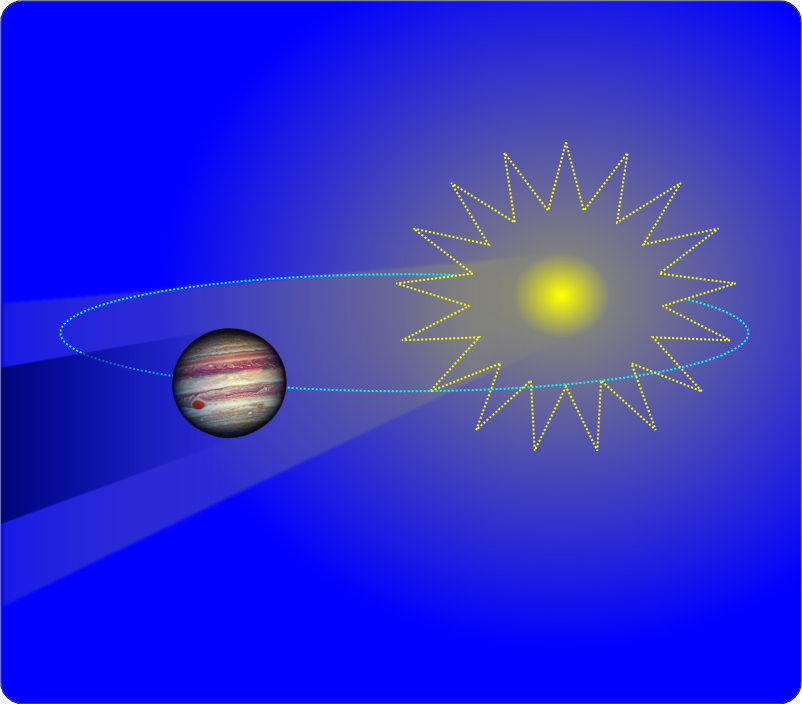
“Thank you. So, the arithmetic on the rest of the slide shows how Dr Hubble might have calculated the speed of a galaxy. But that’s steady motion. Exoplanets orbiting a star appear to speed ahead then fall behind the star, yes? We need to think about how a planet affects its star. This next slide talks about that. My example uses numbers for the Sun and Jupiter. We say Jupiter goes around the Sun, but really, they both go around their common center of gravity, their barycenter. You see how it’s calculated here — MP is the planet’s mass, MS is the star’s mass, dSP is the star-to-planet distance and dB is the distance from the star’s center to the barycenter. I’ve plugged in the numbers. The barycenter is actually ten thousand kilometers outside the Sun!”

“So you could say that our Sun counterbalances Jupiter by going in a tight circle around that point.”

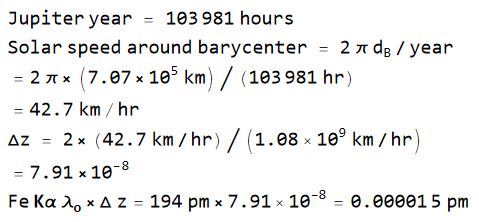
“Exactly! For my third slide I worked out whether a distant astronomer could use Doppler logic to detect Sun‑Jupiter motion. The first few lines calculate the size of the Sun’s circle and than how fast the Sun flies around it. Each Jupiter year’s blue shift to red shift totals only 79 parts per billion. The Sun’s iron K‑alpha1 wavelength varies only between 193.9980015 and 193.9979985 picometers. This is far too small a change to measure, yes?”

<dramatic pause> “I summarize. To make a good Doppler signal, a star must have a massive exoplanet that’s close enough to push its star fast around the barycenter but far enough away to pull the barycenter outside of the star.”

“Thank you, Maria.”

“X” marks the barycenter

~~ Rich Olcott

A Nightcap And Secrets

“A coffee nightcap, Sy? It’s decaf so Teena can have some.”

“Sounds good, Sis.”

“Why didn’t Mr Einstein like entanglement, Uncle Sy? Thanks, Mom. A little more cream in it, please.”

“I’ll bet it has to do with the instant-effect aspect, right, Sy?”

“Thanks, Sis, and you’re right as usual. All of Relativity theory rests on the claim that nothing, not light or gravity or causality itself, can travel faster than light in a vacuum. There’s good strong arguments and evidence to support that, but Einstein himself proved that entanglement effects aren’t constrained to lightspeed. Annoyed him no end.”

“Well, your coin story‘s very nice, but it’s just a story. Is there evidence for entanglement?”

“Oh, yes, though it was fifty years after Einstein’s entanglement paper before our technology got good enough to do the experiments. Since then a whole industry of academics and entrepreneurs has grown up to build and apply devices that generate entangled systems.”

“Systems?”

“Mm-hm. Most of the work has been done with pairs of photons, but people have entangled pairs of everything from swarms of ultra‑cold atoms to electrons trapped in small imperfect diamonds. It’s always a matter of linking the pair members through some shared binary property.”

“Binary! I know what that is. Brian has a computer toy he lets me play with. You tell it where to drive this little car and it asks for decisions like left‑right or go‑stop and they’re all yes or no and the screen shows your answer as ‘0’or ‘1’ and that’s binary, right?”

“Absolutely, Teena. The entangled thingies are always created in pairs, remember? Everything about each twin is identical except for that one property, like the two coin metals, so it’s yes, no, or some mixture. Cars can’t do mixtures because they’re too big for quantum.”

“What kinds of properties are we talking about? It’s not really gold and silver, is it?”

“No, you’re right about that, Sis. Transmutation takes way too much power. Entangled quantum states have little or no energy separation which is one reason the experiments are so hard. Photons are the easiest to work with so that’s where most of the entanglement work has been done. Typically the process splits a laser beam into two rays that have contrasting polarizations, say vertical and horizontal. Or the researchers might work with particles like electrons that you can split into right‑ and left‑handed spin. Whatever, call ’em ones and zeroes, you’ve got a bridge between quantum and computing.”

“Brian says binary can do secret codes.”

“He’s right about that. Codes are about hiding information. Entanglement is real good at hiding quantum information behind some strict rules. Rule one is, if you inspect an entangled particle, you break the entanglement.”

“Sounds reasonable. When you measure it you make it part of a big system and it’s not quantum any more.”

“Right, Sis. Rule two, an entanglement only links pairs. No triples or broadcasts. Rule three is for photons — you can have two independent ways to inspect a property, but you need to use the same way for both photons or you’ve got a 50% chance of getting a mismatch.”

“Oho! I see where the hiding comes in. Hmm… From what I’ve read, encryption’s big problem is guarding the key. I think those three rules make a good way to do that. Suppose Rocky and Bullwinkle want to protect their coded messages from Boris Badinoff. They share a series of entangled photon pairs. and they agree to a measurement protocol based on the published daily prices for a series of stocks — for each photon in a series, measure it with Method 1 if the corresponding price is an odd number, Method 2 if it’s even. Rocky measures his photon. If he measures a ‘1’ then Bullwinkle sees a ‘0’ for that photon and he knows Rocky saw a ‘1.’ Rocky encrypts his message using his measured bit string. Bullwinkle flips his bit string and decrypts.”

“Brilliant. Even if Boris knows the proper sequence of measurements, if he peeks at an entangled photon that breaks the entanglement. When Bullwinkle decodes gibberish Rocky has to build another key. Your Mom’s a very smart person, Teena.”

~ Rich Olcott