
The Acme Pizza and Science Society is back in session at Eddie’s circular table. Al won the last pot so he gets to pick the next topic. “I been reading about Jupiter’s weird moon Io.”
“How’s it any weirder than Ganymede that’s bigger than Mercury?”
”Or Europa that’s got geysers and maybe life?”
“Guys, it’s the only yellow moon in the Solar System. You can’t any weirder than that! We got lots of stony moons that are mostly gray, a few water‑ice moons that are white like snow and then there’s Io by itself covered with sulfur.”
“Yellow?”
“Mostly yellow, except where it’s red or dark brown. Or white. They’re all sulfur colors.”
“I’ve seen yellow sulfur, but red?”
“It’s like carbon can be diamond or graphite. Sulfur can be different colors depending on how hot it was when it froze. The article said the white’s probably frozen sulfur dioxide that smells like burning matches.”
“Where’d all that sulfur come from?”
“From inside Io. It’s got like 400 volcanoes that blast out sulfur and stuff. Some of it falls back and that’s why Io is yellow, but a lot gets all the way into space. The article said Io loses a tonne per second. Nothin’ else in the Solar System is that active. Or that dense, probably ’cause it blasted away all its light stuff a long time ago. Anyway, I got a theory.”
“Don’t stop there. What’s the theory?”
“Jupiter’s stripes got all those colors, right, and Sy here wrote astronomers think the brownish bands have sulfur. My theory is that Jupiter got its sulfur from Io. Whaddaya think, Sy?”
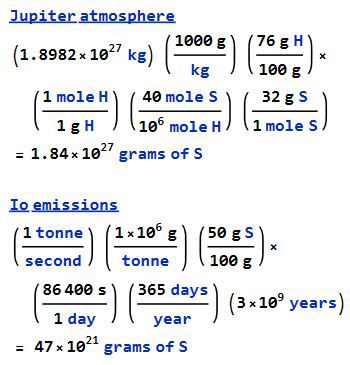
“Interesting idea.” <drawing Old Reliable from its holster> “We need numbers before we can upgrade that to a conjecture.” <screen‑tapping> “So, how much sulfur does Jupiter have, and how much could Io have supplied? … Ah, here’s a chart to get us started. Says for every million hydrogen atoms in Jupiter’s atmosphere there’s 40 sulfurs. This Wikipedia article says that the planet masses 1.898×1027 kilograms. 76% of that is hydrogen which calculates to … 1.8×1027 grams of sulfur.”
“That’s a lot of sulfur.”
“Mm-hm. Now, using your tonne per second loss rate and guessing it’s 50% sulfur and that’s been going on for ¾ of the system’s life so far, I get that Io may have shed about 5×10²² grams of sulfur. That’s short by 4½ powers of 10. Sorry, Al, Io contributed a little to Jupiter’s sulfur stash but not enough to promote your idea to a conjecture.”
Jim tosses some chips into the pot. “It’s worse than that, Sy. Galileo‘s probe fell into a clear hotspot so it sampled Jupiter’s gaseous atmosphere but it totally missed the sulfur tied up in those brown clouds. Jupiter’s got even more sulfur than your calculation shows. But there’s still an open question.”
“What’s open?”

“The inner three Galilean moons are locked into resonant orbits. Laplace explained how their separate gravitational fields continually nudge each other to stay in sync. A 1979 paper supported that explanation but then claimed that the moon‑moon nudges produced enough tidal friction within Io to power volcanoes.”
“What’s wrong with that?”
“It doesn’t tell us why Io’s the only one hot enough to boil off all its water.”
“Io had water?”
“Probably, long ago. All three share the same orbital plane and probably formed from the same disk of gas and dust. Both Europa and Ganymede are water worlds, covered by kilometers of water ice. Io should be wet or the other two would be dry by now. Something’s different with Io and it’s not inter‑moon gravitation.”
“Why not?”
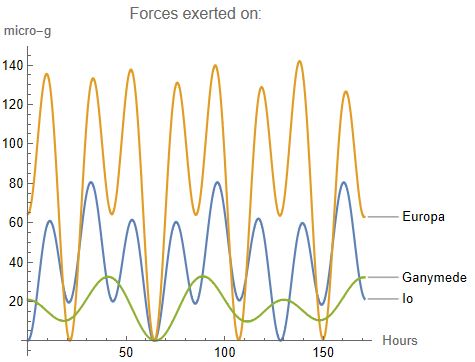
“Numbers. Those moon‑moon interactions are measured in microgravities. Such light impulses can synchronize effectively if repeated often enough, but these just aren’t energetic enough to boil a moon. Besides, Europa stays cool even though it feels a lot more action than Io does.”
“You got a theory?”
“A hypothesis. I’m betting on magnetism. Io’s deep in Jupiter’s lumpy magnetic field which must generate eddy currents in Io’s mostly iron core. I think Io heats up like a pot on an induction stove.”

~~ Rich Olcott
 Hard Science Ain't Hard
