“I think I understand why we have eclipse seasons, Dr O’Meara, but why do the two eclipses in a season travel in such different directions?”
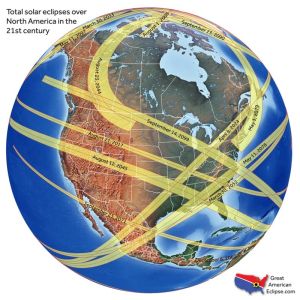
“Put this question on top of Teena’s, Cathleen. Everyone knows the Sun rises in the East because the Earth rotates towards the East. But it seems like eclipses fly eastward even faster than the Earth turns. If that’s true, why?”
“As an Astronomy educator, Sy, I wish ‘everyone’ were truly everyone. You wouldn’t believe the arguments I get from some students when I’m trying to teach 21st Century material. Why are they even in my class?”
“We can only wonder. You and the Flatties, Kareem and the 6000‑year Earthers, poor Jennifer over in Public Health having to cope with the anti‑vaxxers; these contrarians seem to be everywhere. They’re excellent models of Orwellian doublethink — they happily use their science‑dependent smart phones, internet and GPS while they’re trashing Science. Split brains? I dunno.”
“C’mon, Uncle Sy, that’s boring grown‑up stuff. What about my eclipses? Why do they go north or south like that? Does it have to do with those angles that were drawn too big?”
“Sorry, sweetie. Dr O’Meara showed us that the Moon can only make an eclipse if it’s near the Solar System’s plane where Earth’s center stays. The angle of the Moon’s orbital plane only matters when the Moon is away from there.”
“Earth’s center is the Equator! All the eclipses should go on the Equator. But they don’t. That’s wrong.”
“The Equator’s around Earth’s center, Teena, but so are other circles. Think of your globe at home. Does the North Pole point straight up?”
“Noo‑oh … you mean the tilt? Mom said that was about Winter and Summer.”
“Well, she’s not wrong. In the northern hemisphere we have Summer when the North Pole tilts toward the Sun, Winter when it tilts away. That’s only part of the story, though. In Spring and Fall the tilt is broadside to the Sun. Not as hot as Summertime, not as cold as Winter. Those three gyroscopes give us eclipse seasons. But they do more. Look at these diagrams.”

“Sorry, I don’t understand what you’re showing me.”
“No worries. In the upper one, the Earth’s in the rear. The North Pole is the green arrow. The Equator’s the yellow band. Pole and Equator are both tilted 23°. The Sun is in front, shining at the Earth. The Earth orbits the Sun counterclockwise so it’s moving to our left. Moving in that direction gives the northern hemisphere more and more daylight so it’s northern Springtime going towards Summer. Okay?”
“Yyyes….”
“Good. The sketch shows eclipse conditions, when the Moon and its shadow are in Earth’s orbital plane. The only places on Earth that can see the eclipse are on the red band. That’s another circle where the plane intersects the Earth’s surface. What direction does that band point on Earth?”
<chortle> “It goes northeast, just like I noticed on that map! Okay, let me think about the other picture… The North Pole’s a gyroscope and doesn’t change direction so we’re looking at us from the other side … Yeah! That red band goes southeast on Earth. Perfect! … Umm, everything’s upside‑down for Bindi in Australia, so does she … Wait, in the upper picture when it’s Springtime for us it’s Autumn for her so her Autumn eclipses go northeast, just like our Springtime ones do! And her Spring’s the bottom picture and her Springtime eclipses go southeast like our Autumn ones, right?”

“Smart girl! I’m going to tell your Mom about your thinking and she’ll be so proud of you. Now, Cathleen, how about speedy eclipses going east faster than the Earth does?”
“It’s not the eclipse going fast, Sy, it’s the Moon. Relative to the Sun‑Earth line, the Moon in its orbit is traveling eastward at just under 3700 kilometers per hour. Meanwhile, a point on Earth’s Equator is heading in the same direction at just under 1700 kph. Places away from the Equator move even slower. The Moon and its shadow win the race going away.”
~~ Rich Olcott
- Thanks again to Naomi Pequette for her expertise and eclipse‑related internet links.
 Hard Science Ain't Hard