The Road to Gold

Cathleen and Susan share a look.
 ”A conclusion way too far, Kareem.”
  ”Yep, you’ve overbounded your steps.”

Kareem tosses in a couple of chips. “Huh? What did I skip over? Where?”

Cathleen sees his bet and raises. “When you said that the Psyche asteroid’s gold content would be similar to what we dig up on Earth, you skipped many orders of magnitude in applying the Cosmological Principle.”

“I didn’t realize I’d done that. What’s the Cosmological Principle?”

“There’s several ways to state it, but they boil down to, ‘We’re not special in the Universe.‘ We think that fundamental constants and physical laws determined here on Earth have the same values and work the same way everywhere. Astrophysics just wouldn’t work as well as it does if the electron charge or Newton’s Laws of Motion were different a million lightyears away from us.”

“Wait, what about that galaxy that’s going to collide with us even though everything’s supposed to be flying away?”

“Fair question. The un‑boiled Principle includes some qualification clauses, especially the one that says, ‘when averaged over a large enough volume.’ How big a volume depends on what you’re studying. For motions of galaxies and such you have to average over a couple hundred million lightyears. Physical constants measured locally seem to be good out to the edge of the Observable Universe. Elemental abundances are somewhere in‑between — the very oldest, farthest‑away galaxies have less of the heavy stuff than we do around here. <pulls her tablet from her purse> Which brings me to this chart I built for one of my classes.”

“You’re going to have to explain that.”

“Sure. Both graphs are about element abundance. We get the numbers from stellar and galactic spectra so we’re averaging the local Universe out to a few hundred thousand lightyears. Left‑to‑right we’ve got hydrogen, helium, lithium and so on out to uranium in the big graph, out to iron in the small one. Up‑and‑down we’ve got atom count for each element, divided by the number of iron atoms so iron scores at 1.0. The range is huge, 31 000 hydrogens per single iron atom, all the way down to 17 rhenium atoms per billion irons. I needed this logarithmic scale to make the points I wanted to make in class.”

Vinnie sweetens the pot. “You’ve got that nice zig‑zag going in the little graph, Cathleen, but things get weird around iron and the big graph has that near‑constant series starting around 60. Why the differences?”

<lays down Q‑J‑10‑9‑8, all hearts, pulls in the chips> “Perfect straight line, Vinnie. The different behaviors come from nuclear cookery at different stages of a star’s life. Most new‑born stars start by fusing hydrogen nuclei, protons, to produce helium nuclei, alpha particles. Those two swamp everything else. As the star evolves to higher temperatures, proton‑addition processes generate successively more massive nuclei. Carbon starts a new pattern, because alpha‑addition processes it initiates generate the sawtooth pattern you picked up on — an alpha has two protons so each alpha fusion contributes to the atomic number peak two units along the line.”

“What happens with iron?”

“What happens when you put a blow torch to a red‑hot metal ball?”

“The ball melts.”

“Why?”

“Cause the extra energy’s too much for what holds the ball together.”

“Well, there you go. The forces that hold an atomic nucleus together have their limits, too. Iron and its next‑but‑one neighbor nickel are right on the edge of stability for alpha reactions. The alpha process in the core of a normal star can’t make anything heavier.”

“So how do we get the heavy guys?”

“Novas, supernovas and beyond. Those events are so energetic and so chaotic there’s non‑zero probability for any kind of atom to form and evolve to something stable before it can break down. Massive atoms just have a lower probability so there’s less of them when things settle down. Gold, for instance, at only 330 atoms per billion atoms of iron. The explosions spray heavy atoms throughout their neighborhood.”

Kareem antes the next pot. “So you’re saying my mistake was to assume that asteroid Psyche’s composition would match whole‑Universe heavy‑element statistics?”

“Well, that was his first mistake, right, Susan?”

~~ Rich Olcott

GOLD! GOLD! GOLD! Not.

“Ya think there’s water on the Psyche asteroid, Kareem?”

“No more than a smidgeon, Cal.”

“Why so little? They’ve found hundreds of tons of it on the Moon.”

“Wait, water found on the moon? I’d heard about the Chinese rover finding sulfur but I didn’t think anybody’s gotten into a shadowy area that may be icy because sunlight never heats it.”

“Catch up, Eddie. We’ve known about hydrogen on the Moon since the Lunar Reconnaissance Orbiter almost 15 years ago. We just weren’t sure any of it was water‑ice. Could be hydroxyls coating the outside of oxide and silicate moon rocks, or water of crystallization locked into mineral structures.”

“That’s the kind of caveat I’d expect from a chemist, Susan, throwing chemical complexity into the mess.”

“Well, sure, Sy. Silicate chemistry is a mess. Nature rarely gives us neat lab‑purified materials. The silicon‑oxygen lattice in a silicate can host almost any combination of interstitial metal ions. On top of that, the solar wind showers the Moon with atomic and ionic hydrogens eager to bond with surface oxygens and maybe even migrate further into the bulk. The Apollo astronauts found plagioclase rocks, right? That name covers a whole range of aluminum‑silicate compositions from calcium‑rich like we find in meteorites to sodium‑rich that are common in Earth rocks. The astronauts’ rocks were dry, dry, dry, but that collecting was done where the missions landed, near the Moon’s equator. What’s got the geologists all excited is satellite data from around the Moon’s south pole. The spectra suggest actual water molecules at or just below the surface there. Lots of water.”

“Mm-hm, me and a lot of other Earth‑historians would love to compare that water’s isotopic break‑out against Earth and the asteroids and comets.”

“Understood, Kareem. but why so down on Psyche having water?”

“Two arguments. Attenuation, for one. Psyche is 2½ times farther from the Sun than the Earth‑Moon system. Per unit area at the target, stuff coming out of the Sun thins out as the square of the distance. The solar wind near Psyche is at least 85% weaker than what the Moon gets. If Psyche’s built up any watery skin it’s much thinner than the Moon’s. And that’s assuming that they’re both covered with the same kind of rocks.”

“The other argument?”

“Depends on Psyche’s density which we’re still zeroing in on.”

“This magazine article says it’s denser than iron. That’s why they’re shouting ‘GOLD! GOLD! GOLD!‘ like Discworld Dwarfs, ’cause gold is heavier than iron.”

“Shouldn’t that be ‘dwarves‘?”

“Not according to Terry Pratchett. He ought to know ’cause he wrote the books about them.”

“True. So’s saying gold and a lot of the other precious metals are much denser than iron. Unfortunately, it now looks like Psyche isn’t. An object’s density is its mass divided by its volume. You measure an asteroid’s mass by how it affects the orbits of nearby asteroids. That’s hard to do when asteroids average as far apart as the Moon and the Earth. Early mass estimates were as much as three times too big. Also, Psyche’s potato‑shaped. Early size studies just happened to have worked from images taken when the asteroid was end‑on to us. Those estimates had the volume too small. Divide too‑big by too‑small you get too‑big squared.”

“So we still don’t know the density.”

“As I said, we’re zeroing in. Overall Psyche seems to be a bit denser than your average stony meteorite but nowhere near as dense as iron, let alone gold or platinum. We’re only going to get a good density value when our spacecraft of known mass orbits Psyche at close range.”

“No gold?”

“I wouldn’t say none. Probably about the same gold/iron ratio that we have here on Earth where you have to process tonnes of ore to recover grams of gold. Your best hope as an astro‑prospector is that Psyche’s made of solid metal, but in the form of a rubble‑pile like we found Ryugu and Bennu to be. That would bring the average density down to the observed range. It’d also let you mine the asteroid chunk‑wise. Oh, one other problem…”

“What’s that?”

“Transportation costs.”

Adapted from a NASA illustration
Credit: NASA/JPL-Caltech/ASU

~~ Rich Olcott

Comets, Asteroids And Water

“So what about the article, Cal?”

“What article?”

“The article about NASA’s Psyche mission to Psyche, the article in the magazine that you came in here ranting about. What did it say?”

“Not much, actually. It was mostly gee‑whizzery about how the Psyche asteroid is solid metal and probably worth trillions because of its gold and stuff. It’s a new mag, probably desperate for eyeball grabbers so I’m not making bets on it but is any of that possible?”

Kareem, our geologist, takes the bait. “You guys know I specialize in old rocks because they tell us Earth’s early geochemistry. I want to identify when in our history liquid water gave life a chance to start up. That’s why I keep up with asteroid news. Asteroids are the oldest rocks around, far older than what we’ve been able to dig up from the ancient cratons in Canada and Australia. Cratonic rocks max out at around 4 billion years but asteroids and Earth as a planet go back a half‑billion years more. We’ve learned a lot from asteroid‑sourced meteorites, but they’re just a tease. The cooking they get on their way through the atmosphere can burn out part of any water they had. That’s why I followed the Hayabusa2 and OSIRIS‑REx missions so closely — they brought us fresh samples from asteroids that should date back to the Solar System’s birth.”

“How about comets, Kareem? They’re ice‑balls. Those gorgeous tails they spout when they warm up, they’re all water and CO2 and like that. Earth coulda got our water from comets.”

“Good point, Al — sorry, I mean Cal — except for two things. First, asteroids are a lot closer to Earth than comets. The densest part of the asteroid belt courses twice as wide as Earth’s orbit, about a hundred million miles outward from us. Short‑period comets generally drop in from the Kuiper Belt, which is about fifteen times wider. Long‑period comets hang out a thousand times farther out.”

“Yeah, but they do head in our direction every so often and a billion years is a long time. What’s your second thing?”

“Isotopes. You know about light hydrogen and heavy hydrogen, right? They’re both hydrogen, one proton and one electron, but the heavy kind carries a neutron along with the proton in its nucleus. Their chemistry is the same unless speed is a factor. At any given temperature, the lighter atom moves about 40% faster than its heavier cousin. Water molecules containing only light hydrogens evaporate faster than their heavier neighbors because the speedy atoms are primed to rip their molecule loose from the surrounding liquid or ice.”

“Wait, water evaporates from ice?”

“Mm-hm, except technically it’s called sublimation when ice is involved. That was a crucial process in the Solar System’s history. Five billion years ago we were this big disk of gas and dust. When the Sun finally got dense enough to light up, its radiated heat energy baked volatile components like water and such out of the metals and silicates in the rocky inner system. That’s why Earth had to import our water once we cooled off. Volatility is relative, of course. Eventually the volatiles condensed back to solid form in the ice belts near and beyond Uranus and Neptune. That’s your cometary ice balls.”

“But now you’re gonna say that ancient ice evap–, sublimated, too.”

“Sure. It’s a continual process. Sometimes a released molecule docks back on again, but mostly not. Anyhow, the light water molecules happily bounced off into the Universe whenever they could. The heavy ones stayed put. Cometary ice gradually became roughly twice as heavy‑enriched as the rest of the Solar System including us.”

“So when you look at Earth water…”

“It can’t have come from comets which is why we’re looking at asteroids.”

“Ah, but does asteroid water match Earth’s?”

“Mostly, Sy. We’ve found a few meteorites with a high heavy‑hydrogen content, but so few that they’d be <ahem> swamped by the water from all the other meteorites. Most meteorite isotopes match what we have on Earth. You’re drinking asteroid water.”

Comet Hale-Bopp Credit: E. Kolmhofer, H. Raab; Johannes-Kepler-Observatory, Linz, Austria, CC BY-SA 3.0, Wikimedia Commons
Asteroid Bennu Credit: NASA/Goddard/University of Arizona

~~ Rich Olcott

The Name’s Not The Same

The regular Thursday night meeting of the Acme Pizza and Science Society around the big circular table at Pizza Eddie’s. Al comes in, hair afire and ready to bite the heads off tenpenny nails. “This is the last straw!” <flings down yet another astronomy magazine>. “Look at this!”

I pick up the issue. “Looks like the lead article’s about the Psyche mission to the Psyche asteroid. You got a problem with that?”

“Nah, that’s just fine, exciting even. Look at the address label.”

“Ah, I see your objection. Instead of your first name it says ‘A. I.’ like those are your initials. Are they?”

“No. Never had a middle initial until the Navy gave me ‘N‘ for ‘No middle initial‘ and I dropped that soon as I got out.”

“So where’d they get the ‘I’?”

“That’s what chafes my cheeks, Vinnie, people messing with my name. All this stuff going on these days about Artificial Intelligence which everybody calls ‘AI’ which looks too flippin’ much like Al. People have been ribbing me about it since ChatGPT hit the street. They come in here asking me for virtual coffee or wanting to know about my ALgorithms. One guy claimed I parked a driverless coffee machine back of the kitchen. But it’s not just jokes. I get calls asking for programming help with languages I never heard of. My checks have my name as Al but the bank lady gives me grief because I don’t sign them with A. I.”

“You’ve got a good point there. When someone chooses a name, that name’s important to them. I know whole families where everyone has a ‘go‑by‘ name. First class I ever taught, I opened by calling the role so I could tie names to faces. I started out calling out first names but quickly learned that most of the men and half the women went by middle names — this was in the South where that’s common but still. Anyway, I called first and middle names until I got to this one kid. He’d gone through three years of college going by ‘C-M’ until I blew his cover by asking which student was named Clyde and it was him. I don’t think he ever forgave me.”

“I know the feeling, Cathleen. None of the teachers could handle my full name. This magazine’s stupid spell‑checker musta corrected me wrong. I want a new name that doesn’t get messed up.”

“Al’s not your full name?”

“No, it’s Aloysius which I don’t like. No-one can spell it, or say it right if they see it written out. I got named after my Mom’s favorite uncle before I could vote against it. I’ve been going by Al ever since I knew better.”

“We need to figure you a new name that looks different but sounds almost the same so you’ll recognize it when we holler at you, right?”

“That’s about it, Vinnie. Whaddaya got?”

“A negative to begin with. We can rule out Hal, the killer computer in the 2001 movie. Don’t want to see our physicist here walk up for a strawberry scone and get ‘I’m afraid I can’t do that, Sy.’ Haw!”

“How about Sal?”

Eddie waves it away. “My Uncle Salvatore’s already got that. One’s enough.”

I read off Old Reliable’s screen. “Baal was a god worshipped by some of the Old Testament enemy tribes, eventually turned into Beelzebub. That won’t do. And ‘mal‘ means ‘bad‘ in Spanish.”

Resident chemist Susan giggles. “I don’t suppose you’d be happy if I greeted you with a cheery, ‘Hey, Gal‘. Oh, wait, I’ve got a Chemistry thing for us. ‘Cal‘ is the standard abbreviation for ‘calorie,’ one of the old‑time measures of heat energy before everybody settled on the joule. What do you think of ‘Cal‘? Hot and cool and rugged enough for you?”

“Hmm… I like it. ‘Cal’s Coffee‘ even has that market‑winner k’‑kuh sound like Krispy Kreme and Captain Crunch and Crispy Critters. It’s official — from now on, Cal is my official go‑by name. Thanks, Susan.”

She grins. “First time I’ve named an adult. Hi, Cal.”
 ”Hi, Cal.”
  ”Hi, Cal.”
   ”Hi, Cal. Now about that magazine article…”

Adapted from a photo by Edward Eyer

~~ Rich Olcott

Eclipse Correction

From: Robin Feder <rjfeder@fortleenj.com>
To: Sy Moire <sy@moirestudies.com>
Subj: Bad diagram

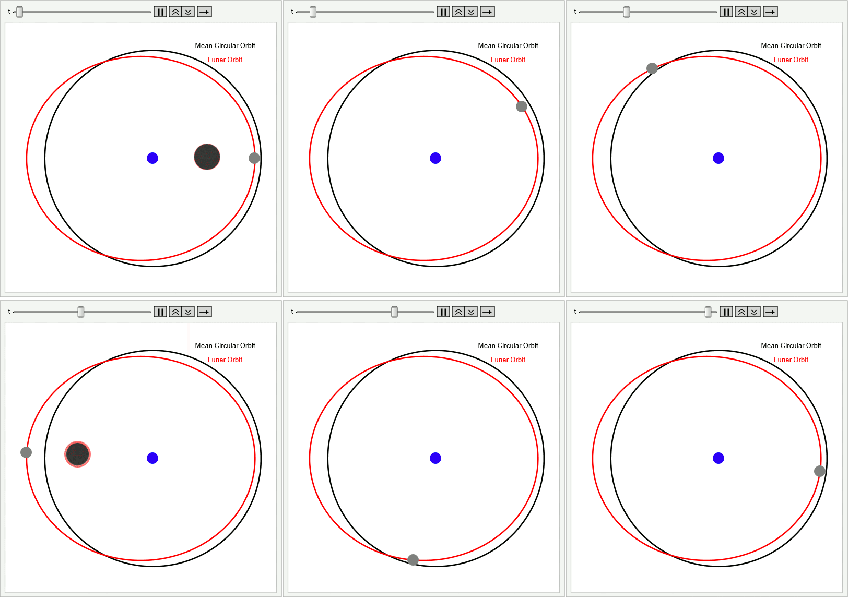
My Dad said I should write you about the bad video that is in your “Elliptically Speaking” post. It shows a circle around a blue dot that’s supposed to be the Earth, and an oval shape that’s supposed to be the Moon’s orbit around the Earth, and blinking thingies that are supposed to show what eclipses look like. I took a screen shot of the video to show you. But the diagram is all wrong because it has two places where the Moon is far away from the Earth and two places where the Moon is closer and that’s wrong. All the orbit pictures I can find in my class books show there’s only one of each. Please fix this. Sincerely, Robin Feder


From: Sy Moire <sy@moirestudies.com>
To: Robin Feder <rjfeder@fortleenj.com>
Subj: Bad Diagram

You’re absolutely correct. That’s a terrible graphic and I’ll have to apologize to Cathleen, Teena and all my readers. Thanks for drawing my attention to my mistake. When I built that animation I was thinking too much about squashed circles and not enough about orbits. I’ve revised the animation, moving the Earth and its circle sideways a bit. Strictly speaking, Earth and the Moon both orbit around their common center of gravity. Also, the COG should be at one focus of an ellipse. An ellipse has two foci located on either side of the figure’s center. However, both of those corrections for the Earth‑Moon system are so small at this scale that you wouldn’t be able to see them. I drew my oval (not a true ellipse) out of scale to make the effect more visible.

Moving the oval so that there’s only one close place and one far place (astronomers call them perigee and apogee) meant that I also had to move the blinking eclipse markers. I think the new locations do a better job of showing why we have both annular and total eclipses. You just have to imagine the Sun being beyond the Moon in each special location so that the eclipse shadow meets the Earth.

I’ve swapped out the bad diagram on the website. Here’s a screenshot of the better diagram I’ve put in its place.

Please remember to use proper eclipse-viewing eyewear when you look at this October’s annular eclipse. And give my regards to your Dad.

~~ Rich Olcott

  • Thanks to Ric Werme for gently pointing out my bogus graphic.

Elliptically Speaking

“Oh. I have one other eclipse question, Dr O’Brien.”

“What’s that, Teena?”

“Well, I found a list of solar eclipses—”

“An interesting place to start, especially for a 10‑year‑old.”

“And it had three kinds of eclipse — total, partial and annual. ‘Total‘ must be when the Moon covers up the whole Sun like when I wink my eye tight. ‘Partial‘ sounds like when I only squinch up my eye like this. I guess that happens when we’re just on the edge of an eclipse track so we still see part of the Sun like we see just part of the Moon most of the time. But my eye wide open is like there’s no eclipse at all. There’s no fourth way to hold my eye left over for ‘annual.’ Besides, ‘annual‘ means ‘every year.’ Is there some special kind of eclipse that comes every year but we don’t see it?”

Cathleen doesn’t quite hide a smile. “Sorry, dear, I think you’ve misread a word. It’s not ‘annual,’ it’s ‘annular.’ They’re very similar and they both came from Latin but they came from different Latin words and have different meanings today. ‘Annual‘ means ‘yearly,’ just as you said. ‘Annular‘ means ‘ring‑shaped‘, like a circle with a hole in the middle.”

“A ring‑shaped eclipse? Is there a big hole in the Moon we only see sometimes?”

“Quite the reverse. The Moon and its shadow are compact, no holes even in an annular eclipse. What we see in those eclipses is a ring of the Sun’s light around the outside of a black disk of Moon‑shadow. The bright ring is called an ‘annulus‘ and you must be very careful to use the special dark glasses to look at it.”

“But … Uncle Sy said the reason we’re so lucky we can see eclipses is that the Moon is just the right size to match the size of the Sun. Does the Moon get smaller for an annular eclipse?”

“Hold up your thumb. Now move your arm out until your thumb just covers my head. Can’t see me at all, can you? Now move your arm out just a little farther until you can see my hair but not my face. Got it? Your thumb didn’t change size, did it?”

“No, it just looked smaller and I could see more of you past it.”

“Right. That’s how an annular eclipse works.”

<drawing Old Reliable from its holster> “Excuse me, Cathleen, I think this might help.”

“What are all those circles, Uncle Sy, and why does it blink?”

“It’s like a map of space. The blue disk represents Earth and the gray disk represents the Moon. If the Moon were always the same distance from Earth it’d follow the black circle, but it doesn’t. It follows the red line which isn’t a true circle. It’s a special shape of squashed circle, called an ellipse. Very few moons or planets follow a truly circular orbit — their track is almost always elliptical to some degree. Now you tell me what the blinky things are about and don’t say it’s when the Moon stops in its orbit because it doesn’t. The animation motion pauses to call attention to when the eclipses happen.”

“Okayyy… Oh! They’re what we’d see in an eclipse, right? The red … ellipse?… brings the Moon closer to us or farther away. When it’s close like over there it’s like my thumb covering Dr O’Brien’s whole head and we don’t see any of the Sun and that’s a total eclipse, right? When we have an eclipse if the Moon’s outside of that circle like on the side, it’s like my thumb farther away and that’s why your picture has the orange ring, it’s an annulus, right?”

“You broke the code, Teena, Well done!”

“I think it’s silly to have two words like eclipse and ellipse that sound so much alike but they’re so different. Like annual and annulus.”

“Sorry about that, sweetie, but we pretty much have to take the language as we find it. English has a long and complicated history. Sometimes I’m surprised it works at all. Sometimes it doesn’t and that makes problems.”

~~ Rich Olcott