
“Oh. I have one other eclipse question, Dr O’Brien.”
“What’s that, Teena?”
“Well, I found a list of solar eclipses—”
“An interesting place to start, especially for a 10‑year‑old.”
“And it had three kinds of eclipse — total, partial and annual. ‘Total‘ must be when the Moon covers up the whole Sun like when I wink my eye tight. ‘Partial‘ sounds like when I only squinch up my eye like this. I guess that happens when we’re just on the edge of an eclipse track so we still see part of the Sun like we see just part of the Moon most of the time. But my eye wide open is like there’s no eclipse at all. There’s no fourth way to hold my eye left over for ‘annual.’ Besides, ‘annual‘ means ‘every year.’ Is there some special kind of eclipse that comes every year but we don’t see it?”
Cathleen doesn’t quite hide a smile. “Sorry, dear, I think you’ve misread a word. It’s not ‘annual,’ it’s ‘annular.’ They’re very similar and they both came from Latin but they came from different Latin words and have different meanings today. ‘Annual‘ means ‘yearly,’ just as you said. ‘Annular‘ means ‘ring‑shaped‘, like a circle with a hole in the middle.”
“A ring‑shaped eclipse? Is there a big hole in the Moon we only see sometimes?”
“Quite the reverse. The Moon and its shadow are compact, no holes even in an annular eclipse. What we see in those eclipses is a ring of the Sun’s light around the outside of a black disk of Moon‑shadow. The bright ring is called an ‘annulus‘ and you must be very careful to use the special dark glasses to look at it.”
“But … Uncle Sy said the reason we’re so lucky we can see eclipses is that the Moon is just the right size to match the size of the Sun. Does the Moon get smaller for an annular eclipse?”
“Hold up your thumb. Now move your arm out until your thumb just covers my head. Can’t see me at all, can you? Now move your arm out just a little farther until you can see my hair but not my face. Got it? Your thumb didn’t change size, did it?”
“No, it just looked smaller and I could see more of you past it.”
“Right. That’s how an annular eclipse works.”
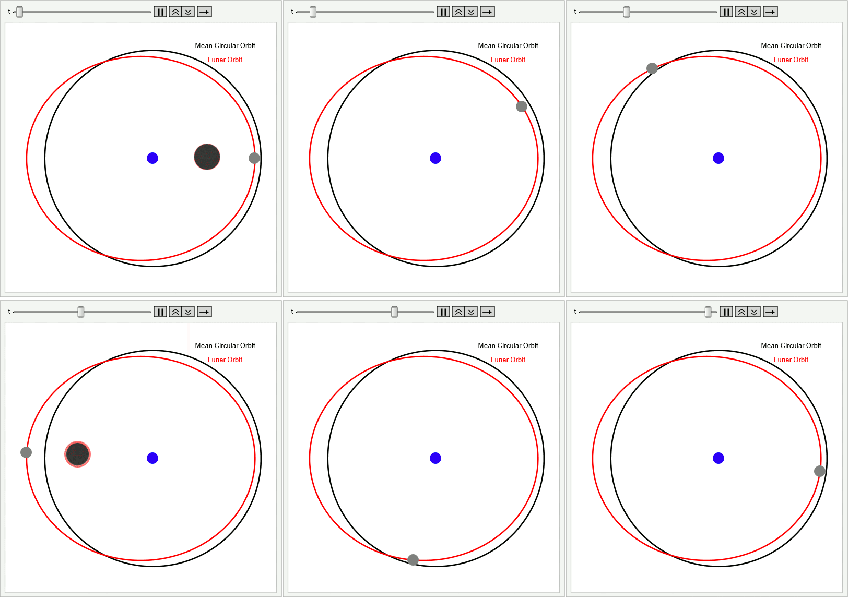
<drawing Old Reliable from its holster> “Excuse me, Cathleen, I think this might help.”
“What are all those circles, Uncle Sy, and why does it blink?”
“It’s like a map of space. The blue disk represents Earth and the gray disk represents the Moon. If the Moon were always the same distance from Earth it’d follow the black circle, but it doesn’t. It follows the red line which isn’t a true circle. It’s a special shape of squashed circle, called an ellipse. Very few moons or planets follow a truly circular orbit — their track is almost always elliptical to some degree. Now you tell me what the blinky things are about and don’t say it’s when the Moon stops in its orbit because it doesn’t. The animation motion pauses to call attention to when the eclipses happen.”
“Okayyy… Oh! They’re what we’d see in an eclipse, right? The red … ellipse?… brings the Moon closer to us or farther away. When it’s close like over there it’s like my thumb covering Dr O’Brien’s whole head and we don’t see any of the Sun and that’s a total eclipse, right? When we have an eclipse if the Moon’s outside of that circle like on the side, it’s like my thumb farther away and that’s why your picture has the orange ring, it’s an annulus, right?”
“You broke the code, Teena, Well done!”
“I think it’s silly to have two words like eclipse and ellipse that sound so much alike but they’re so different. Like annual and annulus.”
“Sorry about that, sweetie, but we pretty much have to take the language as we find it. English has a long and complicated history. Sometimes I’m surprised it works at all. Sometimes it doesn’t and that makes problems.”
~~ Rich Olcott
 Hard Science Ain't Hard
Your animation of the lunar orbit has a major flaw. It shows two perigees and apogees per orbit, there’s only one of each in real life. The Earth (actually the Earth-Luna barycenter) is at one focus of the elliptical orbit so the animation should have that ellipse shifted to one side with the perigee inside the circular orbit and the apogee outside.
The eccentricity of the ellipse is hard to see on a graph, so there aren’t good references on the web, but https://en.wikipedia.org/wiki/Orbit_of_the_Moon#Path_of_Earth_and_Moon_around_Sun tries pretty well.
LikeLike
Good catch, Ric, thanks. I spent too much time thinking “squashed circle” and not enough thinking “orbital dynamics.” I’ve revised the animation. The new version is more correct (though it’s still way out of scale) and supports a better intuition of what’s going on. I think.
LikeLike