Mea Culpa, Sorta

<breaking through the fourth wall> I, the author of this blog, stand before you both proud and abashed. There may be a word for that combination, just as “pareidolia” is the word for our tendency to see faces in inanimate objects.

Credit: NASA

This particular episode of “proud but abashed” began with an attack of pareidolia when I saw this Perseverence photo (→) that NASA retrieved from Mars.

Look closely at the large rock just to the right of center. See those two closed smiley eyes above chubby cheeks that look like they’re mashed into a pillow? I did, too, and now I can’t unsee them. Not to mention the belly button closer to us but that’s another story. Naturally, the mental image reminded me of the “rock monster” CGI effect (see photo below but it’s better in animation) in the Galaxy Quest movie (a knowing and funny parody of Star Trek; watch it if you haven’t already seen it and besides, Missy Pyle was adorable as Laliari).

Just a little later I saw yet another of those click‑bait “They don’t want you to see…” memes. That completed the circuit for a conceptual spark. As often happens, mischief ensued. It took just a few minutes of work with my digital graphics toolkit to produce this cartoon that I meant to be satirical —

I posted it in a few places. What was interesting was what happened next.

First and best, of course, was that a lot of folks recognized it as a joke. Many flagged it with a Like or HaHa and I’m sure many more just smiled (or not) and scrolled on and that’s okay.

One person wrote (I think he was kidding) “Bird poop.” There were several mentions (I think they were kidding) of “Men In Black” and “Pokémon.”

Then there are the people who took the altered image as faithful reportage and looked for explanations — “it’s a chance reflection off the robot’s metal skin” or “the Sun must have moved and illuminated an area that had been shadowed.” One responder expressed surprise and indignation that NASA would allow distribution (though the cartoon’s header says they hadn’t) of material that could incite panic. They were quite earnest about that.

It’s not the first time I’ve posted a graphic that didn’t get the reception I’d expected. There’s this pie chart (→) that compares readings for the same temperature according to different scales. (Rankine is Fahrenheit-sized degrees counting up from absolute zero. Rømer‘s, the first transferrable temperature scale, ran from zero at the freezing point of brine, up to 60 at the boiling point of water. No-one uses it any more.)

Yeah, I know the chart makes no sense, which is why I thought it was funny. I was sharply criticized for abusing the software. The carpers would start with something like, “A pie chart is supposed to demonstrate the relationship between the whole and a portion of it,” and go on from there. They were quite earnest about that.

Hey, numbers are abstractions. Why have them if we can’t chart them any way we feel like?

Other people assert numeric freedom, so I’m not alone in this. Someone in New Cuyama, California got creative and put up this sign (→). The arithmetic is good, I checked, but I wish they’d used a monospace font to put the numbers in proper columns. Anyway, the sign’s layout naturally led me to create the pie chart you see beneath it.

So — proud to have given some people a smile, but also abashed. Oh, well.

~~ Rich Olcott
Map-ematics

Big Vinnie lumbers into my office, a grin on his face and a sheaf of papers in his hand. “Sy, you gotta see these, you’ll love ’em.”

Vinnie and I go way back, so I string him along a little. “New clients, I suppose? Wealthy ones, with interesting problems?”

“Nah, just goofiness. Me and Larry, don’t think you’ve met him yet, were having pizza in Eddie’s place. Larry’d brought his laptop and we got to playing with some map software he just bought. You ever hear of a GIS?”

“Geographic Information Systems? Sure, they go back a century and a half to the guy who mapped cholera cases in London and traced the source back to a contaminated water pump. You use a GIS to produce mapped visualizations of useful geographically‑distributed statistics.”

“Yeah, that, except we weren’t going for anything useful. Here’s the first one we did. We had a list of states alphabetical‑like. There’s whole blocks that start with the same letter, like eight that start with ‘M.’ We told the mapper to put a different color on any three or more that share a letter. Silly, huh?”

“Mm-hm. I don’t see any pattern to it.”

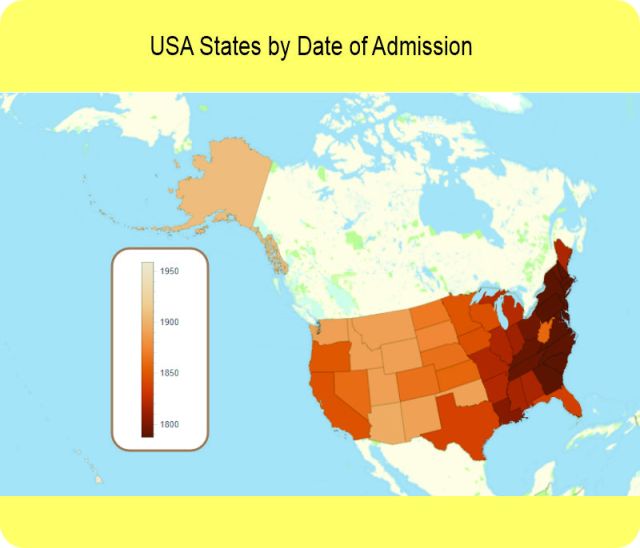
“Right. We didn’t, either, so we went on to build a second map where each state’s colored by the date it entered the Union. We tried a bunch of different color schemes, finally settled on this one.”

“Nice. You can almost see the country growing year‑to‑year. … Ah, Hawai’i’s in there, too, tucked away in the southwest corner. It’s color’s so pale you have to look for it. West Virginia — let me guess, right around 1860 or so, right?”

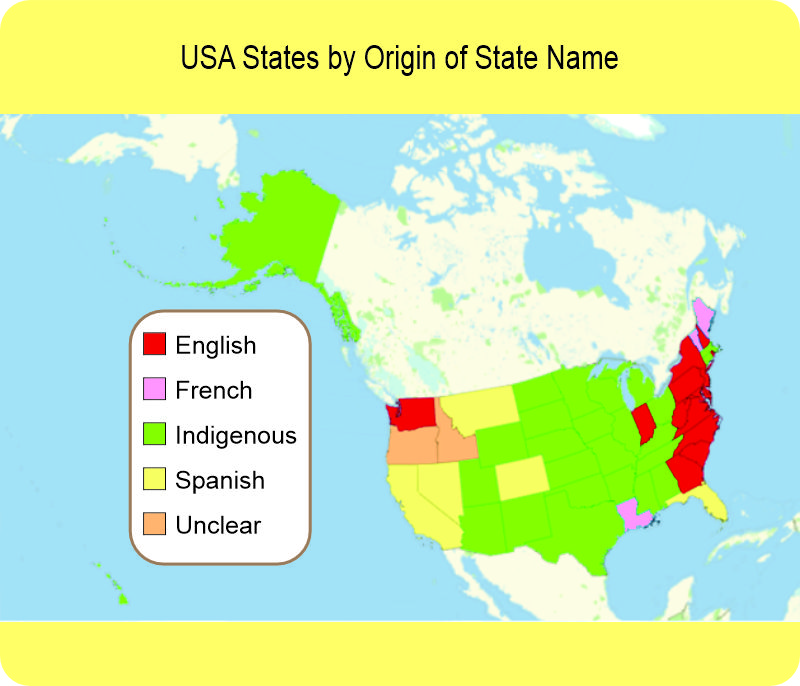
“1863. Those folks rebelled against the Southern rebellion. Anyway, Jeremy was kinda looking over our shoulder and this map lit a fire for him. You know he’s doing an Indigenous History project with Professor Begaye. He ran off and brought back a list of where each state’s name came from. We coded that up, fed it to the program and this came out.”

“Wow. The Europeans pretty much claimed the coasts but look at all the green. It’s like the states acknowledged they were built on Native land. Indiana comes right out and admits it.”

“Yup. Jeremy said it was pretty poor compensation. I understand how he feels.”

“So, did you map anything more than the USA?”

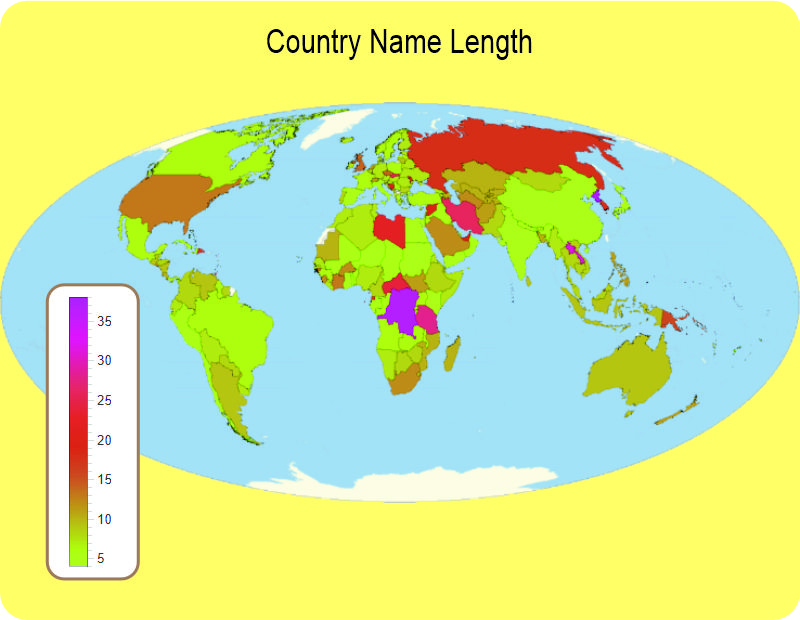
“Of course. Larry wanted more silly so we went with the number of letters in each country’s name.”

“I don’t understand this one. Peru’s green for its short name, naturally, and so are Chad and Cuba, but why are Iran and Iraq different colors? Russia’s name isn’t longer than Saudi Arabia and Madagascar. How can five‑letter Congo be purple for a really long name? Doesn’t make sense.”

“Our name list came from the International Standards Organization. Larry and me, we’re both international charter pilots. We’re often checking ISO files for radio frequencies, airport codes and the like. According to ISO, Iraq is ‘IRAQ‘, but Iran is ‘IRAN (ISLAMIC REPUBLIC OF).’ Russia is ‘RUSSIAN FEDERATION‘ which is longer than the other two. The USA would be redder if it was ‘UNITED STATES OF AMERICA,’ but it’s ‘UNITED STATES‘ and tied with ‘LIECHTENSTEIN‘ and ‘GUINEA‑BISSAU‘ at 13 characters so it’s brown.”

“And Congo?”

“The ISO name is ‘CONGO, THE DEMOCRATIC REPUBLIC OF THE.’ That’s not even the longest. It’s beat by ‘KOREA, DEMOCRATIC PEOPLE’S REPUBLIC OF‘ and ‘MACEDONIA, THE FORMER YUGOSLAV REPUBLIC OF.’ Politics, I suppose, and maybe ego. But I ain’t showed you the coolest map.”

“I’m all eyes.”

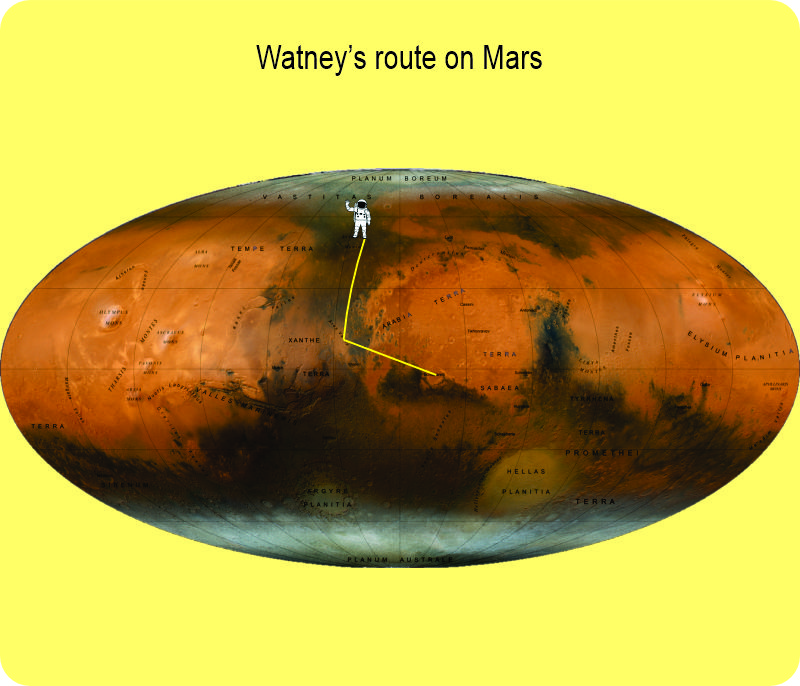
“You’ve read Andy Weir’s book, ‘The Martian‘?”

“Of course. Saw the movie, too. It was a nice change watching a drama that didn’t involve people battling each other physically or emotionally.”

“Uh. Yeah. I just saw it as an adventure story. Whatever. You remember Watney’s epic drive across that red desert to recover parts from the Pathfinder lander and then get to the launch vehicle?”

“Mm‑hm, though I don’t remember the geography.”

“Well, here’s his road map — Aries Base in Acidalia Planitia to Pathfinder in Chryse Planitia to take‑off from Schiaparelli Crater. Cool, huh?”

“Quite cool.”

Mars image credit: EMM/EXI/Dimitra Atri/NYU Abu Dhabi Center for Space Science

~~ Rich Olcott

A Disk of Heat And Violence

Susan suddenly sits bolt upright. “WOW! Kareem, that Chicxulub meteor that killed off the dinosaurs — paleontologists found iridium from it all over the world, right?”

“Right, the famous K‑T or K‑Pg boundary So?”

“It’d take a lot of iridium to cover the world. Iridium’s deep in the Periodic Table’s Soft Siderophile territory. Iron’s Soft. When Earth was molten, iron would extract and concentrate iridium. That’s why there’s so little iridium in Earth’s crust ’cause it’s all gone to the core. That iridium‑carrying meteorite must have been the iron kind.”

“Probably.”

Vinnie guffaws. “HAW! Earth’s Hard and crunchy on the outside, Soft and chewy in the inside, just like a good cookie.”

“Or an armored knight, from the dragon’s viewpoint. But how did Earth get that way, Cathleen?”

“Long story, Sy. The academics are still arguing about the details.”

“I love a good story, especially if it ends up explaining asteroid Psyche.”

“It starts 4½ billion years ago, when the Solar System was a rotating disk of galactic debris, clouds of hydrogen plus heavier dust and grit spewed out by energetic stars. Some of the atoms in that grit were important, right, Kareem?”

“Yup. Iron and nickel for planetary cores, silicon and oxygen for the crusts, radioactive isotopes of potassium, uranium and thorium but especially the short‑lived radioactives like aluminum‑26. Half‑life for that one’s only a million years.”

Al, Eddie and Vinnie erupt.
 ”If the short‑timers are gone, how come you say they were important?”
  ”How do we know they were even there?”
   ”If it’s such a short‑timer, is that stuff even a thing any more?”

Kareem’s not used to such a barrage but Cathleen’s a seasoned teacher. “Aluminum‑26 definitely is still a thing, because it’s continually produced by cosmic rays colliding with silicon atoms that aren’t too deeply buried. The production rate is so steady that Kareem’s colleagues estimate how long a meteorite was exposed to cosmic rays from its load of aluminum‑26 decay products compared to its related stable isotopes. We know aluminum‑26 was in the early debris because we’ve found its decay products on Earth. We even know how much — about 50 atoms per million stable aluminum atoms.”

Kareem regains his footing. “As to why it’s important, molten silicate droplets in the early system became chondrules when they aggregated to form chondritic meteorites. The droplets couldn’t have stayed that hot just from nuclear fission by their long‑lived radioactives. The short‑timers, especially aluminum‑26, must have supplied the extra heat early on. If short‑timers could keep the droplets molten, they certainly could have kept the newly‑forming planets molten for a while. Being fluid’s important because that’s the only state where Susan’s Hard‑Soft phase separation can happen.”

Cathleen nods. “The radioactives were just part of the story, though. The early system was a chaotic place. Forget notions of everything smoothly whirling around like the rings of Saturn. Except for the biggest objects, the idea of an orbit was just silly. Each object was gravitationally influenced by beaucoodles of other objects of all sizes that didn’t even all go in the same direction. There was crashing, lots of crashing. Every smash‑up converted kinetic energy to heat, lots of heat. Each collision could generate fragments which would cascade on to other collisions, maybe even become meteorites. Large objects would accumulate mass and heat energy in violent mergers with smaller objects. A protoplanet’s atom‑level Hard‑Hard and Soft‑Soft interactions would have plenty of chemical opportunities to assemble cohesive masses rising or sinking through the liquid melt just because of buoyancy and there you’ve got your layers.”

“But collisions didn’t have to be violent, Cathleen. Fragments could hang together through gravity or surface stickiness. That’s how the Bennu and Ryugu rubble pile asteroids formed.”

“Good point, Kareem, and that brings us to Psyche. We know its density is higher than stone but less than iron. The asteroid could be part of a planetoid’s interior, surviving after violent collisions chipped away the surface rock. It could be a rubble pile of loose metallic bits. It could be a mix of metal and rock like the Museum’s pallasite slice. Or an armored shell. We just won’t know until the Psyche mission gets there.”

~~ Rich Olcott

Planetary Chemistry

The deal’s gone round to Susan. “Another thing, Kareem — your assumption ignores Chemistry.”

“Didn’t Cathleen take care of that with her nuclear reactions in the star’s core?”

“Not even close. Nuclear reactions in general are literally a million or more times more energetic than chemical ones. Your classic AA alkaline battery is 1½ volts, right, but the initial step in Cathleen’s proton‑to‑helium process would net 1½ megavolts if we could set it up in a battery. Regular chemistry just re‑arranges atoms, doesn’t have a chance when nuclear’s going on.”

“Like trying to carve a cameo with dynamite, huh?”

“Not quite. If nuclear is dynamite, then bench chemistry is a bandsaw. I’d say the analog for carving a cameo would be cell biology. That operates at the millivolt level.”

Cathleen holds up her tablet again. “Speaking of abundance graphs, here’s another one I built for my Astronomy class. I divided each element’s atom count in Earth’s crust by its atom count in the Universe. I color-coded the points according to Goldschmidt’s classification scheme. The lines mark the average ratio for each class. Compared to the Universe, oxide‑formers are ten times more concentrated in the crust than sulfide‑formers are, 150 times more concentrated than iron‑mixers, 900 times more than gases. I see the numbers but I don’t feel comfortable with them. Kareem, what do I tell my students?”

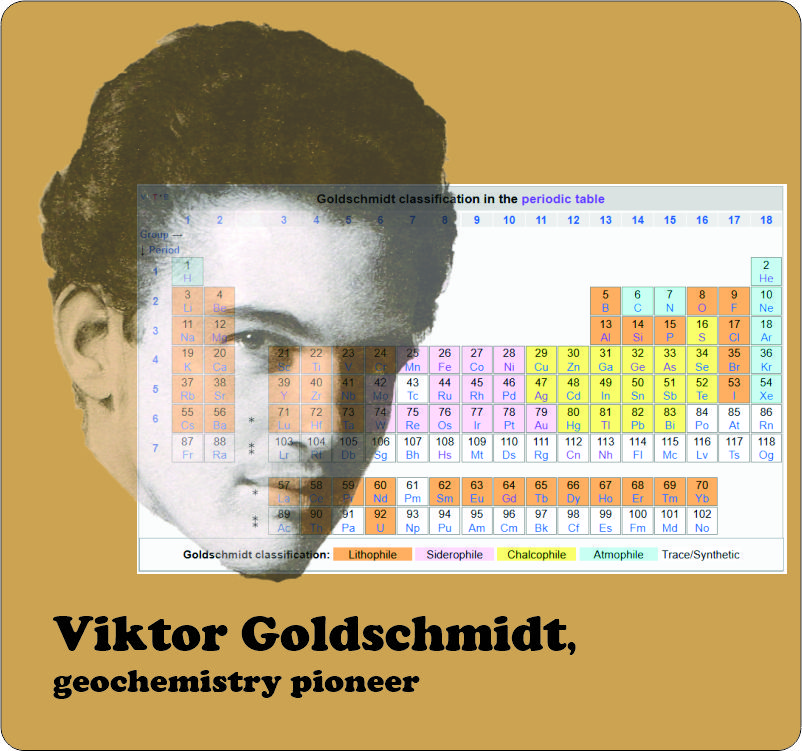
“Happy to explain the what, but Susan will have to explain the why. Goldschmidt started as a mineralogist, invented Geochemistry while bouncing around between Sweden, Norway and Germany until he barely escaped from the Nazis and was smuggled into England. He pioneered using crystallographic and thermodynamic analysis in geology. His scheme slotted each chemical element into one of those five classes. For example, he lumped the five lightest inert gases together with hydrogen, nitrogen and carbon into what he called the Atmophile class because they mostly stay in the atmosphere.”

“Carbon?”

“Yeah, that one’s iffy because coal and limestone. His reasoning involved carbon monoxide, carbon dioxide and methane which don’t show up in rocks. There are other edge cases, like radon which ought to count as a gas but shows up in rocks and basements because it’s locked where it was generated as part of uranium’s decay sequence. We mostly find uranium in oxide minerals so Goldschmidt put it and radon into his Lithophile class of metals that occur in oxides. That’s opposed to mercury, silver and a dozen or so other elements that generally show up in sulfide minerals — that’s his Chalcophile class. There’s another dozen or so that dissolve into molten iron so they’re Siderophiles. We don’t see much of those in Earth’s crust because they were swept down to the core as the molten planet differentiated. Finally, there’s a whole batch of radioactives that huddle together as Other. But why those elements do those things, I dunno. Susan, your turn.”

“It’s a lovely application of Pearson’s Hard‑Soft Acid‑Base theory. Hard chemical thingies have a high charge‑to‑volume ratio. Also, their charge is tightly bound so it doesn’t polarize. Oxide, carbonate and fluoride ions are Hard, and so are alkali and alkali metal ions like sodium and calcium. Uranium’s Hard when it’s at high oxidation state like in a uranyl ion UO22+. (Eddie, stop snickering, that’s its proper name.) Soft thingies are just the reverse — big thingies with mushy electron clouds. Iodide is Soft and so are mercury, silver and gold ions. Bulk metals are extremely Soft, chemically speaking, because their electron clouds are so diffuse. The point is, Hard thingies combine best with Hard thingies, Soft thingies with Soft.”

“So the Lithophiles are Hard metals that make Hard‑Hard stony oxides. I suppose that extends to fluorides and carbonates?”

“Sure.”

“Then the sulfide ores, Goldschmidt’s Chalcogens, are Soft‑Soft compounds. The Siderophile metals combine with each other better than anyone else, and the Atmophiles don’t combine with anything. Cool.”

“Ah‑HAH! Then on my graph the Hard oxides are most common in the crust because they’re light and so float above the heavier Soft sulfides and the ultra‑Soft metals that sink to the core. Our planet is layered by Hardness.”

“Does the same logic apply to asteroids?”

“Sort of.”

~~ Rich Olcott