Fields of Dreams

Vinnie takes a slug of his coffee. “So the gravitational field carries the gravitational wave. I suppose Einstein would blame sound waves on some kind of field?”

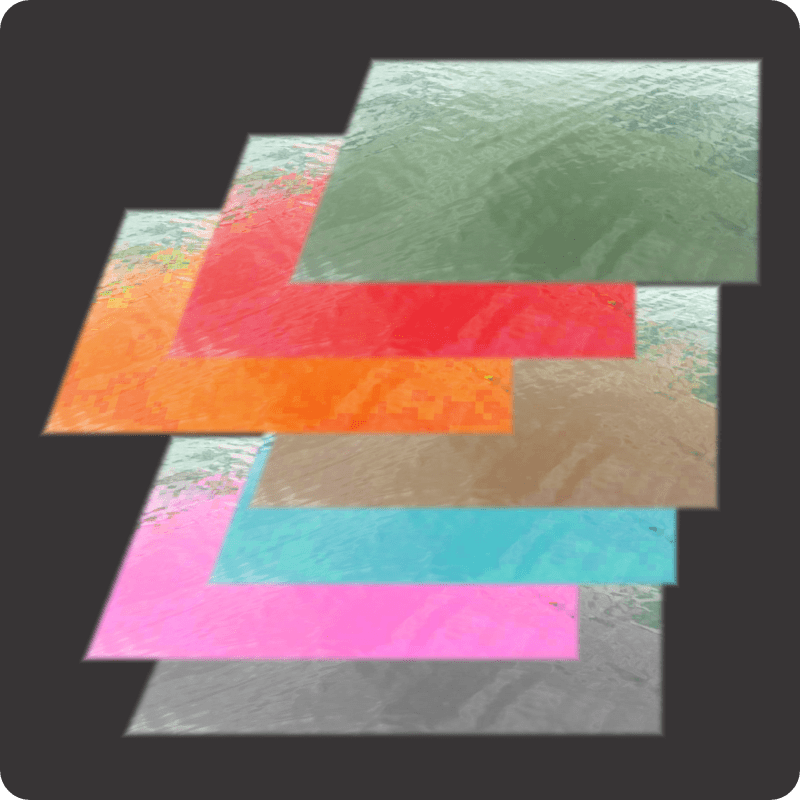
I take a slug of mine. “Mm-hm. We techies call it a pressure field. Can’t do solar physics without it. The weather maps you use when plotting up a flight plan — they lay three fields on top of the geography.”

“Lessee — temp, wind … and barometer reading. In the old days I’d use that one to calibrate my altimeter. You say those are fields?”

“In general, if a variable has a value at every point in the region of interest, the complete set of values is a field. Temperature and pressure are the simplest type. Their values are just numbers. Each point in a wind field has both speed and direction, two numbers treated as a single value, so you’ve got a field of vector values.”

“Oh, I know vectors, Sy. I’m a pilot, remember? So you’re saying instead of looking at molecules back‑and‑forthing to make sound waves we step back and look at just the pressure no matter the molecules. Makes things simpler, I can see that. Okay, how about the idea those other guys had?”

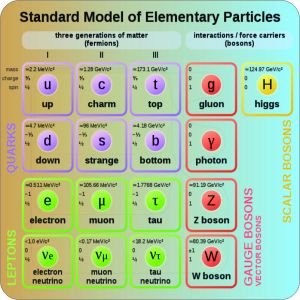
“Hm? Oh, the other wave carrier idea. Einstein’s gravitational waves are just fine, but the Quantum Field Theorists added a collection of other fields, one for each of the 17 boxes in the Standard Model.”

“Boxes?”

<displaying Old Reliable’s screen> “Here’s the usual graphic. It’s like the chemist’s Periodic Table but goes way below the atomic level. There’s a box each for six kinds of quarks; another half‑dozen for electrons, neutrinos and their kin; four more boxes for mediating electromagnetism and the weak and strong nuclear forces. Finally and at last there’s a box for the famous Higgs boson which isn’t about gravity despite what the pop‑sci press says.”

“What’s in the boxes?”

“Each box holds a list of properties — rest mass, spin, different kinds of charge, and a batch of rules for how to interact with the other thingies.”

“Thingies, Sy? I wouldn’t expect that word from you.”

“I would have said ‘particle‘ but that would violate QFT’s tenets despite the graphic’s headline.”

“Tenets? That word sounds more like you. What’s the problem?”

“That the word ‘particle‘ as we normally use it doesn’t really apply at the quantum field level. Each box names a distinct field that spreads its values and waves all across the Universe. There’s an electron field, a photon field, an up‑quark field, a down‑quark field, and so on. According to QFT, what we’d call a particle is nothing more than a localized peak in its underlying field. Where you find a peak you’ll find all the properties listed in its box. Wherever the field’s value is below its threshold, you find none of them.”

“All or none, huh? I guess that’s where quantum comes in. Wait, that means there could be gazillions of one of them popping up wherever, like maybe a big lump of one kind all right next to each other.”

“No, the rules prevent that. Quarks, for instance, only travel in twos or threes of assorted kinds. The whole job of the gluons is to enforce QFT rules so that, for instance, two up‑quarks and a down‑quark make a proton but only if they have different color charges.”

“Wait, color charge?”

“Not real colors, just quantum values that could as easily have been labeled 1, 2, 3 or A, B, C. There’s also an anti- for each value so the physicists could have used ±1, ±2, ±3, but they didn’t, they used ‘red’ and ‘anti‑red’ and so forth. And ‘color charge‘ is a different property from electric charge. Gluons only interact with color charge, photons only interact with electric charge. The rules are complicated.”

“You said ‘waves.’ Each of these fields can have waves like gravity waves?”

“Absolutely. We can’t draw good pictures of them because they’re 3‑dimensional. And they’re constantly in motion, of course.”

“How fast can those waves travel?”

“The particles are limited to lightspeed or slower; the waves, who knows?”

“Ripples zipping around underneath the quantum threshold could account for entanglement, ya’ know?”

“Maybe.”

~~ Rich Olcott

A Million Times Weaker Than Moonlight

Big Vinnie’s getting downright antsy, which is something to behold. “C’mon, Sy. We get it that sonication ain’t sonification and molecules bumping into each other can carry a sound wave across space if the frequency’s low enough and that can maybe account for galaxies having spiral arms, but you said the Cosmic Hum is a sound, too. That’s a gravity thing, not molecules, right?”

“Not quite what I said, Vinnie. The Hum’s sound‑related, but it’s not ‘sound’ even by our extended definition.”

“Then what’s the connection?”

“Waves.”

“Not frames like always?”

“Not frames, for a change.”

“So it’s waves, but they go though empty space. Can’t happen like sound waves from molecules bumping into each other ’cause molecules are too small to have enough gravity do that when they’re so far apart. What’s carrying the waves?”

“Good question. Einstein figured out one answer. A whole cohort of mid‑20th‑century theoreticians came to a slightly different conclusion.”

“Okay, I’ll bite. What was Einstein’s answer?”

“Relativity, of course. Gravity’s the effect we see from mass deforming nearby space. Moving a mass drives corresponding changes in the shapes of space where it was and where it has moved to. The shape‑changes generate follow‑on gravitational effects that propagate outward over time. Einstein even showed that the gravitational propagation speed is equal to lightspeed.”

“Gimme a sec … Okay, that black hole collision signal LIGO picked up back in 2015, the holes lost a chunk of their combined mass all of a sudden. Quick drop in the gravity thereabouts. You’re saying it took time for the missing gravity strength to get noticed where we’re at. If I remember right, the LIGO people said the event was something like a billion lightyears away so that tells me it happened about a billion years ago and what the LIGO gadget picked up was space waves, right?”

“Right, but it wasn’t just the mass loss, it was the rapid and intense waggles in the gravitational field as those two enormous bodies, each 30 times as massive as the Sun, whirled around each other multiple times per second. The ever‑faster whirling shook the field with a frequency that swept upward to the ‘POP‘ when your mass‑loss happened. LIGO eventually picked up that signal. Einstein would say there’s no ‘action at a distance‘ in the collision‑LIGO interaction, because the objects acted on the gravitational field which acted on the LIGO system.”

“Like using a towel to pop someone in the locker room. The towel’s just transmi– ulp.”

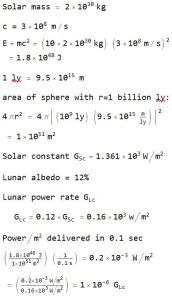
“An admission of guilt if I ever heard one. Yes, like that, except a towel pop carries all the initial energy to its final destination. Gravitational waves spread their energy across the surface of an expanding sphere. The energy per unit area goes down as the square of the distance.” <keying a calculation on Old Reliable> “Suppose the collision releases 10 solar masses worth of energy, we’re a billion lightyears away, and the ‘POP‘ signal is delivered in a tenth of a second. We’d see a signal power … about a millionth as strong as moonlight.”

“Not much there.”

“Right, which is why LIGO and its kin have been such pernickety instruments to build and run. LIGO’s sensors are mirrors roughly a meter across. You get a million times more power sensitivity if your detector’s diameter is a mile across. That was part of the NANOGrav team’s strategy, but they went much bigger.”

“Yeah, that’s the multi-telescope thing, so NANOGrav faked a receiver the size of the Earth, like the Event Horizon Telescope.”

“Much bigger. Their receiver is the entire Milky Way. Instead of LIGO’s mirrors, NANOGrav’s signal generators are neutron stars a dozen or more miles wide scattered across the galaxy.”

“Gotcha, Sy. Two ways. Neutron stars are billions heavier than a LIGO mirror so they’d be less power‑sensitive, not more. Then, power is about moving stuff closer or farther but if I got you right these space waves don’t really do that anyway, right?”

“Right and right, Vinnie, but not relevant. What NANOGrav’s been watching for is pulsar beams being twitched by a gravitational wave. A waltzing black hole pair should generate years‑long or decades‑long wavelengths. NANOGrav may have found one.”

~~ Rich Olcott

Sounds, Harsh And Informative

Vinnie’s frowning. “Wait, Sy. I get how molecules bumping into each other can carry a sound wave across space if the frequency’s low enough and that can maybe account for galaxies having spiral arms. So what’s that got to do with the Sonication Project?”

Now Jeremy’s frowning. “What’s sonication got to do with Astronomy? One of my girl friends uses sonication in Biology lab when she’s studying metabolism in plant cells.”

“Whoa! Sonification, not sonication — they could have called it soundify‑cation but sonification‘s classier. ‘Sonication‘ uses high‑intensity ultrasound to jiggle a sample so roughly that cell walls can’t take the stress. They break open and spill the cell’s internal soup out where your friend’s probes can get to it. Tammy, the chemist down the hall from my lab, uses sonication, too.”

“Whoa, Susan, wouldn’t sonication break up molecules?”

“Depends on the frequency and intensity, Vinnie. Sonication can mess up big floppy proteins and DNA, but chemists who play with little peptides and such don’t care. Tammy does solid‑state chemistry. She’s looking for superconductors and she actually does want to break things. The field’s hot category these days is complex copper oxides doped with other metals. You synthesize those compositions by sintering a mix of oxide powders. To maximize contact for a good reaction you need really fine‑grained powders. Sonication does a great job of shattering brittle oxide grains down to bits just a few‑score atoms wide. But Tammy’s technique is even more elegant than that.”

“Elegant sneezes from the powder?”

Susan wallops my shoulder. “No, Sy, the powders are so small they’d be a lung hazard and some of them are toxic. Everything’s done behind respiratory protection.” <Susan doesn’t joke about lab safety.> “There’s evidence that some of these materials are only superconductive if they have the right kind of layered structure. Turns out that if Tammy has her sonicator setup just right when she preps a sample for sintering, the sound wave peaks and valleys inside the machine make the shattered particles settle out in interesting layers.”

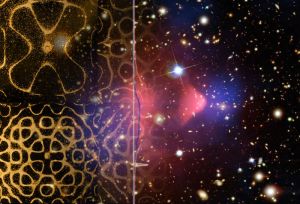
“Like Chladni figures.”

“Oh, you know about them.”

“Yeah, I wrote about them a few years ago. Waves do surprising things.”

Vinnie’s getting impatient. “So what’s sonification then?”

Tinkly music bursts from Cathleen’s tablet. “This one’s listenable, Susan, and it’s a nice demonstration of what sonification’s about and how arbitrary it can be. You start with complicated multi‑dimensional data and use some process to turn it into audible signals. The process algorithm can use any sound characteristics you like — loudness, pitch, timbre, whatever. This example started with the famous Bullet Cluster image that most people accept as the first direct confirmation of dark matter. All the white‑ish thingies are galaxies except for the ones with pointy artifacts — those are stars. The pink haze is X‑ray light from the same region. The blue haze comes from a point‑by‑point assessment of how badly the galaxy images have been distorted by gravitational lensing — that’s an estimate of the dark matter mass between us and that region of sky. Got all that?”

“And that vertical line is like a scan going across the picture?”

“It’s not like a scan, it is a scan. Imagine a collection of tiny multi‑spectral cameras arranged along a carrier bar. As the bar travels across the picture, each camera emits three signals proportional to the amount of white, pink and blue light it sees. If you look close, just to the right of the line, you’ll see moving white, red and blue line‑charts of the respective signals.”

“That’s fine, but what’s with the sound effects?”

“The Project’s sonification processing generated hiss and rumble sounds whose loudness is proportional to the red and blue signals. Each white‑ish peak became a ping whose pitch indicates position along that bar.”

“Why go to all that trouble?”

“The sounds encode the picture for vision‑challenged people. Beyond that, the Project participants hope that with the right algorithms, their music will reveal things the pictures don’t.”

“They should avoid screamy sounds.”

~~ Rich Olcott