

Vinnie’s frowning. “Wait, Sy. I get how molecules bumping into each other can carry a sound wave across space if the frequency’s low enough and that can maybe account for galaxies having spiral arms. So what’s that got to do with the Sonication Project?”
Now Jeremy’s frowning. “What’s sonication got to do with Astronomy? One of my girl friends uses sonication in Biology lab when she’s studying metabolism in plant cells.”
“Whoa! Sonification, not sonication — they could have called it soundify‑cation but sonification‘s classier. ‘Sonication‘ uses high‑intensity ultrasound to jiggle a sample so roughly that cell walls can’t take the stress. They break open and spill the cell’s internal soup out where your friend’s probes can get to it. Tammy, the chemist down the hall from my lab, uses sonication, too.”
“Whoa, Susan, wouldn’t sonication break up molecules?”
“Depends on the frequency and intensity, Vinnie. Sonication can mess up big floppy proteins and DNA, but chemists who play with little peptides and such don’t care. Tammy does solid‑state chemistry. She’s looking for superconductors and she actually does want to break things. The field’s hot category these days is complex copper oxides doped with other metals. You synthesize those compositions by sintering a mix of oxide powders. To maximize contact for a good reaction you need really fine‑grained powders. Sonication does a great job of shattering brittle oxide grains down to bits just a few‑score atoms wide. But Tammy’s technique is even more elegant than that.”
“Elegant sneezes from the powder?”
Susan wallops my shoulder. “No, Sy, the powders are so small they’d be a lung hazard and some of them are toxic. Everything’s done behind respiratory protection.” <Susan doesn’t joke about lab safety.> “There’s evidence that some of these materials are only superconductive if they have the right kind of layered structure. Turns out that if Tammy has her sonicator setup just right when she preps a sample for sintering, the sound wave peaks and valleys inside the machine make the shattered particles settle out in interesting layers.”
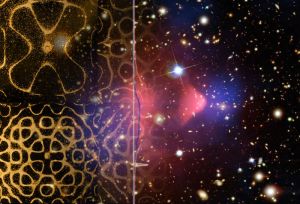
“Like Chladni figures.”
“Oh, you know about them.”
“Yeah, I wrote about them a few years ago. Waves do surprising things.”

Sonification Credit: NASA/CXC/SAO/K.Arcand,
SYSTEM Sounds (M. Russo, A. Santaguida), based on X-Ray image by NASA/CXC/CfA/M.Markevitch,
Optical and lensing map: NASA/STScI, Magellan/U.Arizona/D.Clowe,
Lensing map: ESO WFI
Vinnie’s getting impatient. “So what’s sonification then?”
Tinkly music bursts from Cathleen’s tablet. “This one’s listenable, Susan, and it’s a nice demonstration of what sonification’s about and how arbitrary it can be. You start with complicated multi‑dimensional data and use some process to turn it into audible signals. The process algorithm can use any sound characteristics you like — loudness, pitch, timbre, whatever. This example started with the famous Bullet Cluster image that most people accept as the first direct confirmation of dark matter. All the white‑ish thingies are galaxies except for the ones with pointy artifacts — those are stars. The pink haze is X‑ray light from the same region. The blue haze comes from a point‑by‑point assessment of how badly the galaxy images have been distorted by gravitational lensing — that’s an estimate of the dark matter mass between us and that region of sky. Got all that?”
“And that vertical line is like a scan going across the picture?”
“It’s not like a scan, it is a scan. Imagine a collection of tiny multi‑spectral cameras arranged along a carrier bar. As the bar travels across the picture, each camera emits three signals proportional to the amount of white, pink and blue light it sees. If you look close, just to the right of the line, you’ll see moving white, red and blue line‑charts of the respective signals.”
“That’s fine, but what’s with the sound effects?”
“The Project’s sonification processing generated hiss and rumble sounds whose loudness is proportional to the red and blue signals. Each white‑ish peak became a ping whose pitch indicates position along that bar.”
“Why go to all that trouble?”
“The sounds encode the picture for vision‑challenged people. Beyond that, the Project participants hope that with the right algorithms, their music will reveal things the pictures don’t.”
“They should avoid screamy sounds.”
~~ Rich Olcott
 Hard Science Ain't Hard