In Which Tone of Voice?

“Oh. OH! Wow, Uncle Sy, this changes everything!”

“Which ‘this,’ Teena?”

The resonator thing. Our music teacher, Ms Searcy, has been going on about us singing too much in our heads. I thought she’s been saying we’re thinking about the music too much and should just let the singing happen.”

“Sounds very Zen.”

“I’m too young to know Zen stuff. But now I think maybe she’s saying we’re using those head resonators you just told me about — singing with our sinuses and nasal cavities instead of somewhere else. She’s never been clear on what we can do about that.”

“You’re probably right. No music teacher since Harold Hill would try to get away with ‘think the music.’ I’m sure Ms Searcy’s complaint is about head tones as opposed to chest tones. If so, she’s got a good excuse for being unclear.”

“How can I have chest tones when you said vibrations come from my voice box and that’s above my chest?”

“Sound wave energy is about molecules colliding against any neighboring molecules. Up, down left, right — none of those matter. When air from your lungs makes your vocal cords buzz against each other, much of that buzzing goes up through your throat and head resonators. However, some of the buzz energy travels into your chest cavity. That’s your biggest resonator and it’s where your lowest tones come from.”

“I guess Ms Searcy wants us to send even more buzzing there, but how do we do that?”

“That’s a hard question. People have been interested in it since they started teaching singing and oratory to other people. We learned one part of the answer in medieval times when we began studying anatomy up close and personal. For instance, your voice box, which I really ought to call your larynx now we’re getting into detail, relates to about a dozen different muscles.”

“What’re the other parts?”

“The easiest part was kinesiology — figuring out what action each muscle supports. The hardest part was teaching a student how to feel and control the right muscles to make their voice do exactly what they want.”

“How can that be hard? I can flex my arm and leg muscles any time I want.”

“Can you make your larynx move up and down in your throat?”

“Easy.”

“That motion depends on a chain of muscles running between the back of your tongue and the top of your chest. One way to send buzzes downward is to activate the muscles that pull the larynx in that direction. Shorter distance makes for more efficient buzz transmission. It can also help to pull your head back a little. That tenses those pulled‑down tissues and improves transmission even more.”

<slightly deeper voice> “Like this?”

“That’s the idea. Learning to do that without having to pay attention to it is part of vocal training. Now, can you spread your toes out?”

“That’s weird. I can on my right foot but not my left.”

“Very common. Each foot has little tiny muscles, called intrinsic muscles, buried deep inside. Some people can control the whole set, some not so much. Your larynx has two pairs of intrinsic muscles that govern how your vocal cords work together. Some voice teachers claim the intrinsic muscles inside the larynx are the key to proper voice technique. Unfortunately, you can’t see them or get a feel for controlling them other then ‘keep trying things until you get it right and remember what you did.’ That’s Ms Searcy’s strategy. It’d be much harder with helium.”

“That’s right! Our voices with the balloons were all head tones. How come?”

“The speed of sound.”

“That’s a sideways answer, Uncle Sy.”
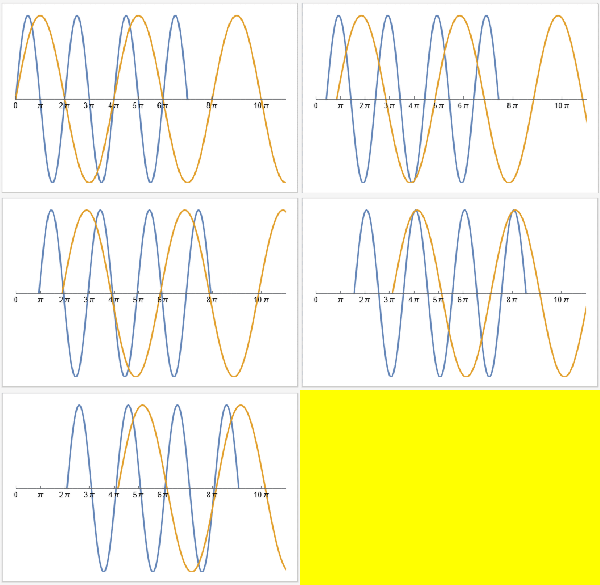
“Okay, this is more direct. We’ve said resonance was about waves whose wavelength just fit across a cavity. Picture two waves, the same number of waves per second, but the wave in helium travels about 3½ times faster than the one in air. The helium wave stretches about 3½ times farther between peaks. Whatever peaks per second your vocal cords make, in helium your chest cavity is 3½ times too small to resonate. Your head cavities, though, can resonate to overtones of those frequencies.”

“Squeaky overtones.”
~ Rich Olcott
When Sounds Rebound

<chirp chirp> “Moire here.”

“Hi, Uncle Sy.”

“Hi, Teena, How was the birthday party?”

“Pretty fun. We had balloons but Mom wouldn’t let us fly them into the sky.”

“Because animals might eat them when they come down, I suppose.”

“Yeah, that’s what she said. What we did was we untied the knotty part so we could breathe in the helium and sing squeaky Happy Birthdays. It didn’t make much difference to my voice but Brian’s came out weird ’cause his voice is breaking anyway. It was almost a yodel.”

“I thought you didn’t like Brian any more.”

“That was last month, Uncle Sy. He ‘poligized on accounta he’s still learning social skills. We had fun playing with the sounds.”

“Sure you did. Do you remember the slide whistle I gave you once?”

“That was a long time ago. It was fun until Brian bent the slider and it didn’t work any more.”

“No surprise. How’d you make it give a high note?”

“I’d push the slider all the way in. Slider-out made a low note, but Brian could make a high note even there if he blew really hard.”

“Well, he would. It all has to do with resonant cavities.”

“I don’t have any cavities! Mom makes sure I brush and floss every day. And what’s resonant?”

“You don’t have dental cavities but there are other kinds. ‘Cavity‘ is another word for ‘hole‘ and some of them are important. You breathe through two nasal cavities that join up to be your posterior nasal cavity and that connects to sinus cavities in your skull and down to your voice box and lungs. Your mouth cavity resonates with all those cavities and vibrations from your voice box to make your speaking sounds.”

“That’s twice you used that ‘resonate‘ word I don’t know.”

“Break it down. ‘–son–‘ means ‘sound,’ like ‘sonic.’ Then—”

“‘Re–‘ means ‘again‘ like ‘rebuild‘ so resonate is sounding again like an echo.”

“Right. Except a resonant cavity is picky about what sounds it works with. Here, I’m sending you a video. Did you get it?”

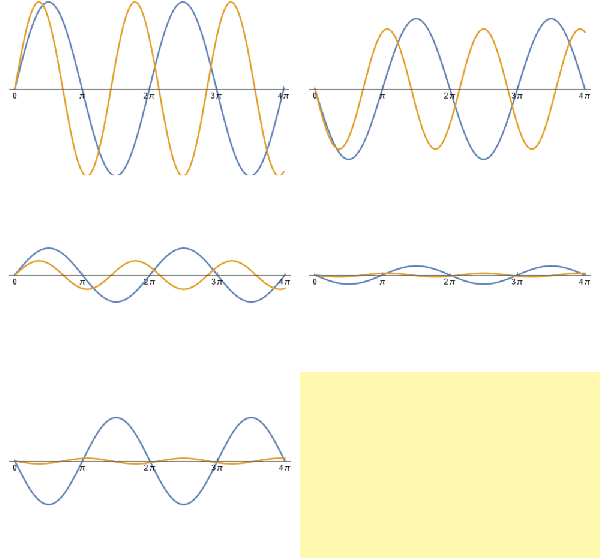
“Yeah, I see a couple of wiggly lines. Wait, the blue line stays the same size but the orange line gets littler until it’s all gone and then the picture goes yellow and starts over.”

“What happens over on the right‑hand side?”

“The blue line bounces back from zero but the orange line waves all over the place. Is that how sound works?”

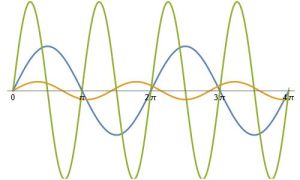
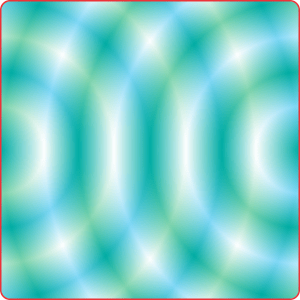
“Sort of. The air molecules in a sound wave don’t go up‑and‑down, they go to‑and‑fro. The wiggly lines are a graph of where the energy is. Where the molecules bunch together they bang into each other more often than in the in‑between places. In open air the energy pushes along even though the molecules stay pretty much where they are. In a resonant cavity, sounds are trapped like the blue line if they have just the right wavelength. A cavity’s longest trappable wavelength is its lowest note, called its fundamental. The energy in the fundamental is sustained as long as new energy’s coming in.”

“What happens to the orange line?”

“It doesn’t get a chance to build up. The energy in those waves spreads out until the wave just isn’t any more.”

“Aww, poor wavey. Wait, what about when Brian blows extra‑hard and gets that high note?”

“He gives the commotion inside the whistle enough energy to excite a second trapped wave with twice the number of crowded places. That’s called an overtone of the fundamental. Sometimes you want to do that, sometimes you don’t.”

“Brian always did on the whistle.”

“Well, he would. The resonant cavity thing also explains why Brian’s voice breaks and how talking works. Your windpipe is a resonating cavity. Brian’s windpipe has grown just large enough that sometimes it resonates in his new fundamental and sometimes switches to some other fundamental or overtone. Talking depends on tuning the resonances inside your mouth cavity. Try saying ‘ooo‑eee‘ while holding your lips steady in ‘ooo‘ position. On ‘eee‘ your tongue rises up to squeeze out the low‑pitched long waves in ‘ooo‘, right?”

oooeeeoooeeeooo

  • Thanks to Xander, whose question inspired this story arc.

~ Rich Olcott

Why Physics Is Complex

“I guess I’m not surprised, Sy.”

“At what, Vinnie?”

“That quantum uses these imaginary numbers — sorry, you’d prefer we call them i‑numbers.”

“Makes no difference to me, Vinnie. Descartes’ pejorative term has been around for three centuries so that’s what the literature uses. It’s just that most people pick up the basic idea more quickly without the woo baggage that the real/imaginary nomenclature carries along. So, yes, it’s true that both i‑numbers and quantum mechanics appear mystical, but really quantum mechanics is the weird one. And relativity.”

“Wait, relativity too? That’s hard to imagine, HAW!”

“Were you in the room for Jim’s Open Mic session where he talked about Minkowski’s geometry?”

“Nope, missed that.”

“Ah, okay. Do you remember the formula for the diagonal of a rectangle?”

“That’d be the hypotenuse formula, c²=a²+b². Told you I was good at Geometry.”

“Let’s use ‘d‘ for distance, because we’re going to need ‘c‘ for the speed of light. While we’re at it, let’s replace your ‘a and ‘b‘ with ‘x‘ and ‘y,’ okay?”

“Sure, why not?”

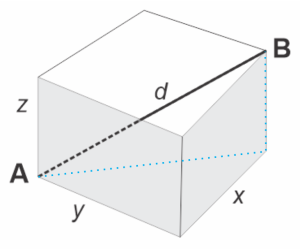
<casting image onto office monitor> “So the formula for the body diagonal of this box is…”

“Umm … That blue line across the bottom’s still √(x²+y²) and it’s part of another right triangle. d‘s gotta be the square root of x²+y²+z².”

“Great. Now for a fourth dimension, time, so call it ‘t.’ Say we’re going for light’s path between A at one moment and B some time t later.”

“Easy. Square root of x²+y²+z²+t².”

“That’s almost a good answer.”

“Almost?”

“The x, y and z are distance but t is a duration. The units are different so you can’t just add the numbers together. It’d be like adding apples to bicycles.”

“Distance is time times speed, so we multiply time by lightspeed to make distance traveled. The formula’s x²+y²+z²+(ct)². Better?”

“In Euclid’s or Newton’s world that’d be just fine. Not so much in our Universe where Einstein’s General Relativity sets the rules. Einstein or Minkowski, no‑one knows which one, realized that time is fundamentally perpendicular to space so it works by i‑numbers. You need to multiply t by ic.”

“But i²=–1 so that makes the formula x²+y²+z²–(ct)².”

“Which is Minkowski’s ‘interval between an event at A and another event at B. Can’t do relativity work without using intervals and complex numbers.”

“Well that’s nice but we started talking about quantum. Where do your i‑numbers come into play there?”

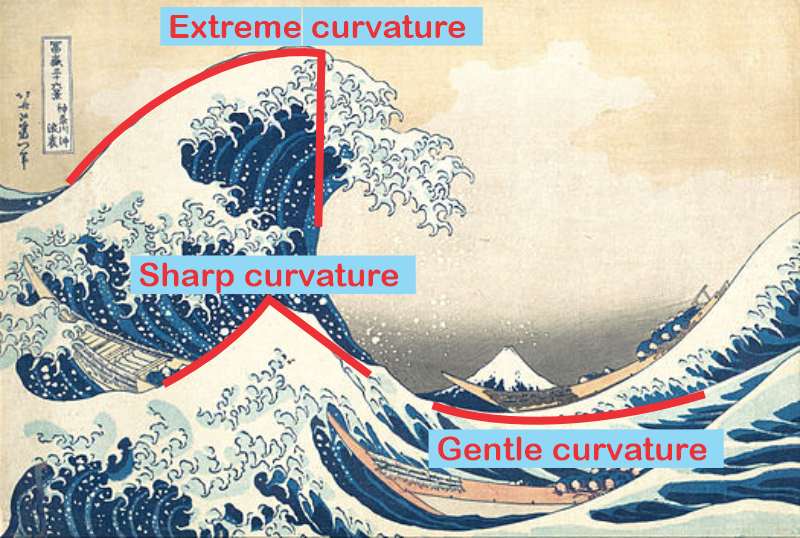
“It goes back to the wave equation— no, I know you hate equations. Visualize an ocean wave and think about describing its surface curvature.”

“Curvature?”

“How abruptly the slope changes. If the surface is flat the slope is zero everywhere and the curvature is zero. Up near the peak the slope changes drastically within a short distance and we say the surface is highly curved. With me?”

“So far.”

“Good. Now, visualize the wave moving past you at some convenient speed. Does it make sense that the slope change per unit time is proportional to the curvature?”

“The pointier the wave segment, the faster its slope has to change. Yeah, makes sense.”

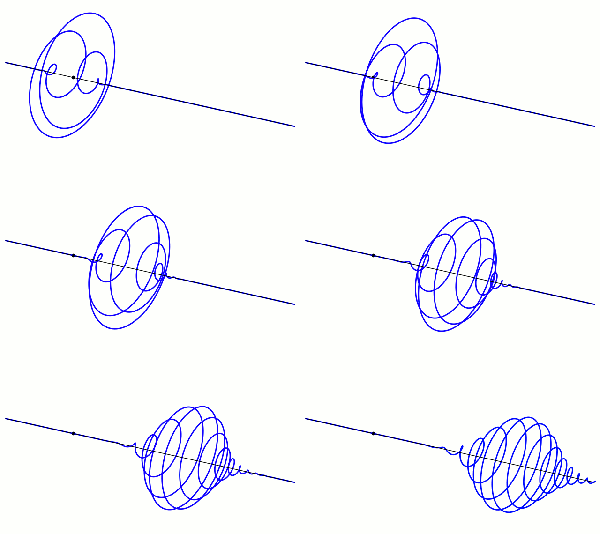
“Which is what the classical wave equation says — ‘time‑change is proportional to space‑change’. The quantum wave equation is fundamental to QM and has exactly the same form, except there’s an i in the proportionality constant and that changes how the waves work.” <casting a video> “The equation’s general solution has a complex exponential factor eix. At any point its value is a single complex number with two components. From the x‑direction, the circle looks like a sine wave. From the i‑direction it also looks like a sine wave, but out of phase with the x‑wave, okay?”

“Out of phase?”

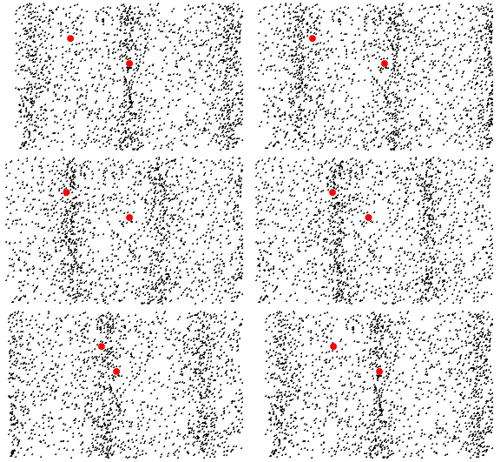
“When one wave peaks, the other’s at zero and vice‑versa. The point is, rotation’s built into the quantum waves because of that i‑component.” <another video> “Here’s a lovely example — that black dot emits a photon that twists and releases the electromagnetic field as it moves along.”

~ Rich Olcott

…With Imaginary Answers

“I’ve got another solution to Larry’s challenge for you, Vinnie.”

“Will I like this one any better, Sy?”

“Probably not but here it is. The a‑line has unit length, right?”

“That’s what the picture says.”

“And the b‑line also has unit length, along the i‑axis.”

“Might as well call it that.”

“And we’ve agreed it’s a right triangle because all three vertices touch the semicircle. A right triangle with two one‑unit sides makes it isosceles, right, so how big is the ac angle?”

“Isosceles right triangle … 45°. So’s the bc angle even though it don’t look like that in the picture.”

“Perfect. Now let me split the triangle in two by drawing in this vertical line.”

“That’s its altitude. I told you I remember Geometry.”

“So you did. Describe the ac triangle.”

“Mm, it’s a right triangle because altitudes work that way. We said the ac angle is 45° which means the top angle is also 45°.”

“What about length ca?”

“Gimme a sec, that’s buried deep. … If the hypotenuse is 1 unit long then each side is √½ units.”

“Vinnie, I’m impressed. So what’s the area of the right half of the semicircle?”

“That’s a quarter‑circle with radius ca which is √½ so the area would be ¼πca² which comes to … π/8.’

“Now play the same game with the b‑side.”

“Aw, geez, I see where you’re going. Everything’s the same except cb has an i in it which is gonna get squared. The area’s ¼πcb² which is … ¼π(i√½)² which is –π/8. Add ’em both together and the total area comes to zero again. … Wait!”

“Yes?”

“You said the i‑axis is perpendicular to everything else.” <sketching on the back of the card> “That’s not really a semicircle, it’s two arcs in different planes that happen to have the same center and match up at one point. The c‑line’s bent. Bo‑o‑o‑gus!”

“I said you wouldn’t like it. But I didn’t quite say ‘perpendicular to everything else‘ because it’s not. The problem is that the puzzle depends on a misleadingly ambiguous diagram. The only perpendicular to i that I worked with was the a‑line. You’ve also got it perpendicular to part of the c‑line.”

“Sy, if these i-number things are ambiguous like that, why do you physics and math guys spend so much time with them? And do they really call them i‑numbers?”

“Ya got me. No, they’re actually called ‘complex numbers,’ because they are complex. The problem is with what we call their components.”

“Components plural?”

“Mm‑hm. Mathematicians put numbers in different categories. There’s the natural numbers — one, two, three on up. Extend that through zero on down and you have the integers. Roll in the integer/integer fractions and you’ve got the rational numbers. Throw in all the irrationals like pi and √2 and you’re got the full number line. They call that category the reals.”

“That’s everything.”

“That’s everything along the real number axis. Complex numbers have two components, one along the real number line, the other along the perpendicular pure i‑number line. A complex number is one number but it has both real and i components.”

“If it’s not real, it’s imaginary, HAW!”

“More correct than you think. That’s exactly what the ‘i‘ stands for. If Descarte had only called the imaginaries something more respectable they wouldn’t have that mysterious woo‑quality and people wouldn’t have as much trouble figuring them out. Complex numbers aren’t mysterious or ambiguous, they’re just different from the numbers you’re used to. The ‘why’ is because they’re useful.”

“What good’s a number with two components?”

“It’s two for the price of one. The real number line is good for displaying a single variable, but suppose one quantity links two variables, x and y. You can plot them using Descartes’ real‑valued planar coordinates. Or you could use complex numbers, z=x+iy and plot them on the complex plane. Interesting things happen in the complex plane. Look at the difference between ex and eix.”

“One grows, the other cycles.”

“Quantum mechanics depends on that cycling.”

~ Rich Olcott