
<chirp chirp> “Moire here.”
“Hi, Uncle Sy.”
“Hi, Teena, How was the birthday party?”
“Pretty fun. We had balloons but Mom wouldn’t let us fly them into the sky.”
“Because animals might eat them when they come down, I suppose.”
“Yeah, that’s what she said. What we did was we untied the knotty part so we could breathe in the helium and sing squeaky Happy Birthdays. It didn’t make much difference to my voice but Brian’s came out weird ’cause his voice is breaking anyway. It was almost a yodel.”
“I thought you didn’t like Brian any more.”
“That was last month, Uncle Sy. He ‘poligized on accounta he’s still learning social skills. We had fun playing with the sounds.”
“Sure you did. Do you remember the slide whistle I gave you once?”
“That was a long time ago. It was fun until Brian bent the slider and it didn’t work any more.”
“No surprise. How’d you make it give a high note?”
“I’d push the slider all the way in. Slider-out made a low note, but Brian could make a high note even there if he blew really hard.”
“Well, he would. It all has to do with resonant cavities.”
“I don’t have any cavities! Mom makes sure I brush and floss every day. And what’s resonant?”
“You don’t have dental cavities but there are other kinds. ‘Cavity‘ is another word for ‘hole‘ and some of them are important. You breathe through two nasal cavities that join up to be your posterior nasal cavity and that connects to sinus cavities in your skull and down to your voice box and lungs. Your mouth cavity resonates with all those cavities and vibrations from your voice box to make your speaking sounds.”
“That’s twice you used that ‘resonate‘ word I don’t know.”
“Break it down. ‘–son–‘ means ‘sound,’ like ‘sonic.’ Then—”
“‘Re–‘ means ‘again‘ like ‘rebuild‘ so resonate is sounding again like an echo.”
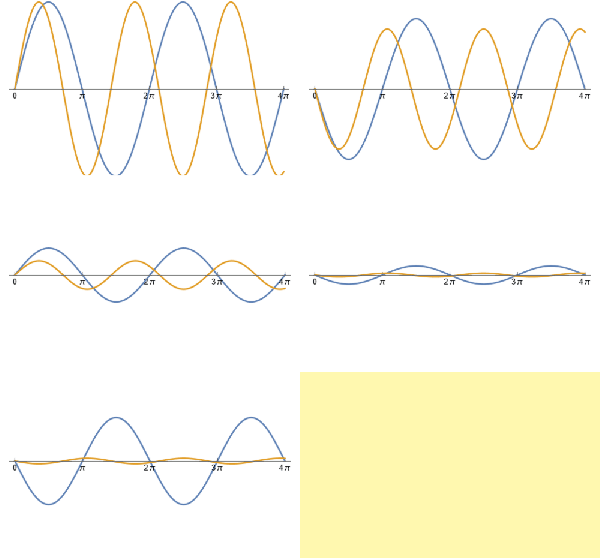
“Right. Except a resonant cavity is picky about what sounds it works with. Here, I’m sending you a video. Did you get it?”
“Yeah, I see a couple of wiggly lines. Wait, the blue line stays the same size but the orange line gets littler until it’s all gone and then the picture goes yellow and starts over.”
“What happens over on the right‑hand side?”
“The blue line bounces back from zero but the orange line waves all over the place. Is that how sound works?”
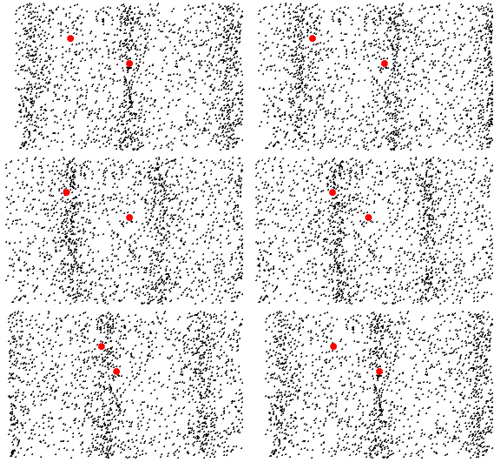
“Sort of. The air molecules in a sound wave don’t go up‑and‑down, they go to‑and‑fro. The wiggly lines are a graph of where the energy is. Where the molecules bunch together they bang into each other more often than in the in‑between places. In open air the energy pushes along even though the molecules stay pretty much where they are. In a resonant cavity, sounds are trapped like the blue line if they have just the right wavelength. A cavity’s longest trappable wavelength is its lowest note, called its fundamental. The energy in the fundamental is sustained as long as new energy’s coming in.”
“What happens to the orange line?”
“It doesn’t get a chance to build up. The energy in those waves spreads out until the wave just isn’t any more.”
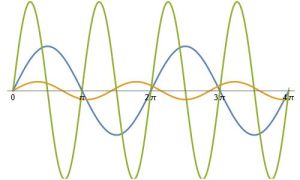
“Aww, poor wavey. Wait, what about when Brian blows extra‑hard and gets that high note?”
“He gives the commotion inside the whistle enough energy to excite a second trapped wave with twice the number of crowded places. That’s called an overtone of the fundamental. Sometimes you want to do that, sometimes you don’t.”
“Brian always did on the whistle.”
“Well, he would. The resonant cavity thing also explains why Brian’s voice breaks and how talking works. Your windpipe is a resonating cavity. Brian’s windpipe has grown just large enough that sometimes it resonates in his new fundamental and sometimes switches to some other fundamental or overtone. Talking depends on tuning the resonances inside your mouth cavity. Try saying ‘ooo‑eee‘ while holding your lips steady in ‘ooo‘ position. On ‘eee‘ your tongue rises up to squeeze out the low‑pitched long waves in ‘ooo‘, right?”
“oooeeeoooeeeooo“
- Thanks to Xander, whose question inspired this story arc.

~ Rich Olcott
 Hard Science Ain't Hard