

“Oh. OH! Wow, Uncle Sy, this changes everything!”
“Which ‘this,’ Teena?”
“The resonator thing. Our music teacher, Ms Searcy, has been going on about us singing too much in our heads. I thought she’s been saying we’re thinking about the music too much and should just let the singing happen.”
“Sounds very Zen.”
“I’m too young to know Zen stuff. But now I think maybe she’s saying we’re using those head resonators you just told me about — singing with our sinuses and nasal cavities instead of somewhere else. She’s never been clear on what we can do about that.”
“You’re probably right. No music teacher since Harold Hill would try to get away with ‘think the music.’ I’m sure Ms Searcy’s complaint is about head tones as opposed to chest tones. If so, she’s got a good excuse for being unclear.”
“How can I have chest tones when you said vibrations come from my voice box and that’s above my chest?”
“Sound wave energy is about molecules colliding against any neighboring molecules. Up, down left, right — none of those matter. When air from your lungs makes your vocal cords buzz against each other, much of that buzzing goes up through your throat and head resonators. However, some of the buzz energy travels into your chest cavity. That’s your biggest resonator and it’s where your lowest tones come from.”
“I guess Ms Searcy wants us to send even more buzzing there, but how do we do that?”
“That’s a hard question. People have been interested in it since they started teaching singing and oratory to other people. We learned one part of the answer in medieval times when we began studying anatomy up close and personal. For instance, your voice box, which I really ought to call your larynx now we’re getting into detail, relates to about a dozen different muscles.”
“What’re the other parts?”
“The easiest part was kinesiology — figuring out what action each muscle supports. The hardest part was teaching a student how to feel and control the right muscles to make their voice do exactly what they want.”
“How can that be hard? I can flex my arm and leg muscles any time I want.”
“Can you make your larynx move up and down in your throat?”
“Easy.”
“That motion depends on a chain of muscles running between the back of your tongue and the top of your chest. One way to send buzzes downward is to activate the muscles that pull the larynx in that direction. Shorter distance makes for more efficient buzz transmission. It can also help to pull your head back a little. That tenses those pulled‑down tissues and improves transmission even more.”
<slightly deeper voice> “Like this?”
“That’s the idea. Learning to do that without having to pay attention to it is part of vocal training. Now, can you spread your toes out?”
“That’s weird. I can on my right foot but not my left.”
“Very common. Each foot has little tiny muscles, called intrinsic muscles, buried deep inside. Some people can control the whole set, some not so much. Your larynx has two pairs of intrinsic muscles that govern how your vocal cords work together. Some voice teachers claim the intrinsic muscles inside the larynx are the key to proper voice technique. Unfortunately, you can’t see them or get a feel for controlling them other then ‘keep trying things until you get it right and remember what you did.’ That’s Ms Searcy’s strategy. It’d be much harder with helium.”
“That’s right! Our voices with the balloons were all head tones. How come?”
“The speed of sound.”
“That’s a sideways answer, Uncle Sy.”
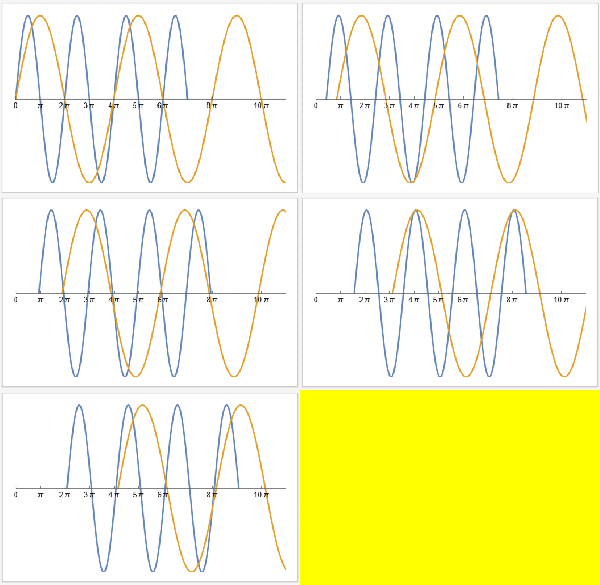
“Okay, this is more direct. We’ve said resonance was about waves whose wavelength just fit across a cavity. Picture two waves, the same number of waves per second, but the wave in helium travels about 3½ times faster than the one in air. The helium wave stretches about 3½ times farther between peaks. Whatever peaks per second your vocal cords make, in helium your chest cavity is 3½ times too small to resonate. Your head cavities, though, can resonate to overtones of those frequencies.”
“Squeaky overtones.”

~ Rich Olcott
 Hard Science Ain't Hard