
A young man’s knock at my office door, eager yet a bit hesitant. “C’mon in, Jeremy, the door’s open.”
“Hi, Mr Moire. Got a minute?”
“It’s slow season, Jeremy. What can I do for you?”
“It’s my physics homework, sir. Professor Hanneken asked a question that I don’t understand.”
“John’s a bit of a joker but asking unsolvable questions isn’t usually one of his things. Well, except for that one about how long it would take to play Mahler’s Piano Quartet if you had only two musicians because of budget restrictions. What’s the question?”
“He wants us to use something called ‘the viral theorem‘ to deduce things about a certain galaxy cluster. I know what viral memes are but I don’t think I’ve ever heard of a theorem that spreads like a virus. I’ve done searches on my class notes and online textbook — nothing. So what is it and how am I supposed to use it?”
“Do you have the question with you?”
“Yessir, it’s #4 on this sheet.”
“Ah, just as I thought. Read it again. The word is ‘virial,’ not ‘viral.’ Big difference.”
“I suppose, but what’s a virial then?”
“We need some context. Imagine a cluster of free‑floating objects bound together by mutual forces of attraction. No central attractor, just lots of pairwise pulling, okay?”
“What kind of forces?”
“That’s the thing, it doesn’t matter. Gravitational, electrostatic, rubber bands even. The only restriction is that the force between each pair of objects follows the same force‑distance rule. For rubber bands it’s mostly just 1/distance until you get near the elastic limit. For gravity and electrostatics the rule is that force runs as 1/distance2. Got that picture?”
<grin> “It’d be tricky rigging up those rubber bands to not get tangled. Anyhow, instead of planets around the Sun you want me to think of stars held in a cluster by each other’s gravity. Do they all have to be the same size or the same distance apart?”
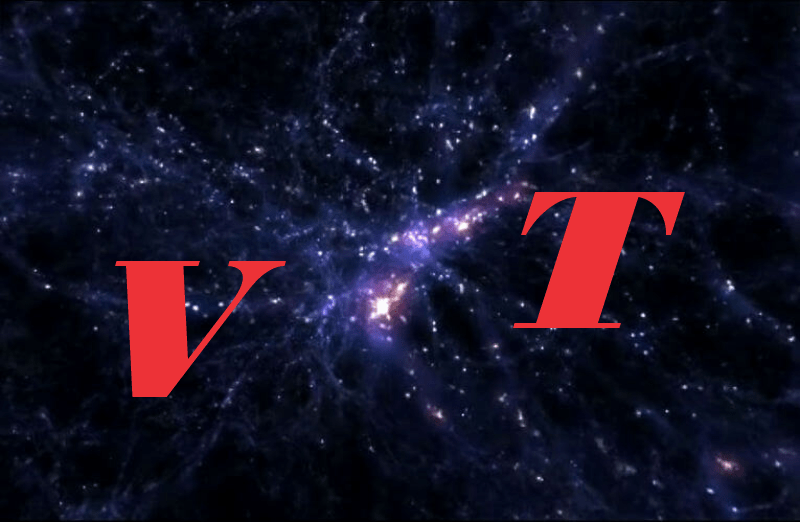
“No, because of what happens next. You’re thinking right — a heavier star pulls harder than a lighter one, and two stars close together feel more mutual force than stars far apart. We account for that variation by taking an average. Multiply force times distance for every possible pairing, then divide the total by the number of objects. The averaged number is the Virial, symbol V.”
“Wait, force times distance. That’s the Physics definition of work, like pulling something up against gravity.”
“Exactly. Work is directed energy. What we’re talking about here is the amount of energy required to pull all those objects away from the center of mass or charge or whatever, out to their current positions. The Virial is the average energy per object. It’s average potential energy because it depends on position, not motion.”
“They’d release all that energy if they just fell together so why don’t … wait, they’re going all different directions so momentum won’t let them, right?”
“You’re on your way. Motion’s involved.”
“Umm … Kepler’s Law — the closer any two of them get, the faster they orbit each other … OH! Kinetic energy! When things fall, potential energy’s converted to kinetic energy. Is there an average kinetic energy that goes up to compensate for the Virial getting smaller?”
“Bingo. When you say ‘average kinetic energy‘ what quantity springs to mind?”
“Temperature. But that’s only for molecules.”
“No reason we can’t define a galactic analog. In fact, Eddington did that back in 1916 when he brought the notion from gas theory over to astrophysics. He even used ‘T‘ for the kinetic average, but remember, this T refers to kinetic energy of stars moving relative to each other, not the temperatures of the stars themselves. Anyhow, the Virial Theorem says that a system of objects is in gravitational or electrostatic equilibrium when the Virial is T/2. Clausius’ ground‑breaking 1870 proof for gases was so general that the theorem’s been used to study everything from sub‑atomic particles to galaxies and dark matter.”
<bigger grin> “With coverage like that, the Virial’s viral after all. Thanks, Mr Moire.”
~~ Rich Olcott
- Thanks to Dr KaChun Yu for helpful pointers to the literature. Naturally, any errors in this post are my own.
 Hard Science Ain't Hard