
The Hacker’s Rap

  • And now for something completely different…

 <click>  <click>  <click>  <click>
So your Mac’s gone splat?
 Well how ’bout that?
Now baby, don’t you panic.
By the light of my screen
You’ll be in a different scene
When I’ve made ME your data mechanic.

 <click>

You think you got secrets?
 You ain’t met me yet.
I’m on a roll,
 you’ve lost control
An’ there ain’t no RESET.
Ethics ain’t my style.
Nasty makes me smile:
You’re in a jam
 ’cause I’ve got a plan
For your personal keyset.
Might as well resign, dear,
Your system’s mine, that’s clear,
Yeah, my attack
 does not hold back
  It’ll feel like a cardiac
    hack,
      Jack,
‘Cause I’m a HACKER!
Ain’t no mush-head slacker.
I can mess your metal mind an’ that’s a fact, son!
Check this action:
If I feel a dejection
  Because of a rejection,
 I can make a selection
 From my collection,
 Set up a connection
 And you’ll get a digital infection
  That defies detection
  Or correction.
 Virus inspection
  Ain’t no protection
 And your objection
 Confirms my direction
 And amplifies my —

        satisfection.

‘Cause I’m a HACKER!
I got tons of tricks in my pack here.
Ain’t no food in the freezer?
No problem, man – I can download pizza.
 Can’t touch this, eithah
  cause it’s a virtual pizza!

You run Windows?
 You’ll hear the wind blow.
You run iOS?
 Say “Bye-bye,” oh yes.
You run Chrome?
 Won’t be no-one home.
You run Android?
 I’ll hit you like an asteroid.
You run Linux?
 You’ll feel the force of my
   mimic gimmicks.
Go on, run to a mainframe —
 You’ll still be in my pain game.
You feel safe in the cloud somewhere?
 You’re right in front of my easy chair.

‘Cause I’m a HACKER!
I POP <click> I FIZZ
 when I find what ROOT’s password is.
I SMILE <click> I GRIN <click>
 I sack the system that lets me in.
Things SPIN <click> Things SPARK <click>
 And suddenly your screen goes dark —
A sadder but wiser LAN you’ll be
‘Cause I am
 TROUBLE
 with a capital T
 and that rhymes with C
 and that stands for
  <click>  <click>  <click>  <click>
   CLICK

~ Rich Olcott

Surf Lake Loki? No, Thanks.

Vinnie’s been eavesdropping (he’s good at that). “You guys said that these researcher teams looked at how iron and sulfur play together at a bunch of different temperature, pressures and blend ratios. That’s a pretty nice chart, the one that shows mix and temperature. Got one for pressure, like the near‑vacuum over Loki’s lava lake on Io?”

“Not to my knowledge, Vinnie. Of course I’m a lab chemist, not a theoretical astrogeochemist. Kareem’s phase diagram is for normal atmospheric pressure. I’d bet virtually all related lab work extends from there to the higher pressures down toward Earth’s center. Million‑atmosphere experiments are difficult — even just trying to figure out whether a microgram sample’s phase in a diamond anvil cell is solid or liquid. Right, Kareem?”

“Mm‑hm, but the computer work’s hard, too, Susan. We’ve got several suites of software packages for modeling whatever set of pressure-temperature-composition parameters you like. The problem is that the software needs relevant thermodynamic data from the pressure and temperature extremes like from those tough‑to‑do experiments. There’s been surprises when a material exhibited new phases no‑one had ever seen or measured before. Water’s common, right, but just within the past decade we may have discovered five new high‑pressure forms of ice.”

“May have?”

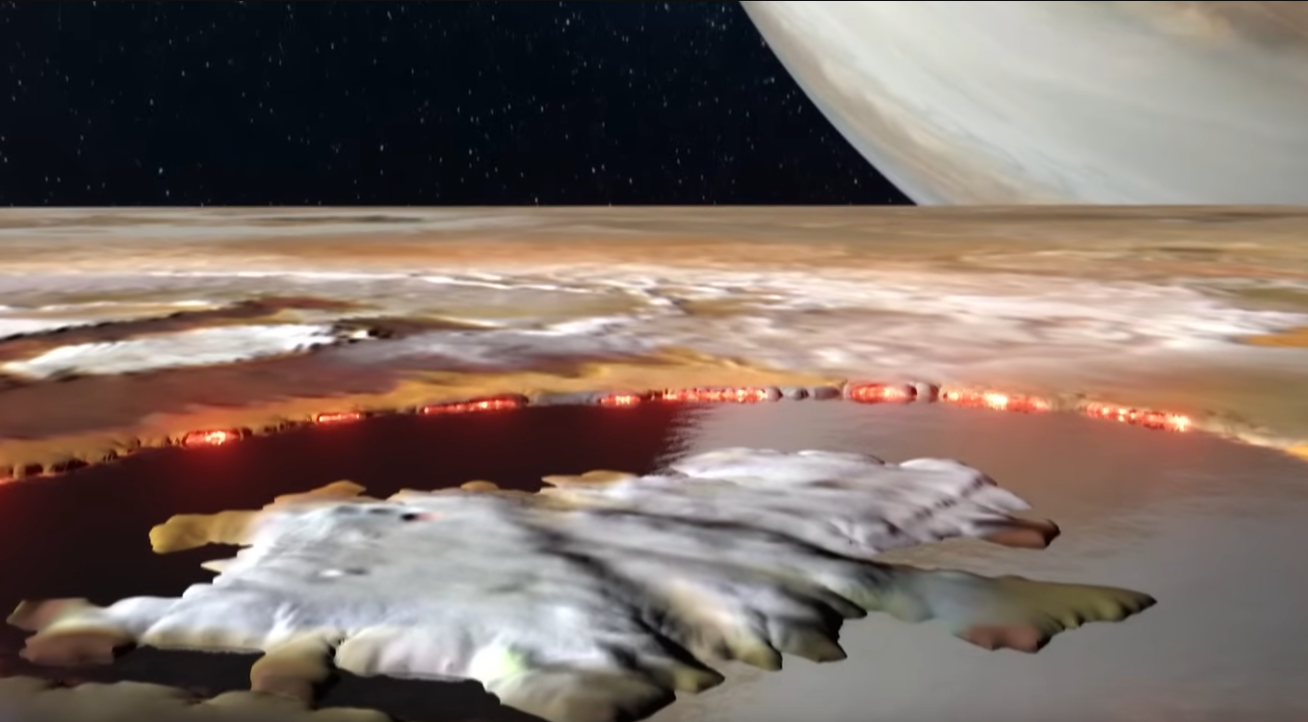
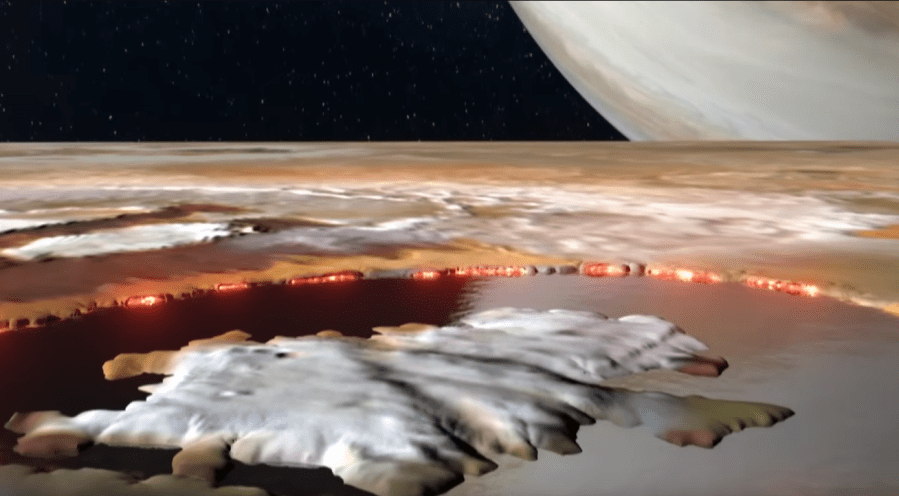
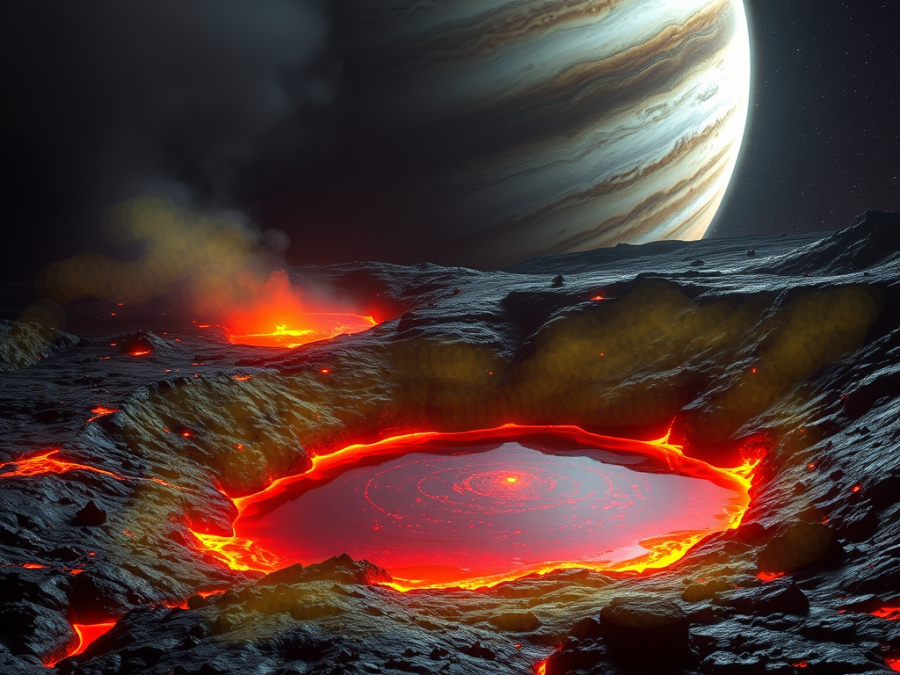
Artist’s concept of Loki Patera,
a lava lake on Jupiter’s moon Io
Credit: NASA/JPL-Caltech/SwRI/MSSS

“The academics are still arguing about each of them. Setting aside that problem, modeling Io’s low‑pressure environment is a challenge because it’s not a lab situation. Consider Cal’s pretty picture there. See those glowing patches all around the lava lake’s shore? They’re real. Juno‘s JIRAM instrument detected hot rings around Loki and nearly a dozen of its cousins. Such continual heat release tells us the lakes are being stirred or pumped somehow. Whatever delivers heat to the shore also must deliver some kind of hot iron‑sulfur phase to the cooler surface. That’ll separate out like slag in a steel furnace.”

“It’s worse than that, Kareem. Sulfur’s just under oxygen in the periodic table, so like oxygen it’s willing to be gaseous S2. Churned‑up hot lava can’t help but give off sulfur vapor that the models will have to account for.”

I cut in. “It’s worse than that, Susan. I’ve written about Jupiter’s crazy magnetic field, off‑center and the strongest of any planet. Io’s the closest large moon to Jupiter, deep in that field. Sulfur molecules run away from a magnetic field; free sulfur atoms dive into one. Either way, if you’re some sulfur species floating above a lava lake when Jupiter’s field sweeps past, you won’t be hanging around that lake for long. Most likely, you’ll join the parade across the Io‑to‑Jupiter flux tube bridge.”

Susan chortles. “Obviously not an equilibrium. It’s a steady state!”

“Huh?” from everyone. Cal gives her, “Steady state?”

Chemical equilibrium is when a reaction and its reverse go at equal rates, right, so the overall composition doesn’t change. That’s the opposite of situations where there’s a forward reaction but for some reason the products don’t get a chance to back‑react. Classic case is precipitation, say when you bubble smelly H2S gas through a solution that may contain lead ions. If there’s lead in there you get a black lead sulfide sediment that’s so insoluble there’s no re‑dissolve. Picture an industrial vat with lead‑contaminated waste water coming in one pipe and H2S gas bubbling in from another. If you adjust the flow rates right, all the lead’s stripped out, there’s no residual stink in the effluent water and the net content of the vat doesn’t change. That’s a steady state.”

“What’s that got to do with Loki’s lake?”

“Sulfur vapors come off it and those glowing rings tell us it’s giving off heat. It’s just sitting there not getting hotter and probably not changing much in composition. There’s got to be sulfur and heat inflow to make up for the outflow. The lake’s in a steady state, not an equilibrium. Thermodynamic calculations like Gibbs’ phase rule can’t tell you anything about the lake’s composition because that depends on the kinetics — how fast magma comes in, how fast heat and sulfur go out. Kareem’s phase diagram just doesn’t apply.”

~ Rich Olcott

Phases And Changes

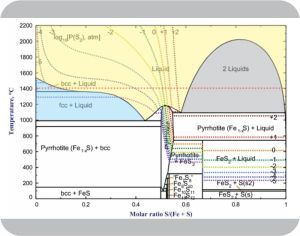
“Okay, so the yellow part of your graph is molten iron and sulfur, Kareem. What’s with all the complicated stuff going on in the bottom half?”

“It’s not a graph, Cal, it’s a phase diagram. Mmm… what do you think a phase is?”

“What we learned in school — solid, liquid, gas.”

“Sorry, no. Those are states of matter. Water can be in the solid state, that’s ice, or in the liquid state like in my coffee cup here, or in the gaseous state, that’d be water vapor. Phase is a tighter notion. By definition, it’s an instance of matter in a particular state where the same chemical and physical properties hold at every point. Diamond and graphite, for example, are two different phases of solid carbon.”

“Like when Superman squeezes a lump of coal into a diamond?”

“Mm-hm. Come to think of it, Cal, have you ever wondered why the diamonds come out as faceted gems instead of a mold of the inside of his fist? But you’ve got the idea — same material, both in the solid state but in different phases. Anyway, in this diagram each bordered region represents a phase.”

“It’s more complicated that that, Kareem. If you look close, each region is actually a mixture of phases. The blue region, for instance, has parts labeled ‘bcc+Liquid’ and ‘fcc+Liquid’. Both ‘bcc’ and ‘fcc’ are crystalline forms of pure iron. Each blue region is really a slush of iron crystals floating in a melt with just enough sulfur to make up the indicated sulfur:iron composition. That line at 1380°C separates conditions where you have one 2‑phase mix or the other.”

“Point taken, Susan. Face it, if region’s not just a straight vertical line then it must enclose a range of compositions. If it’s not strictly molten it must be some mix of at least two separate more‑or‑less pure components. That cool‑temperature mess around 50:50 composition is a jumble when you look at micro sections of a sample that didn’t cool perfectly and they never can. The diagram’s a high‑level look at equilibrium behaviors.”

“Equilibrium?”

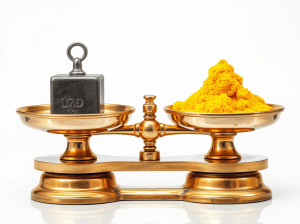
“‘Equi–librium’ came from the Latin ‘equal weight’ for a two-pan balance when the beam was perfectly level. The chemists abstracted the idea to refer to a reaction going both ways at the same rate.”

“Can it do that, Susan?”

“Many can, Cal. Say you’ve got a beaker holding some dilute acetic acid and you bubble in some ammonia gas. The two react to produce ammonium ions and acetate ions. But the reaction doesn’t go all the way. Sometimes an ammonium ion and an acetate ion react to produce ammonia and acetic acid. We write the equation with a double arrow to show both directions. Sooner or later you get equally many molecules reacting in each direction and that’s a chemical equilibrium. It looks like nothing’s changing in there but actually a lot’s going on at the molecular level. Given the reactant and product enthalpies Sy’s been banging on about, we can predict how much of each substance will be in the reaction vessel when things settle down.”

“Banging on, indeed. You’re disrespecting a major triumph of 19th‑Century science. Before Gibbs and Helmholtz, industrial chemists had to depend on rules of thumb to figure reaction yields. Now they just look up the enthalpies and they’ can make good estimates. Gibbs even came up with his famous phase rule.”

“You’re gonna tell us, right?”

“Try to stop him.”

“The Gibbs Rule applies to systems in equilibrium where there’s nothing going on that’s biological or involves electromagnetic or gravitational work. Under those restrictions, there’s a limit to how things can vary. According to the rule, a system’s degrees of freedom equals the number of chemical components, minus the number of phases, plus 2. In each blue range, for instance, iron and sulfur make 2 components, minus 2 phases, plus 2, that’s 2 degrees of freedom.”

“So?”

“Composition, temperature and pressure are three intensive variables that you might vary in an experiment. Pick any two, the third is locked in by thermodynamics. Set temperature and pressure, thermodynamics sets the composition.”

~ Rich Olcott

A Lazy Summer Day at 1400°C

Susan Kim and Kareem are supervising while Cal mounts a new poster in the place of honor behind his cash register. “A little higher on the left, Cal.”

“How’s this, Susan? Hey, Sy, get over here and see this. Ain’t it a beaut?”

“Nice, Cal. What’s it supposed to be? Is that Jupiter in the background?”

“Yeah, Jupiter all right. Foreground is supposed to be a particular spot on its moon Io. They think it’s a lake of molten sulfur!”

“No way, from that picture at least! I’ve seen molten sulfur. It goes from pale yellow to dark red as you heat it up, but never black like that.”

“It’s not going to be lab-pure sulfur, Susan. This is out there in the wild so it’s going to be loaded with other stuff, especially iron. But the molten sulfur I’ve seen in volcanoes is usually burning with a blue flame. I guess the artist left that out.”

“No oxygen to burn it with, Kareem. Why did you mention iron in particular?”

“Yeah, this article I took the image from says that lake’s at 1400°C. I thought blast furnaces ran hotter than that.”

I’ve been looking things up on Old Reliable. “They do, Cal, typically peaking near 2000°C.”

“So if this lake has iron in it, why isn’t the iron solid?”

“Same answer as I gave to Susan, Cal. The iron’s not pure, either. Mixtures generally melt or freeze at lower temperatures than their pure components. Sy would probably start an entropy lecture—”

“I would.”

“But I’m a geologist. Earth is about ⅓ iron. That’s mixed in with about 10% as much sulfur, mostly in the core where pressures and temperatures are immense. We want to understand conditions down there so we’ve spent tons of lab time and computer time to determine how various iron‑sulfur mixtures behave at different temperatures and pressures. It’s complicated.” <brings up an image on his phone> “Here’s what we call the system’s phase diagram.”

“You’re going to have to read that to us.”

“I expected to. Temperature increases along the y‑axis. Loki’s temp is at the dotted red line. Left‑to‑right we’ve got increasing sulfur:iron ratios — pure iron on the left, pure sulfur on the right. The idea is, pick a temperature and a mix ratio. The phase diagram tells you what form or forms dominate. The yellow area, for instance, is liquid — molten stuff with each kind of atom moving around randomly.”

“What’s the ‘bcc’ and ‘fcc’ about?”

“I was going to get to that. They’re abbreviations for ‘body‑centered cubic’ and ‘face‑centered cubic’, two different crystalline forms of iron. The fcc form dominates below that horizontal line at about 1380°C, converts to bcc above that temperature. Pure bcc freezes at about 1540°C, but add some sulfur to the molten material and you drive that freezing temperature down along the blue‑yellow boundary.”

“And the gray area?”

“Always a fun thing to explain. It’s basically a no‑go zone. Take the point at 1400°C and 80:20 sulfur:iron, for instance. The line running through the gray zone along those red dots, we call it a tie line, skips from 60:40 to 95:5, right? That tells you the 60:40 mix doesn’t accept additional sulfur. The extra part of the 80:20 total squeezes out as a separate 95:5 phase. Sulfur’s less dense than iron so the molten 95:5 will be floating on top of the 60:40. Two liquids but they’re like oil and water. If you want a uniform 80:20 liquid you have to shorten the tie line by raising the temp above 2000°C.”

“All that’s theory. Is there evidence to back it up?”

“Indeed, Sy, now that Juno‘s up there taking pictures. When the spacecraft rounded Io last February JunoCam caught several specular reflections of sunlight just like it had bounced off mirrors. At first the researchers suspected volcanic glass but the locations matched Loki and other hot volcanic calderas. The popular science press can say ‘sulfur lakes’ but NASA’s being cagey, saying ‘lava‘ — composition’s probably somewhere between 10:90 and 60:40 but we don’t know.”

~ Rich Olcott

A Sublime Moment

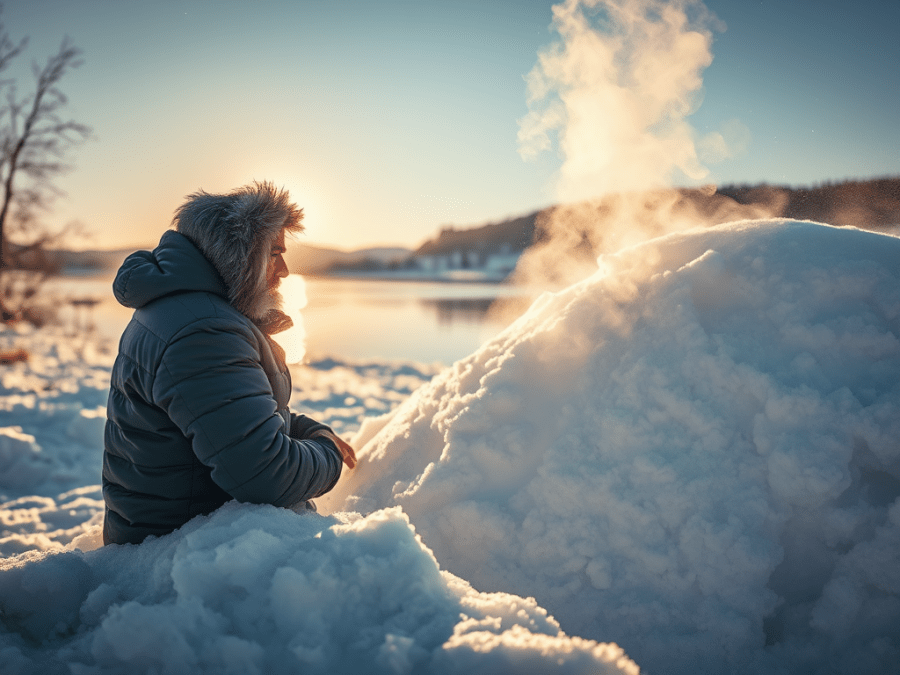
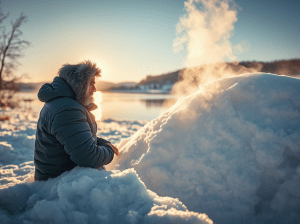
It’s either late Winter or early Spring, trying to make up its mind. Either way, today’s lakeside walk is calm until I get to the parking lot and there he is, all bundled up and glaring at a huge pile of snow. “Morning, Mr Feder. You look even more out of sorts than usual. Why so irate?”

“The city’s dump truck buried my car in that stuff.”

“Your car’s under that? But there’s a sign saying not to park in that spot when there’s a snow event.”

“Yeah, yeah. Back on Fort Lee we figure the city just puts up signs like that to remind us we pay taxes. I’ll park where I want to. Freedom!”

“I’m beginning to understand you better, Mr Feder. Got a spare shovel? I can help you dig out.”

“My car shovel’s in the car, of course. I got another one at home for the sidewalk.”

I notice something, move over for a better view. “Step over here and look close just above the top of the pile where the sunlight’s hitting it.”

“Smoke! My car’s burning up under there!”

“No, no, something much more interesting. You’re looking at something that I’ve seen only a couple of times so you’re a lucky man. That’s steam, or it would be steam at a slightly higher temperature. What you’re looking at is distilled snow. See the sparkles from ice crystals in that cloud? Beautiful. Takes a very special set of circumstances to make that happen.”

“I’d rather be lucky in the casino. What’s so special?”

“The air has to be still, absolutely no breeze to sweep floating water molecules away from the pile. Temperature below freezing but not too much. Humidity at the saturation point for that temperature. Bright sun shining on snow that’s a bit dirty.”

“Dirty’s good?”

“In this case. Here’s the sequence. Snow is water molecules locked into a crystalline structure, right? Most of them are bonded to neighbors top, bottom and every direction. The molecules on the surface don’t have as many neighbors, right, so they’re not bonded as tightly. So along comes sunlight, not only visible light but also infrared radiation—”

“Infrared’s light, too?”

“Mm-hm, just colors we can’t see. Turns out because of quantum, infrared light photons are even more effective than visible light photons when it comes to breaking water molecules away from their neighbors. So a top molecule, I’ll call it Topper, escapes its snow crystal to float around in the air. Going from solid directly to free-floating gas molecules, we call that sublimation. Going the other way is deposition. Humidity’s at saturation, right, so pretty soon Topper runs into another water molecule and they bond together.”

<sarcasm, laid on heavily> “And they make a cute little snow crystal.”

“Not so fast. With only two molecules in the structure, you can’t call it either solid or liquid but it does grow by adding on more molecules. Thing is, every molecule they encounter gives up some heat energy as it ties down. If the weather’s colder than it is here, that’s not enough to overcome the surrounding chill. The blob winds up solid, falls back down onto the pile. If it’s just a tad warmer you get a liquid blob that warms the sphere of air around it just enough to float gently upwards—”

“Like a balloon, I got the picture.”

“Floats up briefly. It doesn’t get up far before the surrounding chill draws out that heat and wins again. Not so brief when there’s a little dirt in there.”

“The dirt floats?”

“Of course not. The dirt’s down in the snow pile, but it’s dark and absorbs more sunlight energy than snow crystals do. What the dirt does is, it tilts the playing field. Heat coming from the dirt particles increases the molecular break‑free rate and there’s more blobs. It also warms the air around the blobs and floats them high enough to form this sparkling cloud we can see and enjoy.”

“You can enjoy it. I’m seeing my car all covered over and that’s not improving my mood.”

“Better head home for that shovel, Mr Feder. The snow dumper’s coming back with another load.”

~ Rich Olcott