Colors Made of Air

Teena’s whirling around in the night with her head thrown back. “I LUVV AURORAS!! They’re SO beautiful beautiful beautiful!”

“Yes, they are, Teena. They’re beautiful and magical, and for me it’s even better because they’re Physics at work right in front of us. Well, above us.”

“Oh, Sy, give it a rest.”

“No, really, Sis. I look at a rainbow and I’m dazzled by its glory against the rainclouds but I’m also aware that each particular glimpse of pure color comes to me by refraction through one individual droplet. Better yet, I appreciate the geometry that presents the entire spectrum in perfectly circular arcs. Marvels supported by underlying marvels. These curtains are another example of beauty emerging from hidden sources.”

“What do you mean?”

“Remember Teena’s teacher’s magnetic force lines that were organized and revealed by iron filings? Auroras are a bit like that, except one level deeper. Again we don’t see magnetic fields directly. What we do see is light coming to us from oxygen and nitrogen atoms that are bombarded by rampaging charged particles.”

“Wait, Uncle Sy, we learned that charges make magnetic fields when they move.”

“That, too. It works both ways, which is why they call it electromagnetism. A magnetic field steers protons and electrons which make their own field to push back on the first one. But my point is, the colors in each curtain and the curtains themselves tell us about the current state of the atmosphere and Earth’s magnetic field.”

“Okay, I can see how magnetic fields up there could steer charged particles to certain parts of the sky, but how does that tell us about the atmosphere? What do the colors have to do with it? Is this more rainbows and geometry?”

“Definitely not. Sis. Rainbows are sunlight refracted through water droplets. Aurora light’s emitted by atoms in our own atmosphere. Each color is like a fingerprint of a specific atom in specific circumstances. The uppermost reds, for instance come from oxygen atoms that rarely touch another atom of any kind. They’re at 150 or more kilometers altitude, way above the stratosphere. There aren’t many of them that far up which is why the curtain tops sort of fade away into infinity.”
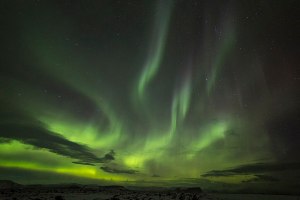
“Oooo, now it’s going green and yellow!”

“Mm-hm, the bombardment’s reaching further now. Excited oxygen atoms emit green lower down in the atmosphere where collisions happen more often and don’t give the red‑emitters a chance to do their thing. The in‑between yellow isn’t really there — it’s what your eye tells you when it sees pure red and pure green overlapping.”

“Why do the curtains have that sharp lower edge, Sy? Surely we don’t run out of oxygen there.”

“Quite the reverse. That level’s about 100 kilometers up. It’s where the atmosphere gets so thick that collisions drain away an excited atom’s energy before it gets a chance to shine.”

“But why are there curtains at all? Why not simply fill the sky with a smooth color wash?”
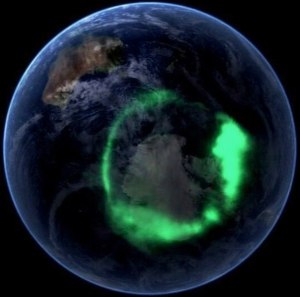
“Mars gets auroras like that, or at least Perseverance just spotted one. We don’t, thanks to our well‑ordered magnetic field. Mars’ field is lumpy and too weak to funnel incoming charged particles to special spots like our poles. Actually, those curtains are just segments of rings that go all around Earth’s magnetic axis. The rings usually lurk about 2/3 of the way to our poles but a really strong solar event like this one can push them closer to the Equator.”

“Mars gets auroras? Uncle Sy, how about other planets?”

“Them, too, but theirs mostly don’t look like ours. You’d have to be able to see X‑rays on Mercury, for instance. Venus gets a general green glow for the same reason that Mars does. Jupiter is Texas for the Solar System — everything’s bigger there, including auroras in every color from X‑ray to infrared. Strong ordered field, so I’m sure there’s curtains up there.”

Sis yanks out her writer’s‑companion notebook and scribbles without looking down…
  ”Curtains made of colors
   Colors made of air.

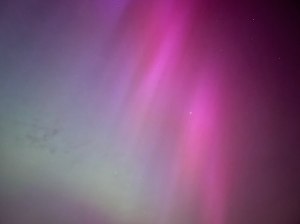
Aurora, photo by Bellezzasolo
licensed under CC BY-SA 4.0

~ Rich Olcott

Sky Lights

“Mom! Uncle Sy! Come outside NOW before it goes away!”

“Whah— oooh!”
 ”An aurora! Thanks for calling us.”

“Glowing curtains rippling across the sky! Spotlights shining down through them! Where do those come from?”

“From the Sun, Teena.”

“C’mon, Sy. The Sun’s 93 million miles away. Even if that bright streak up there is as much as 10 miles across, which I doubt, the beam from the Sun would be only a teeny‑tiny fraction of a degree wide. Not even magnetars send out anything that narrow.”

“Didn’t say it’s a beam, Sis. The whole display comes from the Sun as single package. Sort of. Sometimes.”

“Even for you, little brother, that’s a new level of weasel‑wording.”

“Well, it’s complicated.”

“So unravel it. Start from the beginning.”

“Okay. The Sun’s covered in plasma—”

“Eww!”

“Not that kind of plasma, Teena. This is mostly hydrogen atoms except they’re so hot that the electrons and protons break away from each other and travel separately. What have they told you in school about magnets?”

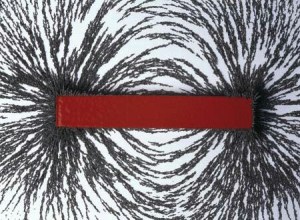
“Not much. Umm … electric currents push on magnets and that’s how motors work, and magnets push on electrons and that’s how a generator works. Oh, and Mr Cox laid a sheet of paper on top of a magnet and sprinkled iron filings on it so we could see the lines of force, but when I asked him what made the magnetism ’cause I didn’t see any wires he started talking about electrons in iron atoms and then the bell rang and I had to go to Spanish class.”

The shape of the bar magnet’s field, disclosed by iron filings chaining together.

<sigh> “The clock rules, doesn’t it? Anyway, he was on the right track, but I want to get back to those lines of force. Were they there before he sprinkled on those filings?”

“Mmm … Mom would say, ‘That’s a good question,’ but how could you know? I’m gonna say they were.”

“Your Mom would be right, but sorry, you’re wrong. With no iron filings in the picture, the magnetic field is nice and smooth, everywhere just the same or maybe only a little bit stronger or weaker than neighboring points. No lines. Conditions change when you put the first bit of iron anywhere in the field. As Mr Cox was probably saying when the bell interrupted, the electrons in the grain’s iron atoms align orbitals with the magnetic field. The alignment affects the surrounding field and that pulls in other iron bits that change the field even more.”

“But wouldn’t that make just a solid iron blob?”

“No, because a magnetic field has both strength and direction. Once the first particle points along the field, the iron bits it recruits rotate to point mostly in the same direction. You wind up with a chain of specks tracing out where they’ve acted together to alter the field. The chain’s surrounded by spaces where the field’s been stressed.”

“And then lotsa chains make lotsa lines, yeah!”

“I see where you’re headed, Sy. You’re going to claim that the vertical lines we see in the curtains trace out the Sun’s magnetic field.”

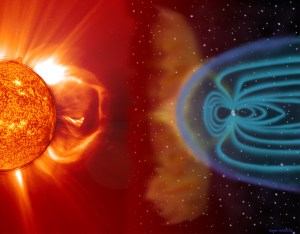
“Not quite, Sis. There’s only one magnetic field, a combination of Earth’s field, the Sun’s field, and the magnetic fields contained in whatever the Sun throws our way. Way out here Earth’s field is about ten thousand times stronger than the Sun’s is, but the fields inside a CME can range up to 10% or 20% of Earth’s. The moving curtains up there are the result of a magnetic tussle between us and a CME or maybe a flare’s outflow.”

“But there aren’t any iron filings up there, Uncle Sy!”

“True, but there are free charged particles in the ionosphere thanks to UV radiation from the Sun. A free electron caught in a magnetic field whips into a tight spiral. Its field gets neighbor particles spiraling. Pretty soon you wind up with a chain of them spiraling together, lining up like the filings do.”

“The spotlights?”

“Probably ion blobs embedded in the CME, but that’s a guess.”

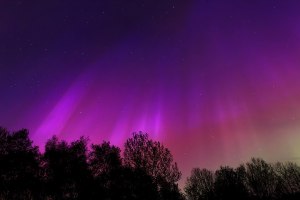
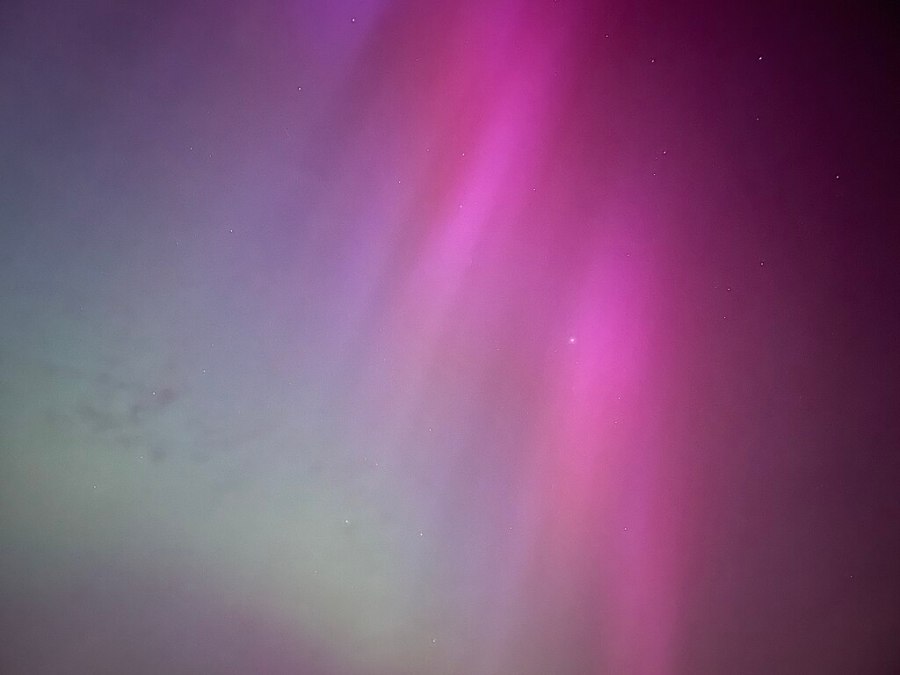
Aurora, photo by W.carter
licensed under CC BY-SA 4.0

~ Rich Olcott
A Play Beyond The Play

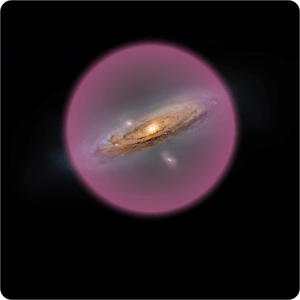
Vinnie takes a long thoughtful look at the image that had dashed his beautiful six‑universe idea. “Wait, Sy. I don’t like this picture”

“Because it messes up your invention?”

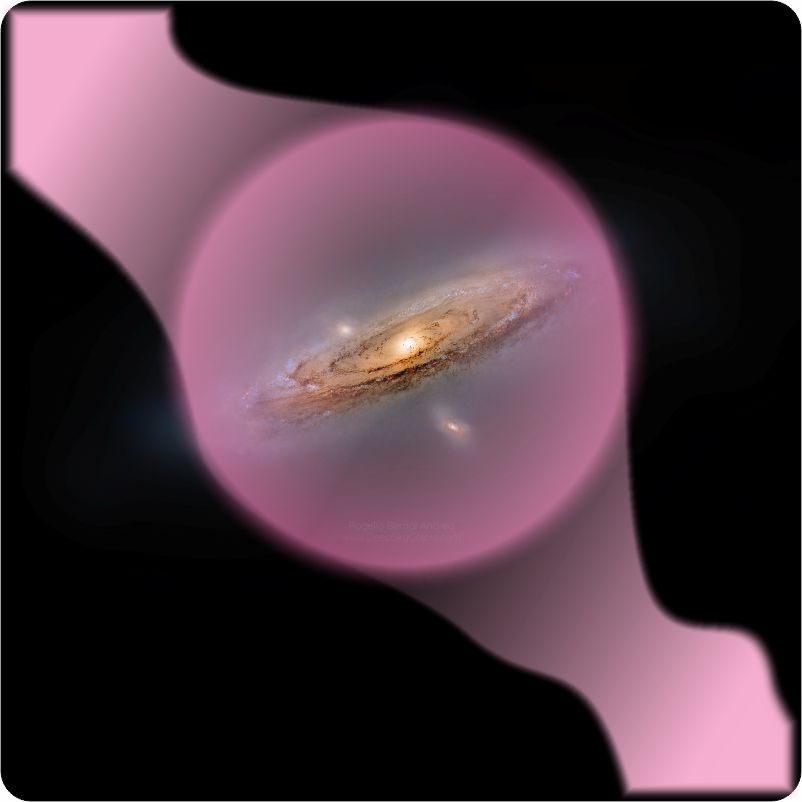
“No, because how can they know what that halo looks like? I mean, the whole thing with dark matter is that we can’t see it.”

“You’re right about that. Dark matter’s so transparent that even with five times more mass than normal matter, it doesn’t block CMB photons coming from 13.8 billion lightyears away. That still boggles my brain every once in a while. But dark matter’s gravitational effects — those we can see.”

“Yeah, I remember a long time ago we talked about Fritz Zwicky and Vera Rubin and how they told people about galaxies held together by too much gravity but nobody believed them.”

“Well, they did, after a while—”

“A long while, like a long while since those talks. Remind me what ‘too much gravity’ was about.”

“It was about conflicts between their observations and the prevailing theoretical models. Everyone thought that galaxies and galaxy clusters should operate pretty much like planetary orbits — your speed increases the closer you are to the center, up to Einstein’s speed limit. Newton’s Laws of Motion predict how fast you should move if you’re at a certain distance from a body with a certain mass. If you’re moving faster than that, you fly away.”

“Yeah, escape velocity. So the galaxies in Zwicky’s cluster didn’t follow Newton’s Laws?”

“They didn’t seem to. Galaxies that should have escaped were still in there. The only way he could explain the stability was to suppose the galaxies are only a small fraction of the cluster’s mass. Extra gravity from the extra mass must bind things together. Forty years later Rubin’s improved technology revealed that stars within galaxies had the same anomalous motion.”

“I’m guessing the ‘faster near the center’ rule didn’t hold, or else you wouldn’t be telling this story. Spun like a wheel, I bet.”

“When a wheel spins, every part of it rotates at the same angular speed, the same number of degrees per second, right?”

“Ahh, the bigger my circle the higher my airspeed so the rule would be ‘faster farther out’.”

“That’s the wheel rule, right, but Rubin’s data showed that stars within galaxies don’t obey that one either. She measured lots of stars in Andromeda and other galaxies. Their linear speeds, kilometers per second, are nearly identical from near the center all the way out. Even dust and gas clouds beyond the galactic starry edges also fit the ‘same linear speed everywhere’ rule. You’d lose the bet.”

“That just doesn’t feel right. How can just gravity make that happen?”

“It can if the right amount of dark matter’s distributed in the right‑shaped smeared‑out hollowed‑out spherical halo. The halo’s radial density profile looks about like this. Of course, profiles for different galaxies differ in spread‑outness and other details, but the models are pretty consistent.”

“Wait, if dark matter only does gravity like you said, why’s that hole in the middle? Why doesn’t everything just fall inward?”

“Dark matter has mass so it also has inertia, momentum and angular momentum, just as normal matter does. Suppose some of the dark matter has collected gravitationally into a blob and the blob is moving slower than escape velocity. If it’s flying straight at the center of gravity it’ll get there and stay there, more or less. But if the blob’s aimed in any other direction, it has angular momentum relative to the center. Momentum’s conserved for dark matter, too. The blob eventually goes into orbit and winds up as part of the shell.”

“Does Zwicky’s galaxy cluster have a halo, too?”

“Not in the same way. Each galaxy probably has its own halo but the galaxies are far apart relative to their size. The theoreticians have burned huge amounts of computer time simulating the chaos inside large ensembles of gravity‑driven blobs. I just read one paper about a 4‑billion‑particle calculation and mind you, a ‘particle’ in this study carried more than a million solar masses. Big halos host subhalos, with filaments of minihalos tying them together. What we can’t see is complicated, too.”

~ Rich Olcott

Five More Alternate Universes?

I unlock my office door and there’s Vinnie inside, looking out the window. “Your 12th‑floor view’s pretty nice, Sy. From above the tree tops you can see leaf buds just starting to show their early green colors.”

“What are you doing here, Vinnie? I thought you were charter‑flying to Vancouver.”

“The guy canceled. Said with all the on‑again, off‑again tariffs there’s no sense traveling to make a deal when he doesn’t know what he’s dealing with. So I got some time to think.”

“And you came here so it’s something physics‑technical.”

“Yeah, some. I notice colors a lot when I’m flying. Some of those trees down there this time of year are exactly the same bright yellow‑green as some of the rice paddies I’ve flown over. But all the trees get the same hard dark green by August before they go every different color when the chlorophyll fades away.”

I’ve noticed that. So you came here to talk about spectra?”

“Some other time. This time I want to talk about dark matter.”

“But we call it dark matter precisely because it doesn’t do light. All our normal matter is made of atoms and the atoms are made of electrons and nuclei and each nucleus is made of protons and neutrons and protons and neutrons are made of quarks. Electrons and quarks carry electrical charge. Anything with electrical charge is subject to electromagnetism, one way or another. Dark matter doesn’t notice electromagnetism. If dark matter had even the slightest interaction with light’s electromagnetic field, we wouldn’t be able to see galaxies billions of lightyears away.”

“Calm down, Sy, breath a couple times. Stay with me here. From your stuff and what else I’ve read, all we know about dark matter is a lot of things it isn’t or doesn’t do. The only force we know it respects is gravity so it attracts itself and also normal matter and they all clump up to make galaxies and such, right?”

<a bit reluctantly and on a rising note> “Mm‑hnn…?”

“I read your three‑part series about the Bullet Cluster, where we think two galaxy clusters went though each other and their gas clouds gave off a lot of X‑rays that didn’t match where the stars were or where the gravity was so the astronomers blame dark matter for the gravity, right?”

“That’s pretty much it. So?”

“So the other thing I got from that series was maybe there’s friction between dark matter and other dark matter, like it doesn’t just slide past itself. If dark matter is particles, maybe they’re sorta sticky and don’t bounce off each other like billiard balls. That doesn’t make sense if all they do is gravity.”

“I see where you’re going. You’re thinking that maybe dark matter feels some kind of force that’s not gravity or electromagnetism.”

“That’s it! We’ve got light photons carrying electromagnetic forces to hold our molecules and rocks together. Could there be dark photons carrying some dark‑sticky force to connect up dark molecules and dark rocks and stuff?”

“That’s an interesting—”

“I ain’t done yet, Sy. It gets better. I’ve read a bunch of articles saying there’s about five times as much dark matter in the Universe as normal matter. You physicists love symmetry, suppose it’s exactly five times as much. There’d be six kinds of force, one called electromagnetism and a different snooty force each for five kinds of dark matter and that’ll add up to the 25% we can’t see. Like, a purple dark force for purple dark rocks, naturally they’re not really purple, and a yellow dark force and so on.”

“You’re proposing that each kind of dark matter responds only to its own special force, so no cross‑communication?”

“Yup, gravity’s the only thing they’d all agree on. That bein’ the case, the galaxies would hold six times as many stars as we think, except 5/6 of them are invisible to our 1/6. Five alternate universes sharing space with ours. Cozy, huh?”

“Clever, Vinnie, except for the evidence that most galaxies are embedded in huge nearly‑spherical halos of dark matter. The halos would have collapsed long ago if only gravity and stickiness were in play.”

“Dang.”

~ Rich Olcott