
“One coffee, one latte and two scones, Cal. Next time is Cathleen’s turn. Hey, you’ve got a new poster behind the cash register. What are we looking at?”
“You like it, Sy? Built the file myself from pics in my astronomy magazines, used the Library’s large‑format printer for the frameable copy. Came out pretty well, didn’t it, Cathleen?”
“Mm‑hm. Sy, you should recognize the pebbly-looking one. It’s granules at the bottom of the Sun’s atmosphere. The image came from the Inouye Solar Telescope at Haleakala Observatory on Maui, probably Earth’s best ground‑based facility for studying the Sun. I showed the image to your niece in that phone call. For scale, those granules of super‑heated rising gas are each about the size of Texas.”
“My magazine article didn’t mention Texas but it said there’s about ten million granules. What it was mostly about was the IST and its resolution. Those edges in the picture are as narrow as 18 miles across. It’s that good ’cause the beast has a 4‑meter mirror, which used to be amazing, but they made it even better with active and adaptive optics.”
“Hmm. It’s obvious that the bigger the mirror, the better it is for catching photons. If someone’s going to build a big mirror they’re going to put it behind a big aperture, which is important for resolving points that are close together. But what are ‘active and adaptive optics’ and why did you say that like they’re two different things?”
” ‘Cause they are two different things, Sy. Different jobs, different time‑scales. Gravity here on Earth can make a big mirror sag, and the sag changes depending on where the machine is pointed and maybe part of it gets the wrong temperature. Active optics is about keeping the whole mirror in the right shape to focus the photons where they’re supposed to go. There’s a bunch of actuators rigged up to give adjustable support at different points behind the mirror. The astronomer tells the system to watch a certain guide point and there’s a computer that directs each actuator’s pushing to sharpen the point’s image.”
“And adaptive optics?”
“That’s about solving a different problem. Stars twinkle, right, and the reason they twinkle is because of the atmosphere. One part refracts light one way, another part maybe warmer or with different humidity sends the light another way. Everything moves second to second. By the time a light‑wave gets down to us it’s been jiggled a lot. Adaptive optics is a small mirror, also with a lot of actuators, placed up in the light path after the primary mirror. Again with a guide point and a computer, the little mirror’s job is to cancel the jiggles so the scope’s sensors see a smooth wave. Adaptive works a lot faster than active, which sounds backwards, but I guess active came first.”
“The granules must be in the Sun’s disk somewhere. The other two images look like they’re on the edge.”
“That’s right, Sy. The bottom one is from the Solar Dynamic Observatory satellite a few years ago. That’s not visible light, it’s EUV—”
“EUV?”
“Extreme UltraViolet, light‑waves too short even for hydrogen so it’s mostly from iron atoms heated to millions of degrees. SDO had to be a satellite to catch that part of the spectrum because the atmosphere absorbs it. Of course, up there there’s no need for active or adaptive optics but imaging EUV has its own problems.”
“How tall is that photogenic tree?”
“It’s a prominence. The article said it’s about twenty times Earth’s diameter.”
“What about the pink one?”
“That’s new, Cathleen, from another Maui telescope. Adaptive optics were in play but there’s a problem. If you’re probing inside the corona there’s no fixed guide point. The team focused their adjustment system on corona features where they were a few seconds ago. The article said the process was ‘tricky,’ but look at the results. The loop is about the size of Earth, and those fine lines are about the width of Vancouver Island. They discovered details no‑one’s ever seen before.”
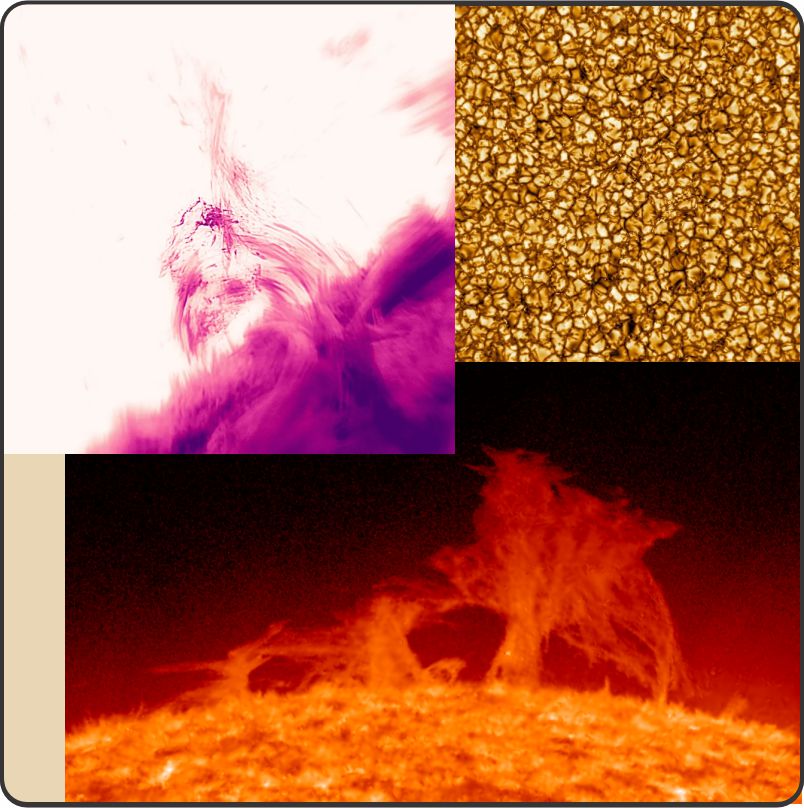
Top right: NSO/AURA/NSF under CC A4.0 Intl license;
Bottom: NASA/SDO
~ Rich Olcott
 Hard Science Ain't Hard
_as_of_January_20,_2020.jpg)
