“My usual cup of — Whoa! Jeremy, surprised to see you behind the counter here. Where’s Cal?”
“Hi, Mr Moire. Cal just got three new astronomy magazines in the same delivery so he’s over there bingeing. He said if I can handle the pizza place gelato stand he can trust me with his coffee and scones. I’m just happy to get another job ’cause things are extra tough back on the rez these days. Here’s your coffee, which flavor scone can I get for you?”
“Thanks, Jeremy. Smooth upsell. I’ll take a strawberry one. … Morning, Cal. Having fun?”
“Morning, Sy. Yeah, lotsa pretty pictures to look at. Funny coincidence, all three magazines have lists of coincidences. This one says February 23, 1987 we got a neutrino spike from supernova SN 1987A right after we saw its light. The coincidence told us that neutrinos fly almost fast as light so the neutrino’s mass gotta be pretty small. 1987’s also the year the Star Tours Disney park attractions opened for the Star Wars fans. The very same year Gene Roddenberry and the Paramount studio released the first episodes of Star Trek: The Next Generation. How about that?”
“Pretty good year.”
“Mm‑hm. Didja know here in 2025 we’ve got that Mercury‑Venus‑Jupiter-Saturn‑Uranus‑Neptune straight‑line arrangement up in the sky and sometimes the Moon lines up with it?”
“I’ve read about it.”
“Not only that, but right at the September equinox, Neptune’s gonna be in opposition. That means our rotation axis will be broadside to the Sun just as Neptune will be exactly behind us. It’ll be as close to us as it can get and it’s face‑on to the Sun so it’s gonna be at its brightest. Cool, huh?”
“Good time for Hubble Space Telescope to take another look at it.”
“Those oughta be awesome images. Here’s another coincidence — Virgo’s the September sign, mostly, and its brightest star is Spica. All the zodiac constellations are in the ecliptic plane where all the planet orbits are. Planets can get in the way between us and Spica. The last planet to do that was Venus in 1783. The next planet to do that will be Venus again, in 2197.”
“That’ll be a long wait. You’ve read off things we see from Earth. How about interesting coincidences out in the Universe?”
“Covered in this other magazine’s list. Hah, they mention 1987, too, no surprise. Ummm, in 2017 the Fermi satellite’s GRB instrument registered a gamma‑ray burst at the same time that LIGO caught a gravitational wave from the same direction. With both light and gravity in the picture they say it was two neutron stars colliding.”
“Another exercise in multi-messenger astronomy. Very cool.”
“Ummm … Galaxy NGC 3690 shot off two supernovas just a few months apart last year. Wait, that name’s familiar … Got it, it’s half of Arp 299. 299’s a pair of colliding galaxies so there’s a lot of gas and dust and stuff floating around to set off stars that are in the brink. If I remember right, we’ve seen about eight supers there since 2018.”
“Hmm, many events with a common cause. Makes sense.”
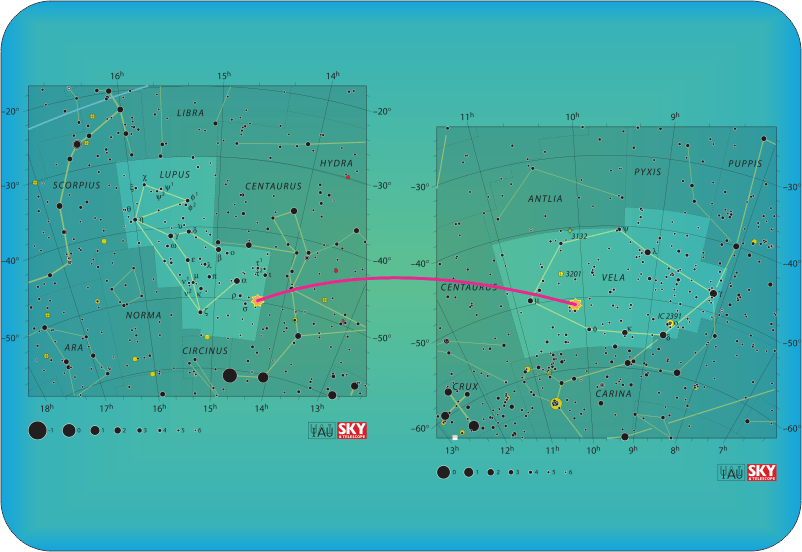
“Oh, it’s a nice idea, alright, but explain V462 Lupi and V572 Velorum. Just a couple months ago, two novas less than 2 weeks apart in two different constellations 20 degrees apart in the sky. Bright enough you could see ’em both with good eyes if you were below the Equator and knew where to look and looked in the first week of June. My skywatcher internet buddies down there went nuts.”
“How far are those events from us?”
“The magazine doesn’t say. Probably the astronomers are still working on it. Could be ten thousand lightyears, but I’d bet they’re a lot closer than that.”

“On average, visible stars are about 900 lightyears away. Twenty degrees would put them about 300 lightyears apart. They’re separated by a slew of stars that haven’t blown up. One or both could be farther away than that, naturally. Whatever, it’s hard to figure a coordinating cause for such a distant co‑occurrence. Sometimes a coincidence is just a coincidence.”

~ Rich Olcott
 Hard Science Ain't Hard