Vinnie gives me the side‑eye. “Wait, Sy. Back there you said Maxwell got the speed of light from the properties of space. What does any of that even mean?”
“Do you remember Newton’s equation for the force of gravity between two objects?”
“Of course not. Lessee… the force’d be bigger when either one gets bigger, and it’d get smaller when the distance between ’em gets bigger and there’s some constant number to make the units right, right?”
“Close enough, it’s the distance squared. The equation’s F=Gm1m2/r². The G is the constant you mentioned. It does more than turn mass‑units times mass‑units divided by length‑units‑squared into force‑units. It says how many force‑units. For one pair of objects at a certain distance, turn the G‑dial up and you get more force. Make sense?”
“Yeah, that looks right.”
“The value of G sets the force‑distance scale for how two objects attract each other everywhere in the Universe. That value is a property of space. So is the fact that the value is the same in all directions.”
“Huh! Never thought of it like a scale factor. Space has other properties like that?”
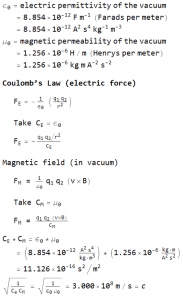
“Certainly. Coulomb’s Law for the electrostatic force between two charged objects has the same basic structure, FE=–(q1q2/r²)/CE. In any units you like you replace the q‘s with object charge amounts and r with the distance between them. For each set of change‑ and distance‑units there’s a well‑researched value of CE to convert your charge and distance numbers into force‑units. Under the covers, though, CE is a scale factor that controls the range of the electrostatic force. It’s the same everywhere in the Universe and it’s completely independent of Newton’s gravity scale factor.”
“Hey, what about ‘like charges repel, opposites attract’?”
“That’s what the minus sign’s in there for. If the q‘s have the same charge, the force is negative, that’s repulsion; opposite charges make for positive, attractive force.”
“If there’s a CE for electric there’s gotta be a CM for magnetic.”
“Sort of. The electrostatic force doesn’t care about direction. Magnetism does care so the equation’s more complicated. You’re right, though, there is a similar universal scale factor we might as well call CM.”
<chuckle> “Electric, magnetic, I don’t suppose we could mix those two somehow for an electromagnetic scale factor?”
<grin> “Did you read ahead in the book? Yes we can, and Maxwell’s equations showed us how. If you multiply the two C‘s together, you get one over the square of the speed of light. Re‑arranging a little, c=√(1/CECM), so c, the electromagnetic scale factor for velocity, is based on those space properties. Einstein showed that no material object can have a velocity greater than c.”
“I’ll take your word for the arithmetic, but how does that combination make for a speed limit?”
“There’s an easy answer you’re not going to like — it’s a speed because the units come out meters per second.”
“That’s a cheat. I don’t like it at all and it doesn’t account for the limit part. Explain it with Physics, no fancy equations.”
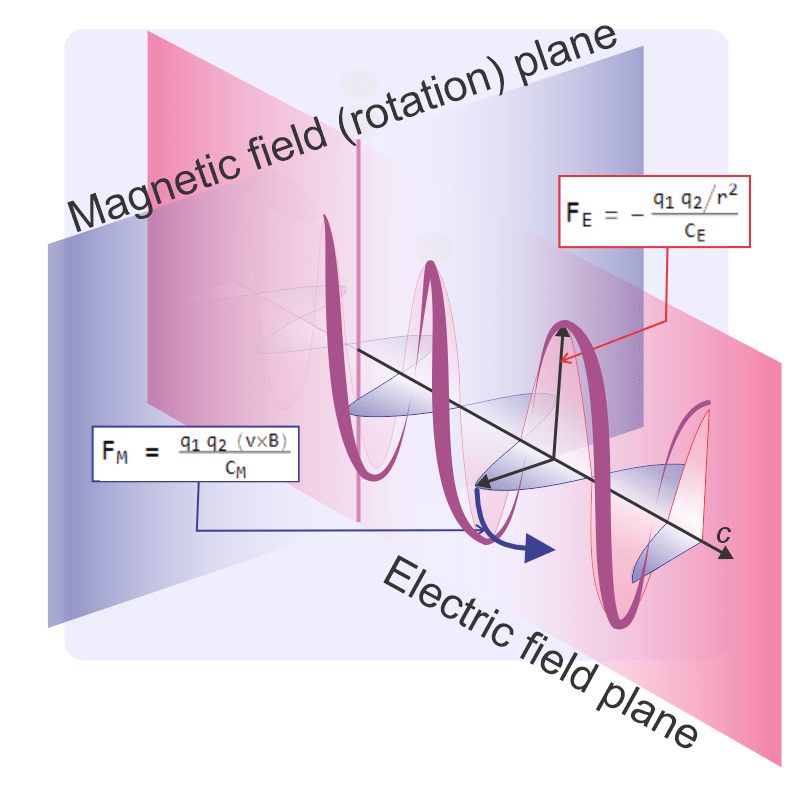
“Tough assignment. Okay, typical waves have a displacement force, like wind or something pushing up on an ocean wave, that works against a restoring force, such as gravity pulling down. Electromagnetic waves are different. The electric component supplies the up force, but the magnetic component twists sideways instead of restoring down. The wave travels as a helix. The CE and CM properties determine how tightly it spirals through space. That’s lightspeed.”
“And the limit part?”
“Einstein maintained that anything that happens must follow the same rules for all observers no matter how each is moving. The only way that can be true is if space is subject to the Lorentz contraction √[1-(v/vmax)²] for some universal maximum speed vmax. Maxwell’s electromagnetism equations showed that vmax is c. Okay?”
“I suppose.”
~ Rich Olcott
- * Vinnie hates equations even with regular letters, Greek letters make it worse. Hence my using CE and CM instead of the conventional ε0 and μ0 notation. Sue me.
 Hard Science Ain't Hard