Was Ramses Pharaoh-magnetic?

Kareem puts in another couple of chips. “Hold your horses, Cal. The conversation‘s just getting interesting.”

Vinnie raises him a few chips. “Hey, Mr Geology. Just how rare are these lanthanide rare earths? And if they’re metals, how come they’re called earths?”
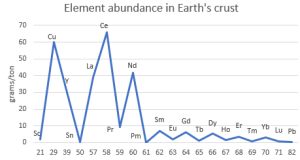
“Not that rare.” <pulls up an image on his phone> “Here’s a quick abundance chart for the lanthanides and a few other elements averaged over all of Earth’s continental crust. Cerium’s more abundant than copper and 350 times more common than lead. Of course, that’s an average. Lanthanide concentrations in economically viable ores are much higher, just like with copper, lead, tin and other important non‑ferrous metals.”

“Funny zig-zag pattern there.”

“Good catch, Cal. Even‑number elements are generally more abundant than their odd‑numbered neighbors. That’s the Oddo-Harkins Rule in action—”

ODDo-Harkins, haw!”

“You’re—” <Susan’s catches Vinnie’s frown and quickly drops few chips onto the pile> “Sorry, Vinnie. You’re not the first person to flag that pun. Two meteorite chemists named Giuseppe Oddo and William Harkins developed the rule a century ago. We’re pretty sure the pattern has to do with how stars fuse even‑numbered alpha particles to build up the elements heavier than hydrogen and helium. As to why the rare earths are called earths, back when Chemistry was just splitting away from alchemy, an ‘earth‘ was any crumbly mineral. Anybody heard of diatomaceous earth?”

Cal perks up. “Yeah, I got a bag of that dust in my garden shed to kill off slugs.”

“Mm‑hm. Powdery, mostly silica with some clay and iron oxide. The original ‘earth’ definition eventually morphed to denote minerals that dissolve in acid” <grin> “which diatomaceous earth doesn’t do. A few favorable Scandinavian mines gave the Swedish chemists lanthanide‑enriched ores to work on. Strictly speaking, in metallic form the lanthanides are rare earth metals, not rare earths, but people get sloppy.”

Eddie pitches in some chips. “So they’re <snort> chemical odd‑ities. Why would anyone but a chemist care about them?”
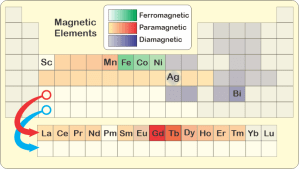
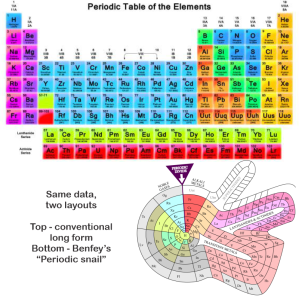
<sigh> “Magnetism.” <shows her laptop’s screen> “Here’s a chart that highlights the elements that are most magnetically active. The lanthanides are that colored strip below the main table. Chemically they’d all fit into that box with the red circle. They’re—”

“Wait, there’s more than one kind of magnetism?”

“Oh, yes. The distinction’s about how an element or material interacts with an external magnetic field. Most elements are at least weakly paramagnetic, which means they’re pulled into the field; diamagnets push away from it. Diamagnetic reaction is generally far weaker. Manganese is the strongest paramagnet, about 70 times stronger per atom than the strongest diamagnet, bismuth. Then there’s iron, cobalt and nickel — they do ferromagnetism, which means their atoms interact so strongly with the field that they get their neighbors to join in and make a permanent magnet.”
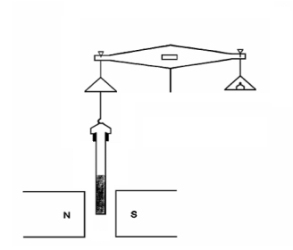
Schematic of a Gouy Balance

“How does anyone find out whether the field’s pulling or pushing?”

“Good question, Cal (you owe the pot, by the way). Basically, the idea is to somehow weigh a sample both with and without a surrounding field. Tammy’s lab down the hall from me has a nice Gouy Balance setup which is one way to make that measurement. The balance stands on a counter over a hole that leads down to a hollow glass tube that guards against air currents. There’s also a big powerful permanent magnet down there, mounted on a hinged arrangement. Your sample hangs on a piece of fishline hooked to the balance pan. Take a weight reading, swing the magnet into position just below the sample, read the weight again, do some arithmetic and you’re done. A higher weight reading when the field’s in place means your sample’s paramagnetic, less weight means it’s diamagnetic.”

“Why does that Ag box look weird in your table, sort of half‑brown and half‑gray?”

“That’s silver, Eddie. It’s an edge case. The pure metal’s diamagnetic but alloy a sample with even a small fraction of some ferromagnetic atoms and you’ve made it paramagnetic. Magnetism’s one test that people in the silver trade use to check if a coin or bar is pure. How that works isn’t my field. Sy, it’s your turn to bet and explain.”

~ Rich Olcott
That Lump in The Table

The Acme Building Science and Pizza Society is back in session. It’s Cal’s turn to deal the cards and the topic. “This TV guy was talking about rare earths that China’s got a lock on and it’s gonna mess up our economy, but he didn’t say what they are or why we should care about them. What’s goin’ on?”

Vinnie passes but Susan tosses a chip into the pot. “The rare earths are oxides of the lanthanide elements—”

“Wait, they’re from the planet that the Strange New Worlds engineering prof is from?”

“Put in a chip, Vinnie, you know the rules.” <He does.> “No, they have nothing to do with Pelia or her home planet. She’s a Lanthanite, these elements are lanthanides. Although these days we’re supposed to call them lanthanoids because ‑ides are ionic compounds like oxides.”

It’s not Kareem’s turn yet but he chuckles and flips in a chip. “Funny. The geology community settled on meteoroids as rocks floating in space, meteors when they flash through the sky, and meteorites when they hit the ground. I don’t think there’s such a thing as a meteoride. Sorry, Susan, go on.”

“As a matter of fact, Kareem, I once did a high‑rated downhill mountain bike path in Arizona called the Meteoride. Once. Didn’t wipe out but I admit I used my brakes a whole lot. Where was I? Oh, yes, the lanthanides. They’re a set of fourteen near‑identical twins, chemistry so similar that it took decades of heroic effort by 19th‑century Swedish chemists in the long, cold Swedish nights to separate and identify them.”

“Similar how?”

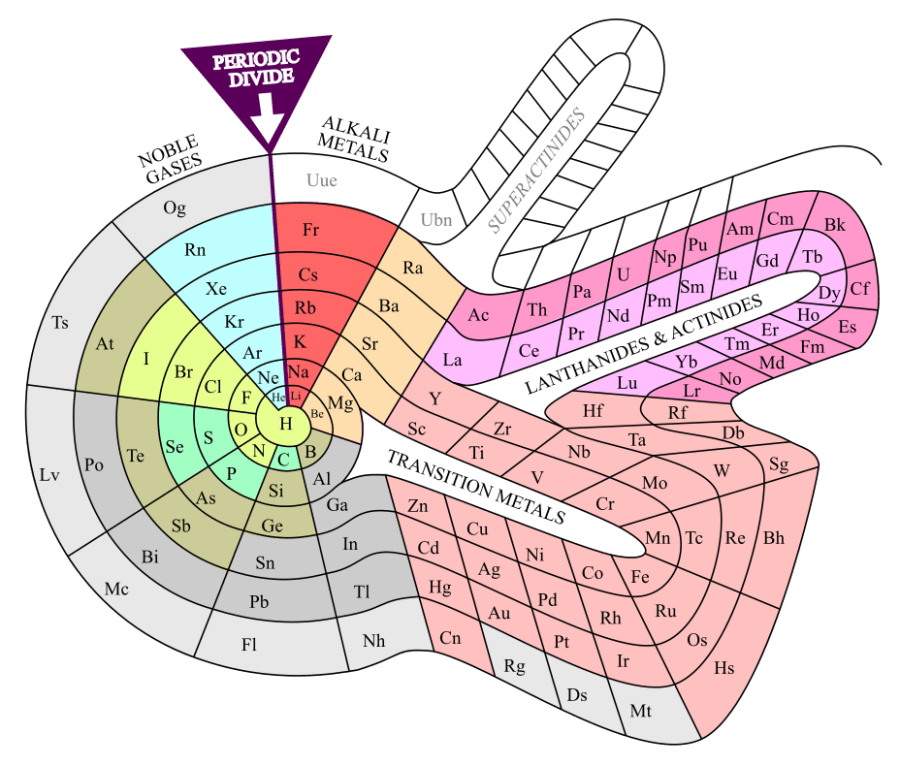
“They all act like aluminum.” <pulls laptop from her purse, points to two stickers on its lid> “You’ve all at least heard of the Periodic Table, right? Back in the mid-1800s, the chemists had isolated dozens of chemical elements, enough that they could start classifying them. They didn’t know what atoms were yet but they had developed ways to measure average atomic weights. Some theorists played with the idea of arranging elements with similar chemistries according to their atomic weights. Mendeleev did the best job, even predicting three elements to fill empty slots in his tabulation. These guys in the lime green row and the pale pink bulge were his biggest puzzlement.”

“Why’s that? They’re all spread out nice.”

“Because like I said, Vinnie, they all have pretty much the same chemistry. Aluminum’s a soft silvery metal, oxidizes readily to a 3+ ion and stays there. Same for almost all the lanthanides. Worse yet, all their atoms are nearly the same size, less than 8% difference from the largest to the smallest.”

“Why’s that make a difference?”

“Because they can all fit into the same crystalline structure. Nineteenth‑century chemistry’s primary technique for isolating a metallic element was to dissolve a likely‑looking ore, purify the solution, add an organic acid or something to make crystalline salts, burn away the organics, add more acid to dissolve the ash, purify the solution and re‑crystallize most it. Do that again and again until you have a provably pure product. All the lanthanide ions have the same charge and nearly the same size so the wrong ions could maliciously infiltrate your crystals. It took a lot of ingenious purification steps to isolate each element. There were many false claims.”

Kareem contributes another chip. “Mm‑hm, because geology doesn’t use chemically pure materials to create its ores. Four billion years ago when our planet was coated with molten magma, the asteroids striking Earth in the Late Heavy Bombardment brought megatons of stone‑making lithophile elements. The lanthanides are lithophiles so random mixtures of them tended to concentrate within lithic silicate and phosphate blobs that later cooled to form rocky ores. Industry‑scale operations can tease lanthanides out of ores but the processes use fierce chemicals and require close control of temperature and acidity. Tricky procedures that the Chinese spent billions and decades to get right. For the Chinese, those processes are precious national security assets.”

Cal’s getting impatient. “Hey, guys, are we playing cards or what?”

~ Rich Olcott

A Cosmological Horse Race

A crisp Fall day, perfect for a brisk walk around the park. I see why the geese are huddled at the center of the lake — Mr Feder, not their best friend, is on patrol again. Then he spots me. “Hey, Moire, I gotta question!”

“Of course you do, Mr Feder. What is it?”

“Some guy on TV said Einstein proved gravity goes at the speed of light and if the Sun suddenly went away it’d take eight minutes before we went flying off into space. Did Einstein really say that? Why’d he say that? Was the TV guy right? And what would us flying across space feel like?”

“I’ll say this, Mr Feder, you’re true to form. Let’s see… Einstein didn’t quite prove it, the TV fellow was right, and we’d notice being cold and in the dark well before we’d notice we’d left orbit. As to why, that’s a longer story. Walk along with me.”

“Okay, but not too fast. What’s not quite about Einstein’s proving?”

“Physicists like proofs that use dependable mathematical methods to get from experimentally-tested principles, like conservation of energy, to some result they can trust. We’ve been that way since Galileo used experiments to overturn Aristotle’s pure‑thought methodology. When Einstein linked gravity to light the linkage was more like poetry. Beautiful poetry, though.”

“What’s so beautiful about something like that?”

“All the rhymes, Mr Feder, all the rhymes. Both gravity and light get less intense with the square of the distance. Gravity and light have the same kinds of symmetries—”

“What the heck does that mean?”

“If an object or system has symmetry, you can execute certain operations on it yet make no apparent difference. Rotate a square by 90° and it looks just the same. Gravity and light both have spherical symmetry. At a given distance from a source, the field intensity’s the same no matter what direction you are from the source. Because of other symmetries they both obey conservation of momentum and conservation of energy. In the late 1890s researchers found Lorentz symmetry in Maxwell’s equations governing light’s behavior.”

“You’re gonna have to explain that Lorentz thing.”

Lorentz symmetry has to do with phenomena an observer sees near an object when their speed relative to the object approaches some threshold. Einstein’s Special Relativity theory predicted that gravity would also have Lorentz symmetry. Observations showed he was right.”

“So they both do Lorentz stuff. That makes them the same?”

“Oh, no, completely different physics but they share the same underlying structure. Maxwell’s equations say that light’s threshold is lightspeed.”

“Gravity does lightspeed, too, I suppose.”

“There were arguments about that. Einstein said beauty demands that both use the same threshold. Other people said, ‘Prove it.’ The strongest argument in his favor at the time was rough, indirect, complicated, and had to do with fine details of Earth’s orbit around the Sun. Half a century later pulsar timing data gave us an improved measurement, still indirect and complicated. This one showed gravity’s threshold to be with 0.2% of lightspeed.”

“Anything direct like I could understand it?”

“How about a straight‑up horse race? In 2017, the LIGO facility picked up a gravitational signal that came in at the same time that optical and gamma ray observatories recorded pulses from the same source, a colliding pair of neutron stars in a galaxy 130 million lightyears away. A long track, right?”

“Waves, not horses, but how far apart were the signals?”

“Close enough that the measured speed of gravity is within 10–15 of the speed of light.”

“A photo-finish.”

“Nice pun, Mr Feder. We’re about 8½ light-minutes away from the Sun so we’re also 8½ gravity-minutes from the Sun. As the TV announcer said, if the Sun were to suddenly dematerialize then Earth would lose the Sun’s orbital attraction 8½ minutes later. We as individuals wouldn’t go floating off into space, though. Earth’s gravity would still hold us close as the whole darkened, cooling planet leaves orbit and heads outward.”

“I like it better staying close to home.”

~ Rich Olcott

Why No Purple?

<ding/ding/ding> <yawn> “Who’s texting me at this time of night?”

This better be good.

At this hour? Of course you did, Teena. What’s going on?

Well, I’m awake. What’s the question?

Whoa! That’s not really an either‑or proposition. Energy is continuous, but the energy differences that atoms/molecules respond to are stepwise. You get continuous white light from hot objects like stars and welding torches.
If white light passes a hydrogen atom, the atom will only absorb certain specific frequencies (frequency is a measure of energy).

Yes, except they don’t bounce off, they pass by.

Mostly, though the usual sequence read ‘upward’ in energy is radio, microwave, infrared, red, orange, yellow, green, blue, violet, ultraviolet, X-rays, gamma rays.
White is an even mixture of all frequencies.

Mmm?

Ah, what you’re really looking at is variation in fuel/air mixture (and possibly which fuel — I’ll get to that).
A rich methane mixture (not much oxygen, like a shuttered Bunsen burner) doesn’t get very hot, has lots of unburnt carbon particles and looks orange. Add more oxygen and the flame gets hotter, no more soot particles, just isolated CO, CO2, and water molecules, each of which gets excited to flame temp and then radiates light but only at its own characteristic frequencies. Switch to acetylene fuel and the flame gets hotter still because C2H2+O2 reactions give off more energy per molecule than CH4+O2. Now you’re in plasma temperature range, where free electrons can emit whatever frequency they feel like.

Sunsets are a whole other thing — the sun’s white light is transformed in various ways as it filters through dust and such in the atmosphere. Anyway, no flame or atom/molecule excitation in a sunset

Yes, but in each of these cases the *source* is different — soot particles, excited molecules, plasma.

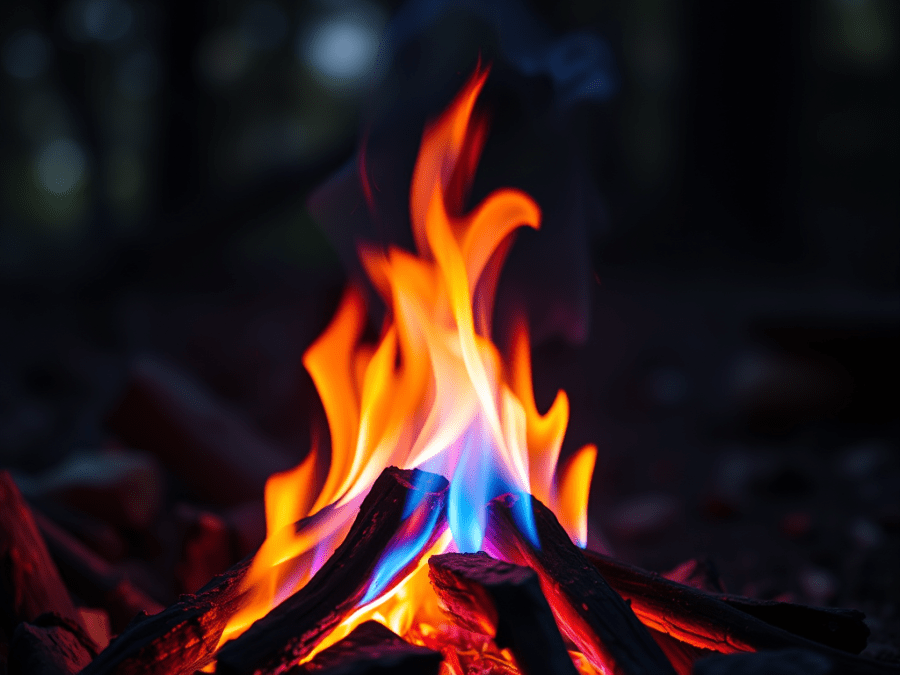
The campfire has several different processes going on. Close in, the heated wood emits various gases. The gases reacting with O2 *are* the flame, generally orange to yellow from excited molecules but you can get blue where the local ventilation forms a jet and brings in extra oxygen for an efficient flame. Further out it’s back to red-hot soot.

To your original question — this is a hypothesis, but I suspect the particular atoms and molecules emitted from untreated burning wood simply don’t have any strong emissions lines in the green region. I know there aren’t for any hydrogen atoms — look up “Balmer series” in wikipedia.

*spectra
Right.
As you said, you could throw in copper or sodium salts to get those blue and golden colors.

G’night, Teena.
Now get to bed.

~ Rich Olcott

  • Thanks to Alex, who wrote much of this.