Cozy Numbers

If you’ve followed this blog for more than a year (in which case, thanks), you’ve probably noticed that I like numbers. As a kid I got a thrill when I figured out why (111 111 111)² is the amazingly symmetrical 12 345 678 987 654 321. Like many other numberphiles I’m fascinated by special categories like primes (no divisor other than unity and the number itself) and figurate numbers (counting the dots that make a geometrical pattern like concentric hexagons).

Every number has charms of its own (2025 is a delicious example), but 2026 doesn’t seem like it’s particularly special. 2026 is 2×10¹³, so it’s not prime nor is it the square or power of some smaller number. It’s not palindromic like 1991 and 2002 are. In binary it’s 111 1110 10102 — not very interesting. It can be written as 201013 , which is just silly. But 2026 does turn out to be special, in a special way — it’s a Beprisque number and they’re rare.

The On-line Encyclopedia of Integer Sequences®, a.k.a. OEIS, does for whole numbers what Bartlett’s Familiar Quotations does for words: it’s a venerable compendium of usage in context, with citations. An OEIS search for “2026” found 270 sequences that include the number. Most are technical or abstruse to a fault. Entry A118454, for example, identifies 2026 as the algebraic degree of the onset of the logistic map’s 11th bifurcation. Don’t ask.

Among my search hits was A216840, “palindromic numbers of 3 digits in two bases.” It’s cool that 202610 is bcb13 and also a4a14. Unfortunately, my math software’s number‑base converter has only 36 available digits (0‑9, a‑z) so it can’t display numbers in base‑37 or worse.

My favorite entry in the set is A163492: Beprisque numbers are integers such that their two immediate neighbors on the number line are a perfect square and a prime. 10 is Beprisque because it’s nestled between 9=3² and 11 (a prime). So is 2026, sitting between 2025=45² and 2027 (prime).

“Beprisque” — looks kind of French, doesn’t it? Maybe named after one of those 18th century scientist‑aristocrats that Robespierre killed off? Nope, it’s simply a mash‑up of “between prime and square.”

This being a New Year post, I couldn’t resist mentioning the New Year monkey. Every year the financial press services trot the poor thing out, give it a handful of darts with instructions to fling them it at the Wall Street Journal‘s stock listing or some such. The monkey’s acumen is assessed by how much its dart‑selected equities have grown (or not) over the past year. Usually the monkey’s score rates near or even better than that of the “professional” stock pickers, which is supposed to tell us something.

Suppose we were to direct the monkey to toss its darts at the number line. How well would it do at hitting Beprisque numbers? How dense are the primes and squares and what are the odds that one from one category is exactly two seats away from one from the other?

It depends on how much of the line the monkey can aim at. The range between 1 and 100 has 10 squares (10% coverage), 25 primes (25% coverage) and 9 Beprisques (1, 2, 3, 8, 10, 24, 48, 80, 82). Nine out of a hundred is 9% coverage; looks good. But widen the range to 1000 and the coverages drop — 31 squares (3%), 168 primes (17%) and 17 Beprisques — 10 times the range but fewer than twice the hits. Extend the number line to 1 000 000 and the percentages get even worse: 0.1% squares, 7.9% primes and only 0.022 6% Beprisques. The Beprisque coverage drops to 0.007 2% if the monkey’s target range shifts to the span between one and two million.

Why so few? On the average primes are further apart for bigger numbers because the prime count grows about 15% more slowly than the range does. Meanwhile, the separation between successive squares grows linearly as the squared number increases:
  (n+1)² – n² = n²+2n+1 – n² = 2n+1
The two trends conspire to thin out those cozy sequences. Give the poor monkey an infinite range and its odds on a square‑Beprisque‑prime triplet evaporate like a certain team’s championship hopes.

~ Rich Olcott

Does Tomorrow Exist?

Power’s back on. The elevator lets us out on the second floor where we proceed into Eddie’s Pizza Place. We order, find a table, and Cathleen cocks an eyebrow. “So, Anne, you’re a time‑traveler?”

“Lots of dimensions, actually. Time, space, probability… Once I accidentally jumped into a Universe where the speed of light was a lot slower. I was floating near a planet in a small system whose sun flared up but it took a long, long time for the flash to reflect off the planet behind me. Funny, I felt stiffer than usual. It was a lot harder to move my arms. I avoid cruising dimensions like that one.”

<The other eyebrow goes up> “Wait, what’s the speed of light got to do with dimensions? And why would it affect moving your arms?”

My cue. “Physics has a long‑standing problem with the speed of light and a dozen or so other fundamental numbers like Newton’s gravitational constant and Einstein’s cosmological constant. We can measure them but we can’t explain why they have the values they do. Okay, the speed of light depends on electric and magnetic force constants, but we can’t explain those, either — the rabbit hole just gets deeper. In practice, our Laws of Physics are a set of equations with blanks for plugging in the measured values. People have suggested that there’s a plethora of alternate universes with the same laws of physics we have but whose fundamental constants can vary from ours. Apparently Anne traveled along a dimension that connects universes with differing values of lightspeed.”

“I suppose. … But the arm‑moving part?”

“An effect of Special Relativity. Newton’s Second Law a=F/m says that an object’s acceleration equals the applied force per unit mass. That works fine in every‑day life but not when the object’s velocity gets close to lightspeed.” <jotting on a paper napkin> “I don’t see Vinnie nearby so here’s the relativistic equation: a=(F/m)×√[1–(v/c)²]. The v/c ratio compares object velocity to lightspeed. The Lorentz factor, that square root, is less than 1.0 for velocities less than lightspeed. This formula says a given amount of force per unit mass produces less acceleration than Newton would expect. How much less depends on how fast you’re already going. In fact, the acceleration boost approaches zero when v approaches c. With me?”

“If your factor’s exactly zero, then even an infinite force couldn’t accelerate you, right? But what’s all that got to do with my arm?”

“Zero acceleration, mm‑hm. Suppose your arm’s rest mass and muscle force per unit mass are the same in the slow‑light universe as they are in ours. The Lorentz factor’s different. Lightspeed in our Universe is 3×10⁸ m/s. Suppose you wave your arm at 10 m/s. Your Lorentz factor here is √[1–(10/3×108)²] which is so close to unity we couldn’t measure the difference. Now suppose ‘over there’ the lightspeed is 20 m/s and you try the same wave. The Lorentz formula works out to √[1–(10/20)²] or about 85%. That wave would cost you about 15% more effort.”

<Both eyebrows down> “Have you tried going forward in time?”

“Sure, but I can’t get very far. It’s like I’ve got an anchor ‘here.’ I can move back ‘here’ from the past, no problem, but when I try to move forward from ‘here’ even a day or so … It’s hard to describe but as I go everything feels fuzzier and then I get queasy and have to stop. Do you have an explanation for that, Sy?”

“Well, an explanation but I can’t tell you it’s correct. Einstein thought it conflicts with Relativity, other people disagree. According to the growing block theory of time, the past and present are set and unchanging but the future doesn’t exist until we get there. Your description sounds like a build on that theory, like maybe the big structures extend a bit beyond us but their quantum details are still chaotic until time catches up with them. There are a few reports of lab experiments that would be consistent with something like that but it’s early days in the research.”

“As the saying goes, ‘Time will tell,’ right, Sy?”

“Mm-hm, lo que será, será.

~ Rich Olcott

A Shot Through The Dark

<THUNK!!> “Oh, dear. Is this the same elevator that you and Vinnie got trapped in, Sy?”

“Afraid so, Cathleen, but at least we had lights. This looks like a power outage, not a stuck door mechanism. Calling the building super probably won’t help. Hope you’re okay being stuck in the dark.”

“I’m an astronomer, Sy. A dark night’s my best thing. Remember the time we got locked with no light in my Mom’s closet?”

<chuckle> “Mm-hm. It was our pretend spaceship to Mars. We had no idea that closet had a catch we couldn’t reach. We were stuck there until your Mom came home. <sigh> We’ll have to wait ’til power comes back.”

<FZzzzzttPOP!!> … <then a voice like molten silver> “Oh, there you are, Sy! I’ve been looking all over for you. Who’s this?”

“Been a while, Anne. This is Cathleen. Cathleen, meet Anne. Anne’s an … explorer.”

“Ooo, where do you explore? For that matter, how did you get in here, and why is your dress (is it satin?) glowing like that?”

“Yes, it is satin, at the moment. It figures out whatever I need and makes that happen. It’s glowing because we’re in the dark.”

“I suspect your dress saved you when you met anti‑Anne.”

“Auntie Anne?”

“No, Cathleen, anti‑Anne, another me in the anti‑Universe. You might be right, Sy. It would have held anti‑Earth’s anti‑atoms away long enough for me to escape annihilation. Maybe I should explain.”

“I wish you would.”

“Wellll, I’ve got this super‑power for jumping across spacetime. Sy helped me calibrate my jumps and we even worked out how I can change size and use entropy to navigate between probabilities. So I explore everywhere and everywhen and that’s how I got into this elevator.” <brief fizzing sound> “Don’t worry, power will be back on soon but we’ve got time for Sy to explain my most recent experience.”

“Ah‑boy, now what?”

“Well, it seemed like a fun thing to do — go back to the earliest time I could, maybe even watch the Big Bang. I did some reading so I had an idea of what to expect as I dove down the time axis — gas clouds collapsing with glittering bursts of star formation, stars collecting into galaxies, galaxies streaming by like granular gas — so beautiful, especially because I can tweak my time rate and watch it all in motion!”

“And did you see all that?”

“Oh, yes, but then I hit a wall I couldn’t get past and I don’t understand why.”

“What were things like just before you hit the wall?”

“This was just beyond when I saw the very first stars turning on. There were vague clouds glowing here and there but basically the Universe became pitch black, no light at all for a while until the background started to glow with a very deep red just before I was blocked.”

“Ah. Cathleen, this is more your bailiwick than mine. Anne, Cathleen teaches Astronomy and Cosmology.”

“Just as a check, Anne, do you know exactly how far into the past you got?”

“Sorry, no. My time sense is pretty well calibrated for hours‑to‑centuries but this was billions of years. You probably know when I was better than I do.”

“On the evidence, I’d say you got 99.98% of the way back to your goal, nearly to the beginning of the Dark Age.”

“Dark Age? I’ve been there — 10th‑century Earth, bad times for everyone unless you were at the top of the heap but you wouldn’t stay there long. But I was too far out in space to see Earth. I couldn’t even pick out the Milky Way.”

“No, this was the Universe’s Dark Age, a couple hundred million years between when atoms formed and stars formed. Nothing could make new light. The Dark Age started at Big Bang plus 370 000 years when temperature cooled to 4000 K. The dark red you saw everywhere was atoms emitting blackbody radiation at 4000 K. Just 0.01% further into the past, the Universe was a billion‑degree quark plasma where not even atoms could survive. No wonder your dress wouldn’t let you enter.”

<THUNK!!> “Oh, good, power’s back on. We have light again!”

~ Rich Olcott

It’s All About The Coupling

The game‘s over but there’s still pizza on the table so Eddie picks up the conversation. “So if gadolinoleum has even more unpaired electrons than iron, how come it’s not ferromagnetic like iron is?”

Vinnie’s tidying up the chips he just won. “I bet I know part of it, Eddie. Sy and me, we talked about magnetic domains some years ago. If I remember right, each iron atom in a chunk is a tiny little magnet, which I guess is the fault of its five unpaired electrons, but usually the atom magnets are pointing in all different directions so they all average out and the whole chunk doesn’t have a field. If you stroke the chunk with a magnet, that collects the little magnets into domains and the whole thing gets magnetic. How come gadomonium” <winks at Eddie, Eddie winks back> “doesn’t play the domain game, Susan?”

“It’s gadolinium, boys, please. As to the why, part’s at the atom level and part’s higher up. My lab neighbor Tammy schooled me on rare earth magnetism just last week. She does high‑temperature solid state chemistry with lanthanide‑containing materials. Anyway, she says it’s all about coupling.”

“I hope she told you more than that.”

“She did. Say you’ve got a single gadolinium atom floating in space. Its environment is spherically symmetrical, no special direction to organize the wave‑orbitals hosting unpaired charges. Now turn on a magnetic field to tell the atom which way is up, call that the z‑axis. The atom’s wave‑orbital with zero angular momentum orients along z. Six more wave‑orbitals with non‑zero angular momentum spin one way or the other at various angles to the z‑axis. Those charges in motion build the atom’s personal magnetic field.”

“But we’re on Earth, not in space.”

“Bear with me. First, as a chemist I must say that most of the transition and lanthanide elements happily lose two electrons so in general we’re dealing with ions. Before you ask, Vinnie, that goes even for metals where the ions float in an electron sea. When Tammy said ‘coupling’ she was talking about how strongly one ion feels the neighboring fields. Iron and other ferromagnetic materials have a strong coupling, much stronger than the paramagnetics do.”

“Why’s the ferro- coupling so much stronger?”

“Two effects. You can read both of them right off the Periodic Table. Physical size, for one. Each row down in the table represents one electronic shell which takes up space. The atom or ion in any row is bigger than the ones above it. Yes, the heavy elements have more nuclear charge to pull electronic charge close, but shielding from their completed lower shells lets the outer charge cloud expand. Tammy told me that gadolinium’s ions are about 20% wider than iron’s.”

“Makes sense — you make the ions get further apart, they won’t connect so good. What’s the other effect?”

“It’s about how each orbital distributes its charge. There are tradeoffs between shell number, angular momentum and distance from the nucleus. Unpaired charge concentration in gadolinium’s high‑momentum 4f‑orbitals on the average stays inside of all its 3‑shell waves. The outermost charge shelters the unpaired waves inside it. That weakens magnetic coupling with unpaired charge in neighboring ions. Bottom line — gadolinium and its cousins are paramagnetic because they’re bigger and less sensitive than ferromagnetic iron is.”

“Then how come rare earth supermagnets the Chinese make are better than the cheapie ironic kinds we can make here?”

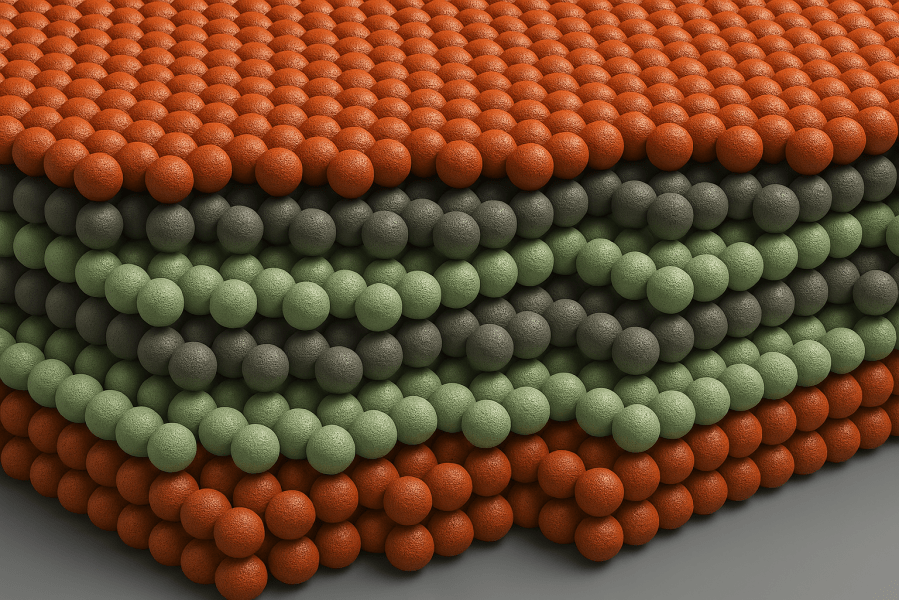
“The key is getting the right atoms into the right places in a crystalline solid. Neodymium magnets, for instance, have clusters of iron atoms around each lanthanide. The cluster arrangement aligns everyone’s z‑axes letting the unpaired charges gang up big‑time. You find materials like that mostly by luck and persistence. Tammy’s best samples are multi‑element oxides that arrange themselves in planar layers. Pick a component just 1% off the ideal size or cook your mixture with the wrong temperature sequence and the structure has completely different properties. Chinese scientists worked decades to perfect their recipes. USA chose to starve research in that area.”

~ Rich Olcott

Flipping An Edge Case

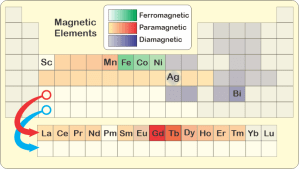
“Why’s the Ag box look weird in your chart, Susan?”

“That’s silver, Eddie. It’s an edge case. The pure metal’s diamagnetic. If you alloy silver with even a small amount of iron, the mixture is paramagnetic. How that works isn’t my field. Sy, it’s your turn to bet and explain.”

I match Eddie’s bet (the hand’s not over). “It’s magnetism and angular momentum and how atoms work, and there are parts I can’t explain. Even Feynman couldn’t explain some of it. Vinnie, what do you remember about electromagnetic waves?”

“Electric part pushes electrons up and down, magnetic part twists ’em sideways.”

“Good enough, but as Newton said, action begets reaction. Two centuries ago, Ørsted discovered that electrons moving along a wire create a magnetic field. Moving charges always do that. The effect doesn’t even depend on wires — auroras, fusion reactor and solar plasmas display all sorts of magnetic phenomena.”

“You said it’s about how atoms work.”

“Yes, I did. Atoms don’t follow Newton’s rules because electrons aren’t bouncing balls like those school‑book pictures show. An electron’s only a particle when it hits something and stops; otherwise it’s a wave. The moving wave carries charge so it generates a magnetic field proportional to the wave’s momentum. With me?”

“Keep going.”

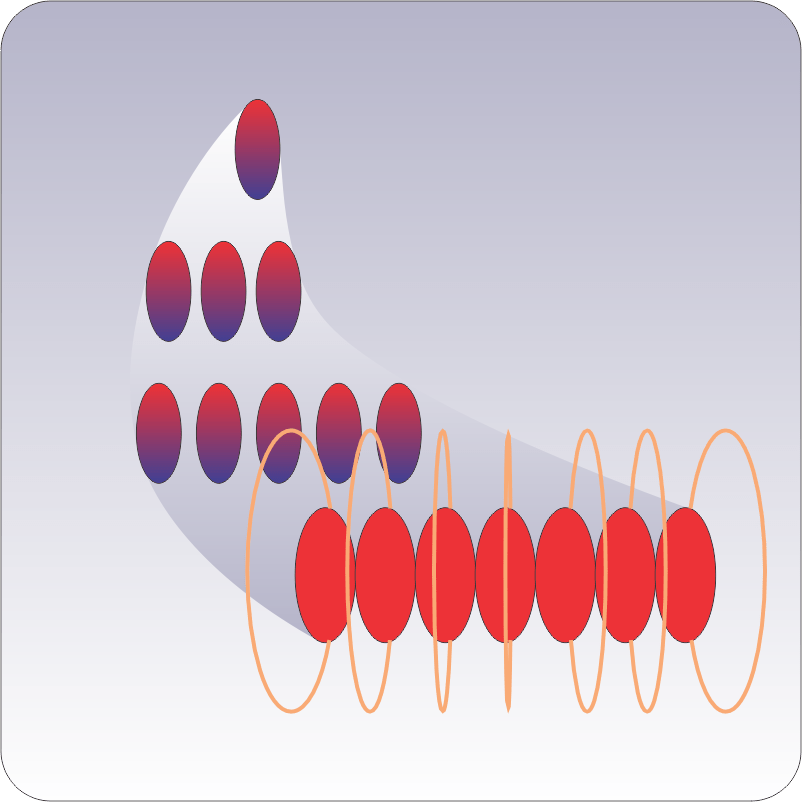
“That picture’s fine for a wave traveling through space, but in an atom all the charge waves circle the nucleus. Linear momentum in open space becomes angular momentum around the core. If every wave in an atom went in the same direction it’d look like an electron donut generating a good strong dipolar magnetic field coming up through the hole.”

“You said ‘if’.”

“Yes, because they don’t do that. I’m way over‑simplifying here but you can think of the waves pairing up, two single‑electron waves going in opposite directions.”

“If they do that, the magnetism cancels.”

“Mm‑hm. Paired‑up configurations are almost always the energy‑preferred ones. An external magnetic field has trouble penetrating those structures. They push the field away so we classify them as diamagnetic. The gray elements in Susan’s chart are almost exclusively in paired‑up configurations, whether as pure elements or in compounds.”

“Okay, so what about all those paramagnetic elements?”

“Here’s where we get into atom structure. An atom’s electron cloud is described by spherical harmonic modes we call orbitals, with different energy levels and different amounts of angular momentum — more complex shapes have more momentum. Any orbital hosting an unpaired charge has uncanceled angular momentum. Two kinds of angular momentum, actually — orbital momentum and spin momentum.”

“Wait, how can a wave spin?”

“Hard to visualize, right? Experiments show that an electron carries a dipolar magnetic field just like a spinning charge nubbin would. That’s the part that Feynman couldn’t explain without math. A charge wave with spin and orbital angular momentum is charge in motion; it generates a magnetic field just like current through a wire does. The math makes good predictions but it’s not something that everyday experience prepares us for. Anyway, the green and yellow‑orange‑ish elements feature unpaired electrons in high‑momentum orbitals buried deep in the atom’s charge cloud.”

“So what?”

“So when an external magnetic field comes along, the atom’s unpaired electrons join the party. They orient their fields parallel to the external field, in effect allowing it to penetrate. That qualifies the atom as paramagnetic. More unpaired electrons means stronger interaction, which is why iron goes beyond paramagnetic to ferromagnetic.”

“How does iron have so many?”

“Iron’s halfway across its row of ten transition metals—”

“I know where you’re going with this, Sy. It’ll help to say that these elements tend to lose their outer electrons. Scandium over on the left ionizes to Sc3+ and has zero d‑electrons. Then you add one electron in a d orbital for each move to the right.”

“Thanks, Susan. Count ’em off, Vinnie. Five steps over to iron, five added d‑electrons, all unpaired. Gadolinium, down in the lanthanides, beats that with seven half‑filled f‑orbitals. That’s where the strength in rare earth magnets arises.”

“So unpaired electrons from iron flip alloyed silver paramagnetic?”

“Vinnie wins this pot.”

~ Rich Olcott