Directional Reset

Professor of Astronomy Cathleen O’Meara barges into Cal’s Coffee Shop. “There you are, Sy Moire! You numbskull! You addlepate! You … nincompoop!

We’ve known each other since we were kids but I’ve rarely seen her this angry. “What have I done this time, Cathleen? I apologize, but what for?”

That last post you put up. One of the hardest things to get across to planet science students is the Coriolis Effect. You got it exactly backwards, you lummox! Confused the be-jeepers out of half my students and it’s going to take a whole class period to unwind it.”
All those exclamation points sting when they strike home. “It did feel funny. All the sources I checked said Coriolis skews travel to the right in the northern hemisphere but I worked hard for hours on that video and it clearly shows ‘left‘.”

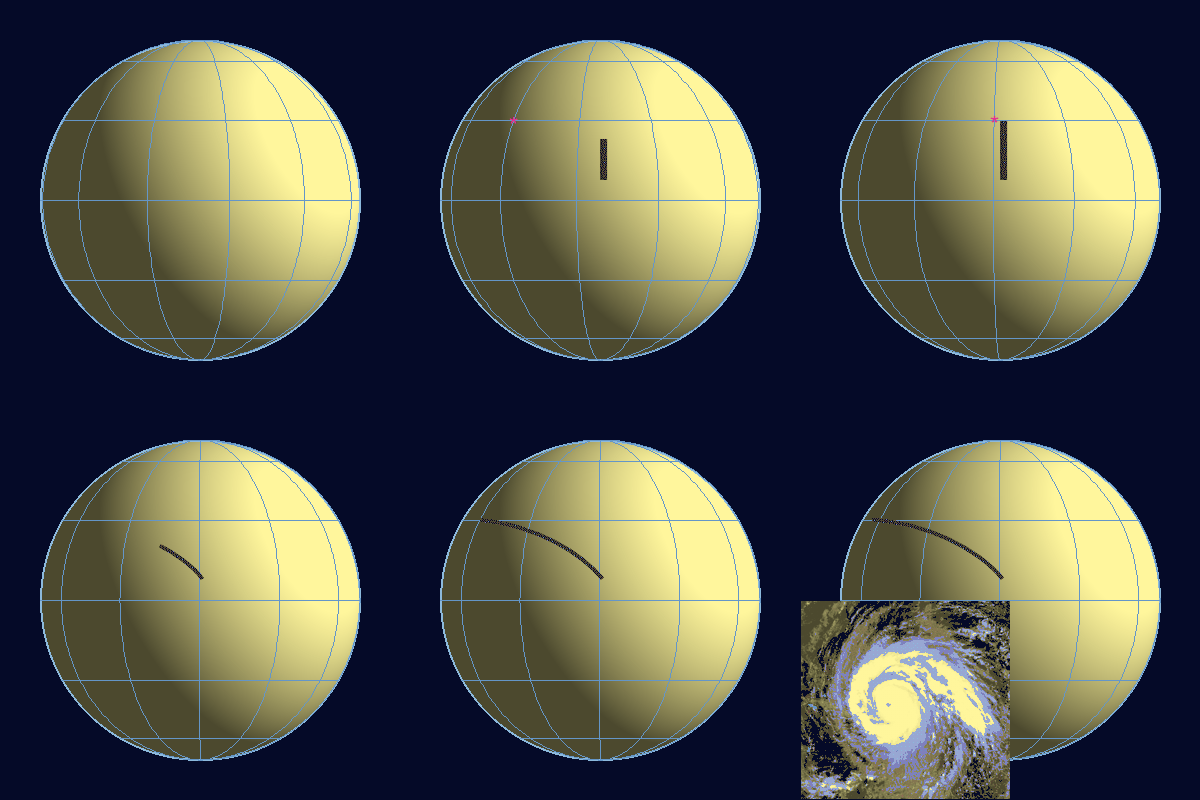
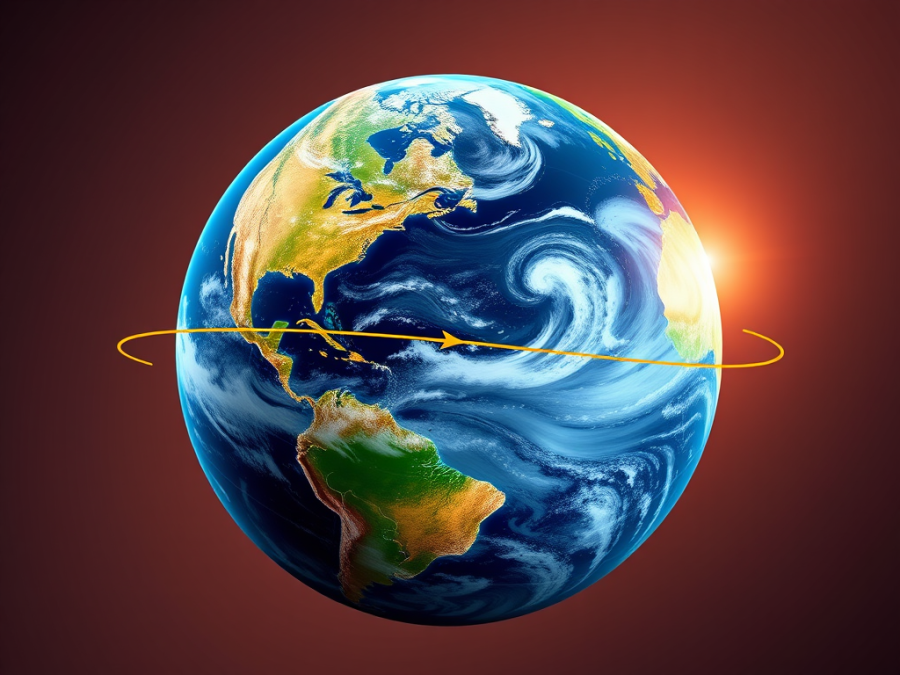
<sniff> “Stupid waste of time, chump! That video doesn’t show Coriolis.” <she grabs one of Cal’s graph-paper napkins and starts sketching> “Your balloon or whatever isn’t traveling north along Earth’s surface. It’s going out into space. That dark line tracks the thing’s shadow, or it would if you had the Sun behind it instead of off to the side. It has nothing at all to do with the cloud stream at the top of the hurricane and by the way those winds in the picture are outward, not inward as you’d’ve known if you’d’ve thought about for even a moment, blockhead! Here, look at a sideways view.”
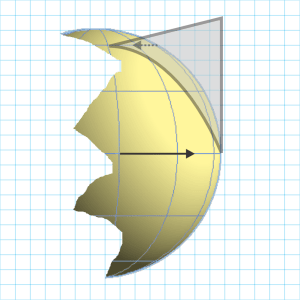
“You’re saying my balloon’s not following the surface, it’s vectored away from the surface parallel to the north‑south axis. Also that the shadow points that I plotted on Earth trend westward only because the Earth turns west‑to‑east underneath the balloon. … Okay, I can see that. Goes so high up I guess it can’t be a balloon, huh?”

“Don’t try to deflect the conversation, nitwit. Figure out what you got wrong and put up a correction post that gives a proper account of Coriolis. Sorry, Cal, I’ll need my coffee in a sippy‑cup. Gotta go revise my lesson plan, again.”

She grabs her caffeine to‑go, flings me a final “Dolt! ” and storms out the door trailing a cloud of grumbles.

Vinnie’s open-mouthed. “Geez, Sy, she does have a temper.”

“You know it, Vinnie. Fortunately she saves it up for deserving occasions but don’t ever get her started on politics. So let’s see, what part of what I posted did I get right?”

“Well, there’s the part about Helsinki’s rotation around the Earth runs fewer kilometers per hour than Quito’s. That’s just fact, can’t argue with it.”

“Yeah, Mr Moire, and there’s Conservation of Momentum.”

“Right, Jeremy.” Synapses connect in my head. “Got it! Vinnie, what’s the rule between speed and orbit size?”

“The closer the faster. The Moon’s a quarter‑million miles away, takes a month to go round the Earth; the ESS is 250 miles up, circles us every 90 minutes. If you’re in some orbit and wanna go lower, you gotta speed up. Took me an hour to convince Larry that’s the way it works. He was all about centrifugal force forcing you outward, but if you want to get deeper in the gravity well you need the extra speed to balance the extra gravity.”

“That’s the rule for space orbits, alright, but things work exactly the opposite for travel on the surface of a rotating sphere. Gravity pulls centerward with the same strength everywhere so gravity’s not what balances the centrifugal force.”

“What does?”

“Geometry. In space orbits, velocity and kinetic energy increase toward the core. On a sphere’s surface, the highest velocity is farthest away from the rotational axis, at the equator. Velocity falls off to zero at both poles. Every latitude has its characteristic velocity and kinetic energy. Suppose you’re loose on Earth’s northern hemisphere and moving east too fast for your latitude. You’ll drift southward, away from the axis, until you hit a latitude that matches your speed. Meanwhile, because you’re moving east the landscape will flow westward beneath you. The blend is the Coriolis Effect.”

“So if I’m slower than my latitude I drift north and Coriolis sends me east?”

“Cathleen would agree, Jeremy.”

~ Rich Olcott
When It’s Not The Same Frame – Never Mind

  • Author‘s note — Please ignore everything below the separator line. It’s bogus. No excuses, it’s just wrong. I intend to embarrass Vinnie and Sy just as soon as I get my head straight. My apologies to every reader, especially teachers, that I’ve confused.

“Hey, Sy, I couldn’t help overhearing—”

<chuckle> “Of course not, Cal. Overhearing what?”

“When you said Quito goes round the world twice as fast as Helsinki. That can’t be true! Things would collide and we’d get all kinds of earthquakes and stuff.”

“Well, sure, Cal, if those two airports moved relative to each other. But they don’t, they’re stuck 10750 kilometers apart just like they’ve always been. I hated flying that route. Mountains to dodge at both ends, in between there’s bad weather a lot of the time and no place good to set down if something goes wrong. … Wait — different speeds — it’s frames again, ain’t it, Sy?”

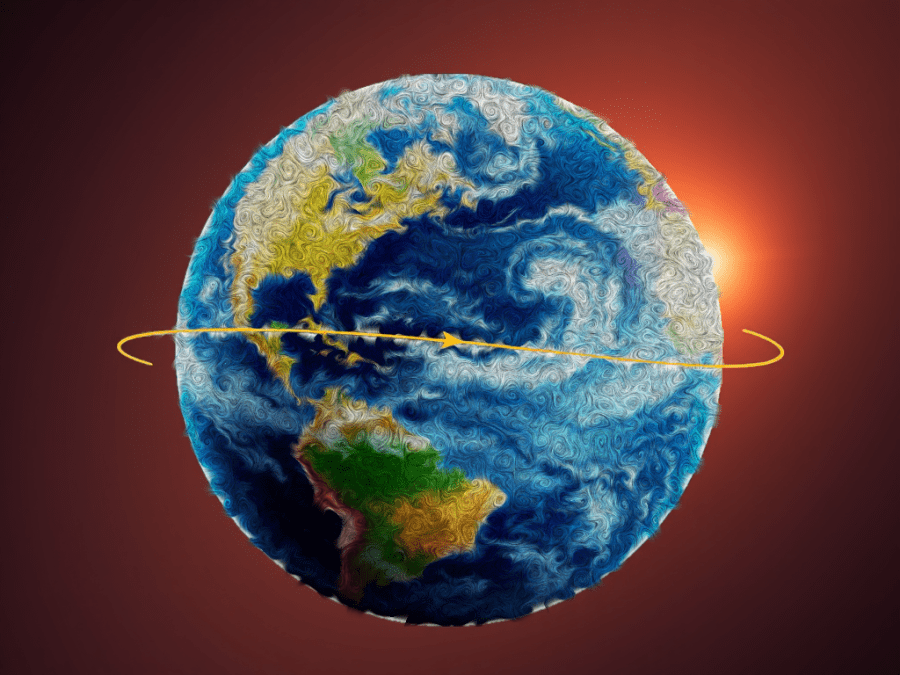
“Exactly, Vinnie, even though it’s not black holes for a change. Relative to an inertial frame on the Earth’s surface, the Earth itself doesn’t move and neither does either city. Relative to a Sun‑centered frame, though, the Earth spins on its axis once every 24 hours. In the Sun’s frame, Quito on Earth’s 40‑thousand kilometer Equator does 1666 kilometers per hour. Helsinki’s at 60° North. Its circle around the spin axis is only 20 thousand kilometers so its linear speed is 833 kilometers per hour even though it does the same 15 degrees per hour that Quito does.”

“Hi, Mr Moire. Welcome back. I couldn’t help overhearing—”

<chuckle> “Of course not, Jeremy. Overhearing what?”

“You talking about places on Earth moving different speeds. We just studied about that in Dr O’Meara’s planet science class but it’s still loose in my head. It has to do with why storms go counterclockwise, right?”

“It has everything to do with that, except the counterclockwise storms are only in the northern hemisphere. Southern hemisphere storms rotate the other way.”


“I got this, Sy. Bring up that movie you got on Old Reliable, the one that shows the northern hemisphere. Yeah, that one. Jeremy, some guy in a balloon is the dark line on his way from Kansas to the North Pole to meet Santa. In his frame the earth is moving left‑to‑right relative to his northbound course. See how the red star’s moving?”

“Yeah, it’s moving towards sunrise so his movie’s got the rotation right. Why Kansas?”

“‘Cause he’s got a good long shot over flatlands before any mountains or big lakes get in the way, okay? So, the other section of Sy’s movie is like it was shot from a satellite in geostationary orbit. In its frame the Earth is standing still, but the balloon guy’s swerving to his left which is west. Also counterclockwise.”

“Mmm, okay. So you’re saying that in our earthbound frame we see northerly winds getting twisted to their left which is west but it’s really the Earth turning under the atmosphere and that’s why hurricanes turn the way they do.”

“There are other ways to analyze it, guys.”

“Like what, Sy?”

“Let’s get back to Quito and Helsinki. In the northern hemisphere the latitude lines make shorter circles as you go north so your distance traveled per day gets smaller.”

“Makes sense, yeah.”

“Right. Your balloon guy’s at rest somewhere in the Earth’s frame before he starts his trip so the satellite sees him traveling eastward at say 1200 kilometers per hour. The atmosphere around him is doing about the same. Suppose he suddenly moves a few hundred kilometers north where the atmosphere’s moving significantly slower but he still has his original eastward momentum. What happens?”

“He gets slowed down.”

“Why?”

“Drag from the slower air. He dumps some of his momentum to the air molecules.”

“Conservation of Momentum does apply, Vinnie. That’s an explanation I see a lot in the pop‑sci press, but I’m not happy with it. An astronaut in a shuttlecraft going point‑to‑point across the airless Moon would see the same between‑frames contrast.”

“Oh! Newton’s First Law says you can’t change momentum unless an external force acts on you. So that’s the Coriolis Force, Mr Moire?”

“It’s related, Jeremy. Gravity restricts planet‑bound travelers to surface motion. Geometry and the force of gravity give that westward push in the planet’s frame to northbound objects in the northern hemisphere. The balloon guy and the astronaut don’t observe the Coriolis Effect unless they look out the window.”

~ Rich Olcott

When It’s Not The Same Frame

  • Author‘s note — Please ignore everything below the separator line. It’s bogus. No excuses, it’s just wrong. I intend to embarrass Vinnie and Sy just as soon as I get my head straight. My apologies to every reader, especially teachers, that I’ve confused.

“Hey, Sy, I couldn’t help overhearing—”

<chuckle> “Of course not, Cal. Overhearing what?”

“When you said Quito goes round the world twice as fast as Helsinki. That can’t be true! Things would collide and we’d get all kinds of earthquakes and stuff.”

“Well, sure, Cal, if those two airports moved relative to each other. But they don’t, they’re stuck 10750 kilometers apart just like they’ve always been. I hated flying that route. Mountains to dodge at both ends, in between there’s bad weather a lot of the time and no place good to set down if something goes wrong. … Wait — different speeds — it’s frames again, ain’t it, Sy?”

“Exactly, Vinnie, even though it’s not black holes for a change. Relative to an inertial frame on the Earth’s surface, the Earth itself doesn’t move and neither does either city. Relative to a Sun‑centered frame, though, the Earth spins on its axis once every 24 hours. In the Sun’s frame, Quito on Earth’s 40‑thousand kilometer Equator does 1666 kilometers per hour. Helsinki’s at 60° North. Its circle around the spin axis is only 20 thousand kilometers so its linear speed is 833 kilometers per hour even though it does the same 15 degrees per hour that Quito does.”

“Hi, Mr Moire. Welcome back. I couldn’t help overhearing—”

<chuckle> “Of course not, Jeremy. Overhearing what?”

“You talking about places on Earth moving different speeds. We just studied about that in Dr O’Meara’s planet science class but it’s still loose in my head. It has to do with why storms go counterclockwise, right?”

“It has everything to do with that, except the counterclockwise storms are only in the northern hemisphere. Southern hemisphere storms rotate the other way.”


“I got this, Sy. Bring up that movie you got on Old Reliable, the one that shows the northern hemisphere. Yeah, that one. Jeremy, some guy in a balloon is the dark line on his way from Kansas to the North Pole to meet Santa. In his frame the earth is moving left‑to‑right relative to his northbound course. See how the red star’s moving?”

“Yeah, it’s moving towards sunrise so his movie’s got the rotation right. Why Kansas?”

“‘Cause he’s got a good long shot over flatlands before any mountains or big lakes get in the way, okay? So, the other section of Sy’s movie is like it was shot from a satellite in geostationary orbit. In its frame the Earth is standing still, but the balloon guy’s swerving to his left which is west. Also counterclockwise.”

“Mmm, okay. So you’re saying that in our earthbound frame we see northerly winds getting twisted to their left which is west but it’s really the Earth turning under the atmosphere and that’s why hurricanes turn the way they do.”

“There are other ways to analyze it, guys.”

“Like what, Sy?”

“Let’s get back to Quito and Helsinki. In the northern hemisphere the latitude lines make shorter circles as you go north so your distance traveled per day gets smaller.”

“Makes sense, yeah.”

“Right. Your balloon guy’s at rest somewhere in the Earth’s frame before he starts his trip so the satellite sees him traveling eastward at say 1200 kilometers per hour. The atmosphere around him is doing about the same. Suppose he suddenly moves a few hundred kilometers north where the atmosphere’s moving significantly slower but he still has his original eastward momentum. What happens?”

“He gets slowed down.”

“Why?”

“Drag from the slower air. He dumps some of his momentum to the air molecules.”

“Conservation of Momentum does apply, Vinnie. That’s an explanation I see a lot in the pop‑sci press, but I’m not happy with it. An astronaut in a shuttlecraft going point‑to‑point across the airless Moon would see the same between‑frames contrast.”

“Oh! Newton’s First Law says you can’t change momentum unless an external force acts on you. So that’s the Coriolis Force, Mr Moire?”

“It’s related, Jeremy. Gravity restricts planet‑bound travelers to surface motion. Geometry and the force of gravity give that westward push in the planet’s frame to northbound objects in the northern hemisphere. The balloon guy and the astronaut don’t observe the Coriolis Effect unless they look out the window.”

~ Rich Olcott

The Disk That Bent Space

<Author’s note — Side projects completed. Back to the fun stuff…>

“A cup of mud and a strawberry scone, please.”

“Sy! You’re back! Spent the winter months down in Bermuda with the onions and the eels, eh?”

“Not quite, Cal. A contract needed me on-site to monitor how well the company executed my recommendations. They did a pretty good job. They’re happy; I’m happy, paid and back home again. The weather here’s more to my liking.”

A hefty hand grabs my shoulder. “Hey, Sy, you’re back. Where ya been and how was it?”

“Sorry, Vinnie, my lips are sealed. You know how that works.”

“Yeah, I been there. Well, not there there, but. Anyways, I got a question I been saving up for you.”

“Always good to have a conversation-starter. Out with it.”

“Came from a Calvin And Hobbes comic strip some years ago but I saw it again on the internet. Calvin, that’s the kid who has a stuffed tiger named Hobbes but it talks, he’s sitting on the floor listening to something on his record player which tells you how old the strip is. His Dad comes over, points one finger at the disk’s edge and another at the label near the center. Got the picture?”

“Clear so far.”

“Dad leads off, ‘Both points make a complete circle in the same amount of time, right?‘ And the kid says, yeah, and Dad’s like, ‘But this point on the edge has to make a bigger circle than this point near the center so it has to move faster. Two points on the same disk move at different speeds but they both do the same revolutions per minute‘, and the kids goes to bed all frazzled.”

“Ah, the difference between angular speed and linear speed. The whole Earth turns once every 24 hours so Quito on the Equator does 1040 miles an hour but Helsinki up 60 degrees north goes half that.”

“Yeah, I know all about that stuff, I fly airplanes for a living, remember? That’s not my question.”

“Okay, what’s your question?”

“Suppose Calvin’s record speeds up until the label point’s going near the speed of light? What happens to the edge point?”

“Things get interesting, like Einstein-level interesting. On his way to General Relativity he did an important thought experiment about a disk like this. Sort-of like this.”

“Sort of?”

“Calvin’s disk represents a real material object, Einstein’s doesn’t. Objects made of matter have a limit to how fast you can spin them and it’s way short of lightspeed. Remember that time you were in here playing with that kid-toy top?”

“Gimme a sec… that was about centrifugal force, right, the kind that tries to shoot stuff straight out away from a spin center?”

“Sharp as ever, Vinnie. The centrifugal force per unit mass rises with the square of the rotation speed. Spin twice as fast, the force quadruples. Spin it faster and faster, eventually the outward force exceeds any material’s tensile strength. Chunks near the rim tear loose from the rest of the disk and it’s not a disk any more. Einstein imagined an infinitely strong disk that wouldn’t have that problem. In the kind of argument that good scientists love, Ehrenfest thought up a Special Relativity paradox that led Einstein to his big breakthrough.”

“A pair o’ docs, HAW!”

“Ha. Ha. We’ve talked about how Special Relativity says—”

“It’s gonna be frames again, ain’t it?”

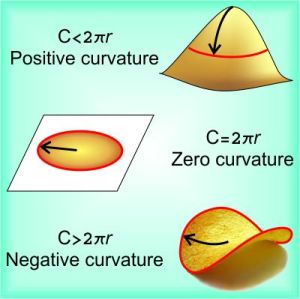
“Relativity’s always about frames, Vinnie. Ehrenfest wrote that according to Special Relativity, the radius r of a disk doesn’t change when the disk rotates, but its circumference should be compressed to something smaller than 2πr which is non‑physical. Einstein replied that Ehrenfest had it backwards. In the disk’s rotating frame, you’d measure the circumference by seeing how many yardsticks you can pack around it.”

“Short yardsticks.”

“Millimeter-sticks, whatever. Einstein pointed out that when the disk spins, each yardstick gets shorter so you can pack in more yardsticks. Rotation doesn’t shrink the circumference, it expands it by warping space from a flat plane to a curved surface like a potato chip. Chasing that idea got him to curved space and General Relativity.”

~ Rich Olcott

  • Thanks to Alex, who asked the question.