Tropical beach with palm trees next to icy polar region with glaciers.

The Big Water Pump

“Springtime! Could you make me a lilac latte, Cal?”

“Maybe if I left out the coffee, Cathleen. Lilac’s too delicate to stand up to coffee’s punch. How about a cold brew of light roast? I just made a batch. Plenty of caffeine in there, not too much intensity and you can imagine the flowery part.”

“I’ll have that, and a lemon scone, please.”

“Here you go, fresh from the filter. Hey, you sure lit a fire under Sy. He’s done a whole string of posts about Coriolois Effects.”

“Tsk, Cal, the scientist’s name was Coriolis. I’m not surprised there’s been multiple posts — the same pseudo‑force shows up in many ways.”

“Pseudo‑force?”

<looks around> “Good, Sy’s not here. He’d talk our ears off about inertial frames. My quick answer from a planet scientist perspective is that real forces are the ones that make things happen in systems where everything’s moving in straight lines at a steady pace.”

“Like on a pool table?”

“Mm-hm. You can generally make good predictions on systems like that, which is how pool sharks make their money. But if part of the system is accelerating in some way, maybe it’s rotating, you’ve got two choices for predicting how the system will behave. The hard way is to calculate each individual component’s motion in a single coordinate system using just the real forces. The easier way is to group components that have a common acceleration. Pick a convenient group to serve as your base subsystem. Define another subsystem for the components that all have the same acceleration relative to the first subsystem and so on. Then you pretend a pseudo‑force drives the interactions between your subsystems.”

“Like Earth and our Moon make a subsystem ’cause they orbit the Sun together and you said rotation’s a kind of acceleration. The pseudo‑force is centrifugal, fighting against the Sun’s gravity to keep Earth’s subsystem in orbit!”

“I love it when that kind of connection‑making happens in my classroom. Thank you, Cal.”

“You’re welcome. So your subsystems are what Sy calls frames?”

“Pretty much. Skipping some technical caveats, that’s the idea. When I think about atmosphere dynamics, I could try to calculate the planet’s whole atmosphere as an incredibly messy collection of atoms. I prefer to think of the Earth as a subsystem hosting some number of air mass subsystems, all embedded in the Universe system. The Universe enforces straight‑line inertia and the Earth adds rotational acceleration but the air masses are constrained to the planet’s spherical geometry. The Coriolis pseudo‑force summarizes all three effects. The calculation’s still messy, but it’s a lot more manageable. And then there’s water.”

“Water?”

“The piston that drives the climate. Water molecules are small so they move easily through the atmosphere. The important thing is, they’re good at transporting heat energy.”

“How’s that? They’d be the same temperature as everything else.”
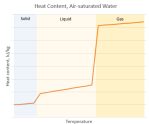
“Temperature doesn’t always measure energy. Water molecules like to hold onto other water molecules. It takes energy to get them apart. When they get back together, the energy’s released so it’s like the freed‑up molecules store heat energy. In solid water, every molecule is locked into position. Melting a given mass of water amounts to breaking those locks. The liquid mass at freezing temperature contains more energy than the ice did. When liquid water evaporates, the gas contains even more energy, because the molecules can roam even more freely. Visualize a bucket of water someplace warm.”

“A Hawai’ian beach.”

“That bucketful absorbs heat energy as it evaporates, cooling the Pacific Ocean. Winds sweep up the gas and carry it north to the Arctic where it freezes. In the process it warms the ice cap by giving up its liquid‑to‑gas heat and also its solid‑to‑liquid heat. Water’s two active phase transitions make it a far more efficient heat transporter than dry air alone.”

“One bucket’s teeny in the ocean, though.”

“Multiply that by gazillions. We have gigatons of surface water. The evaporate/freeze/melt process cycles as the icecaps degrade, continuously acting to moderate Earth’s temperature differences. If Earth were dry, the gradient would be far steeper. Thermal gradients drive air movement. A dry Earth’s extreme temperature discrepancies would generate permanent gale‑force winds towards the poles.”

~ Rich Olcott
Atmospheric Jiu-jitsu

A gorgeous early Spring day for a walk by the lake — blue sky, air just the right side of crisp, trees showing their young green leaves, geese goosily paddling around. As I pass the park bench I hear a familiar voice. “Hello, Mr Moire.”

“Morning, Walt. It’s been a while. What do your people want to know about now?”

“We’ve been reading your series of posts about the Coriolis Effect. You have masses of air pushing each other around, you have pendulums twisting about, and you have objects flying weird orbits around latitudes instead of the planet’s center. Which is the real Effect?”

“All three.”

“They’re so different. How can all three be right?”

“Knowing something of your interests, I can think of another Coriolis application will help clarify the connection. How do you steer an old‑fashioned artillery shell?”

“You don’t, you aim it.” <His eyes are looking inward.> “Those old howitzers, you traverse to the target’s coordinates, set the elevation for the distance and your munitions and whatever your barrel’s still good for, load ‘er up, let ‘er rip and wait for the forward observer to tell you how to adjust.”

“No correction for the Earth turning west‑to‑east beneath the shell’s trajectory?”

“No need. Inside a max 10‑mile range, the artillery, target and shell all share the same initial eastward vector. Windage and temperature inversions are more of a problem than Coriolis forces. That’s where judgement, feedback and reload speed come in.”

“Now stand that up against a cruise missile.”

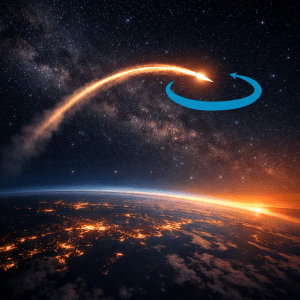
“Very different situation. With cannons, all the propulsion happens at the start. That’s why they call it ballistic. Cruise missiles have an extended boost phase, maybe more than one, so they can do in‑flight steering. On the other hand, range is hundreds of miles or more so you do need to figure in relative easting.”

“And the easting correction takes power, right?”

“Of course.”

“From the missile’s point of view, that power goes to counteract the Coriolis force pushing it off‑course. You don’t see it from the ground but the missile does. Clearer now?”

“Give me a minute.” <sketches on his notepad> “Okay, counteracting attempt to deflect course — got it. Hmm, a pendulum’s even simpler, because it’s not trying to keep in sync with the Earth’s rotation. No forces in play crosswise to the swing plane so it can maintain orientation relative to the Universe. To museum visitors it looks like something’s twisting, but it’s us doing the moving. The air masses, though … forces are in play with that one.”

“It’s always important to keep track of who’s doing what to whom. That system has four distinct frames of reference: the Earth, a moving air mass, the air mass it collides with, and the Universe.”

“The Universe?”

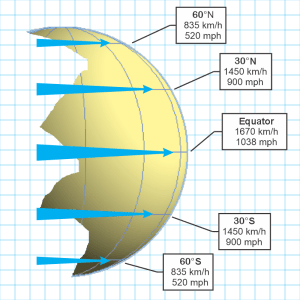
“Sets the stage for Newton’s First Law, about conservation of linear momentum. Say there’s an air mass hovering over Dallas, latitude 30° north. Relative to the Earth it’s stationary, but relative to the Sun and the rest of the Universe it has an eastward vector clocking 1450 km/hour. Now suppose that mass moves north relative to the Earth.”

“But there’s already an airmass taking up space there, say in Manitoba. There’ll be a collision, northbound momentum against Manitoban inertia.”

“Here’s where Coriolis gets into the game. Manitoba may have zero motion relative to Earth, but Manitoba and its air mass are also moving eastward relative to the Universe. Manitoba’s speed is slower than Dallas’ but it’s not zero. Manitoba’s momentum deflects the Dallas mass into an even more easterly vector.”

“You’re saying that Coriolis plays jiu‑jitsu with the atmosphere.”

“I wouldn’t have come up with that interpretation, but it’s reasonable.”

“What about the weird orbits?”

“Not really orbits, more like equilibrium bands. The concept comes from the theoretical notion that every latitude along a meridian has a natural equilibrium speed where air pressure balances other forces. The bands would be parallel circles around the globe except for geography and transient disturbances. Dallas’ 1450‑km/h number was an example. If you exceed your local natural speed, centrifugal force moves you towards the Equator; if you’re a slowpoke, you’re shoved towards the nearest pole. Real weather’s more complicated.”

“Everything’s always more complicated.”

~ Rich Olcott

The Polar Expression

“Good afternoon, Mr … Moire, yes?”

“The same. Can I help you?”

“Yes. I am Tomas Frashko. I am new to this University. I could not help overhearing—”

“The whole neighborhood couldn’t help overhearing.”

“Mmm, yes. My sympathy. But I have some questions, if you have a moment.”

“My coffee mug’s not empty yet. Please sit down. I’ll help if I can.”

“Thank you. I have often seen the Coriolis Effect explained as an atmospheric effect — northbound air with high‑speed low‑latitude momentum deflected eastward by slower‑moving air already at higher latitudes. The last part of your recent post goes to some trouble to avoid that explanation. Why is that?”

“Because the Effect doesn’t only play with the atmosphere. It drives gyre currents in the oceans and probably the magma flows deep inside Earth’s mantle.”

“So fluids, not just air. But it is still a matter of fluid with a velocity in one direction being diverted by fluid with a different velocity. Also, these cases are planet‑scale effects operating over large distances. Surely systems at small scale do not experience a measurable amount of Coriolis force.”

“But they do. Museum Foucault pendulums swing on a scale measured in meters. There’s dozens of them on display all over the world, they act just as Coriolis’ ideas predicted, and the host institutions go to a great deal of trouble to ensure the steady swinging isn’t disturbed by rushing air.”

“Ah, yes. I have seen the pendulum exhibit in our museum in the city where I grew up. A hypnotic thing, swinging back and forth on its wire, each swing a little closer to knocking down a pin … finally! Then slowly turning direction to knock down another one. The museum docent said the plane of the pendulum’s swing pivots to demonstrate Earth’s rotation, but then she mentioned that the full circle takes more than a day to complete. She couldn’t explain why.”

“If it were swinging from a point above the North or South Pole it would be a one-day completion, 15 arcseconds per second.. Scientists tried mounting one at the South Pole and that’s exactly what they determined. The poles are the only points on Earth’s surface where the the pendulum’s inertial frame matches Earth’s so it looks like the Earth is simply turning beneath the pendulum. On the other hand, along the Equator the Coriolis force doesn’t affect a pendulum’s motion at all.”

“Not at all?”

“Nope. Centrifugal force, a little bit, but not Coriolis force.”

“Does the one become the other?”

“Oh no, they’re quite different. Centrifugal force represents competition between dissimilarly rotating frames; Coriolis force represents their coupling. If you’re riding on a merry‑go‑round—”

“A what?”

“Mm, you’d probably call it a carousel.”

“Ah. Yes, go on.”

“If you’re riding on a carousel, your straight‑line inertia in the fairgrounds frame tries to drive you forward. To stay in position on the rotating carousel, you fight that outward inertial impetus by holding onto something. In the ride’s rotating frame, that looks like you’re exerting centripetal force to counterbalance a centrifugal force that the fairgrounds frame doesn’t see.”

“Yes, yes, but how does that differ from Coriolis force?”

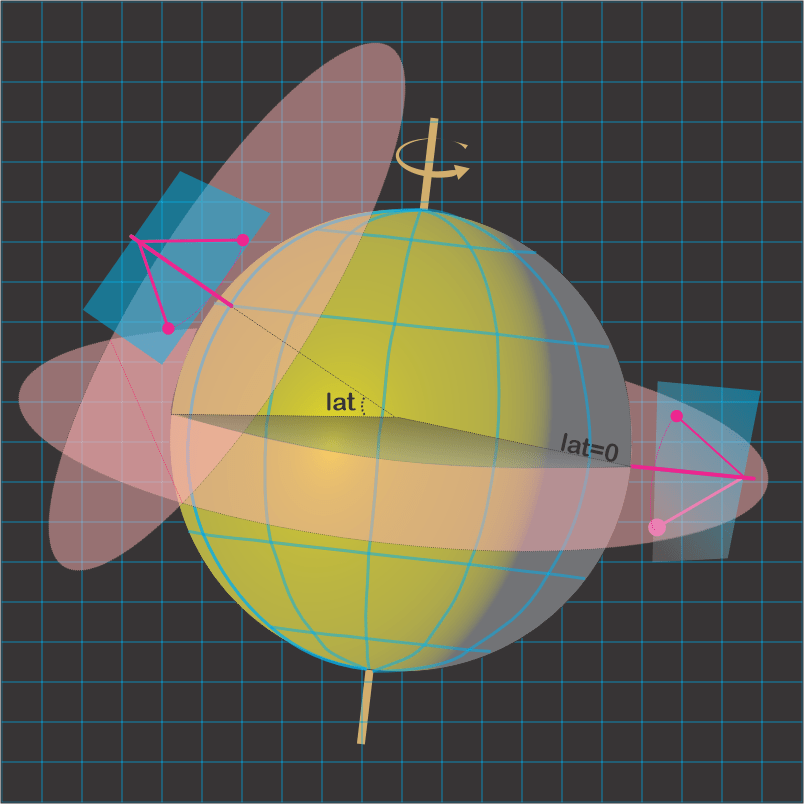
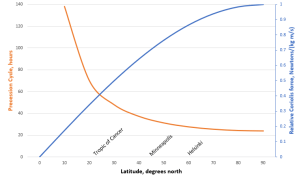
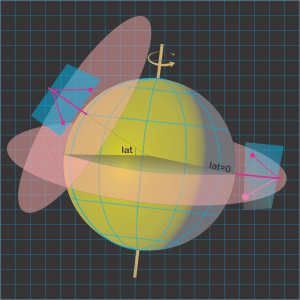
“Centrifugal force depends on an object’s distance from the center of rotation. Coriolis force doesn’t care about that. It rises with the sine of the angle between the object’s vector and the axis of rotation. On a sphere the relevant angle is the latitude. A northbound object, could be a pendulum bob, arrives at the North Pole traveling perpendicular to the Earth’s axis. Perpendicular angles have the maximum sine, 1.0. The Coriolis coupling is strongest there and that’s why a pendulum’s reference frame is locked to the Earth’s 24‑hour period. At the equator a northbound object moves parallel to the polar axis. Parallel lines have zero angle with zero sine so the Coriolis coupling’s zero. A pendulum’s plane of motion at the equator stays where it started, infinite precession completion time.”

“And in‑between?”

“In between. A pendulum’s cycle would run 27.7 hours in Helsinki, more than 60 hours at the Tropic of Cancer.”

“Small coupling, not much swerving.”

~ Rich Olcott

  • Thanks to Ric Werme for his thoughtful comments and suggestions.