
A gorgeous early Spring day for a walk by the lake — blue sky, air just the right side of crisp, trees showing their young green leaves, geese goosily paddling around. As I pass the park bench I hear a familiar voice. “Hello, Mr Moire.”
“Morning, Walt. It’s been a while. What do your people want to know about now?”
“We’ve been reading your series of posts about the Coriolis Effect. You have masses of air pushing each other around, you have pendulums twisting about, and you have objects flying weird orbits around latitudes instead of the planet’s center. Which is the real Effect?”
“All three.”
“They’re so different. How can all three be right?”
“Knowing something of your interests, I can think of another Coriolis application will help clarify the connection. How do you steer an old‑fashioned artillery shell?”
“You don’t, you aim it.” <His eyes are looking inward.> “Those old howitzers, you traverse to the target’s coordinates, set the elevation for the distance and your munitions and whatever your barrel’s still good for, load ‘er up, let ‘er rip and wait for the forward observer to tell you how to adjust.”
“No correction for the Earth turning west‑to‑east beneath the shell’s trajectory?”
“No need. Inside a max 10‑mile range, the artillery, target and shell all share the same initial eastward vector. Windage and temperature inversions are more of a problem than Coriolis forces. That’s where judgement, feedback and reload speed come in.”
“Now stand that up against a cruise missile.”
“Very different situation. With cannons, all the propulsion happens at the start. That’s why they call it ballistic. Cruise missiles have an extended boost phase, maybe more than one, so they can do in‑flight steering. On the other hand, range is hundreds of miles or more so you do need to figure in relative easting.”
“And the easting correction takes power, right?”
“Of course.”
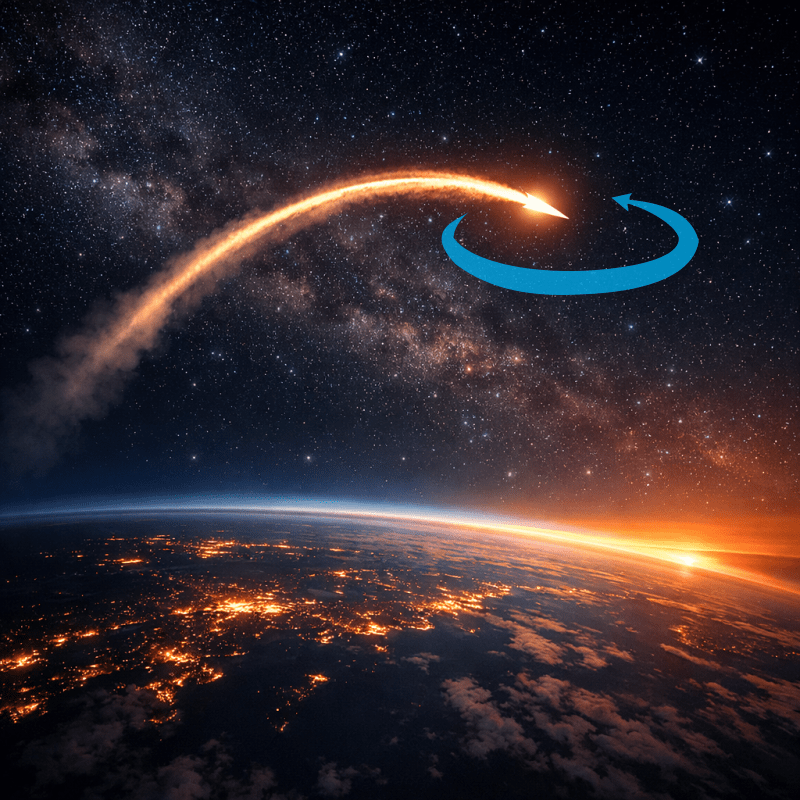
“From the missile’s point of view, that power goes to counteract the Coriolis force pushing it off‑course. You don’t see it from the ground but the missile does. Clearer now?”
“Give me a minute.” <sketches on his notepad> “Okay, counteracting attempt to deflect course — got it. Hmm, a pendulum’s even simpler, because it’s not trying to keep in sync with the Earth’s rotation. No forces in play crosswise to the swing plane so it can maintain orientation relative to the Universe. To museum visitors it looks like something’s twisting, but it’s us doing the moving. The air masses, though … forces are in play with that one.”
“It’s always important to keep track of who’s doing what to whom. That system has four distinct frames of reference: the Earth, a moving air mass, the air mass it collides with, and the Universe.”
“The Universe?”
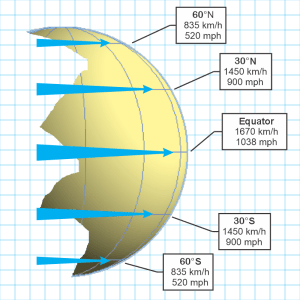
“Sets the stage for Newton’s First Law, about conservation of linear momentum. Say there’s an air mass hovering over Dallas, latitude 30° north. Relative to the Earth it’s stationary, but relative to the Sun and the rest of the Universe it has an eastward vector clocking 1450 km/hour. Now suppose that mass moves north relative to the Earth.”
“But there’s already an airmass taking up space there, say in Manitoba. There’ll be a collision, northbound momentum against Manitoban inertia.”
“Here’s where Coriolis gets into the game. Manitoba may have zero motion relative to Earth, but Manitoba and its air mass are also moving eastward relative to the Universe. Manitoba’s speed is slower than Dallas’ but it’s not zero. Manitoba’s momentum deflects the Dallas mass into an even more easterly vector.”
“You’re saying that Coriolis plays jiu‑jitsu with the atmosphere.”
“I wouldn’t have come up with that interpretation, but it’s reasonable.”
“What about the weird orbits?”
“Not really orbits, more like equilibrium bands. The concept comes from the theoretical notion that every latitude along a meridian has a natural equilibrium speed where air pressure balances other forces. The bands would be parallel circles around the globe except for geography and transient disturbances. Dallas’ 1450‑km/h number was an example. If you exceed your local natural speed, centrifugal force moves you towards the Equator; if you’re a slowpoke, you’re shoved towards the nearest pole. Real weather’s more complicated.”
“Everything’s always more complicated.”
~ Rich Olcott
 Hard Science Ain't Hard