

“Morning, Sy. You see the news about the Infinite Monkey thing?”
“No, Cal, with everything else going on I seem to have missed that.”
“Understandable. I only heard about it from a ‘lighter side of the news’ piece on the radio. Something about disproving what everybody used to believe. You wrote about it a while ago, didn’t you?”
“Mm-hm. Did a lot of arithmetic for that one. The idea is that if you somehow managed to get an infinite number of monkeys banging away on typewriters, sooner or later one of them would produce the complete works of Shakespeare. The piece I did, gee, years ago, used Terry Pratchett’s idea of a library that contains all the books that have been written, all those that will be written, and all those that would have been written but the author thought better of it. I asked, how big is that library?”
“That’s gotta be a lot of books. Here’s your coffee.”
“Thanks. I guessed maybe a billion, maximum. The Library of Congress has only 30‑some million, last I looked, and that’s real books. Anyhow, I decided to compare that to the number of possible books, printed up using some configuration of 500 characters.”
“500? What else besides ‘a, b, c‘?”
“Upper case, lower case, blanks, punctuation, math symbols, alphabets from other languages, whatever. No pictographic systems like Japanese kanji and Chinese but you can’t have everything. I defined ‘possible book’ as 500 pages, 4000 characters per page so two million per book.”
“All my books are shorter than that and they don’t scramble alphabets from different languages.”
“Short books you could pad to 500 characters with blanks at the end. Some of the experimental fanfic I’ve seen is pretty creative. At any rate, I calculated 5002,000,000 = 105,397,940 different possible books. Limit the library to 250 pages and 100 characters in, say, Spanish with no math that’d be 1001,000,000 = 102,000,000 different possible books, which is still huge, right?”
“My calculator doesn’t do numbers up in the air like that. I’ll believe you, it’s a big number. So where are you going with this?”
“So even a billion‑book library would be swamped by the other 105,397,931 books in an all‑possible‑books library. My point in that old post was that the monkeys could indeed type up Shakespeare but you wouldn’t be able to find it in the welter of absolute nonsense books.”
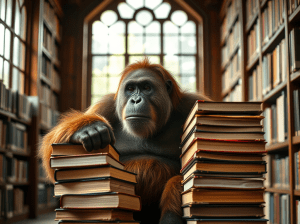
“Looks good to me, so what’d these guys prove?”
“Dunno, haven’t seen their paper yet. Give me a minute with Old Reliable … Ah, here it is, ‘A numerical evaluation of the Finite Monkeys Theorem‘ by Woodcock and Falletta. Aand it’s not paywalled!” <reading> “Wait, finite — that’s different.”
“How’s it different? Arithmetic’s arithmetic, right?”
“Until you get into infinities. True infinity operates differently than ‘large beyond anything we can measure’. I highlighted the difference in a tech note I wrote a few years ago. How would you bet if someone suggested there’s an exact duplicate Earth existing somewhere else in the Universe?”
“That’s what that goofy ‘Everything Everywhere’ movie was all about, right? Multiverses?”
“Mmm, no, the bet’s about only in our Universe.”
“Knowing you, I’d stay out of the betting.”
“Wise choice. The right answer is ‘It depends’. I calculated that there could be 1.54×10154 possible Earths with exactly the same atom count that we have, just arranged differently, maybe swap one nickel atom with one iron atom inside a hematite rock. So 1.54×10154 chances for an identical copy of you. If the Universe is infinite, then you’re guaranteed to have not just one, but an infinite number of identical copies, each of whom thinks they’re the only you.”
“That’s comforting, somehow.”
“On the other hand, if the Universe is finite, then the planet creation process would have to run through something like 10150 creations before it had a good shot at re‑making you. Vanishingly small odds.”
“So what’s this got to do with finite monkeys?”
“Woodcock and Falletta maintain that there’s only a limited number of monkeys and they’re time‑constrained. Under those conditions, there’s vanishingly small odds for Shakespeare or even the word ‘bananas’.”

~ Rich Olcott

