“Chemical potential energy is something else, Sy. You’ve got like this lump of putty just sitting there and suddenly WHAMO! Kinetic energy all over the place.”
“Sounds like you’ve been playing with explosives, Vinnie.”
“Sorta. Some of the Specials down at the base let me watch a couple of their C-4 practice shots. You know anything about C-4?”

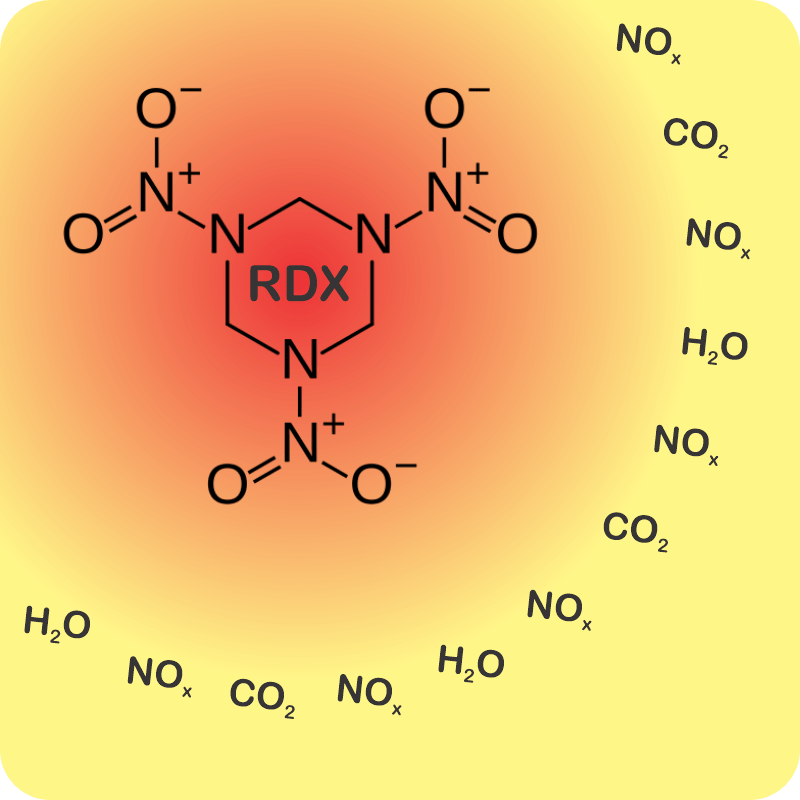
“A little, like what it’s made of. Susan Kim’s interested in the main ingredient for some chemical reason. She calls it RDX, drew me a picture of it once. Nice symmetrical molecule loaded with nitrogen and carbon atoms just itching to fly away as a dozen separate gas molecules. Funny, how such violent stuff can be so relaxed until just the right thing sets it off. Like some people I know.”

“Ouch. Yeah, it happens, but I’m mellowing, okay? A dozen fragments per molecule, got it. Hey, what chemical is ‘NOx‘?”
“Could be nitrous oxide N2O, or nitric oxide NO, or some combination depending, which is why there’s no number in the equation in front of oxygen’s O2. Combustion is messy.”
“Yeah, enthalpy all over the place! Those separate gas molecules spread out to a way bigger volume than the solid molecule used up. Lotsa pressure‑volume work there, right?”
“True, but gas expansion’s only one factor in an RDX discharge. Did the guys at the base mention that if you detonate that putty when it’s spread thin it can burn through an I‑beam?”
“So there’s heat, too. Can’t be much stacked up against the expansion.”
“Don’t be so sure. I’m not up on RDX thermochemistry. I never asked Susan and I don’t know whether she or anyone knows the breakout. It’s hard to do a precision measurement on an explosion, even if you do it in milligram quantities. I’ve got a good substitute for that, though. Water’s way simpler and much more thoroughly studied.”
“How is water a substitute? It doesn’t explode.”
“True, but it boils. No changes in molecular bonding, so enthalpy’s chemical part isn’t a factor. Carnot taught us to figure the pressure‑volume and thermal parts separately. Suppose you load a liter of water into a cylinder‑piston arrangement that stays at one atmosphere pressure. Get it up to boiling temperature then measure the energy input while the water boils away. The water absorbs energy while it turns to steam, right, even though there’s no change in temperature.”
“It stays at 212°?”

“212°F is 100°C or 373 K, stays steady provided the pressure stays at one atmosphere, 14.7 psi or 101325 pascals, whichever units you want to use. Pressure and temperature work together when it comes to phase changes. Anyway, the only way your rig can maintain that exact pressure is to do some kind of work, lifting a weight or something, until the cylinder’s final volume above the piston is 1705 liters. That’ll be 172 kilojoules of useful work.”
“Big cylinder.”
“Granted, but we supposed a liter of water. Scale the equipment to handle just a milliliter of water and the swept volume’s down to 1.7 liters. Neat how the metric system works. But now you’ve got a design decision to make. You can release the steam with a loud CHUFF that carries away 92% of the energy you put into it—”
“That’s no good.”
“— or you can run it through a condenser that preheats the feed water for the next cycle. Saves a lot of fuel that way.”
“That’d be my choice.”
“Mm-hm. That was Watt’s crucial improvement on Newcomen’s design. Funny thing, though. Both guys are credited with ‘inventing the steam engine’ but neither one built a device like the engines we’re used to, ones that develop power by pushing on a piston. The big demand in their day was pumping water out of mine shafts. Newcomen and Watt built vacuum gadgets.”

“I had a well once. You can’t pull water up more than about 35 feet.”
“Right. Vacuum pumping is limited. Unfortunately, so was manufacturing technology in Watt’s time. Making a piston and cylinder that would fit together efficiently over a wide temperature range was a big challenge.”
“Their engines sucked, huh?”
~ Rich Olcott


