
“Cathleen, this Coriolis Effect‘s rule is so easy. The force always twists you to the right no matter which way you travel. Going north, you swerve eastward; going south you swerve westward, always to the right. But what about the in‑betweens? What if I’m going east or west? Does the force just go away?”
“Of course not, Cal, but it mutates. Mind you, the rules you quoted only apply in Earth’s northern hemisphere. If you’re south of the Equator they go the other direction. Anyway, the northbound and southbound cases everybody writes about are the simplest to describe. You might be surprised how it varies across all the compass points separating them.” <pulling another image up on her tablet> “Here’s a chart I did for my class.”
“Whoa, that’s complicated.”
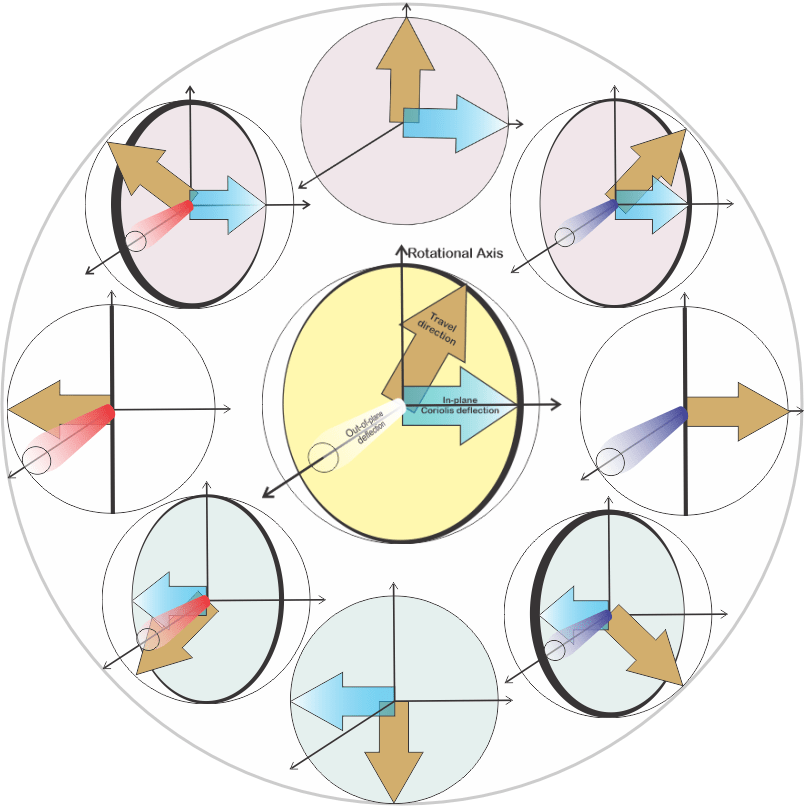
“Let me break it down for you. The circles around the outside represent different travel orientations — north’s at the top, then northeast to its left, directly east at the three-o’clock position, and so on. The brown arrows point to the corresponding direction. They’re all the same length to imply equal travel speed because why not.”
“Southbound’s at the bottom, just like on a map, right?”
“Right. Now, the blue arrow in a circle shows the relative Coriolis force experienced by an object traveling in that circle’s direction. See how the leftward force falls off from full‑strength if you’re northbound, to 70% if you’re going northeast, so zero for eastbound motion.”
“I’ll take your word for the 70%, but yeah, that’s what the picture shows. Wait, right after you turn the corner from east to south that blue arrow flips like the rule says.”
“It’s not like there’s a big toggle switch somewhere. If you’re going a little bit north of due east, there’s just a little bit of east‑pushing Coriolis; drive just a little bit south of due east there’s just a little bit of west‑pushing Coriolis. Build a Coriolis swerve‑meter. Swivel it all around the compass. It’ll show peak force when pointed north or south. The force smoothly fades away through zero, grows to a peak in the other direction, fades away, then re‑grows as you come back full circle.”
“So that’s what the pink and green disks are about, huh? Strong to fade‑away east both sides in the top half, strong to fade‑away west in the south?”
“You’ve got it.”
“What’s the red and blue stuff about then?”
“Re‑think the picture to 3‑D. Visualize each of those circles as a sphere. The thin black arrows are x‑y‑z pointers coming out from the sphere’s center. Can you see that?”
“The arrows coming out an angle, that’s like coming out of the screen?”
“Mm‑hm. Suppose you’re driving straight east in a vehicle that doesn’t care about gravity. What would happen?”
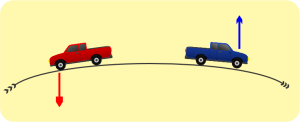
“Heh‑heh‑heh, lift‑off!”
“Exactly. It’s not centrifugal force, technically, but the Coriolis Effect’s equation establishes a trade‑off between Coriolis acting horizontally and a centrifuge‑like sibling acting vertically. Both sibs act to increase or decrease an object’s effective inertia depending on the object’s direction of motion relative to Earth’s rotation. The vertical component strengthens as the horizontal component weakens and vice‑versa.”
“The vertical one is the tubes coming out?”
“Yes, that’s what those are about. Long tubes in the diagram indicate high relative strength, short tubes signify weaker intensity, which is why the northbound and southbound spheres don’t have any tubes at all.” <grins> “Sy would appreciate my color choices.”
“I don’t get the joke.”
“Over there on the left side, the vertical component is upward, towards us. If a star’s coming towards its spectrum is shifted to shorter wavelengths, bluer than it it were standing still. No surprise, we call that a blue shift. Being an astronomer, I made those tubes blue‑ish.”
“I suppose the right side has red tubes because the vertical component pushes down when you’re westbound?”
“You broke the code, Cal. Red‑shifted stars are flying away from us. I’m being careful here — the red tubes don’t represent a true centripetal force. There’s no pushing and the effect doesn’t depend on distance from the rotation axis. But it makes a westbound truck act a bit like the road’s coming up to meet it.”
~ Rich Olcott

