SPAM Wars

  • I’ve received a spate of bogus emails lately so I did some research. I hope you’ll join me in the defense effort. Sy and the gang will be back next week.

I hate electronic SPAM. You’re probably with me on this – Stupid Pointless Annoying Messages in your email inbox, cluttering up the place and getting in the way of communications you really want or may even need to receive.

The SPAM tide keeps rising – legit and fake ads, legit and fake charity pleas, legit and fake political pitches, fake personal notes, any of which may be phishing attacks or vehicles for malware.

You can do something about that.

When I get an email, I wonder: Is that email really from who it says it’s from? Does it carry hidden malware? Will that clickable thingie do exactly and only what it says it’ll do? If I reply, will my reply go to the sender and nowhere else?

Those questions bother the communications infrastructure, too. SPAM parasitizes server and carrier resources that cost real money. The Internet Engineering Task Force (IETF) is on the case.

IETF’s defense strategy tries to snuff SPAM early in the transmission process. The part of an email address after the @-sign is called its domain. Each domain has an owner who is responsible for protecting their domain’s output. If a mail item’s FROM: address names a domain it’s not authorized to use (called “spoofing” in the trade), IETF-supplied protocols (if you’re curious, they’re SPF, DKIM and DMARC) can block the item –  IF the domain owner has properly configured their system to block spoofing.

But suppose a slippery item aimed at you gets past that defense. Here’s where self-defense comes into play. You have help, but that help depends on you and many other email recipients raising penalty flags on the bad guys.

Your Mail User Agent, the place you go to look at your emails, is another gate-keeper along the path. These range from huge (Outlook, gmail, Apple Mail) to tiny (maybe you have your own personal mail server).  Your MUA may be configured with filters that can inspect and block incoming emails before you see them.

Inspect? Sounds like Big Brother, right? In some places and at some times it might be, but these inspections have a different intent. What’s important is that they depend on penalty flags. Different filters (a MUA may use several) look and feel different, but basically the system records a penalty flag against every email you’ve marked as “Junk” or “SPAM” or bounced to your MUA’s abuse@ or fraud@ mailbox. Check whether they have one — if so, save its address.

Conversely, it’s good to mark “Not SPAM” on something you find in your Junk or SPAM folder that shouldn’t be there. In the trade that’s a “false positive”; your “Not SPAM” lowers the penalty level.

Each filter has its own way to use our flags – some build a blacklist of heavily‑penalized domains; some look for suspiciously hidden links or known malware attachments; some use pattern matching to suss out significant phrases or graphics shared among groups of flagged emails, tactics abound. The tricksters are tricky, though, so catching SPAM is a continuously‑escalating game of whack‑a‑mole.

The threats have created a demand for A.I. in this application. I don’t want A.I. that’s been trained on the unpaid work of legitimate creators, but I do want A.I. that’s been trained on SPAM. Even A.I. needs real‑time updating, which is why we’re a vital part of the feedback loop. Our self‑defense is in recognizing and flagging each speck of SPAM we see.

What do we look for? Some caution signals:

  1. If it asks for money AND it’s in a hurry. OK, political email does that, but so do scammers. (Yes, they may overlap, but.)
  2. Poor grammar and spelling. Believe it or not, this is often on purpose. The idea is to make the recipient feel smarter than the sender, too smart to fall for anything, and thus actually a little bit less leery.
  3. Requests for personal information, including as part of an online “survey.”
  4. FROM: or REPLY: addresses that don’t look right. If it comes from gmail.com it’s probably not really from your bank.
  5. Related: Links via bit.ly – you never know where they’ll take you until you’re there.
  6. And this is basic: If it looks too good to be true, it generally is too good to be true.

Please use those flags aggressively and help us stay safe out there.

~ Rich Olcott

A No-Charge Transaction

I ain’t done yet, Sy. I got another reason for Dark Matter being made of faster‑then‑light tachyons.”

“I’m still listening, Vinnie.”

“Dark Matter gotta be electrically neutral, right, otherwise it’d do stuff with light and that doesn’t happen. I say tachyons gotta be neutral.”

“Why so?”

“Stands to reason. Suppose tachyons started off as charged particles. The electric force pushes and pulls on charges hugely stronger than gravity pulls—”

“1036 times stronger at any given distance.”

“Yeah, so right off the bat charged tachyons either pair up real quick or they fly away from the slower‑than‑light bradyon neighborhood leaving only neutral tachyons behind for us bradyon slowpokes to look at.”

“But we’ve got un‑neutral bradyon matter all around us — electrons trapped in Earth’s Van Allen Belt and Jupiter’s radiation belts, for example, and positive and negative plasma ions in the solar wind. Couldn’t your neutral tachyons get ionized?”

“Probably not much. Remember, tachyon particles whiz past each other too fast to collect into a star and do fusion stuff so there’s nobody to generate tachyonic super‑high‑energy radiation that makes tachyon ions. No ionized winds either. If a neutral tachyon collides with even a high-energy bradyon, the tachyon carries so much kinetic energy that the bradyon takes the damage rather than ionize the tachyon. Dark Matter and neutral tachyons both don’t do electromagnetic stuff so Dark Matter’s made of tachyons.”

“Ingenious, but you missed something way back in your initial assumptions.”

“Which assumption? Show me.”

“You assumed that tachyon mass works the same way that bradyon mass does. The math says it doesn’t.” <grabbing scratch paper for scribbling> “Whoa, don’t panic, just two simple equations. The first relates an object’s total energy E to its rest mass m and its momentum p and lightspeed c.”

E² = (mc²)² + (pc)²

“I recognize the mc² part, that’s from Einstein’s Equation, but what’s the second piece and why square everything again?”

“The keyword is rest mass.”

“Geez, it’s frames again?”

“Mm‑hm. The (mc²)² term is about mass‑energy strictly within the object’s own inertial frame where its momentum is zero. Einstein’s famous E=mc² covers that special case. The (pc)² term is about the object’s kinetic energy relative to some other‑frame observer with relative momentum p. When kinetic energy is comparable to rest‑mass energy you’re in relativity territory and can’t just add the two together. The sum‑of‑squares form makes the arithmetic work when two observers compare notes. Can I go on?”

“I’m still waitin’ to hear about tachyons.”

“Almost there. If we start with that equation, expand momentum as mass times velocity and re‑arrange a little, you get this formula

E = mc² / √(1 – v²/c²)

The numerator is rest‑mass energy. The v²/c² measures relative kinetic energy. The Lorentz factor down in the denominator accounts for that. See, when velocity is zero the factor is 1.0 and you’ve got Einstein’s special case.”

“Give me a minute. … Okay. But when the velocity gets up to lightspeed the E number gets weird.”

“Which is why c is the upper threshold for bradyons. As the velocity relative to an observer approaches c, the Lorentz factor approaches zero, the fraction goes to infinity and so does the object’s energy that the observer measures.”

“Okay, here’s where the tachyons come in ’cause their v is bigger than c. … Wait, now the equation’s got the square root of a negative number. You can’t do that! What does that even mean?”

“It’s legal, when you’re careful, but interpretation gets tricky. A tachyon’s Lorentz factor contains √(–1) which makes it an imaginary number. However, we know that the calculated energy has to be a real number. That can only be true if the tachyon’s mass is also an imaginary number, because i/i=1.”

“What makes imaginary energy worse than imaginary mass?”

“Because energy’s always conserved. Real energy stays that way. Imaginary mass makes no sense in Newton’s physics but in quantum theory imaginary mass is simply unstable like a pencil balanced on its point. The least little jiggle and the tachyon shatters into real particles with real kinetic energy to burn. Tachyons disintegrating may have powered the Universe’s cosmic inflation right after the Big Bang — but they’re all gone now.”

“Another lovely theory shot down.”

~ Rich Olcott

Got To Be Good-lookin’ ‘Cause He’s So Hard To See

I’ll be sorry when Acme Building’s management swaps out our old‑style door locks for electronic ones. Vinnie has such fun lock‑picking his way past my office door in the morning. “Morning, Vinnie.”

“Morning, Sy. Hey, I got a new Crazy Theory for you. Nobody knows what Dark Matter is, right?”

“Right. All we know is that it has about five times as much mass as normal matter so it participates in gravitational interactions. Some of it seems to gather in spherical halos around galaxies and some of it seems to collect in spikes near their centers. Cosmologists are arguing about whether or not Dark Matter is particles, much less how they’d be quantized. And we call it Dark because it absolutely doesn’t care about electromagnetism.”

“That’s what I thought. I remember you said if Dark Matter did play with light waves at all it’d block our view of the CMB. So yeah, absolute. Good.”

“I gather your theory is about Dark Matter.”

“Mm-hm. I thought of a way that all that mass could be hiding in plain sight except we can’t see it.”

“Alright, I’m listening.”

“Tachyons.”

“Come again?”

“Tachyons — particles that fly around faster than light. I read an article about ’em. Some people say they can’t exist but hear me out, okay? The reason they’re not supposed to exist is ’cause it would take an infinite amount of energy to boost something up past lightspeed. I got that, but suppose they were born above lightspeed, back when the Big Bang singularity had energy packed so tight the Physics laws we know don’t apply. A lot of particles got flung out below lightspeed, but maybe even more got flung out above it.”

“What does this have to do with dark matter?”

“I’m gettin’ there. The thing with tachyons is, the article said it’d take infinite energy to slow one down to lightspeed. A tachyon rock hits a slow rock, it don’t stop ’cause the slow rock don’t have the juice for that. The collision may take a little energy from the tachyon rock but that just changes its trajectory.”

“Mmm, those tachyon rocks can’t be a thing. The — what can I call it? slow matter?”

“The article called ’em bradyons.”

“Thanks. We know that 92% of all … bradyonic atoms in the Universe are hydrogens. Rocks are made of silicon, oxygen and other atoms that are even heavier. Everything heavier than hydrogen and maybe some helium was created by nuclear reactions inside a star. Tachyonic atoms zooming beyond lightspeed couldn’t gather together to form a star or even join one. No significant tachyonic fusion, no tachyonic rocks.”

“Okay, they all stay tachy‑hydrogen, still not a problem. The point is, there could be a lot of them and they could add up to a lot of mass. So the next thing I asked is, where would tachyons hang out? Gotta be around galaxies, but being tachyons going super‑lightspeed they can’t just hang, they orbit around the centers. They’d spend the most time where they go slowest which is where they’re farthest away ’cause that’s how orbits work. But they’d be thickest close in ’cause of gravity but that’s where they go fastest.”

“Cute, so you’re predicting galaxies with halos of tachyons, plus spikes of them at each center. That just happens to be the dark matter distribution the astronomers find.”

“It gets better, Sy. I’m not so sure of this because math, but it feels right. I don’t think tachyons can do electromagnetism things.”

“Why not?”

“No blue glow — you know, that blue glow in nuclear reactors when electrons go through the cooling water faster than light?”

“Cherenkov radiation, happens when fast electrons polarize the water. The polarizing slows light in water relative to a vacuum.”

“Right, but tachyons in space travel through vacuum. They ought to polarize the vacuum like what fast electrons do to water. Electromagnetic tachyons orbiting galaxies ought to make a blue glow but there isn’t one, so tachyons don’t do electromagnetism things and that makes them Dark Matter.”

“You’re going to have to do better than that, Vinnie. Absence of evidence just might be evidence of absence. Maybe they’re not there to begin with.”

~ Rich Olcott

Properties of Space

Vinnie gives me the side‑eye. “Wait, Sy. Back there you said Maxwell got the speed of light from the properties of space. What does any of that even mean?”

“Do you remember Newton’s equation for the force of gravity between two objects?”

“Of course not. Lessee… the force’d be bigger when either one gets bigger, and it’d get smaller when the distance between ’em gets bigger and there’s some constant number to make the units right, right?”

“Close enough, it’s the distance squared. The equation’s F=Gm1m2/r². The G is the constant you mentioned. It does more than turn mass‑units times mass‑units divided by length‑units‑squared into force‑units. It says how many force‑units. For one pair of objects at a certain distance, turn the G‑dial up and you get more force. Make sense?”

“Yeah, that looks right.”

“The value of G sets the force‑distance scale for how two objects attract each other everywhere in the Universe. That value is a property of space. So is the fact that the value is the same in all directions.”

“Huh! Never thought of it like a scale factor. Space has other properties like that?”

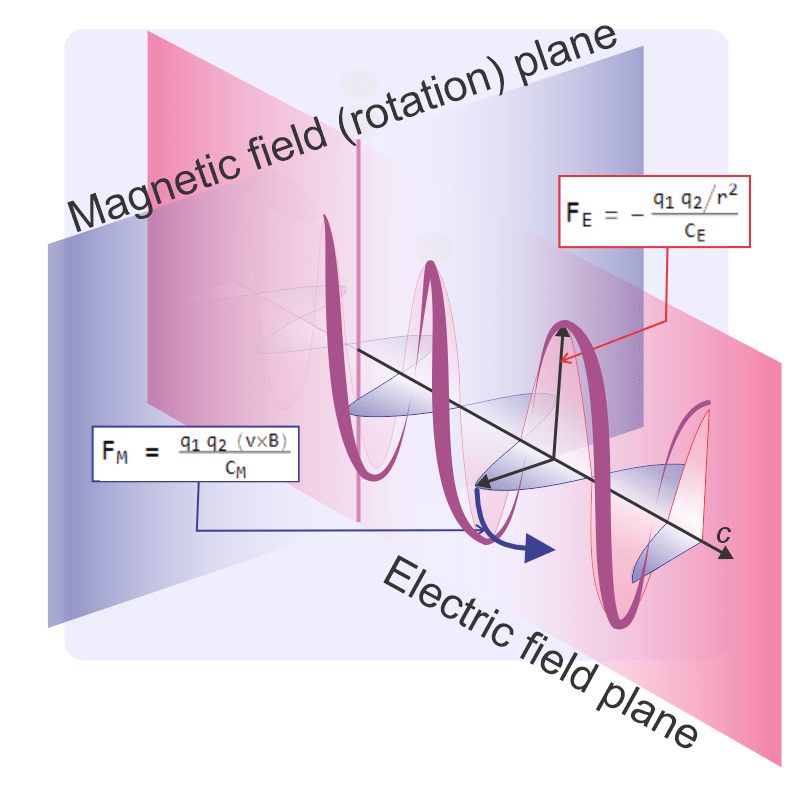
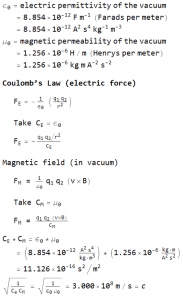
“Certainly. Coulomb’s Law for the electrostatic force between two charged objects has the same basic structure, FE=–(q1q2/r²)/CE. In any units you like you replace the q‘s with object charge amounts and r with the distance between them. For each set of change‑ and distance‑units there’s a well‑researched value of CE to convert your charge and distance numbers into force‑units. Under the covers, though, CE is a scale factor that controls the range of the electrostatic force. It’s the same everywhere in the Universe and it’s completely independent of Newton’s gravity scale factor.”

“Hey, what about ‘like charges repel, opposites attract’?”

“That’s what the minus sign’s in there for. If the q‘s have the same charge, the force is negative, that’s repulsion; opposite charges make for positive, attractive force.”

“If there’s a CE for electric there’s gotta be a CM for magnetic.”

“Sort of. The electrostatic force doesn’t care about direction. Magnetism does care so the equation’s more complicated. You’re right, though, there is a similar universal scale factor we might as well call CM.”

<chuckle> “Electric, magnetic, I don’t suppose we could mix those two somehow for an electromagnetic scale factor?”

<grin> “Did you read ahead in the book? Yes we can, and Maxwell’s equations showed us how. If you multiply the two C‘s together, you get one over the square of the speed of light. Re‑arranging a little, c=√(1/CECM), so c, the electromagnetic scale factor for velocity, is based on those space properties. Einstein showed that no material object can have a velocity greater than c.”

“I’ll take your word for the arithmetic, but how does that combination make for a speed limit?”

“There’s an easy answer you’re not going to like — it’s a speed because the units come out meters per second.”

“That’s a cheat. I don’t like it at all and it doesn’t account for the limit part. Explain it with Physics, no fancy equations.”

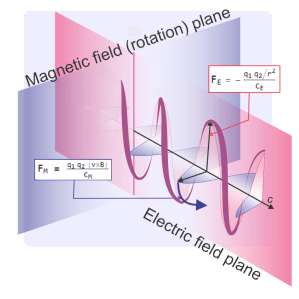
“Tough assignment. Okay, typical waves have a displacement force, like wind or something pushing up on an ocean wave, that works against a restoring force, such as gravity pulling down. Electromagnetic waves are different. The electric component supplies the up force, but the magnetic component twists sideways instead of restoring down. The wave travels as a helix. The CE and CM properties determine how tightly it spirals through space. That’s lightspeed.”

“And the limit part?”

“Einstein maintained that anything that happens must follow the same rules for all observers no matter how each is moving. The only way that can be true is if space is subject to the Lorentz contraction √[1-(v/vmax)²] for some universal maximum speed vmax. Maxwell’s electromagnetism equations showed that vmax is c. Okay?”

“I suppose.”

~ Rich Olcott

  • * Vinnie hates equations even with regular letters, Greek letters make it worse. Hence my using CE and CM instead of the conventional ε0 and μ0 notation. Sue me.

Squaring The Circle

Vinnie gives me the eye. “That crazy theory of yours is SO bogus, Sy, and there’s a coupla things you said we ain’t heard before.”

“What’s wrong with my Mach’s Principle of Time?”

“If the rest of the Universe is squirting one thing forward along Time, then everything’s squirting everything forward. No push‑back in the other direction. You might as well say that everything’s running away from the Big Bang.”

“That’s probably a better explanation. What are the couple of things?”

“One of them was, ‘geodesic,‘ as in ‘motion along a geodesic.‘ What’s a geodesic?”

“The shortest path between two points.”

“That’s a straight line, Mr Moire. First day in Geometry class.”

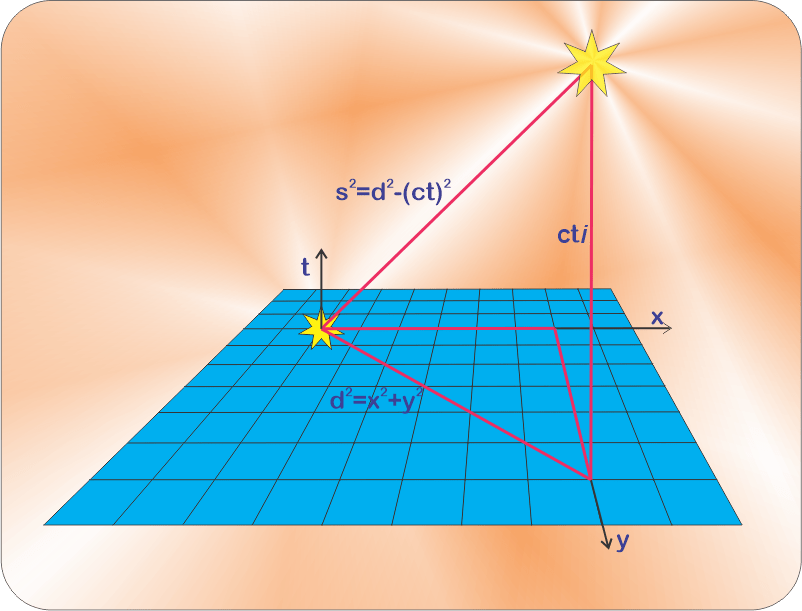
“True in Euclid’s era, Jeremy, but things have moved on since then. These days the phrase ‘shortest path’ defines ‘straight line’ rather than the other way around. Furthermore, the choice depends on how you define ‘shortest’. In Minkowski’s spacetime, for instance, do you mean ‘least distance’ or ‘least interval’?”

“How are those different?”

“The word ‘distance’ is a space‑only measurement. Minkowski plotted space in x,y,z terms just like Newton would have if he could’ve brought himself to use René Descartes’ cartesian coordinates. You know Euclid’s a²+b²=c² so you should have no problem calculating 3D distance as d=√(x²+y²+z²).”

“That makes sense. So what’s ‘interval’ about then?”

“Time has entered the picture. In Minkowski’s framework you handle two ‘events’ that may be at different locations and different times by using what he called the ‘interval,’ s. It measures the path between events as
s=√[(x²+y²+z²)–(ct)²]. Usually we avoid the square root sign and work with s².”

“That minus sign looks weird. Where’d it come from?”

“When Minkowski was designing his spacetime, he needed a time scale that could be combined with the x,y,z lengths but was perpendicular to each of them. Multiplying time by lightspeed c gave a length, but it wasn’t perpendicular. He could get that if he multiplied by i=√(–1) to get cti as a partner for x,y,z. Fortunately, that forced the minus sign into the sum‑of‑squares
(x²+y²+z²)–(ct)² formula.”

Vinnie’s getting impatient. “What is an actual geodesic, who cares about them, and what do these equations have to do with anything?”

“A geodesic is a path in spacetime. Light always travels along a geodesic. The modern version of Newton’s First Law says that any object not subject to an outside force travels along a geodesic. By definition the geodesic is the shortest path, but you can’t select which path from A to B is the shortest unless you can measure or calculate them. There’s math to tell us how to do that. Time’s a given in a Newtonian Universe, not a coordinate, so geodesics are distance‑only. We calculate d along paths that Euclid would recognize as straight lines. That’s why the First Law is usually stated in terms of straight lines.”

“So the lines can go all curvy?”

“Depends, Vinnie. When you’re piloting an over‑water flight, you fly a steady bearing, right?”

“Whenever ATC and the weather lets me. It’s the shortest route.”

“So according to your instruments you’re flying a straight line. But if someone were tracking you from the ISS they’d say you’re flying along a Great Circle, the intersection of Earth’s surface with some planar surface. You prefer Great Circles because they’re shortest‑distance routes. That makes them geodesics for travel on a planetary surface. Each Circle’s a curve when viewed from off the surface.”

“Back to that minus sign, Mr Moire. Why was it fortunate?”

“It’s at the heart of Relativity Theory. The expression links space and time in opposite senses. It’s why space compression always comes along with time dilation.”

“Oh, like at an Event Horizon. Wait, can’t that s²=(x²+y²+z²)–(ct)² arithmetic come out zero or even negative? What would those even mean?”

“The theory covers all three possibilities. If the sum is zero, then the distance between the two events exactly matches the time it would take light to travel between them. If the sum is positive the way I’ve written it then we say the geodesic is ‘spacelike’ because the distance exceeds light’s travel time. If it’s negative we’ve got a ‘timelike’ geodesic; A could signal B with time to spare.”

~ Rich Olcott

The Time Is Out of Joint

Vinnie galumphs over to our table. “Hi, guys. Hey, Sy, I just read your Confluence post. I thought that we gave up on things happening simultaneous because of Einstein and relativity but I guess that wasn’t the reason.”

“Oh, things do happen simultaneously, no‑one claims they don’t, it’s just that it’s impossible for two widely‑separated observers to have evidence that two widely‑separated events happened simultaneously. That’s a very different proposition.”

“Ah, that makes me feel better. The ‘nothing is simultaneous‘ idea was making me itchy ’cause I know for sure that a good juggler lets go with one hand just as they’re catching with the other. How’s Einstein involved then?”

“Lightspeed’s a known constant. Knowing distance and lightspeed lets you calculate between‑event time, right? The key to simultaneity was understanding why lightspeed is a constant. We’d known lightspeed wasn’t infinite within the Solar System since Rømer’s time, but people doubted his number applied everywhere. Maxwell’s theory of electromagnetism derived lightspeed from the properties of space itself so it’s universal. Only in Newton’s Universe was it possible for two distant observers to agree that two also‑distant events were simultaneous.”

“Why was Newton’s Universe special?

“Space held still and didn’t bend. Astronomers A and B had a stable baseline between them. After measuring the baseline with light they could measure the angles each observed between the events. Some trigonometry let them send each other congratulatory messages on seeing a simultaneous pair of incidents. After Einstein’s work, they knew better.”

“It’s frames again, ain’t it?”

“Of course, Vinnie. A‘s frame is almost certainly moving relative to B‘s frame. Motion puts the Lorentz relativity factor into the game, making each astronomer’s clock run faster than the other’s. Worse, each astronomer sees that the other’s yardsticks are too short.”

Jeremy gives me a confused look.

Space compression goes along with time dilation, Jeremy. Professor Hanneken will explain it all when your class gets to that unit. Bottom line, things can happen simultaneously in Einstein’s Universe, but no‑one can agree on which things.”

“Wait, if every frame has its own time‑rate, how can two spaceships rendezvous for an operation?”

“Good question, Jeremy. Einstein had an answer but complications hide under the covers. He suggested that A start a timer when sending a light pulse to a mirror at B. A waits for the reflection. B starts a timer when they see A‘s pulse. A measures the pulse’s round‑trip time. Each creates a clock that advances one tick for half of the round-trip time. B sets their clock back by one tick. That done, they agree to meet some number of ticks later.”

“Hmm… That should work, but you said there are complications.”

“There are always complications. For instance, suppose B is slingshotting around a black hole so that pulse and reflection travel different pathlengths. Or suppose one frame is rotating edge‑on to the other. In practice the ships would re‑sync repeatedly while approaching the rendezvous point.”

Vinnie erupts. “HAW! Successive approximation again!”

“Indeed. If we could extend the method to more than two participants we’d have a true Universal Coordinated Time.”

“Don’t we have that, Mr Moire? The Big Bang happened 14 billion years ago. Couldn’t we measure time from that?”

“Sort of. Last I looked the number was 13.787 plus‑or‑minus 20 million years. Too much slop for an instantaneous fleet‑level rendezvous like the final battle scene in StarTrek:Picard. But you’ve brought up an interesting question for a Crazy Theories seminar. One of Cosmology’s deepest unsolved questions is, ‘How does inertia work?’ Do you remember Newton’s First Law?”

<closes eyes> “In an inertial reference frame, an object either remains at rest or continues to move at a constant velocity, unless acted upon by a net force.

“Right. In other words, every object resists change to its current steady motion along a geodesic. Why is that? There’s no coherent, well‑founded, well‑tested theory. Einstein liked Mach’s Principle, which says inertia exists because every object is attracted through space to all the mass in the Universe. Suppose there’s a Mach’s Principle for Time, saying that objects squirt up the Time axis because they’re repelled by all the mass in the Universe.”

Vinnie hoots, “Bo-o-o-ohh-GUS!”

~ Rich Olcott

Hillerman, Pratchett And Narrativium

No-one else in the place so Jeremy’s been eavesdropping on my conversation with Cal. “Lieutenant Leaphorn says there are no coincidences.”

“Oh, you’ve read Tony Hillerman’s mystery stories then?”

“Of course, Mr Moire. It’s fun getting a sympathetic outsider’s view of what my family and Elders have taught me. He writes Leaphorn as a very wise man.”

“With some interesting quirks for a professional crime solver. He doesn’t trust clues, yet he does trust apparent coincidences enough to follow up on them.”

“It does the job for him, though.”

“Mm‑hm, but that’s in stories. Have you read any of Terry Pratchett’s Discworld books?”

“What are they about?”

“Pretty much everything, but through a lens of laughter and anger. Rather like Jonathan Swift. Pratchett was one of England’s most popular authors, wrote more than 40 novels in his too‑brief life. He identified narrativium as the most powerful force in the human universe. Just as the nuclear strong force holds the atomic nucleus together using gluons and mesons, narrativium holds stories together using coincidences and tropes.”

“Doesn’t sound powerful.”

“Good stories, ones that we’d say have legs, absolutely must have internal logic that gets us from one element to the next. Without that narrative flow they just fall apart; no‑one cares enough to remember them. As a writer myself, I’ve often wrestled with a story structure that refused to click together — sparse narrativium — or went in the wrong direction — wayward narrativium.”

“You said ‘the human universe’ like that’s different from the Universe around us.”

“The story universe is a multiverse made of words, pictures and numbers, crafted by humans to explain why one event follows another. The events could be in the objective world made of atoms or within the story world itself. Legal systems, history, science, they’re all pure narrativium. So is money, mostly. We don’t know of anything else in the Universe that builds stories like we do.”

“How about apes?”

“An open question, especially for orangutans. One of Pratchett’s important characters is The Librarian, a university staff member who had accidentally been changed from human to orangutan. He refuses to be restored because he prefers his new form. Which gives you a taste of Pratchett’s humor and his high regard for orangutans. But let’s get back to Leaphorn and coincidences.”

“Regaining control over your narrativium, huh?”

“Guilty as charged. Leaphorn’s standpoint is that there are no coincidences because the world runs on patterns, that events necessarily connect one to the next. When he finds the pattern, he solves the mystery.”

“Very Diné. Our Way is to look for and restore harmony and balance.”

“Mm‑hm. But remember, Leaphorn is only a character in Hillerman’s narrativium‑driven stories. The atom‑world may not fit that model. A coincidence for you may not be a coincidence for someone else, depending. Those two concurrent June novas, for example. For most of the Universe they’re not concurrent.”

“I hope this doesn’t involve relativistic clocks. Professor Hanneken hasn’t gotten us to Einstein’s theories yet.”

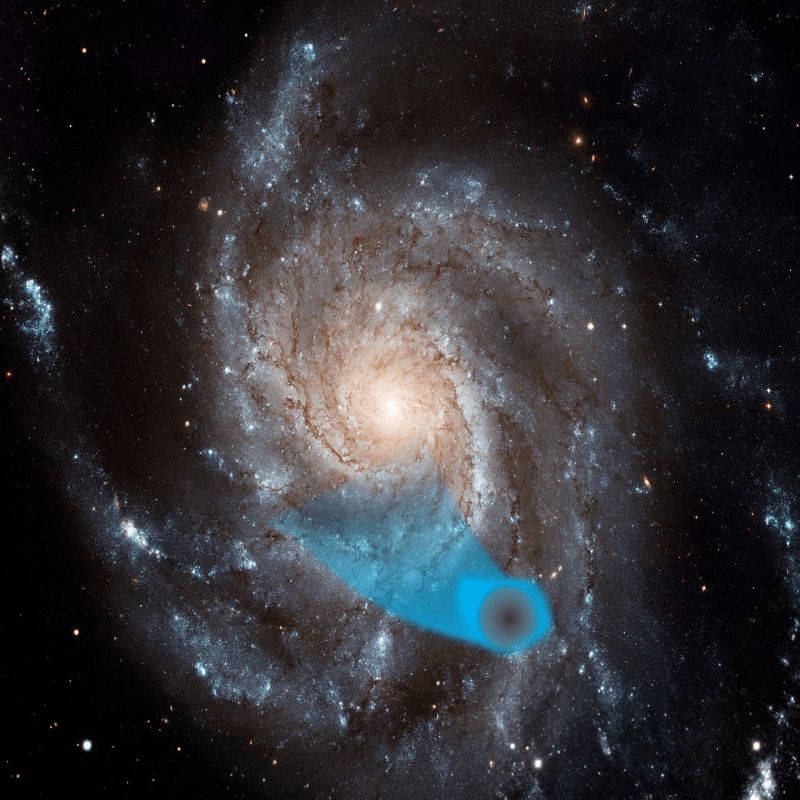
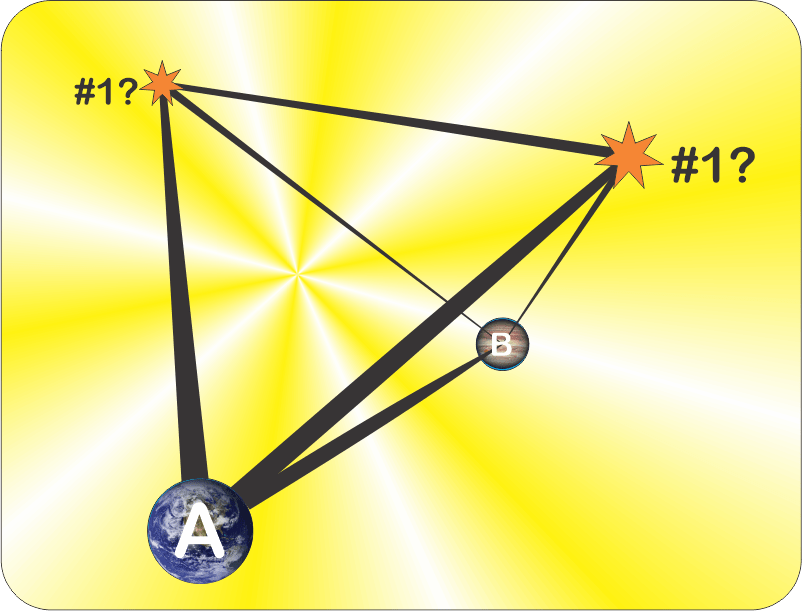
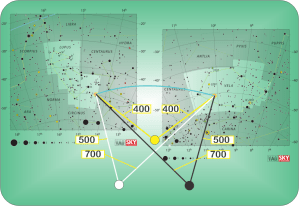
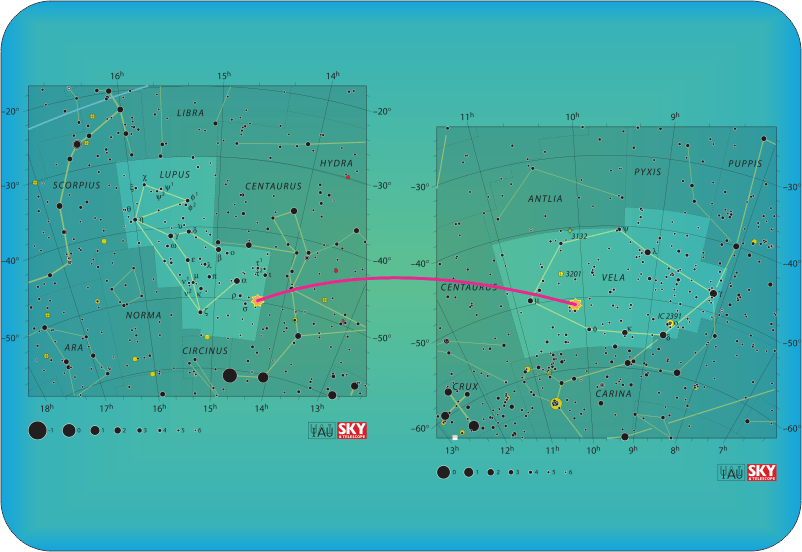
“No relativity; this is straight geometry. Rømer could have handled it 350 years ago.” <brief tapping on Old Reliable’s screen> “Here’s a quick sketch and the numbers are random. The two novas are connected by the blue arc as we’d see them in the sky if we were in Earth’s southern hemisphere. We live in the yellow solar system, 400 lightyears from each of them so we see both events simultaneously, 400 years after they happened. We call that a coincidence and Cal’s skywatcher buddies go nuts. Suppose there are astronomers on the white and black systems.”

<grins> “Those four colors aren’t random, Mr Moire.”

<grins back> “Caught me, Jeremy. Anyway, the white system’s astronomers see Vela’s nova 200 years after they see the one in Lupus. The astronomers in the black system record just the reverse sequence. Neither community even thinks of the two as a pair. No coincidence for them, no role for narrativium.”

~ Rich Olcott

  • This is the 531st post in an unbroken decade‑long weekly series that I originally thought might keep going for 6 months. <whew!>

Confluence

“My usual cup of — Whoa! Jeremy, surprised to see you behind the counter here. Where’s Cal?”

“Hi, Mr Moire. Cal just got three new astronomy magazines in the same delivery so he’s over there bingeing. He said if I can handle the pizza place gelato stand he can trust me with his coffee and scones. I’m just happy to get another job ’cause things are extra tough back on the rez these days. Here’s your coffee, which flavor scone can I get for you?”

“Thanks, Jeremy. Smooth upsell. I’ll take a strawberry one. … Morning, Cal. Having fun?”

“Morning, Sy. Yeah, lotsa pretty pictures to look at. Funny coincidence, all three magazines have lists of coincidences. This one says February 23, 1987 we got a neutrino spike from supernova SN 1987A right after we saw its light. The coincidence told us that neutrinos fly almost fast as light so the neutrino’s mass gotta be pretty small. 1987’s also the year the Star Tours Disney park attractions opened for the Star Wars fans. The very same year Gene Roddenberry and the Paramount studio released the first episodes of Star Trek: The Next Generation. How about that?”

“Pretty good year.”

“Mm‑hm. Didja know here in 2025 we’ve got that Mercury‑Venus‑Jupiter-Saturn‑Uranus‑Neptune straight‑line arrangement up in the sky and sometimes the Moon lines up with it?”

“I’ve read about it.”

“Not only that, but right at the September equinox, Neptune’s gonna be in opposition. That means our rotation axis will be broadside to the Sun just as Neptune will be exactly behind us. It’ll be as close to us as it can get and it’s face‑on to the Sun so it’s gonna be at its brightest. Cool, huh?”

“Good time for Hubble Space Telescope to take another look at it.”

“Those oughta be awesome images. Here’s another coincidence — Virgo’s the September sign, mostly, and its brightest star is Spica. All the zodiac constellations are in the ecliptic plane where all the planet orbits are. Planets can get in the way between us and Spica. The last planet to do that was Venus in 1783. The next planet to do that will be Venus again, in 2197.”

“That’ll be a long wait. You’ve read off things we see from Earth. How about interesting coincidences out in the Universe?”

“Covered in this other magazine’s list. Hah, they mention 1987, too, no surprise. Ummm, in 2017 the Fermi satellite’s GRB instrument registered a gamma‑ray burst at the same time that LIGO caught a gravitational wave from the same direction. With both light and gravity in the picture they say it was two neutron stars colliding.”

“Another exercise in multi-messenger astronomy. Very cool.”

“Ummm … Galaxy NGC 3690 shot off two supernovas just a few months apart last year. Wait, that name’s familiar … Got it, it’s half of Arp 299. 299’s a pair of colliding galaxies so there’s a lot of gas and dust and stuff floating around to set off stars that are in the brink. If I remember right, we’ve seen about eight supers there since 2018.”

“Hmm, many events with a common cause. Makes sense.”

“Oh, it’s a nice idea, alright, but explain V462 Lupi and V572 Velorum. Just a couple months ago, two novas less than 2 weeks apart in two different constellations 20 degrees apart in the sky. Bright enough you could see ’em both with good eyes if you were below the Equator and knew where to look and looked in the first week of June. My skywatcher internet buddies down there went nuts.”

“How far are those events from us?”

“The magazine doesn’t say. Probably the astronomers are still working on it. Could be ten thousand lightyears, but I’d bet they’re a lot closer than that.”

“On average, visible stars are about 900 lightyears away. Twenty degrees would put them about 300 lightyears apart. They’re separated by a slew of stars that haven’t blown up. One or both could be farther away than that, naturally. Whatever, it’s hard to figure a coordinating cause for such a distant co‑occurrence. Sometimes a coincidence is just a coincidence.”

~ Rich Olcott

Sussing Out The Unseeable

<chirp, chirp> “Moire here.”

“Hello, Mr Moire.”

“Afternoon, Walt. Pizza time again?”

“No, too public. Poor craft to be seen too often in the same place. There’s a park bench by the lake.”

“I know the spot.”

“Fifteen minutes.”

“Twenty.”


“Afternoon, Walt. What are your people curious about this time?”

“Word is that astronomers uncovered a huge amount of matter they’d been searching for. We’re interested in concealment techniques, so we want to know how it was hidden and how was it found.”

“Forty percent of all baryonic matter—”

“Baryonic?”

“Made out of atoms. Baryons are multi-quark particles like protons and—”

“Leave the weeds and get back to the topic. Where was that 40% hiding?”

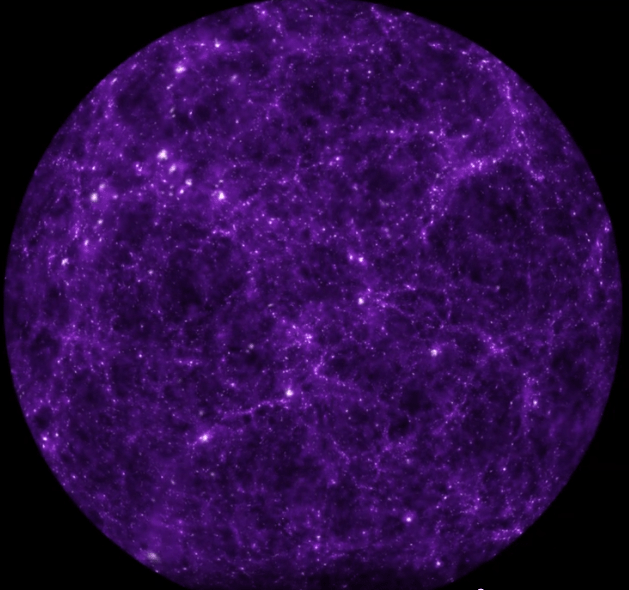
“In plain sight, all over the sky, in strands forming a network that connects galaxies and galaxy clusters. They’re calling it the Cosmic Web.”

“Something that big … how was hidden?”

“Some techniques I’m sure you’ll recognize. First, the material in the strands is diffuse — just an atom or two per cubic meter. An Earth laboratory would be proud to pump down a vacuum ten million times more dense.”

<taking notes> “Spread your forces so there’s no prime target for counter‑attack, mm‑hm. But if the material’s that thin, surely it doesn’t mass much.”

“Remember how big space is. These filaments span the widths of multiple galaxies. Do the math. A thread could be on the order of 100 million lightyears long by 1000 lightyears in diameter. A lightyear is 1016 meters. The thread has a volume of about 1062 cubic meters. At 10-26 kilogram per cubic meter that’s 1036 kilograms which is comparable to the mass of a small galaxy. That’s just one thread. Add them up and you get roughly half the baryons in the Universe, all hiding in the Web.”

“Concealment by dispersal, got it. What’s another technique?”

“Camouflage. No, not tiny uniforms in a woodland pattern. These atoms fade into the background because oncoming light waves pass right by them unless the wave has exactly the right wavelength for an absorption.”

“So how did astronomers detect these scattered and camouflaged atoms?”

“A couple of different ways. X‑rays, for one.”

“But these atoms are camouflaged against passing light. X‑rays are light waves.”

“X‑rays the atoms emit. Everybody thinks that space is cold, but those lonely atoms bounce around with a kinetic energy equivalent to million‑degree temperatures. When two of them collide some of that kinetic energy escapes as high‑frequency light, X‑ray range. Not a whole lot, because the atoms are sparse, but enough that European and Japanese space telescopes were able to tweeze it out of the background.”

“Use sensitive mics to pick up whispered convo in the opposing line.”

<pause> “Right, more or less. What do you know about refraction?”

“Mmm… Newton and his prism, splitting white light into different colors. I’ve no idea how that works.”

“The short answer is that the speed of light depends on its wavelength and the medium it’s traversing. In a perfect vacuum, light always goes at top speed just like Einstein said, but charged particles in its path slow it down.”

“Even those atoms in space that you said can’t absorb light?”

“Yup. It’s called virtual coupling; quantum’s involved. One inaccurate way to describe the interaction is that atoms occasionally absorb wrong‑wavelength photons but spit them right back out again after a brief delay. Short wavelengths see more of that effect than long wavelengths do. With me?”

<pause> “Go on.”

“Does the phrase ‘Fast Radio Burst’ sound familiar?”

“Of course, but probably not the way you mean.”

“Ah. Right. For this context, Fast Radio Bursts are isolated pulses of radio‑frequency light from incredibly bright extra-galactic sources we don’t understand. They’re all over the sky. A pulse lasts only a millisecond or so. What’s important here is that refraction skews each pulse’s wavelength profile as it travels through the intergalactic medium. Researchers analyze the distortions to detect and characterize Web filaments in the direction each pulse came from.”

“Intercept the oppo’s communications to the front.”

“That’s about the size of it.”

“Bye.”

“Don’t mention it.”

~ Rich Olcott

Black, White And Wormy

“Whaddaya mean, Sy, if white holes exist? You just told me how they’re in the equations just like black holes.”

“Math gives us only models of reality, Vinnie. Remarkably good models, some of them, but they’re only abstractions. Necessarily they leave out things that might skew math results away from physical results or the other way around. Einstein believed his math properly reflected how the Universe works, but even so, he doubted that black holes could exist. He didn’t think it’d be possible to collect that much mass into such a small space. Two decades after he said that, Oppenheimer figured out how that could happen.”

“Oppenheimer like the A‑bomb movie guy?”

“Same Oppenheimer. He was a major physicist even before they put him in charge of the Manhattan Project. He did a paper in 1939 showing how a star‑collapse could create the most common type of black hole we know of. Twenty‑five years after that the astronomers found proof that black holes exist.”

“Well, if Einstein was wrong about black holes, why wasn’t he wrong about white holes?”

“We need another Oppenheimer to solve that. So far, no‑one has come up with a mechanism that would create a stand‑alone white hole. That level of stress on spacetime requires an enormous amount of mass‑energy in a tiny volume. Whatever does that must somehow do it with a time‑twist opposite to how a black hole is formed. Worse yet, by definition the white hole’s Event Horizon leaks matter and energy. The thing ought to evaporate almost as soon as it’s formed.”

“I heard weaseling. You said, ‘a stand‑alone white hole,’ like there’s maybe another kind. How about that?”

“Could be, maybe not, depending on who’s talking and whether or not they’re accounting for magnetic fields, neutrinos or quantum effects. The discussion generally involves wormholes.”

“Wormholes.”

“Mm-hm. Some cosmologists think that wormholes might bridge between highly stressed points in spacetime. Black hole or white, the stress is what matters. The idea’s been around nearly as long as our modern idea of black holes. No surprise, ‘wormhole’ was coined by John Archibald Wheeler, the same guy who came up with the phrases ‘black hole’ and ‘quantum foam’.”

“Quantum—. Nope, not gonna bite. Get back to white holes.”

“I’m getting there. Anyway, the relativity theory community embraced black holes, white holes and wormholes as primary tools for studying how spacetime works.”

“How’re they gonna do that? That squib Cal showed me said we’ve never seen a white hole.”

“Fair question. Last I heard, the string theory community confidently predicted 10500 different Universes with little hope of narrowing the field. In contrast, relativity theory is firmly constrained by well‑founded math, a century of confirmation from experimental tests and a growing amount of good black hole data. Perfectly good math says that wormholes and white holes could form but only under certain unlikely conditions. Those conditions constrain white holes like Oppenheimer’s conditions constrained forming a stellar‑size black hole.”

“So how do we make one?”

We don’t. If the Universe can make the right conditions happen somewhere in spacetime, it could contain white holes and maybe a network of wormholes; otherwise, not. Maybe we don’t see them because they’ve all evaporated.”

“I remember reading one time that with quantum, anything not forbidden must happen.”

“Pretty much true, but we’re not talking quantum here. Macro‑scale, some things don’t happen even though they’re not forbidden.”

“Name one.”

“Anti‑matter. The laws of physics work equally well for atoms with positive or negative nuclear charge. We’ve yet to come up with an explanation for why all the nuclear matter we see in the Universe has the positive‑nucleus structure. The mystery’s got me considering a guess for Cathleen’s next Crazy Theories seminar.”

“Oh, yeah? Let’s have it.”

“Strictly confidential, okay?”

“Sure, sure.”

“Suppose the Big Bang’s chaos set up just the right conditions to make a pair of CPT‑twin black holes, expanding in opposite directions along spacetime’s time dimension. Suppose we’re inside one twin. Our time flows normally. If we could see into the other twin, we’d see inside‑out atoms and clocks running backwards. From our perspective the twin would be a white hole.”

“Stay outta that wormhole bridge.”

~ Rich Olcott