
A Fleeting Shadowed Sky

“Hey, Uncle Sy, I’ve got a what‑if for you.”

“What’s that, Teena?”

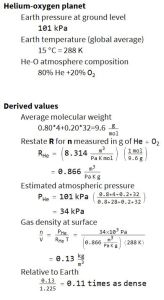
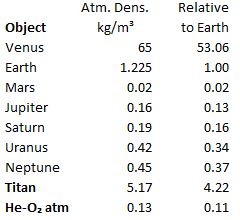
“Suppose we switched Earth’s air molecules with helium. No, wait, except for the oxygen molecules. I know we need them.”

“First off, a helium-oxygen atmosphere wouldn’t last very long, not on the geological time scale. That’s an unstable situation.”

“Why, would the helium burn up like I’ve seen hydrogen do?”

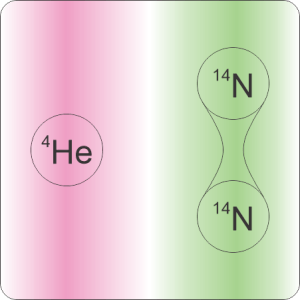
“No, helium doesn’t burn. Helium atoms are smug. They’re happy with exactly the electrons they have. They don’t give, take or share electrons with oxygen or anything else. No, the issue is that helium’s so light.”

“What difference does that make?”

“The oxygen and helium won’t stay mixed together.”

“The air’s oxygen and nitrogen molecules are all mixed together. They told us that in Science class.”

“That’s correct. But oxygen and nitrogen molecules weigh nearly the same. It would take eight balloon‑fulls of helium to match the weight of one balloon‑full of oxygens. Suppose you had a bunch of equal‑weighted marbles, say red ones and blue ones. Pretend you pour them into a big bucket and stir them around like an atmosphere does. Which color would wind up on top?”

“Both, they’d stay mixed together.”

“Uh-huh. Now replace the blue marbles with marble‑sized ping‑pong balls and stir well.”

“The heavy marbles slide to the bottom. The light balls need to be somewhere so they get bullied up to the top.”

“Exactly. That’s what the oxygen molecules would do — sink down toward the ground and shove the helium atoms up to the top of the atmosphere. Funny thing though — the shoving happens faster than the sinking.”

“Why’s that?”

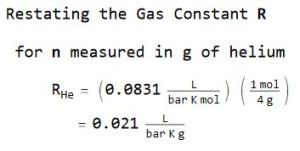
“It’s the mass thing again. At any given temperature, helium atoms in a gas zip around four times faster than oxygen molecules do. Anyway, the helium atoms that arrive up top won’t stay there.”

“Where else would they go?”

“Anywhere else, basically. Have you heard the phrase, ‘escape velocity‘?”

“It has something to do with rockets, doesn’t it?”

“Well, them, too. The general idea is that once you reach a certain threshold speed relative to a planet or something, you’re going too fast for its gravity to pull you back down. There’s a formula for calculating the speed. The fun thing is, the speed depends on the mass of what you’re escaping from and your distance from the object’s center, but it doesn’t depend on your own mass. It applies to everything from rockets to gas molecules.”

“And we were just talking about helium being zippy. Is it zippy enough to escape Earth?”

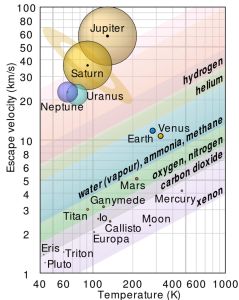
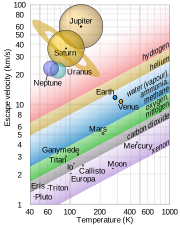
“Good thinking! That’s exactly where I was going. The answer is, ‘Maybe.’ It depends on temperature. Warm molecules are zippy, cold molecules not so much. At the same temperature, light molecules are zippier than heavy ones. There’s a chart that shows thresholds for different molecules escaping from different planets. Earth could hold onto its helium atoms, but only if our atmosphere were more than a hundred degrees colder than it is. Warm as we are, bye‑bye helium.”

“How long would that take?”

“That’s a complicated question with lots of ‘It depends’ in the answer. Probably the most important has to do with water.”

“I didn’t say anything about water, just helium and oxygen.”

“I know, but much of Earth’s weather is driven by water vaporizing or condensing or just carrying heat from place to place. Water‑powered hurricanes and even big thunderstorms stir up the atmosphere enough to swoosh helium up to bye‑bye territory. On the other hand, suppose our helium‑Earth is dry. The atmosphere’s layers would be mostly stable, light atoms would be slow to rise. We’d have a very odd‑looking sky.”

“No clouds.”

“Pretty much. But it wouldn’t be blue, either.”

“Would it be pink? I like pink.”

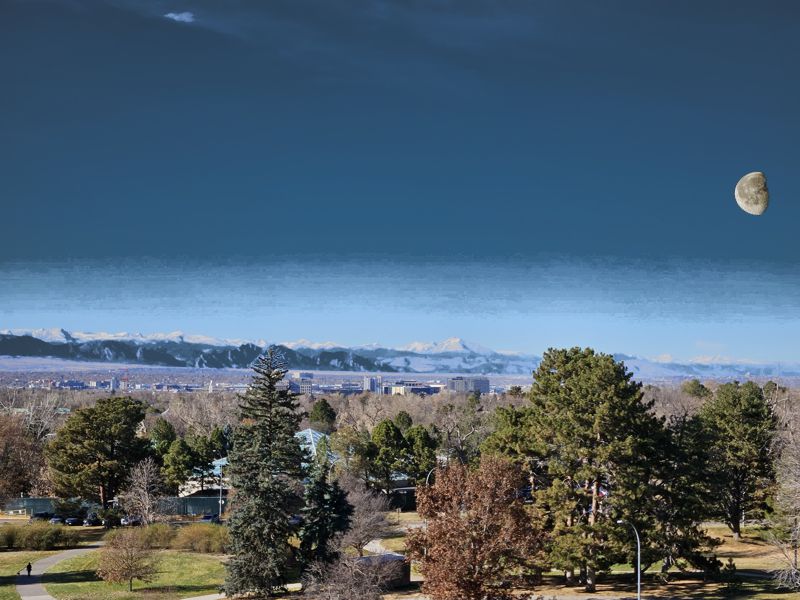
“Sorry, sweetie, it’d be dark dark blue, some lighter near the horizon. Light going past an atomic or molecular particle can scatter from its temporarily distorted electron cloud. Nitrogen and oxygen molecules distort more easily than helium atoms do. Earth skies are blue thanks to sunlight scattered by oxygen and nitrogen. Helium skies wouldn’t have much of that.”

~ Rich Olcott
  • Thanks again to Xander, who asked a really good helium question.

New Volcano, Old Crater

Now Eddie’s dealing the cards and the topic choice. “So I saw something on TV about a new volcano on Mars. You astronomy guys have been saying Mars is a dead planet, so what’s with a new volcano? Pot’s open.”

Vinnie’s got nothing, throws down his hand. So does Susan, but Kareem antes a few chips. “I doubt there’s a new volcano, it’s probably an old one that we just realized is there. We find a new old caldera on Earth almost every year. Sy, I’ll bet your tablet knows about it.”

I match Kareem’s bet and fire up Old Reliable. A quick search gets me to the news item. “You’re right, Kareem, it’s a new find of an old volcano. This article’s a puff‑piece but the subject’s in your bailiwick, Cathleen.”

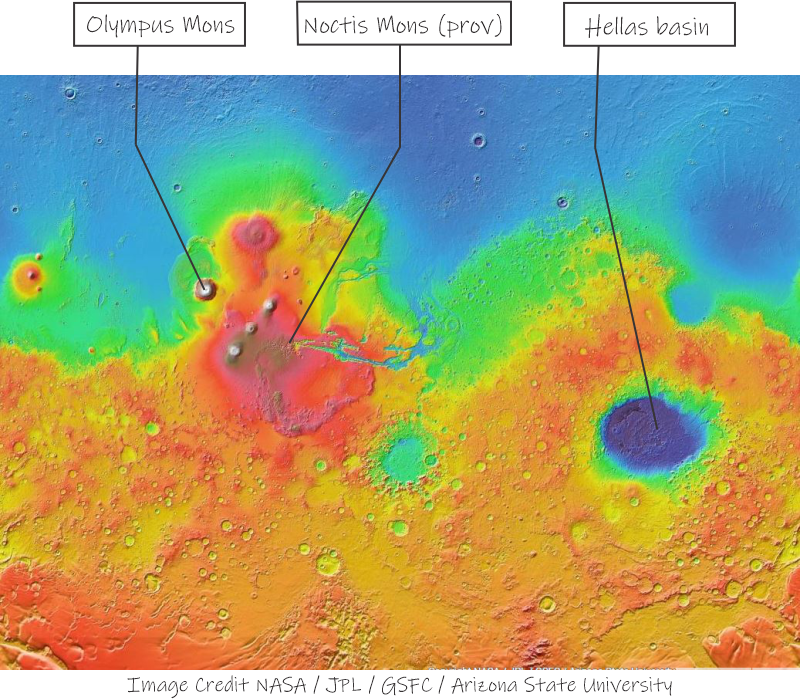
Cathleen puts in her bet and pulls out her tablet. “You’re right, Kareem. It’s a volcano we all saw but no‑one recognized until this two‑person team did. Here’s a wide‑angle view of Mars to get you oriented. North is up top, east is to the right just like usual.”

“Gaah. Looks like a wound!”

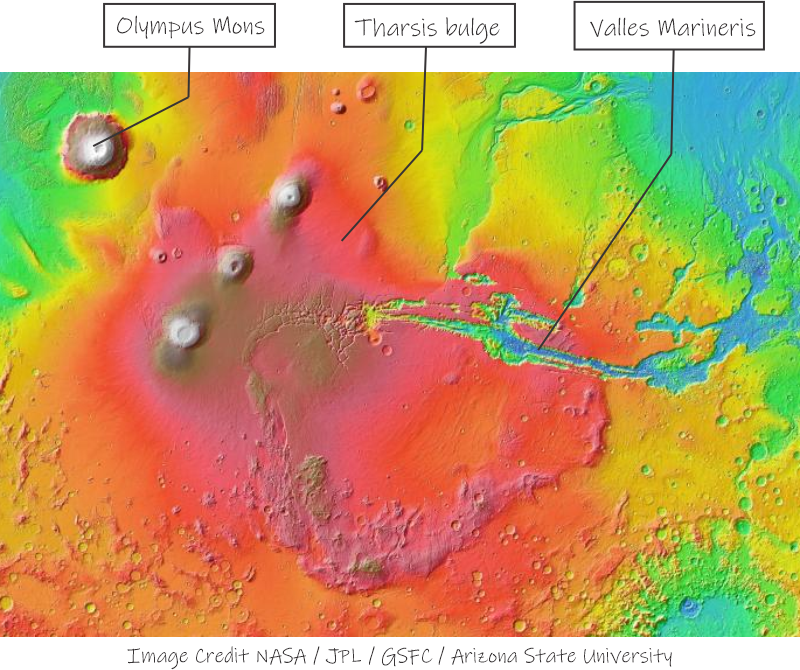
“We’ll get to that. The colors code for elevation, purple for lowlands up through the rainbow to red, brown and white. Y’all know about Olympus Mons, the 22‑kilometer tallest volcano in the Solar System, and there’s Valles Marineris, at 4000 kilometers the longest canyon. The Tharsis bulge is red‑to‑pink because it’s higher than most all the rest of the planet’s surface. Do you see the hidden volcano?”

“It’s hard to tell the volcanos from the meteor craters.”

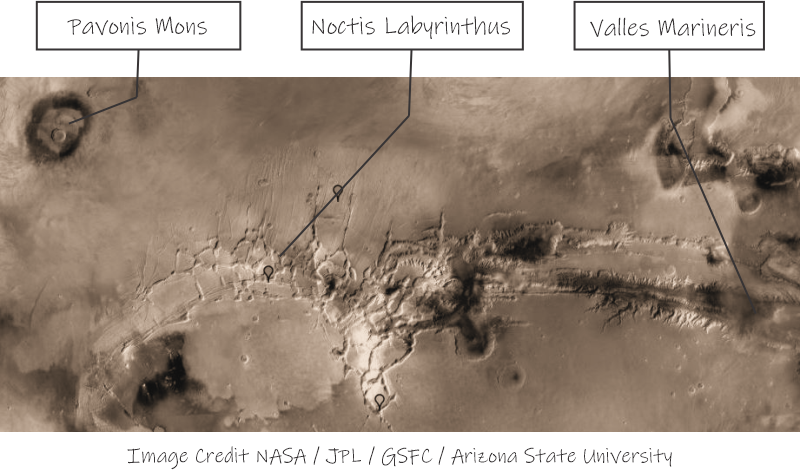
“Understandable. Let me switch to a closer view of the canyon’s western end. This one’s in visible light, no color‑coding games. The middle one of the three Tharsis volcanos is to the left, no ginormous meteor craters in the view. Noctis labyrinthus, ‘the Labyrinth of Night.’ is that badlands region left of center. Lots of crazy canyons that go helter‑skelter.”

“That’s more Mars‑ish, but it’s still unhealthy‑looking.”

“It is a bit rumpled. Do you see the volcano?”

“Mmm, no.”

“This should help. It’s a close-up using the elevation colors to improve contrast.”

“Wow, the area inside that circle sure does look like it’s organized around its center, not higgledy-piggledy like what’s west of it. That brown image had something peaky right about there. What’s ‘prov’?”

“Good eye, Susan. The ‘prov’ means ‘provisional‘ because names aren’t real until the International Astronomical Union blesses them. The peak is nine kilometers high, almost half the height of Olympus Mons. The concentric array of canyons and mesas around it certainly make it look like a collapsed and eroded volcano. But IAU demands more evidence than just ‘look like.’ Using detailed spectroscopic data from two different Mars orbiters, the team found evidence of hydrated minerals plus structural indications that their proposed volcano either punched through a glacier or flowed onto one. Better yet, the mesas all tilt away from the peak, and the minerals are what you’d expect from water reacting with fresh lava.”

“Did they use the word ‘ultramafic‘?”

“I don’t think so, Kareem, just ‘mafic‘.”

“From underground but not deep down, then.”

“I suppose.”

Cal bets. “You said we’d get back to wounds. What was that about?”

“Well, just look at all that mess related to the Tharsis bulge — higher than all its surroundings, massive volcanos nearby, the Noctis badlands, Valles Marineris that doesn’t look water‑carved but has that delta at its eastern end. Why is all of that clustered in just one part of the planet? Marsologists have dozens of hypotheses. My own favorite centers on Hellas basin. It’s the third largest meteor strike in the Solar System and just happens to be almost exactly on the opposite side of Mars.”

Eddie looks a bit gobsmacked. “A wallop like that would carry a lot of momentum. Kareem, can a planet’s interior just pass that along in a straight line?”

“Could be, depending. If it’s solid or high‑viscosity, I guess so. If it’s low‑viscosity you’d get a doughnut‑shaped circulatory pattern inside that’d turn the energy into heat and vulcanism. How long was Mars cooling before the hit?”

“We don’t know.”

Cal’s pair of jacks apologetically takes the pot.

~~ Rich Olcott

No Symphony on Mars

“Evening, Jeremy, a scoop of your pistachio gelato, please. What’re you reading there?”

“Hi, Mr Moire. It’s A City on Mars by Kelly and Zach Weinersmith. One of my girlfriends read it and passed it along to me. She said it’s been nominated for a Hugo even though it’s non‑fiction and it argues against the kind of go‑to‑Mars‑soon planning that Mr Musk is pushing.”

“Is she right about the argument?”

“Pretty much, so far, but I’m not quite done. You get a clue, though, from the book’s subtitle — ‘Can we settle space, should we settle space, and have we really thought this through?‘ Here’s your gelato.”

“Thanks. Not just Mars, space also?”

“That’s right. It’s about the requirements and implications for people living in space and on the Moon and on Mars. The discussion starts with making and raising babies.”

“That first part sounds like fun.”

“Well, you’d think so, but apparently you need special equipment. Hard to stay in contact if there’s no gravity to key on. But that’s only the start of a problem cascade. Suppose the lady gets pregnant. The good news is in zero gravity it’s easy for her to move around. The bad news is we don’t know whether Earth gravity’s important for making babies develop the way they’re supposed to. Also, delivering a baby isn’t the only medical procedure that’d be a real challenge in zero‑g where you need to keep fluid droplets from bouncing around the cabin and into the air system.”

“Whoa. Hmm, never thought about it in this context before, but babies leak. Diapers can help, but babies burp up stuff along with the air. Yuck! Tears they cry in space would just stay on their eyes instead of rolling down cheeks. So … we’d need OB/GYN clinics and nurseries somewhere down a gravity well.”

“For sure, although no‑one knows whether even the Moon’s 1/6g is strong enough for good development. I know my little cousins burn up a lot of energy just running around. Can’t give a toddler resistance bands or trust it on a treadmill.”

“So we need an all‑ages gym down there, too, with enough room for locals and visiting spacers.”

“You’re coming round to the Weinersmiths’ major recommendation — don’t go until you can go big! Don’t plan on growing from a small colony, plan on starting with a whole city that can support everything you need to be mostly self‑sufficient.”

“So you’re young, Jeremy. Are you looking forward to being a Mars explorer?”

“I’ll admit all that rusty landscape reminds me of Navajoland, but I think I’d rather stay here. On Mars I’d be trapped in tunnels and domes and respirators and protective coveralls. I wouldn’t be able to just go out and run under the sky the way I was brought up to do.”

“Wouldn’t be able to do a lot of things. Concerts would sound weird, according to a paper I just read.”

“Sure, wind instruments wouldn’t work with bubble helmets. We could still have strings, percussion and electronics, though, right?”

“Sure you could have them. But it’s worse than that. Mars atmosphere is very different from Earth’s. Its temperature measured in kelvins is 25% colder. The pressure’s 99% lower. Most important, molecule for molecule Mars’ mostly‑CO2 atmosphere’s is 50% heavier than Earth’s N2‑O2 mixture. Those differences combine to muffle sounds so they don’t carry near as far as they would on Earth. Most sounds travel about 30% more slowly, too, but that’s where a CO2 molecule’s internal operation makes things weird.”

“Internal? I thought molecules in sound waves just bounced off each other like little billiard balls.”

“That’s usually the case unless you’re at such high pressures that molecules can start sticking to each other. CO2 under Mars conditions is different. If there’s enough time between bounces, CO2 can convert some of its forward kinetic energy into random heat. The threshold is about 4 milliseconds. A sound wave frequency longer than that travels noticeably slower.”

“Four milliseconds is 250 Hertz — that’s a middle B.”

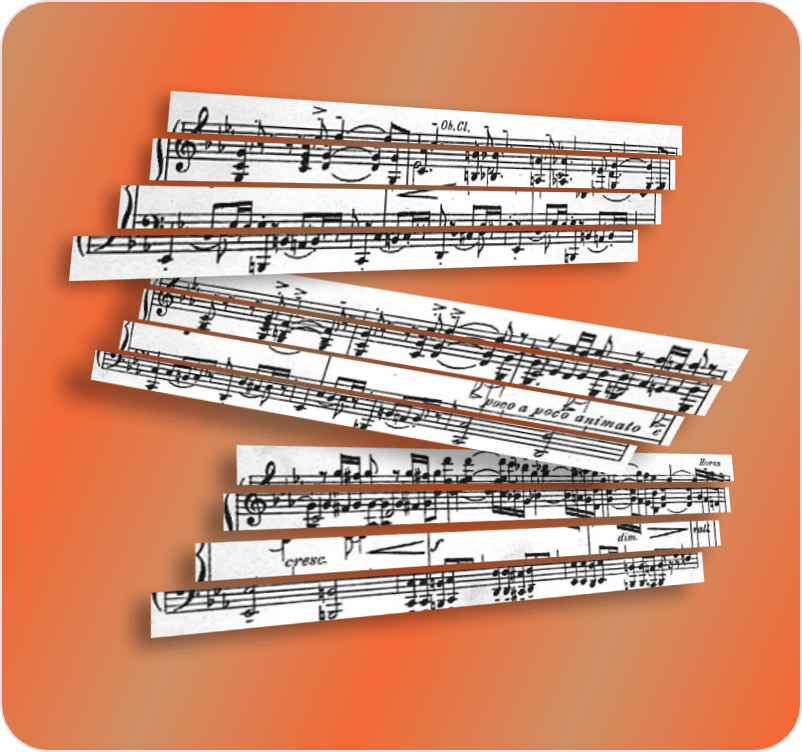
“Mm-hm. Hit a cymbal and base drum simultaneously, your audience hears the cymbal first. Terrible acoustics for a band.”

~~ Rich Olcott

A Spherical Bandstand

“Whoa, Sy, something’s not right. Your zonal harmonics — I can see how latitudes go from pole to pole and that’s all there are. Your sectorial harmonic longitudes start over when they get to 360°, fine. But this chart you showed us says that the radius basically disappears crazy close to zero. The radius should keep going forever, just like x, y and z do.”

“Ah, I see the confusion, Susan. The coordinate system and the harmonic systems and the waves are three different things, um, groups of things. You can think of a coordinate system as a multilevel stage where chords of harmonic musicians can interact to play a composition of wave signals. The spherical system has latitude and longitude levels for the brass and woodwind players, plus one in back for the linear percussion section. Whichever direction the brass and woodwinds point, that’s where the signals go out, but it’s the percussion that determines how far they get. Sure, radius lines extend to infinity but except for R0 radial harmonics damp out pretty quickly.”

“Signals… Like Kaski’s team interpreted Juno‘s orbital twitches as a signal about Jupiter’s gravitational unevenness. Good thing Juno got close enough to be inside the active range for those radial harmonics. How’d they figure that?”

“They probably didn’t, Cathleen, because radial harmonics don’t fit easily into real situations. First problem is scale — what units do you measure r in? There’s an easy answer if the system you’re working with is a solid ball, not so easy if it’s blurry like a protein blob or galaxy cluster.”

“What makes a ball easy?”

“Its rigid surface that doesn’t move so it’s always a node. Useful radial harmonics must have a node there, another node at zero and an integer number of nodes between. Better yet, with the ball’s radius as a natural length unit the r coordinate runs linearly between zero at the center and 1.0 at the surface. Simplifies computation and analysis. In contrast, blurries usually don’t have convenient natural radial units so we scrabble around for derived metrics like optical depth or mixing length. If we’re forced into doing that, though, we probably have worse challenges.”

“Like what?”

“Most real-world spherical systems aren’t the same all the way through. Jupiter, for instance, has separate layers of stratosphere, troposphere, several chemically distinct cloud‑phases, down to helium raining on layers of hydrogen in liquid, maybe slushy or even solid form. Each layer has its own suite of physical properties that put kinks into a radial harmonic’s smooth curve. Same problem with the Sun.”

“How about my atoms? The whole Periodic Table is based on atoms having a shell structure. What about the energy level diagrams for atomic spectra? They show shells.”

“Well, they do and they don’t, Susan. Around the turn of the last Century, Lyman, Balmer, Paschen, Brackett and Pfund—”

“Sounds like a law firm.”

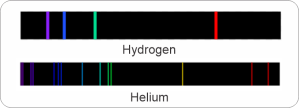
“<ironically> Ha, ha. No, they were experimental physicists who gave the theoreticians an important puzzle. Over a 40‑year period first Balmer and then the others, one series at a time, measured the wavelengths of dozens of lines in hydrogen’s spectrum. ’Okay, smarties, explain those!‘ So the theoreticians invented quantum mechanics. The first shot did a pretty good job for hydrogen. It explained the lines as transitions between discrete states with different energy levels. It then explained the energy levels in terms of charge being concentrated at different distances from the nucleus. That’s where the shell idea came from. Unfortunately, the theory ran into problems for atoms with more than one electron.”

“Give us a second… Ah, I get why. If one electron avoids a node, another one dives in there and that radius isn’t a node any more.”

“Got it in one, Cathleen. Although I prefer to think of electrons as charge clouds rather than particles. Anyhow, when an atom has multiple charge concentrations their behavior is correlated. That opens the door to a flood of transitions between states that simply aren’t options for a single‑electron system. That’s why the visible spectrum of helium, with just one additional electron, has three times more lines than hydrogen does.”

“So do we walk away from spherical harmonics for atoms?”

“Oh, no, Susan, your familiar latitude and longitude harmonics fit well into the quantum framework. These days, though, we mostly use combinations of radial fade‑aways like my Sn00 example.”

~~ Rich Olcott

Jupiter And The Atoms

“Okay, Sy, what’s your third solution?”

“Solution to what, Susan?”

These harmonic thingies. They’re about angles so it makes sense to chart them in polar or spherical coordinates, but when they take on negative values the radius goes the wrong way. You said one solution was to chart the negatives in a different color. That’s confusing, though. Another solution is to square all the values to get everything into positive territory. That’s okay for chemists like me because the peaks and nodes we care about stay in the same places. What’s the third option?”

“One that gets to why these ‘harmonic thingies’ are interesting at all. When Juno‘s orbiting Jupiter, does it feel each of Kaspi’s Jn shapes individually?”

“No, of course not, she just reacts to how they all add togethherrr … Oh! So you’re saying we can handle negative values from one harmonic by adding it to another one that’s more positive and plotting the combination.”

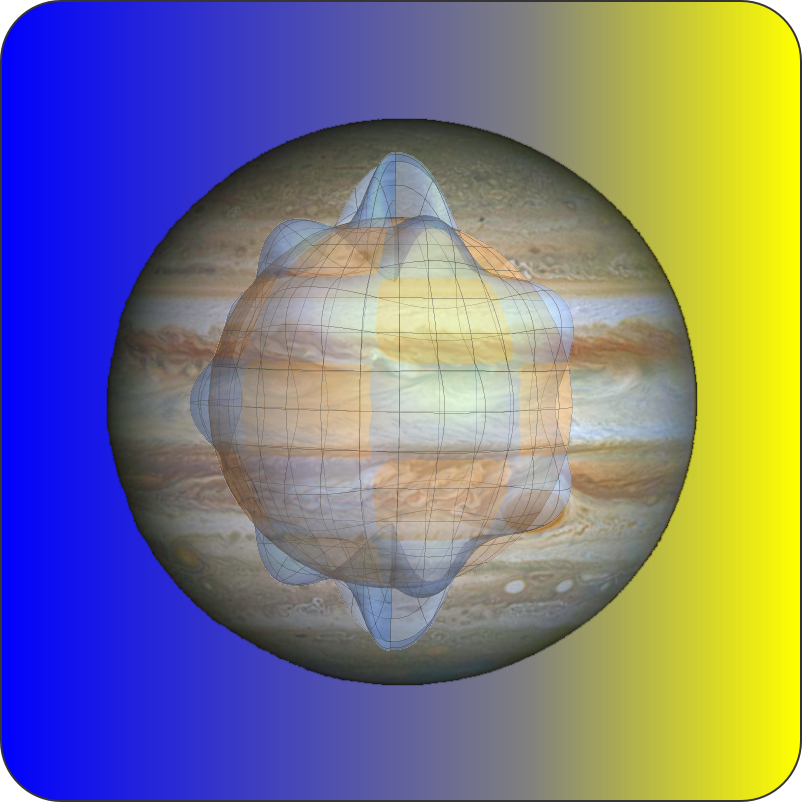
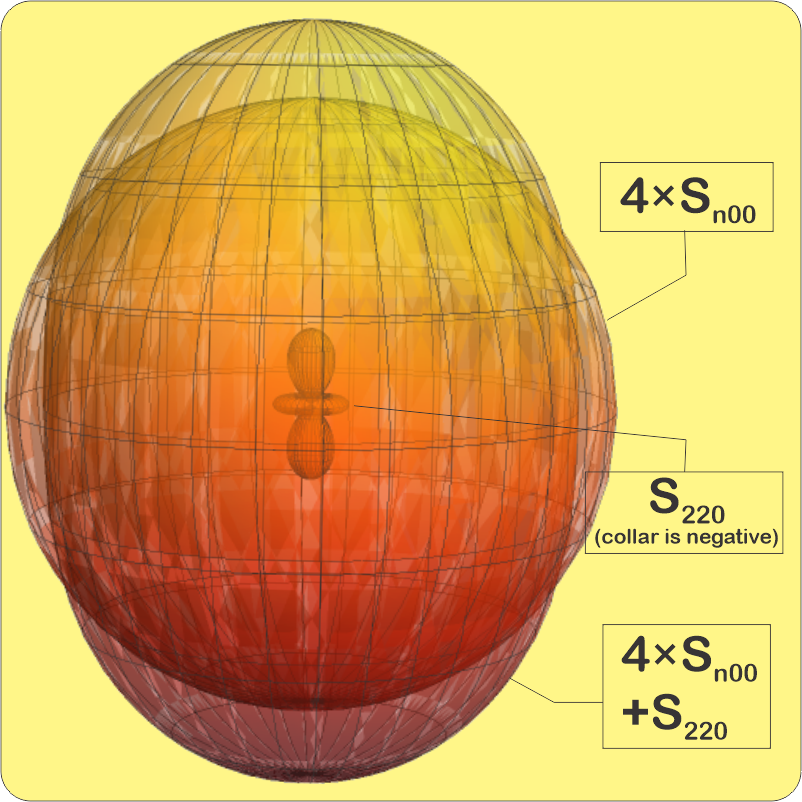
<pointing to paper napkin> “Bingo! Remember this linear plot of J2 where I colored its negative section pink?” <pointing to display on Old Reliable> “When you multiply J2 by C0 you get S220. I added that to four helpings of Sn00 to get this combination.”

“Ah, that negative region in S220‘s middle shaves back the equator on Sn00‘s sphere while the positive part adds bumps top and bottom.” <Susan gives me the side‑eye> “Why’d you pick that 4‑to‑1 ratio, and what’s with those n subscripts instead of numbers?”

“Getting a little ahead of myself. For the moment let’s concentrate on Juno‘s experience with Jupiter’s gravity. One reason I chose that ratio was that it’s pretty easy to see in the picture. In real cases the physical system determines the ratios. Kaspi’s team derived their ratios experimentally. They used math to fit a model to Juno‘s very slightly wobbly orbit. Their model of Jupiter’s gravity field started from the spherical J0 shape. They tweaked that by adding different ratios of J2 through J40, adjusting the ratios until the model’s total gravity field predicted an orbit that matched the real‑world one. J2‘s share was about 15 parts per thousand but most of the rest contributed less than a part per million. Jupiter probably uses multiple mass blobs to make the J2 shape. The point is, the planet’s really a mess but we can analyze the mess in terms of the harmonics.”

“So that’s how you drew what Cal called your wiggle-waggles — you followed Kaski’s Jn recipe and then added some constant to push the polar plot out far enough that the negatives didn’t poke out the wrong side. That constant — what value did you use and why that one?”

“That’s exactly what I did do, Cathleen. Frankly, I don’t even remember what constant I added, just something that was big enough to make the negatives behave nicely, not so large that the peaks vanished by comparison. Calibrating accurately to Jupiter’s J0 would shrink the peaks down to parts‑per‑thousand invisibility. After all, I was more concerned with peak position than peak size.”

“Now we’re back to your 4‑to‑1 ratio. Was that arbitrary, too?”

“No, it wasn’t, Susan. Would it have been closer to Chemistry if I’d labeled that figure as 1s22s22p1?”

“Two electrons in the 1s‑shell, two in the 2s‑shell plus one 2p electron … that’s a boron atom? But you’re showing only one radial shell, not two separate ones.”

“True, but that’s to make another point. There isn’t an electron in the 1s shell, or even a pair of them nicely staying on opposite sides. The atom’s charge, all five electrons‑worth of it, is smeared out as a wave pattern across the entire structure. The Sn00 pattern captures everything that’s spherical. The S220 pattern gets what’s left.”

“But what about the radial nodes? Isn’t that the difference between 1s and 2s, that 2s has a node?”

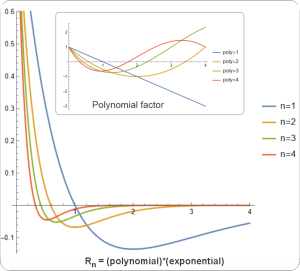
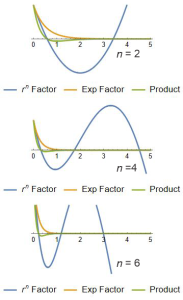
“Oh there are nodes, alright, but they don’t have much effect. Each radial harmonic is the product of two factors — a polynomial and an exponential. The exponential part squeezes the polynomial so hard that adjacent peaks and valleys are barely bumps and dents.”

“So Jupiter and atoms use the same math, huh?”

“So does the Sun.”

~~ Rich Olcott

A Loose-end Lagniappe

<chirp, chirp> “Moire here.”

“We have some loose ends to tie up. Too early for pizza. Coffee at Cal’s?”

“Hello, ‘Walt‘. Fifteen minutes?”

“Confirmed.”


He’s at a back table, facing the door, of course. He points to the steaming mug and strawberry scone beside it on the table. I nod to acknowledge. ”So, Walt, what are these loose ends?”

“My people say that Juno‘s not on a 53‑day orbit any more. NASA’s jiggled it down to 33 days. What’s that do to the numbers you gave me?”

<sliding a folded paper scrap across the table> “I had a hunch you’d want more so I worked up estimates. Juno started with a 53‑day orbit but a Ganymede flyby dropped it to 43 days. A Europa flyby took Juno to a 38‑day orbit. Now it’s swerved by Io and we’re at 33 days. I threw in the 23‑day line for grins, no extra charge.”

“Half the orbit size but no significant change in the close‑in specs. That’s surprising.”

“Not really. It’s like a dog’s butt wagging its tail. At close approach, we call it perijove, Juno is only 76 500 kilometers out from Jupiter’s center. Its orbit thereabouts is pretty much nailed down by the big guy’s central field. But there’s no second attractor to constrain the orbit’s other extreme millions of kilometers out. Do an Oberth burn near perijove or arrange for a gravity tweak from a convenient moon, you get a big difference at the far end.”

“That wraps that.” <reaches for his cane, then settles back to do a Columbo> “Just one more thing, Moire. I came in with a question about the Sun’s effect on Juno. You took care of that pretty quick but spent a load of my time and consultancy budget on these spherical harmonics. How come?”

“As I recall, you and your people kept coming back for more detail. Also, the 225 000‑kilometer radius I got from R2‘s structure was essential in calculating these close‑in numbers. You’re getting your money’s worth. I’ll even throw in a lagniappe.”

“A free gift? I never trust them.”

“Such a mean world you live in, Walt.” <displaying an image on Old Reliable> “Here it is, take it or leave it.”

Top: F000 plus a time-varying contribution from F660
Bottom: C0 plus a time-varying contribution from C4

“What is it?”

“It’s a bridge between the physics of light and sound, and the physics of atoms and stars. When I say ‘coordinates,’ what words spring to your mind?”

“Traverse and elevation.”

“Interesting choice. Any other systems?”

“Mm, latitude, longitude and altitude. And x‑y‑z if you’re in a classroom.”

“Way beyond the classroom. You use spreadsheets, right?”

“Doesn’t everyone?”

“Rowscolumnssheets is xyz. On digital screens, pixelslinesluminosity is xyz. Descarte’s rectilinear invention is so deeply embedded in our thinking we don’t even notice it. Perpendicular straight‑line coordinates fit things that are flat or nearly so, not so good for spheres and central‑force problems. Movement there is mostly about rotation, which is why your first two picks were angular instead of linear.”

“Okay, but our choice of coordinates is our choice. What have xyz or your Fnnm to do with natural things?”

“Overtones and resonance. Look at that black line in the movie. It could be a guitar string or a violin string, doesn’t matter. One end’s fixed to the instrument’s bridge, the other end’s under somebody’s finger. All other points on the string are free to move, subject to tension along the string. Then someone adds energy to the string by plucking or bowing it.”

“At one of those peaks or valleys, right?”

“Nope, anywhere, which goes to my point. The energy potentially could contort the string to any shape. Doesn’t happen. The only stable shapes are combinations of sine waves with an integer number of nodes, like C4‘s quartet. Adding even more energy gives you overtones, waves that add in‑between nodes to lower‑energy waves. C0‘s no‑nodes black line could run along x, y or z in any flat system.”

“So you’re going to tell me that your C‘s, J‘s and R‘s support wave structures for spheres.”

“Indeed. All four giant planets have stripes along their J arcs. Solar seismologists have uncovered C, R and maybe J wave structures inside the Sun.”

“Bye.”

“Don’t mention it.”

~ Rich Olcott

Completing The Triad

Walt’s mustache bristles as he gives me the eye. ”You claim three harmonics control how the Sun’s gravity could affect spacecraft orbits around a target planet like Jupiter. You said we don’t have to care about Jupiter’s gravitational zones and isolating the sectors probably isn’t doable. What’s the third?”

Time to twist the screws. ”Three harmonic systems, Walt, all working together and you’ve got their names wrong. They control nothing, they’re a framework for analysis. And Jupiter’s special. Solar gravity doesn’t affect its zonal harmonic arcs but that’s only because Jupiter’s polar axis is nearly perpendicular to its orbital plane. Zonal‑effect N‑S twisting at Jupiter is pennies on a C‑note. Any mission we send to Mars, Saturn or Uranus we’ll care a lot about their zonal harmonics because their axes have more tilt. An 82° tilt for Uranus, can’t get much more tilted than that. Sectorial harmonics may still help us navigate there because Uranus probably has a lot less magnetism than Jupiter.”

That rocks him but he comes back strong. ”The third kind of harmonic?!! C’mon, give!”

“Radial, the center‑out dimension. The gravitational force between bodies depends on center‑to‑center distances so yeah, your people would be interested.”

“I presume radial harmonics have numbers like Jn and Cm do?”

“They do. Sorry, this’ll get technical again but I’ll go as light as I can. Each radial harmonic is the product of two factors. You know about factors, right?”

“Sure, force multipliers.”

“You would know that kind. More generally, factors are things that get multiplied together. I’ll call the general radial harmonic Rn. It’s the product of two factors. The first is a sum of terms that begin with rn, where r is the distance. For instance, R3‘s first factor would look like a*r³+b*r²+c*r+d, where the a,b,c,d are just some numbers. Different radial harmonics have different exponents in their lead terms. You still with me?”

“Polynomials from high school algebra. Tell me something new.”

“The second factor decreases exponentially with n*r. No matter how large rn gets, when you multiply an rn polynomial by something that decreases exponentially, the (polynomial)×(exponential) product eventually gets really small.”

“Give me a second. … So what you’re saying is, at a big enough distance these radial harmonics just die away.”

“That’s where I was going.”

“How far is ‘enough’?”

“Depends on n. Higher values of n shut down faster.”

“So these Cms and Jns and Rns just add together?” <pauses, squints at me suspiciously> “Is there some reason you used n for both Jn and Rn?”

“No but yes, and yes. You combine a C, a J and an R using multiplication to get a full harmonic F, except there are rules. The J and R must belong to the same n. The m can’t be larger than n. From far away we’d model Jupiter’s gravity as F000=R0×J0×C0, which is an infinite sphere — R0 never dies away and J0×C0 says ‘no angular dependence.’ The Sun’s gravity acts along R0 and that’s what keeps Jupiter in orbit. If the problem demands combining full harmonics, you use addition.” <rousing a display on Old Reliable> “Here’s how a particular pair of harmonics combine to increase or decrease spherical gravity in specific directions.”

“But Juno doesn’t see those gravity lumps until it gets close‑in. How close?”

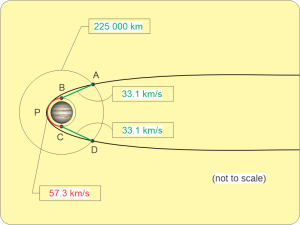
R2‘s down to less than a part per thousand at three planetary radii, call it 225 000 kilometers away from the planet’s center.”

“How much time is it closer than that distance?”

“Complicated question. A precise answer requires some calculus — is your smart phone set up for elliptic integrals?”

“Of course not. A good estimate will do.”

“Okay, here’s the plan. What we’d like is total time spent while Juno travels along the ellipsoidal arc between points A and D where the orbit crosses the 225 000‑km circle. Unfortunately, Juno speeds up approaching point P, slows down going away — calculating the A‑D time is tricky. I’ll assume Juno travels straight lines AB and CD at the A-speed. I’ll also approximate the orbit’s close pass as a semicircle at P‑speed.” <tapping> “I get a 3.6-hour duration, less than 0.3% of the full 53-day orbit. Will that satisfy your people?”

“You’ll know if it doesn’t.”

~~ Rich Olcott

Sectorial Setbacks

<chirp, chirp> “Moire here.”

“Moire, you were holding out on me. Eddie’s, fifteen minutes.”

“Not so fast, Walt. That wasn’t me holding out, that was you leaving too soon. From now on you’re paying quite a bit more. And it’ll be thirty minutes.”

“So we’re negotiating, hmm?”

“That’s about the size of it. You still interested?”

“My people are, they sent me back here. Oh well. Thirty minutes.”


Thirty-three minutes later I walk into Eddie’s. Walt’s already gotten a table. He beckons, points to the freshly‑served pizza, raises an eyebrow.

“Apology accepted. What made your people unhappy?”

“You told me flat‑out that the Sun’s gravity couldn’t affect those zonal harmonics. Do you have anything to back that up?”

“Symmetry. Zonal harmonics and latitude are about north‑south. Each Jn is a pole‑to‑pole variation pattern. The only way solar gravity can tilt Jupiter’s north‑south axis is to exert torque along the zonal harmonics. Jupiter’s equator is within 3° of edge‑on to the Sun.” <showing an image on Old Reliable’s screen> “Here’s what the Sun sees looking at J10, for instance. Solar pull on any northern zone segment, say, would be counteracted by an equal pull on the corresponding southern segment of the same zone. No net torque, no tilt. J0‘s the only exception. It’s simply a sphere that doesn’t vary across the whole planet. The Sun’s pull along J0‘s arc can’t tilt Jupiter.”

“Okay, so the zonal picture’s too simple. Just one set of waves, running up and down the planet—”

“No, not running. One way to characterize a wave is by how its components change with time. You’re thinking like ocean waves that move from place to place as time goes by. There’s also standing waves like on a guitar string, where individual points move but the peaks and valleys don’t. There’s time‑only waves like how the day length here changes through the year. And there’s static waves where time’s not even in the equation. Jupiter’s stripes don’t move, they’re peaks and valleys in a static wave pattern. By definition, the zonal harmonic system is static like that. But you’re right, it’s only part of the picture.”

“Give me the part the Sun’s gravitational field does play with.”

“That’d be two parts — sectorial and radial harmonics. Sectorial is zonal’s perpendicular twin. Zonal wave patterns show variation along the polar axis; sectorial wave patterns Cm vary around it. I’m keeping it non‑technical for you but Cm‘s actually cos(m*x) where x is the longitude.”

“Just don’t let it go any farther.”

“I’ll try not to. My point is that each sector pattern can be labeled with a positive integer just like we did with the zones.”

“If the Jn arcs aren’t affected by solar gravity, why would I care about these Cms?”

“You wouldn’t, except for the fact that mass distribution across Jupiter’s sectors is probably lumpy. We know the Great Red Spot holds its position in the southern hemisphere and the planet’s magnetic field points way off to the side. Maybe those features mark off‑center mass deficits and concentrations. Suppose a particular sectorial wave’s peak sits directly over a mass lump or hole. Everything under that harmonic’s influence is tugged back and forth by solar gravity each time the wave traverses the day side. Juno in its N‑S path just isn’t an efficient sensor for those tugs. Good sectorial sensing would require an orbiter on an E‑W path, preferably right over the equator.  Any orbital wobbles we’d see could be fed into a sectorial gravity map. Cross that with the zonal map and we’d be able to locate underlying mass variations by latitude and longitude.”

“Not a good idea. Gravity’s not the only field in play. You’ve just mentioned Jupiter’s magnetic field. I’ve read it’s stronger than any other planet’s. If your E‑W orbiter’s built with even a small amount of iron, you’d have a hard time deciding which field was responsible for any observed irregularities.”

“Good point. The idea’s even worse than you think, though. Jupiter’s sulfur‑coated moon—”

“Io. Yes, your induction‑heating idea might even be real. What about it?”

“I haven’t written yet about the high‑voltage Io‑to‑Jupiter bridge made of sulfur, oxygen and hydrogen ions. Jupiter’s magnetism plays a complicated game with them but the result is a chaotic sheet of radiating plasma around the planet’s equator. An E‑W orbiter in there would be tossed about like a paper boat on the ocean.”

~~ Rich Olcott

A Pencil In Space

<chirp, chirp> “Moire here.”

“I have a question I think you’ll find interesting, but it’s best we talk in person. Care for pizza?”

“If you’re buying.”

“Of course. Meet me at Eddie’s, twenty minutes. Bring Old Reliable.”

“Of course.”


Tall fellow, trimmed chevron mustache, erect bearing except when he’s leaning on that cane. “Moire?”

“That’s me. Good to meet you, Mr … ?”

“No names. Call me … Walt.”

We order, find a table away from the kitchen. “So, Walt, what’s this interesting question?”

“Been following this year’s Jupiter series in your blog. Read over the Kaspi paper, too, though most of that was over my head. What I did get was that his conclusions and your conclusions all come from measuring very small orbit shifts which arise from millionths of a g of force. Thing is, I don’t see where any of you take account of the Sun’s gravity. If the Sun’s pull holds Jupiter in orbit, it ought to swamp those micro-g effects. Apparently it doesn’t. Why not?”

“Well. That’s one of those simple questions that entail a complicated answer.”

“I’ve got time.”

“I’ll start with a pedantic quibble but it’ll clarify matters later on. You refer to g as force but it’s really acceleration. The one‑g acceleration at Earth’s surface means velocity changes by 980 meters/second per second of free fall. Drop a one kilogram mass, it’ll accelerate that fast. Drop a 100 kilogram mass, it’ll experience exactly the same acceleration, follow?”

“But the second mass feels 100 times the force.”

“True, but we can’t measure forces, only movement changes. Goes all the way back to Newton defining mass in terms of force and vice‑versa. Anyway, when you’re talking micro‑g orbit glitches you’re talking tiny changes in acceleration. Next step — we need the strength of the Sun’s gravitational field in Jupiter’s neighborhood.”

“Depends on the Sun’s mass and Jupiter’s mass. No, wait, just the Sun’s mass because that’s how it curves spacetime. The force depends on both masses.”

I’m impressed. “And the square of the very large distance between them.” <tapping on Old Reliable’s screen> “Says here the Sun’s field strength out there is 224 nano‑g, which is pretty small.”

“How’s that compare to what else is acting on Juno?”

<more tapping> “Jupiter’s local field strength crushes the Sun’s. At Juno’s farthest point it’s 197 micro‑g but at Juno’s closest point the field’s 22.7 million micro‑g and the craft’s doing 41 km/s during a 30-minute pass. Yeah, the Sun’s field would make small adjustments to Juno’s orbital speed, depending on where everybody is, but it’d be a very slow fluctuation and not the rapid shakes NASA measured.”

“How about side‑to‑side?”

“Good point, but now we’re getting to the structure of Juno’s orbit. Its eccentricity is 98%, a long way from circular. Picture a skinny oval pencil 8 million kilometers long, always pointed at Jupiter while going around it. It’s a polar orbit, rises above Jupiter on the approach, then falls below going away. The Sun’s effect is greatest when the orbit’s at right angles to the Sun‑Jupiter line. The solar field twists the oval away from N‑S on approach, trues it back up on retreat. That changes the angle at which Juno crosses Jupiter’s gravitational wobbles but won’t affect how it experiences the zonal harmonics.”

“Tell me about those zonal things.”

“A zone is a region, like the stripes on Jupiter, that circles a sphere at constant latitude. Technically, zonal harmonic Jn is the nth Legendre polynomial in cos(θ)—”

“Too technical.”

“Gotcha. Okay, each Jn names a shape, a set of gravitational ripples perpendicular to the polar axis. J0‘s a sphere with no ripples. Jupiter’s average field looks like that. A bigger n number means more ripples. Kaspi’s values estimate how much each Jn‘s intensity adds to or subtracts from J0‘s strength at each latitude. The Sun’s field can modify the intensity of J0 but none of the others.”

Walt grabs his cane, stands, drops a C‑note on the table. “This’ll cover the pizza and your time. Forget we had this conversation.” And he’s gone.

“Don’t mention it.”

~~ Rich Olcott

  • Thanks to Will, who asked the question.

Screaming Out Of Space

Cal (formerly known as Al) comes over to our table in his coffee shop. “Lessee if I got this right. Cathleen is smug twice. First time because the new results from Juno‘s data say her hunch is right that Jupiter’s atmosphere moves like cylinders inside each other. Nearly cylinders, anyhow. Second smug because Sy used the Juno data to draw a math picture he says shows the Great Red Spot but I’m lookin’ at it and I don’t see how your wiggle‑waggles show a Spot. That’s a weird map, so why’re you smug about it, Cathleen?”

“The map’s weird because it’s abstract and way different from the maps you’re used to. It’s also weird because of how the data was collected. Sy, you tell him about the arcs.”

“Okay. Umm… Cal, the maps you’re familiar with are two‑dimensional. City maps show you north‑south and east‑west, that’s one dimension for each direction pair. Maps for bigger‑scale territories use latitude for north‑south and longitude for east‑west but the principle’s the same. The Kaspi group’s calculations from Juno‘s orbit data give us a recipe for only a one‑dimensional map. They show how Jupiter’s gravity varies by latitude, nothing about longitude. We could plot that as a rectangle, latitude along the x‑axis, relative strength along the y‑axis. I thought I’d learn more by wrapping the x‑axis around the planet so we could look for correlations with Jupiter’s geography. I found something and that’s why Cathleen’s smug. Me, too.”

“Why latitude but nothing about longitude?”

“Because of the way Juno‘s orbit works. The spacecraft’s not hovering over the planet or even circling it like the ISS circles Earth. NASA wanted to minimize Juno‘s exposure to Jupiter’s intense magnetic and radiation fields. The craft spends most of its 53‑day orbit at extreme distance, up to millions of kilometers out. When it approaches, it screams in at about 41 kilometers per second, that’s 91 700 mph, on a mostly north‑to‑south vector so it sees all latitudes from a few thousand kilometers above the cloud‑tops. Close approach lasts only about three hours, for the whole planet, and then the thing is on its way out again. During that three hours, the planet rotates about 120° underneath Juno so we don’t have a straight vertical N‑S pass down the planet’s face. Gathering useful longitude data’s going to take a lot more orbits.”

“So you’re sayin’ Juno felt gravity glitches at all different angles going pole to pole, but only some of the angles going round and round.”

“Exactly.”

“So now explain the wiggle‑waggles.”

“They represent parts‑per‑million variations in the field pulling Juno towards Jupiter at each latitude. Where the craft is over a more massive region it’s pulled a bit inwards and Sy’s map shows that as a green bump. Over a lighter region Juno‘s free to move outward a little and the map shows a pink dip. Kaspi and company interpret the heaviness just north of the equator to be a dense inward flow of gas all around the planet. Maybe it is. Sy and I think the pink droplet south of the equator could reflect the Great Red Spot lowering the average mass at its latitude. Maybe it is. As always, we need more data, okay? Now I’ve got questions for you, Sy.”

“Shoot.”

“You built your map by multiplying each Jn‑shape by its Kaspi gravitational intensity then adding the multiplied shapes together. But you only used Jn‑shapes with integer names. Is there a J½?”

“Some mathematicians play with fractional J‑thingies but I’ve not followed that topic.”

“Understandable. Next question — the J‘s look so much like sine waves. Why not just use sine‑shapes?”

“I used Jn‑shapes because that’s how Kaspi’s group stated their results. They had no choice in the matter. Jn‑shapes naturally appear in spherical system math. The nice thing about Jn‑shapes is that n provides a sort of wavelength scale. For instance, J35 divides Jupiter’s pole‑to‑pole arc into 36 segments each as wide as Earth’s diameter. Here’s a plot of intensity against n.”

Adapted from Kaspi, Figure 2a

“Left to right, red light to blue.”

“Exactly.”

~ Rich Olcott