Why A Disk?

Late Summer is quiet time on campus and in my office. Too quiet. I head over to Cal’s coffee shop in search of company. “Morning, Cal.”

“Morning, Sy. Sure am glad to see you. There’s no‑one else around.”

“So I see. No scones in the rack?”

“Not enough traffic yet to justify firing up the oven on such a hot day. How about a biscotti instead?”

“If it’s only the one it’s a biscotto. Pizza Eddie’s very firm on that. Yeah, I’ll have one.”

“Always learning. By the way, a photo spread in one of my astronomy magazines got me thinking. How come there’s so much flat out there?”

“Huh? I know you’re not one of those flat‑Earthers.”

“Not the planets, I mean the way their orbits go all in the same plane. Same for most of the asteroids and the Kuiper belt, even. Our Milky Way galaxy’s basically flat, too, and so are a lot of the others. Black hole accretion disks are flat. You’d think if some baby star or galaxy was attracting stuff from everywhere to grow itself, the incoming would make a big globe. But it’s not, we get flatness. How come?”

“Bad aim and angular momentum.”

“What’s aim got to do with it?”

“Suppose there’s only two objects in the Universe and they’re closing in on each other. If they’re aimed dead‑center to each other, what happens?”

“CaaaRUNCH!!!”

“Right. Now what if the aim’s off so they don’t quite touch?”

“Oh, I know that one … it’ll come to me … yeah, Roche’s limit, it was in an article a few months ago. Whichever’s less dense will break up and all the pieces go like Saturn’s rings. Which are also flat, by the way.”

“In orbit around the survivor, mm‑hm. The pieces can’t fall straight down because they still have angular momentum.”

“I know about momentum like when you crash a car if you go too fast for your brakes. Heavier car or faster speed, you get a worse crash. How does angle fit into that — bigger angle, more angular momentum?”

“Not quite. In general, momentum is mass multiplied by speed. It’s a measure of the force required to stop something or at least slow it down. You’ve described linear momentum, where ‘speed’ is straight‑line distance per time. If you’re moving along a curve, ‘speed’ is arc‑length per time.”

“Arc‑length?”

“Distance around part of a circle. Arc‑length is angle in radians, multiplied by the circle’s radius. If you zip halfway around a big circle in the same time it took me to go halfway around a small circle, you’ve got more angular momentum than I do and it’d take more force to stop you. Make sense?”

“What if it’s not a circle? The planet orbits are all ellipses.”

“It’s still arc‑length except that you need calculus to figure it. That’s why Newton and Leibniz invented their methods. A falling something that misses a gravity center keeps falling but on an orbit. Whatever momentum it has acts as angular momentum relative to that center. There’s no falling any further in without banging into something else coming the other way and each object canceling the other’s momentum.”

“Or burning fuel if it’s a spaceship.”

“… Right. … So anyway, suppose you’ve got a star or something initially surrounded by a spherical cloud of space junk whirling around in all different orbits. What’s going to happen?”

“Lots of banging and momentum canceling until everything’s swirling more‑or‑less in the same direction and closer in than at come‑together time. But it’s still a ball.”

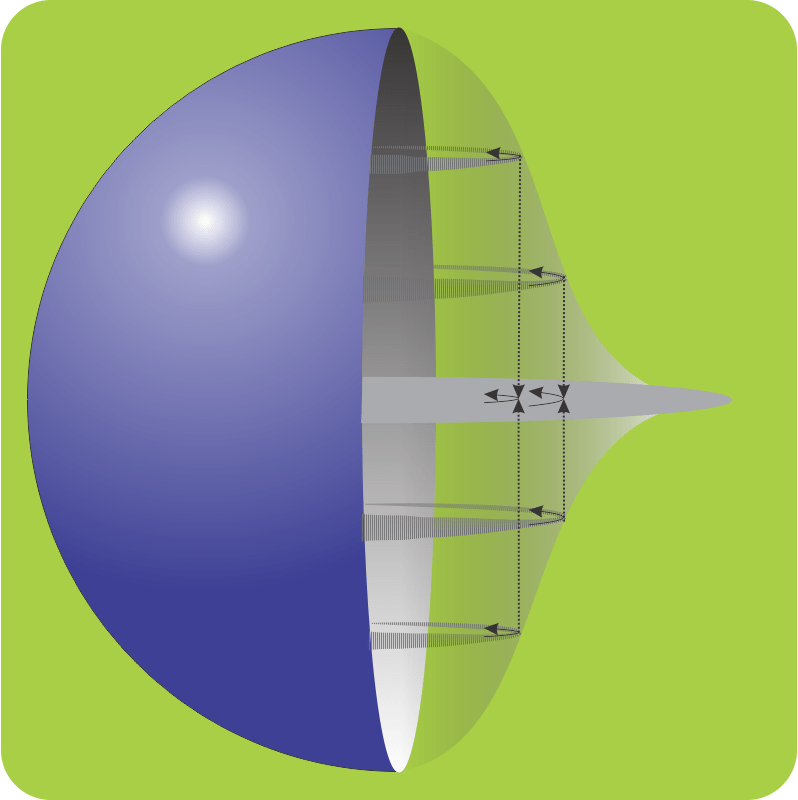
“Gravity’s not done. Think about northern debris. It’s attracted to the center, but it’s also attracted to the southern debris and vice-versa. They’ll meet midway and build a disk. The ball‑to‑disk collapse isn’t even opposed by angular momentum. Material at high latitudes, north and south, can lose gravitational potential energy by dropping straight in toward the equator and still be at the orbitally correct distance from the axis of rotation.”

“That’d work for stuff collecting around a planet, wouldn’t it?”

“It’d even work for stuff collecting around nothing, just a clump in a random density field. That may be how stars are born. Collapsing’s the hard part.”
~ Rich Olcott
Sharpening The Image

“One coffee, one latte and two scones, Cal. Next time is Cathleen’s turn. Hey, you’ve got a new poster behind the cash register. What are we looking at?”

“You like it, Sy? Built the file myself from pics in my astronomy magazines, used the Library’s large‑format printer for the frameable copy. Came out pretty well, didn’t it, Cathleen?”

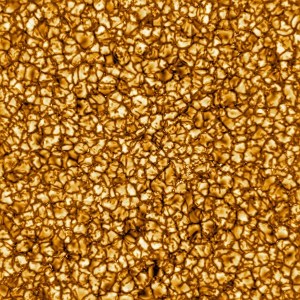
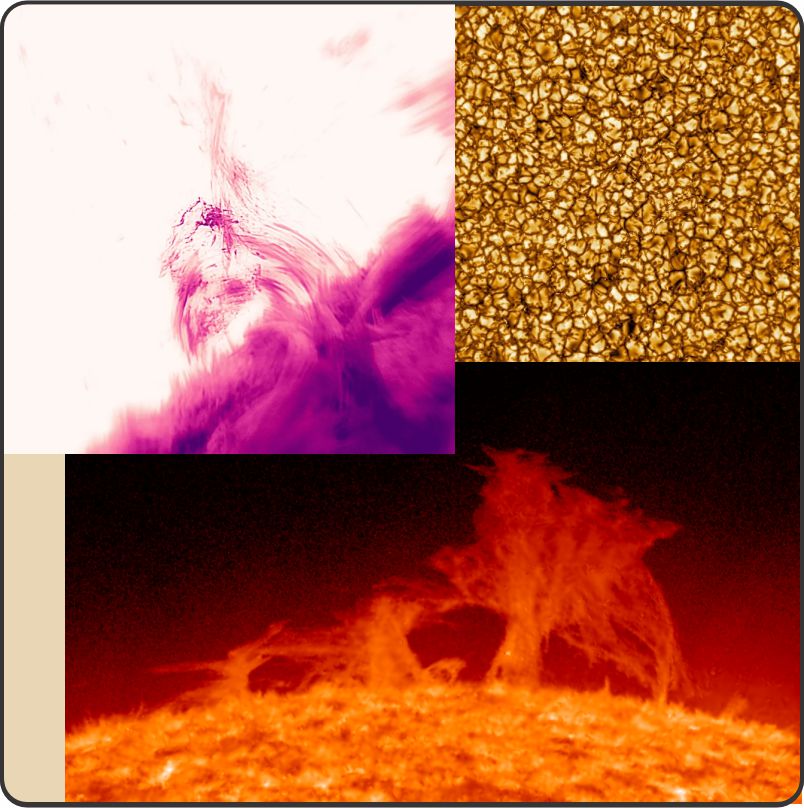
“Mm‑hm. Sy, you should recognize the pebbly-looking one. It’s granules at the bottom of the Sun’s atmosphere. The image came from the Inouye Solar Telescope at Haleakala Observatory on Maui, probably Earth’s best ground‑based facility for studying the Sun. I showed the image to your niece in that phone call. For scale, those granules of super‑heated rising gas are each about the size of Texas.”

“My magazine article didn’t mention Texas but it said there’s about ten million granules. What it was mostly about was the IST and its resolution. Those edges in the picture are as narrow as 18 miles across. It’s that good ’cause the beast has a 4‑meter mirror, which used to be amazing, but they made it even better with active and adaptive optics.”

“Hmm. It’s obvious that the bigger the mirror, the better it is for catching photons. If someone’s going to build a big mirror they’re going to put it behind a big aperture, which is important for resolving points that are close together. But what are ‘active and adaptive optics’ and why did you say that like they’re two different things?”

” ‘Cause they are two different things, Sy. Different jobs, different time‑scales. Gravity here on Earth can make a big mirror sag, and the sag changes depending on where the machine is pointed and maybe part of it gets the wrong temperature. Active optics is about keeping the whole mirror in the right shape to focus the photons where they’re supposed to go. There’s a bunch of actuators rigged up to give adjustable support at different points behind the mirror. The astronomer tells the system to watch a certain guide point and there’s a computer that directs each actuator’s pushing to sharpen the point’s image.”

“And adaptive optics?”

“That’s about solving a different problem. Stars twinkle, right, and the reason they twinkle is because of the atmosphere. One part refracts light one way, another part maybe warmer or with different humidity sends the light another way. Everything moves second to second. By the time a light‑wave gets down to us it’s been jiggled a lot. Adaptive optics is a small mirror, also with a lot of actuators, placed up in the light path after the primary mirror. Again with a guide point and a computer, the little mirror’s job is to cancel the jiggles so the scope’s sensors see a smooth wave. Adaptive works a lot faster than active, which sounds backwards, but I guess active came first.”

“The granules must be in the Sun’s disk somewhere. The other two images look like they’re on the edge.”

“That’s right, Sy. The bottom one is from the Solar Dynamic Observatory satellite a few years ago. That’s not visible light, it’s EUV—”

“EUV?”

“Extreme UltraViolet, light‑waves too short even for hydrogen so it’s mostly from iron atoms heated to millions of degrees. SDO had to be a satellite to catch that part of the spectrum because the atmosphere absorbs it. Of course, up there there’s no need for active or adaptive optics but imaging EUV has its own problems.”

“How tall is that photogenic tree?”

“It’s a prominence. The article said it’s about twenty times Earth’s diameter.”

“What about the pink one?”

“That’s new, Cathleen, from another Maui telescope. Adaptive optics were in play but there’s a problem. If you’re probing inside the corona there’s no fixed guide point. The team focused their adjustment system on corona features where they were a few seconds ago. The article said the process was ‘tricky,’ but look at the results. The loop is about the size of Earth, and those fine lines are about the width of Vancouver Island. They discovered details no‑one’s ever seen before.”

Top left: Schmidt et al./NJIT/NSO/AURA/NSF;
Top right: NSO/AURA/NSF under CC A4.0 Intl license;
Bottom: NASA/SDO

~ Rich Olcott

Snap The Whip

“You say Alfven invented a whole science, Sy, but his double‑layer structures in plasma don’t look like much compared with the real ground‑breakers like Herschel or Hubble.”

“Your Astronomy bias is showing, Cathleen. The double‑layer thing was only a fraction what he gave to magnetohydrodynamics. To begin with, he dreamed up a new kind of wave.”

“There’s more than light waves, sound waves and ocean waves?”

“Certainly. There’s dozens of different kinds — look up waves in Wikipedia some day. Some move, some make other things move; sometimes things move in the direction the wave does, sometimes crosswise to it. From a Physics perspective waves are about repetition. Something that happens just once, where do you go from there?”

“That used to be Astronomy’s problem — only one solar system with fewer than a dozen planets, only two galaxies we could inspect closely. Now our space telescopes and monster‑mirror ground‑based observatories have given us thousands of planets and billions of stars and galaxies. If we get our classifications right we can follow an object type through every stage of development. It’s almost like watching Chemistry happen.”

“I doubt Susan Kim would agree but I get your point. Anyhow, most waves have a common underlying process. Many systems have an equilibrium condition. Doing something energetic like plucking on a guitar string moves the system away from equilibrium. That provokes some force to restore equilibrium. For the guitar, tension in the wire pulls it straight. Usually the restoration overshoots so the restoring force turns around to act in the opposite direction. That’s when the repetition starts, right?”

“Mm-hm, that’s sound waves in a nutshell. Ocean waves, too, because gravity’s the restoring force fighting with the wind to pull things flat.”

“Same idea. Well, Alfven’s first trick was to demonstrate that in a plasma or any conducting medium, a magnetic field acts like that guitar string. The field’s equilibrium configuration is straight and smooth. If you perturb the medium somehow to put a bend or kink in the field, magnetic tension kicks in to restore equilibrium. Waves restored by magnetic fields are important enough that they’re now called Alfven waves in his honor.”

“First trick, mmm? There’s more?”

“Yup, an old one he borrowed from Maxwell — the flux tube. Maxwell worked before atoms were a conceptual thing. He thought about magnetism in terms of immaterial ‘lines of force’ that followed the rules laid out in his equations. Think of grabbing a handful of barely cooked spaghetti, still mostly stiff.”

“Yuck.”

“You’re wearing gloves, okay? The point is, you’ve got a more‑or‑less cylindrical bundle of parallel strands. Pretend each strand is a line of magnetic force. Maxwell’s rules say the number of lines of force, the total magnetic flux, coming out one end of the bundle exactly equals the flux that went in the other end. There’s no sourcing or destroying magnetic flux in between.”

“What if I squeeze real hard?”

“Nope. The flux per unit area intensifies — that’s called ‘the pinch effect’ and particle beam folks love it — but the total flux stays the same. Here’s where it gets interesting. Alfven showed that if the flux tube passes through a plasma or other conducting medium, the medium’s charged particles get frozen into the field. Waggle the field, you waggle the particles. Now put that together with his waves.”

“Oh, that’s what those guys have been talking about! There’s a slew of recent papers built on observations from the Parker Solar Probe mission. One of the biggest outstanding problems in solar physics is, how can the corona, the outermost layer of the Sun’s atmosphere, be millions of degrees hotter than the 6000‑degree photosphere beneath it? Well, PSP and other satellite missions have recorded many observations where the ambient magnetic field suddenly flipped from one direction to its near‑opposite. It’s like the probe had flown through a flux tube zig‑zag in space.”

“Those sharp angles indicate a lot of pent‑up magnetic tension.”

“Absolutely! Now imagine those zig‑zags in the crowded chaos inside the Sun’s atmosphere, colliding, criss‑crossing, disconnecting, reconnecting, releasing their magnetic flux energy into frozen‑in particles that aren’t frozen any more. What do you get, Sy?”

“Immense amounts of kinetic energy. Hot times, indeed”

~ Rich Olcott

Old Sol And The Pasta Pot

<chirp, chirp> “Excuse me, folks, it’s my niece. Hello, Teena.”

“Hi, Uncle Sy. What’s a kme?”

“Sorry, I don’t know that word. Spell it.”

“I’ve never seen it written down. Brian says the Sun’s specially active and gonna spit out a kme that’ll bang into Earth and knock us out of our orbit.”

“Ah, that’s a C‑M‑E, three separate letters. It stands for Coronal Mass Ejection. As usual, Brian’s got some of it right and much of it wrong. The right part is that the Sun’s at the peak of its 11‑year activity cycle so there’s lots of sunspots and flares—”

“He said flares, too. They’re super bright and could cook an Astronaut and it’d happen so fast we won’t have any warning.”

“Once again, partially right but mostly wrong. Here, let me give you to Cathleen who can set you straight. Cathleen, did you catch the conversation’s drift?”

<phone‑pass pause> “Hello, Teena. I gather you’re upset about solar activity?”

“Hi, Dr O’Meara. Yes, my sorta‑friend Brian likes to scare me with what he brings back from going down YouTube rabbit holes. I don’t really believe him but. You know?”

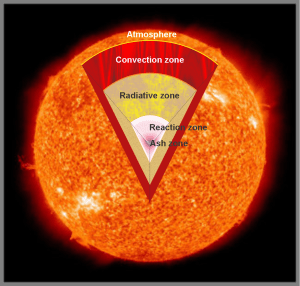
“I understand. Rabbit holes do tend to collect rubbish. Here, let me send you a diagram I use in my classes.” <another pause> “Did you get that?”

“Mm‑hm. Brian showed me a picture like that without the cut‑out part because he was all about the bright flashes.”

“Of course he was. I’ll skip the details, but the idea is that the Sun generates its heat and light energy deep in the reaction zone. Various processes carry that energy up through other zones until it hits the Sun’s atmosphere. You’ve watched water boil on the stove, surely.”

“Oh, yes. Mom put me in charge of doing the pasta last year. I don’t care what they say, a watched pot does eventually boil if there’s enough heat underneath it. I experimented.”

“Wonderful. That process, heat rising into a fluid layer, works the same way on the Sun as it does in your pasta pot. Heat ascends through the fluid but it doesn’t do that uniformly. No, the continuous fluid separates into distinct cells, they’re called Bénard cells, where hot fluid comes up the center, spreads out and cools across the top and then flows down the cell’s outer boundary.”

“That’s what I see happen in the pot with low water and low heat just before the bubbling starts.”

“Right, bubbling will disturb what had been a stable pattern. The cells in the Sun’s surface, they’re called granules, continually rise up to the surface and crowd out neighbors that have cooled off enough to sink or disappear.”

“Funny to say something on the Sun is cool.”

“Relatively cool, only 4000K compared to 6000K. But the Sun has bubbles, too. The granules run about 1500 kilometers wide and last only a quarter‑hour. There’s evidence they’re in top of a supporting layer of supergranules 20 times wider. Or maybe the plasma’s magnetic field is patchy. Anyhow, the surface motion is chaotic. Occasionally, especially concentrated heat or magnetic structure punches out between the granules. There’s a sudden huge release of superhot plasma, a blast of electromagnetic energy radiating out at all frequencies — that’s one of Brian’s flares. Lasts about as long as the granules.”

“That’s what could cook an astronaut?”

“Not really, The radiation’s pretty spread out by the time it’s travelled 150 million kilometers to us. The real danger is from high‑energy particle storms that travel along the Sun’s magnetic field lines. Space crews need to take shelter from them but particle masses travel slower than light so there’s several hours notice.”

“So what about the CMEs?”

“They’re big bubbles of plasma mass that the Sun throws off a few times a year on average. Maybe they come from ultra‑flares but we just don’t know. Their charged particles and magnetic fields can mess up our electronic stuff, but don’t worry about their mass. If a CME’s entire mass hit us straight on, it’d be only a millionth of a millionth of Earth’s mass. We’d roll on just fine.”

~ Rich Olcott

The Road to Gold

Cathleen and Susan share a look.
 ”A conclusion way too far, Kareem.”
  ”Yep, you’ve overbounded your steps.”

Kareem tosses in a couple of chips. “Huh? What did I skip over? Where?”

Cathleen sees his bet and raises. “When you said that the Psyche asteroid’s gold content would be similar to what we dig up on Earth, you skipped many orders of magnitude in applying the Cosmological Principle.”

“I didn’t realize I’d done that. What’s the Cosmological Principle?”

“There’s several ways to state it, but they boil down to, ‘We’re not special in the Universe.‘ We think that fundamental constants and physical laws determined here on Earth have the same values and work the same way everywhere. Astrophysics just wouldn’t work as well as it does if the electron charge or Newton’s Laws of Motion were different a million lightyears away from us.”

“Wait, what about that galaxy that’s going to collide with us even though everything’s supposed to be flying away?”

“Fair question. The un‑boiled Principle includes some qualification clauses, especially the one that says, ‘when averaged over a large enough volume.’ How big a volume depends on what you’re studying. For motions of galaxies and such you have to average over a couple hundred million lightyears. Physical constants measured locally seem to be good out to the edge of the Observable Universe. Elemental abundances are somewhere in‑between — the very oldest, farthest‑away galaxies have less of the heavy stuff than we do around here. <pulls her tablet from her purse> Which brings me to this chart I built for one of my classes.”

“You’re going to have to explain that.”

“Sure. Both graphs are about element abundance. We get the numbers from stellar and galactic spectra so we’re averaging the local Universe out to a few hundred thousand lightyears. Left‑to‑right we’ve got hydrogen, helium, lithium and so on out to uranium in the big graph, out to iron in the small one. Up‑and‑down we’ve got atom count for each element, divided by the number of iron atoms so iron scores at 1.0. The range is huge, 31 000 hydrogens per single iron atom, all the way down to 17 rhenium atoms per billion irons. I needed this logarithmic scale to make the points I wanted to make in class.”

Vinnie sweetens the pot. “You’ve got that nice zig‑zag going in the little graph, Cathleen, but things get weird around iron and the big graph has that near‑constant series starting around 60. Why the differences?”

<lays down Q‑J‑10‑9‑8, all hearts, pulls in the chips> “Perfect straight line, Vinnie. The different behaviors come from nuclear cookery at different stages of a star’s life. Most new‑born stars start by fusing hydrogen nuclei, protons, to produce helium nuclei, alpha particles. Those two swamp everything else. As the star evolves to higher temperatures, proton‑addition processes generate successively more massive nuclei. Carbon starts a new pattern, because alpha‑addition processes it initiates generate the sawtooth pattern you picked up on — an alpha has two protons so each alpha fusion contributes to the atomic number peak two units along the line.”

“What happens with iron?”

“What happens when you put a blow torch to a red‑hot metal ball?”

“The ball melts.”

“Why?”

“Cause the extra energy’s too much for what holds the ball together.”

“Well, there you go. The forces that hold an atomic nucleus together have their limits, too. Iron and its next‑but‑one neighbor nickel are right on the edge of stability for alpha reactions. The alpha process in the core of a normal star can’t make anything heavier.”

“So how do we get the heavy guys?”

“Novas, supernovas and beyond. Those events are so energetic and so chaotic there’s non‑zero probability for any kind of atom to form and evolve to something stable before it can break down. Massive atoms just have a lower probability so there’s less of them when things settle down. Gold, for instance, at only 330 atoms per billion atoms of iron. The explosions spray heavy atoms throughout their neighborhood.”

Kareem antes the next pot. “So you’re saying my mistake was to assume that asteroid Psyche’s composition would match whole‑Universe heavy‑element statistics?”

“Well, that was his first mistake, right, Susan?”

~~ Rich Olcott

SPLASH Splish plink

<chirp, chirp, chirp, chirp> “Moire here. This’d better be good.”

“Hello, Mr Moire. I’m one of your readers.”

“Do you have any idea what time it is?”

“Afraid not, I don’t know what time zone you’re in.”

“It’s three o’clock in the morning! Why are you calling me at this hour?”

“Oh, sorry, it’s mid-afternoon here. Modern communications tech is such a marvel. No matter, you’re awake so here’s my question. I’ve been pondering that micro black hole you’ve featured in the last couple of posts. You convinced me it would have a hard time hitting Earth but then I started thinking about it hitting the Sun. The Sun’s diameter is 100 times Earth’s so it presents 10,000 times more target area, yes? Further, the Sun’s 300,000 times more massive than Earth so it has that much more gravity. Surely the Sun is a more effective black hole attractor than Earth is.”

“That’s a statement, not a question. Worse yet, you’re comparing negligible to extremely negligible and neither one is worth losing sleep over which is what I’m doing now.”

“Wait on, I’ve not gotten to my question yet which is, suppose a black hole did happen to collide with the Sun. What would happen then?”

<yawn> “Depends on the size of the black hole. If it’s supermassive, up in the billion‑sun range, it wouldn’t hit the Sun. Instead, the Sun would hit the black hole but there’d be no collision. The Sun would just sink quietly through the Event Horizon.”

“Wouldn’t it rip apart?”

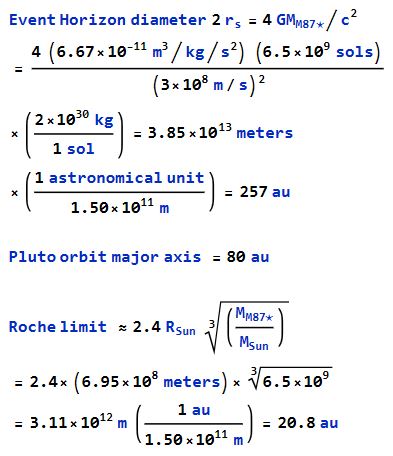
“You’re thinking of those artistic paintings showing great blobs of material being torn away by a black hole’s gravity. Doesn’t work that way, at least not at this size range.” <grabbing Old Reliable from my nightstand and key‑tapping> “Gravitational forces are distance‑dependent. Supermassives are large even by astronomical standards. The M87* black hole, the first one ESA got an image of, has the mass of 6 billion Suns and an Event Horizon three times wider than Pluto’s orbit. The tidal ripping‑apart you’re looking for only happens when the mass centers of two objects approach within Roche’s limit. Suppose a Sun‑sized star flew into M87*’s Event Horizon. Their Roche limit would be 100 astronomical units inside the Event Horizon. If any ripping happened, no evidence could escape to us.”

“Another illusion punctured.”

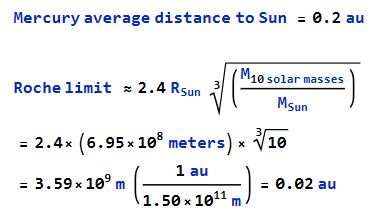
“Don’t give up hope. The next‑smaller size category have masses near our Sun’s. The Event Horizon of a 10‑solar‑mass black hole would be only about 60 kilometers wide. The Roche Zone for an approaching Sun is a million times wider. There’s plenty of opportunity for ferocious ripping on the way in.”

“Somehow that’s a comfort, but my question was about even smaller black holes — micro‑size flyspecks such as you wrote about. What effect would one have on the Sun?”

“You’d think it’d be a simple matter of the micro‑hole, let’s call it Mikey, diving straight to the Sun’s center while gobbling Sun‑stuff in a gluttonous frenzy, getting exponentially bigger and more voracious every second until the Sun implodes. Almost none of that would happen. The Sun’s an incredibly violent place. On initial approach Mikey’d be met with powerful, rapidly moving magnetic fields. If he’s carrying any charge at all they’d give him whip‑crack rides all around the Sun’s mostly‑vacuum outer layers. He might not ever escape down to the Convection Zone.”

“He’d dive if he escaped there or he’s electrically neutral.”

“Mostly not. The Convection Zone’s 200,000-kilometer depth takes up two‑thirds of the Sun’s volume and features hyper‑hurricane winds roaring upward, downward and occasionally sideward. Mikey would be a very small boat in a very big forever storm.”

“But surely Mikey’s density would carry him through to the core.”

“Nope, the deeper you go, the smaller the influence of gravity. Newton proved that inside a massive spherical shell, the net gravitational pull on any small object is zero. At the Sun’s core it’s all pressure, no gravity.”

“Then the pressure will force‑feed mass into Mikey.”

“Not so much. Mikey has jets and and an accretion disk. Their outward radiation pressure sets an upper limit on Mikey’s gobbling speed. The Sun will nova naturally before Mikey has any effect.”

“No worries then.”

~~ Rich Olcott

Stars Are REALLY Warm-hearted

“I don’t understand, profesora. The Sun’s fuel is hydrogen. The books say when the Sun runs out of fuel it will eject much hydrogen and collapse to a white dwarf. So it didn’t run out of fuel, yes?”

“That’s an excellent question, Maria. Your simple sketch of layered zones is adequate for a stable star like our Sun is now. When things go unstable we need to pay more attention to dynamic details like mass, pressure and diffusion. The numbers matter.”

“I had that the fusion zone is 30% up from the center, and the top of the radiation zone is at 70%.”

“Yes, but percentages of a straight line don’t really give us a feel for the volumes and masses. Volumes grow as the radius cubed. The Sun’s core, the part inside your 30% radius, holds (30%)3 which is less than 3% of the Sun’s volume. The convection shell on the outside is also 30% thick, but that zone accounts for ⅔ of the star’s volume.”

“But not ⅔ of the mass, I think. The core is the most dense, yes?”

“Truly. The core is <chuckle> at the core of the matter. It’s obviously under compression from all the mass above it, but there’s a subtler and more important reason. The Sun’s internal temperatures are so high that everything acts like an ideal gas, even near the center. Once you’re beneath the convection zone, the only transport mechanism is diffusion influenced by gravity. Helium nuclei weigh four times what hydrogen nuclei do. Helium and heavier things tend to sink toward the center, hydrogen tends to float upward. What effect does that have on the core’s composition?”

“The core is heavy with much helium, not as much hydrogen.”

“Good. Now, what’s next above the core?”

“The fusion zo– Oh! The place where there’s enough hydrogen to do the fusing.”

“If the temperature and pressure are right. That turns out to be a delicate balance. Too much heat makes that region expand, average distance between atoms increases and that slows down the fusion reaction. Too much pressure slows diffusion which then slows the reaction by hindering hydrogen’s entry and helium’s exit. Too little heat or too little pressure do the opposite. Now you know why the fusion zone is so narrow in our diagrams, only about 10% of a radius.”

“No fusion in the other layers?”

“Less than 1% of the total. So we’ve got nearly all the heat in the star coming from hydrogen‑to‑helium fusion in this diffusion‑controlled gaseous reaction zone buried deep in the star.”

“Ah! Now I see. It is wrong to say the star dies because it runs out of fuel. There is still much hydrogen in the upper zones, but the diffusion doesn’t let enough enter the fusion zone. That is why the fire goes out. What happens then?”

“It mostly depends on the star’s mass. Really big ones have a sequence of deeper, hotter fusion layers in their core, forming heavier and heavier atoms all the way down to iron. Each layer is diffusion‑limited, of course, and the whole thing is like a stack of Jenga blocks supported by heat coming from below. If reaction in any layer overruns its fuel delivery then it stops producing heat. The whole stack collapses violently to form a neutron star or a black hole. Nearby infalling atoms collide and radiate in an exponential heat‑up. But the stars are many millions of kilometers across. The outermost layers don’t have time to fall all the way in. Their imploding gases slam into gases exploding from the collapse zone — BLOOEY! — there’s a nova spewing hydrogen and stardust across the Universe.”

“That is how our Sun will die?”

“No, it’s too small for such violence so it’s fated for a gentler old age. Five billion years from now its core will be mostly carbon and oxygen. Fuel delivery won’t be able to sustain further fusion reactions. The radiation and convection layers will simply settle inward, releasing enough gravitational potential energy to start hydrogen fusion in an expanding cool red shell outside the core.”

“Hee-hee — no lo va la nova, profesora, the nova doesn’t go.

  • Thanks to Victoria, who asked the question.

~~ Rich Olcott

Layer Upon Layer

“Excuse me, profesora, you wanted me to come to your office?”

“Yes, Maria. Come in, please. I wanted to have a chat with you before you give your class presentation tomorrow.”

“I am a little nervous about it.”

“I thought you might be. I wanted to help with that. I’ll start by saying that your English language skills have gotten much better than you give yourself credit for. Better yet, you’ll be speaking before friends who want you to succeed. I’m sure you’ll do fine. I think if we go over your material together you’ll be more confident. Come open your laptop on my desk where we can both see it. Now bring up your first slide.”

“Yes, profesora. Already you know that the title of my presentation is ‘The Structure of The Sun.’ I only have one slide, this one, that shows a slice of a star like our Sun.”

“How did the star get that way?”

“It condensed from a galactic gas cloud that was mostly hydrogen. I plan to talk about that with waving of the hands because a good picture of it needs to be in motion and I don’t know how to do that yet.”

“Fair enough, just don’t skip over it. Beginnings are important. Now talk me through your diagram.”

“It starts in the middle ¿see the fusion zone? where protons, that’s hydrogen atoms without their electrons, are squeezed together to release energy and make alpha particles, that’s helium atoms without their electrons. The protons have the same charge so they push each other away, but they are beneath many kilometers of mass that push them together. Also, the temperature is very hot, tens of millions of degrees. Hot atoms move fast, so when the protons are pushed together it happens with enough force and speed .. sorry, I need a word, superar?”

“Overcome.”

“Thank you. The protons are pushed together with enough force and speed to overcome the charge barrier. The actual reactions are complicated. At the end there is an alpha particle, four times heavier than a proton, and there is much more energy than the overcoming used up. The fusion zone makes heat and the heavy alpha particles fall down into the ash zone. The heat must go somewhere. Already the center is hotter so the new heat goes upward into the radiation zone.”

“And it’s called that because…?”

“Because atom motion is so, mm, frantic?”

“Good word.”

“… So frantic that there’s no moving in the same direction together, no convection like when steam rises over boiling water. Heat can only travel by convection, conduction or radiation. If there is no convection, moving heat must go neighbor‑to‑neighbor by conduction which is collision or by radiation which is photons jumping between atoms again and again until they escape. I have read that one photon’s energy can take 10000 years to cross the radiation zone.”

“So how is the next zone different?”

“It is much higher up from the center, nearly ¾ of the way to the surface. The pressure is 100 times less than in the fusion zone. The atoms have more room to move around together and form winds to carry the heat up by convection. But they can’t only go up, they have to come down, too, and that’s why my drawing has loops.”

“Is there a name for the loops?”

“Oh, yes, they are called Bénard cells and they’re very much like what I see looking into a pot of water just before it boils.”

“What’s the orange above the convection zone?”

“That’s the part of the Sun that we see, the photosphere that emits light in a continuous spectrum. The Fraunhofer lines, the dark lines in the astronomer’s spectrum, are the shadows of atoms high in in the photosphere that absorb only certain colors. I was surprised to learn how narrow the photosphere is, not even 0.02% of the Sun’s radius. Anyway, that’s my presentation, but now I have a question. The Sun’s fuel is hydrogen. The books say when the Sun runs out of fuel it will eject much of its hydrogen mass and collapse to a white dwarf. So it didn’t run out of fuel, yes?”

~~ Rich Olcott

Generation(s) of Stars

“How’re we gonna tell, Mr Moire?”

“Tell what, Jeremy?”

“Those two expanding Universe scenarios. How do we find out whether it’s gonna be the Big Rip or the Big Chill?”

“The Solar System will be recycled long before we’d have firm evidence either way. The weak dark energy we have now is most effective at separating things that are already at a distance. In the Big Rip’s script a brawnier dark energy would show itself first by loosening the gravitational bonds at the largest scale. Galaxies would begin scattering into the voids between the multi‑galactic sheets and filaments we’ve been mapping. Only later would the galaxies themselves release their stars to wander off and dissolve when dark energy gets strong enough to overcome electromagnetism.”

“How soon will we see those things happen?”

“If they happen. Plan on 188 billion years or so, depending on how fast dark energy strengthens. The Rip itself would take about 2 billion years, start to finish. Remember, our Sun will go nova in only five billion years so even the Rip scenario is far, far future. I prefer the slower Chill story where the Cosmological Constant stays constant or at least the w parameter stays on the positive side of minus‑one. Weak dark energy doesn’t mess with large gravitationally‑bound structures. It simply pushes them apart. One by one galaxies and galaxy clusters will disappear beyond the Hubble horizon until our galaxy is the only one in sight. I take comfort in the fact that our observations so far put w so close to minus‑one that we can’t tell if it’s above or below.”

“Why’s that?”

“The closer (w+1) approaches zero, the longer the timeline before we’re alone. We’ll have more time for our stars to complete their life cycles and give rise to new generations of stars.”

“New generations of stars? Wow. Oh, that’s what you meant when you said our Solar System would be recycled.”

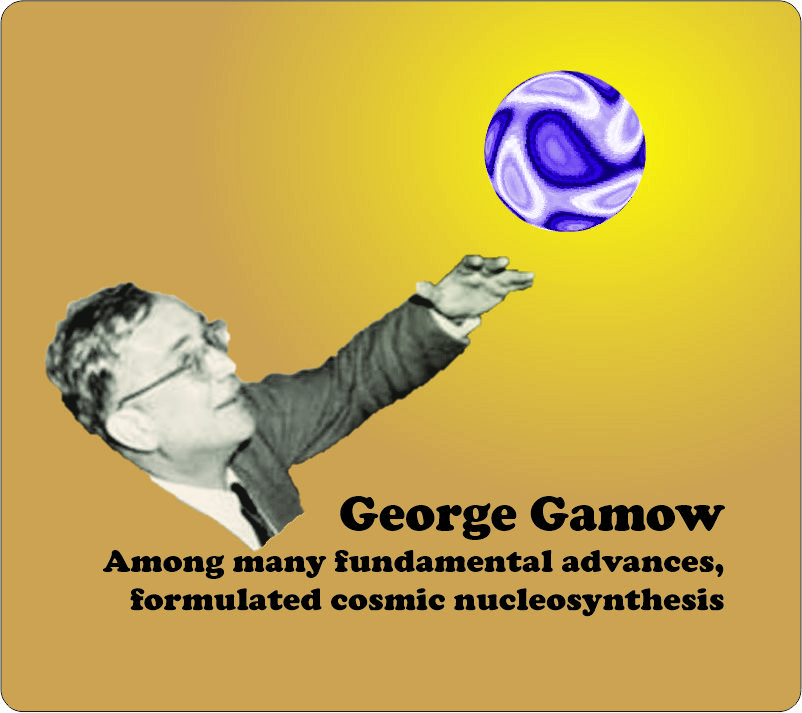
“Mm-hm. Think about it. Back when atoms first coalesced after the Big Bang, they were all either hydrogen or helium with just a smidgeon of lithium for flavor. Where did all the other elements come from? Friedmann’s student George Gamow figured that out, along with lots of other stuff. Fascinating guy, interested in just about everything and good at much of it. Born in Odessa USSR, he and his wife tried twice to defect to the West by kayak. They finally made it in 1933 by leveraging his invitation to Brussels and the Solvay Conference on Physics where Einstein and Bohr had their second big debate. By that time Gamow had produced his ‘liquid drop‘ theory of how heavy atomic nuclei decay by spitting out alpha particles and electrons. He built on that theory to explain how stars serve as breeder reactors.”

“I thought breeder reactors are for turning uranium into plutonium for bombs. Did he have anything to do with that?”

“By the start of the war he was a US citizen as well as a top-flight nuclear theorist but they kept him away from the Manhattan Project. That undoubtedly was because of his Soviet background. During the war years he taught university physics, consulted for the Navy, and thought about how stars work. His atom decay work showed that alpha particles could escape from a nucleus by a process a little like water molecules in a droplet bypassing the droplet’s surface tension. For atoms deep inside the Sun, he suggested that his droplet process could work in reverse. He calculated the temperatures and pressures it would take for gravity to force alpha particles or electrons into different kinds of nuclei. The amazing thing was, his calculations worked.”

“Wait — alpha particles? Where’d they come from if the early stars were just hydrogen and helium?”

“An alpha particle is just a helium atom with the electrons stripped off. Anyway, with Gamow leading the way astrophysicists figured out how much of which elements a given star would create by the time it went nova. Those elements became part of the gas‑dust mix that coalesces to become the next generation of stars. We may have gone through 100 such cycles so far.”

“A hundred generations of stars. Wow.”

~~ Rich Olcott

Galaxies Fluffy And Faint

Cathleen’s at the coffee shop’s baked goods counter. “A lemon scone, please, Al.”

I’m next in line. “Lemon sounds good to me, too. It’s a warm day.”

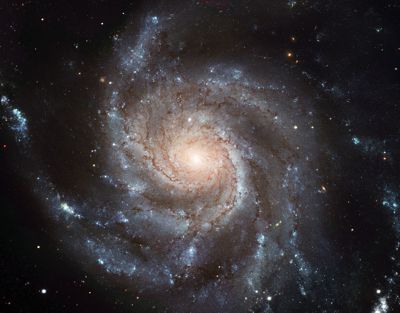
The Pinwheel Galaxy, NGC 5457
Credit: ESA/Hubble

“Sure thing, Sy. Hey, got a question for you, Cathleen, you bein’ an Astronomer and all. I just saw an Astronomy news item about a fluffy galaxy and they mentioned a faint galaxy. Are they the same and why the excitement?”

“Not the same, Al. It’ll be easier to show you in pictures. Sy, may I borrow Old Reliable?”

“Sure, here.”

“Thanks. OK, Al, here’s a classic ‘grand design‘ spiral galaxy, NGC 5457, also known as The Pinwheel. Gorgeous, isn’t it?”

“Sure is. Hey, I’ve wondered — what does ‘NGC‘ stand for, National Galaxy Collection or something?”

“Nope. The ‘G‘ doesn’t even stand for ‘Galaxy‘. It’s ‘New General Catalog‘. Anyway, here’s NGC 2775, one of our prettiest fluffies. Doesn’t look much like the Pinwheel or Andromeda, does it?”

NGC 2775
Credit: NASA / ESA / Hubble / J. Lee / PHANGS-HST Team / Judy Schmidt

“Nah, those guys got nice spiral arms that sort of grow out of the center. This one looks like there’s an inside edge to all the complicated stuff. And it’s got what, a hundred baby arms.”

“The blue dots in those ‘baby arms’ are young blue stars. They’re separated by dark lanes of dust just like the dark lanes in classic spirals. The difference is that these lanes are much closer together. The grand design spirals are popular photography subjects in your astronomy magazines, Al, but they’re only about 10% of all spirals. I’ll bet your news item was about 2775 because we’re just coming to see how mysterious this one is.”

“What’s mysterious about it?”

“That central region. It’s huge and smooth, barely any visible dust lanes and no blue dots. It’s bright in the infra‑red, which is what you’d expect from a population of old red stars. In the ultra‑violet, though, it’s practically empty — just a small dot at the center. UV is high‑energy light. It generally comes from a young star or a recent nova or a black hole’s accretion disk. The dot is probably a super-massive back hole. but its image is just a tiny fraction of the smooth region’s width. With a billion red stars in the way it’s hard to see how the black hole’s gravity field could have cleaned up all the dust that should be in there. Li’l Fluffy here is just begging for some Astrophysics PhD candidates to burn computer time trying to explain it.”

NGC 1052-DF2
Credit: NASA, ESA, and P. van Dokkum (Yale University)

“What about Li’l Faint?”

“That’s probably this one, NGC 1052-DF2. Looks a bit different, doesn’t it?

“I’ll say. It’s practically transparent. Is it a thing at all or just a smudge on the lens?”

“Not a smudge. We’ve got multiple images in different wavelength ranges from multiple observatories, and there’s another similar object, NGC 1052-DF4, in the same galaxy group. We even have measurements from individual stars and clusters in there. The discovery paper claimed that DF2 is so spread out because it lacks the dark matter whose gravity compacts most galaxies. That led to controversy, of course.”

“Is there anything in Science that doesn’t? What’s this argument?”

“It hinges on distance, Sy. The object is about as wide as the Milky Way but we see only 1% as many stars. Does their mass exert enough gravitational force to hold the structure together? There’s a fairly good relationship between a galaxy’s mass and its intrinsic brightness — more stars means more emitting surface and more mass. We know how quickly apparent brightness drops with distance. From other data the authors estimated DF2 is 65 lightyears away and from its apparent brightness they back‑calculated its mass to be just about what you’d expect from its stars alone. No dark matter required to prevent fly‑aways. Another group using a different technique estimated 42 lightyears. That suggested a correspondingly smaller luminous mass and therefore a significant amount of dark matter in the picture. Sort of. They’re still arguing.”

“But why does it exist at all?”

“That’s another question.”

~~ Rich Olcott

  • Thanks to Oriole for suggesting this topic.