A Carefully Plotted Tale

<chirp, chirp> “Moire here.”

“Hello, Mr Moire. Remember me?”

“Yes, I do, Walt. I hope your people were satisfied with what you brought them from our last meeting.”

“They were, which is why I’m calling. Buy you pizza at Eddie’s, fifteen minutes?”

“Make it twenty.”


We’re at the rear‑corner table, Walt facing both doors, naturally. “So, what’s the mysterious question this time?”

“Word on the street is that the CPT Law’s being violated. We want to know who’s involved, and what’s their connection with ChatGPT.”

Good thing I’ve just bit into my pizza so I can muffle my chuckle in my chewing. “What do you know about anti‑matter?”

“Inside‑out atoms — protons outside whizzing around electrons in the nucleus.”

“Common misconception. One proton has the mass of 1800 electrons. An atom built as you described would be unstable — the thing would fly apart. You’ve got anti‑matter’s charges arranged right but not the particles. Anti‑matter has negative anti‑protons in the nucleus and positrons, positive electrons, on the outside.”

<writing rapidly in his notebook> “You can do that? Just flip the sign on a particle?”

“No, positrons and such are respectable particles in their own right, distinct from their anti‑partners. Electric charge comes built into the identity. What’s important is, an anti‑atom behaves exactly like a normal atom does. Maxwell’s Equations and everything derived from them, including quantum mechanics, work equally well for either charge structure.”

“There’s a bit of Zen there — change but no‑change.”

“Nice. Physicists call that sort of thing a symmetry. In this case it’s charge symmetry, often written as C.”

“The C in CPT?”

“Exactly.”

“What about the P and T?”

“When someone says something is symmetrical, what do you think of first?”

“Right side’s a reflection of left side. Symmetrical faces look better but they’re usually less memorable.”

“Interesting choice of example. Anyway, reflection symmetry is important in common physical systems.”

“Classical Greek and Cambodian architecture; the Baroque aesthetic without the decorative frills.”

“I suppose so. Anyway, we call reflection symmetry Parity, or P for short.”

“And T?”

“Time.”

“Time’s not symmetrical. It’s always past‑to‑future.”

“Maybe, maybe not. In all our physical laws that deal with a small number of particles, you can replace t for time with –t and get the same results except for maybe a flipped sign. Newton’s Laws would run the Solar System in reverse just as well as they do forward.”

“But … Ah, ‘small number of particles,’ that’s your out. If your system has a large number of particles, you’re in chaos territory where randomness and entropy have to increase. Entropy increase is the arrow for one‑way time.”

“Good quote.”

“I’ve been in some interesting conversations. You’re not my only Physics source. So CPT is about Charge AND Parity AND Time symmetries. But you can’t simply add them together.”

“You multiply them. Technically, each of them is represented by a mathematical operator—”

“Step away from the technically.”

“Understood. This’ll be simpler. If a system’s atoms have positive nuclei, set C=1, otherwise set C=1. If the system’s naturally‑driven motion is counterclockwise set P=1, otherwise P=1. If time is increasing, set T=1, otherwise set T=1. Okay?”

“Go on.”

“You can summarize any system’s CPT state by multiplying the prevailing symmetry values. The product will be either +1 or 1. The CPT Law says that in any universe where quantum mechanics and relativity work, one CPT state must hold universe‑wide.”

“Make it real for me.”

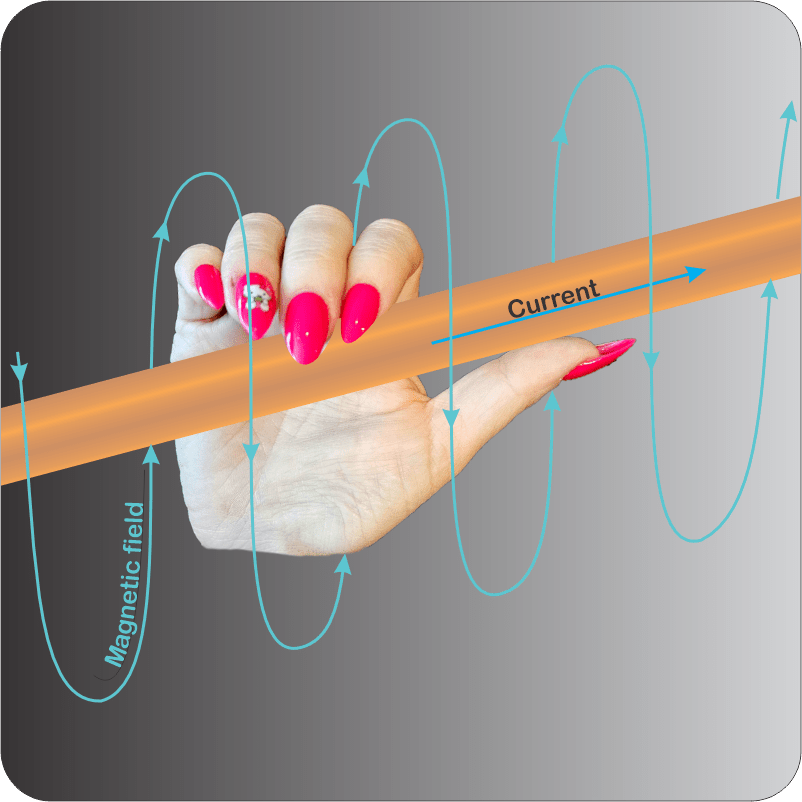
“You know the Right-hand Rule for electromagnetism?”

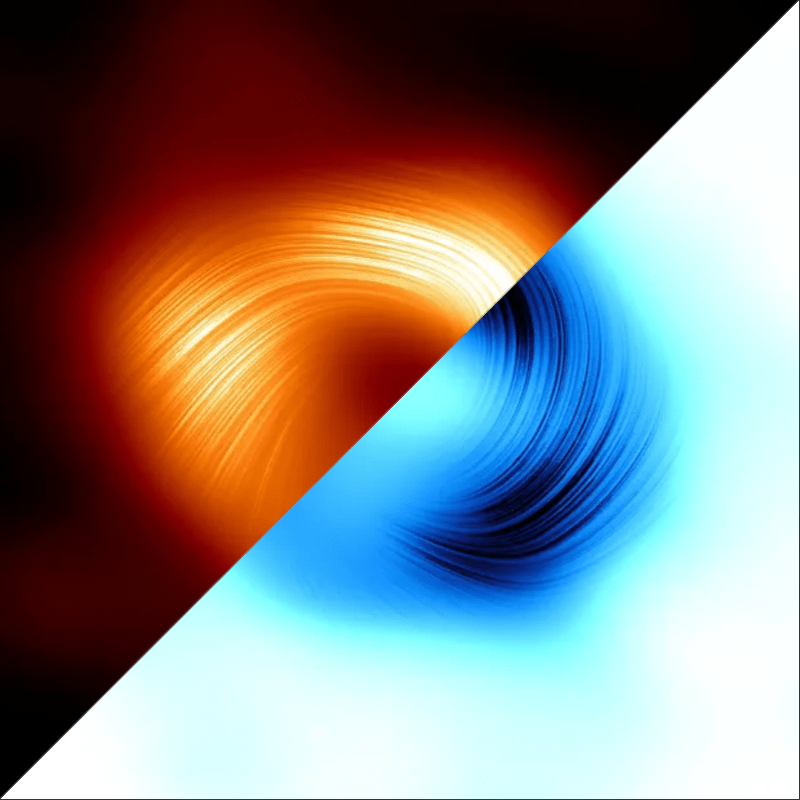
“Grab the wire with your right hand, thumb pointing along the current. Your fingers wrap in the direction of the spiraling magnetic field.”

“Perfect. Suppose C*P*T=+1 for this case. Now reverse the charge, making C=1. What happens?”

“Ssss… The magnetic spin flips orientation. That’s a reflection operation so P=1. The C*P*T calculation is (+1)*(1)*(1)=+1, no change.”

“The CPT Law in action. The CPT violation you’ve heard about is only observed in rare weak‑force‑mediated radioactive decays of a carefully prepared nucleus. That was a 1956 Nobel‑winning discovery, though the right person didn’t win it.”

“1956. Decades before A.I.”

“Yup, ChatGPT is off the hook. For that.”

“Bye.”

“Don’t mention it.”

~ Rich Olcott

  • Thanks to Caitlin, the hand model.

Why A Disk?

Late Summer is quiet time on campus and in my office. Too quiet. I head over to Cal’s coffee shop in search of company. “Morning, Cal.”

“Morning, Sy. Sure am glad to see you. There’s no‑one else around.”

“So I see. No scones in the rack?”

“Not enough traffic yet to justify firing up the oven on such a hot day. How about a biscotti instead?”

“If it’s only the one it’s a biscotto. Pizza Eddie’s very firm on that. Yeah, I’ll have one.”

“Always learning. By the way, a photo spread in one of my astronomy magazines got me thinking. How come there’s so much flat out there?”

“Huh? I know you’re not one of those flat‑Earthers.”

“Not the planets, I mean the way their orbits go all in the same plane. Same for most of the asteroids and the Kuiper belt, even. Our Milky Way galaxy’s basically flat, too, and so are a lot of the others. Black hole accretion disks are flat. You’d think if some baby star or galaxy was attracting stuff from everywhere to grow itself, the incoming would make a big globe. But it’s not, we get flatness. How come?”

“Bad aim and angular momentum.”

“What’s aim got to do with it?”

“Suppose there’s only two objects in the Universe and they’re closing in on each other. If they’re aimed dead‑center to each other, what happens?”

“CaaaRUNCH!!!”

“Right. Now what if the aim’s off so they don’t quite touch?”

“Oh, I know that one … it’ll come to me … yeah, Roche’s limit, it was in an article a few months ago. Whichever’s less dense will break up and all the pieces go like Saturn’s rings. Which are also flat, by the way.”

“In orbit around the survivor, mm‑hm. The pieces can’t fall straight down because they still have angular momentum.”

“I know about momentum like when you crash a car if you go too fast for your brakes. Heavier car or faster speed, you get a worse crash. How does angle fit into that — bigger angle, more angular momentum?”

“Not quite. In general, momentum is mass multiplied by speed. It’s a measure of the force required to stop something or at least slow it down. You’ve described linear momentum, where ‘speed’ is straight‑line distance per time. If you’re moving along a curve, ‘speed’ is arc‑length per time.”

“Arc‑length?”

“Distance around part of a circle. Arc‑length is angle in radians, multiplied by the circle’s radius. If you zip halfway around a big circle in the same time it took me to go halfway around a small circle, you’ve got more angular momentum than I do and it’d take more force to stop you. Make sense?”

“What if it’s not a circle? The planet orbits are all ellipses.”

“It’s still arc‑length except that you need calculus to figure it. That’s why Newton and Leibniz invented their methods. A falling something that misses a gravity center keeps falling but on an orbit. Whatever momentum it has acts as angular momentum relative to that center. There’s no falling any further in without banging into something else coming the other way and each object canceling the other’s momentum.”

“Or burning fuel if it’s a spaceship.”

“… Right. … So anyway, suppose you’ve got a star or something initially surrounded by a spherical cloud of space junk whirling around in all different orbits. What’s going to happen?”

“Lots of banging and momentum canceling until everything’s swirling more‑or‑less in the same direction and closer in than at come‑together time. But it’s still a ball.”

“Gravity’s not done. Think about northern debris. It’s attracted to the center, but it’s also attracted to the southern debris and vice-versa. They’ll meet midway and build a disk. The ball‑to‑disk collapse isn’t even opposed by angular momentum. Material at high latitudes, north and south, can lose gravitational potential energy by dropping straight in toward the equator and still be at the orbitally correct distance from the axis of rotation.”

“That’d work for stuff collecting around a planet, wouldn’t it?”

“It’d even work for stuff collecting around nothing, just a clump in a random density field. That may be how stars are born. Collapsing’s the hard part.”

~ Rich Olcott

A Play Beyond The Play

Vinnie takes a long thoughtful look at the image that had dashed his beautiful six‑universe idea. “Wait, Sy. I don’t like this picture”

“Because it messes up your invention?”

“No, because how can they know what that halo looks like? I mean, the whole thing with dark matter is that we can’t see it.”

“You’re right about that. Dark matter’s so transparent that even with five times more mass than normal matter, it doesn’t block CMB photons coming from 13.8 billion lightyears away. That still boggles my brain every once in a while. But dark matter’s gravitational effects — those we can see.”

“Yeah, I remember a long time ago we talked about Fritz Zwicky and Vera Rubin and how they told people about galaxies held together by too much gravity but nobody believed them.”

“Well, they did, after a while—”

“A long while, like a long while since those talks. Remind me what ‘too much gravity’ was about.”

“It was about conflicts between their observations and the prevailing theoretical models. Everyone thought that galaxies and galaxy clusters should operate pretty much like planetary orbits — your speed increases the closer you are to the center, up to Einstein’s speed limit. Newton’s Laws of Motion predict how fast you should move if you’re at a certain distance from a body with a certain mass. If you’re moving faster than that, you fly away.”

“Yeah, escape velocity. So the galaxies in Zwicky’s cluster didn’t follow Newton’s Laws?”

“They didn’t seem to. Galaxies that should have escaped were still in there. The only way he could explain the stability was to suppose the galaxies are only a small fraction of the cluster’s mass. Extra gravity from the extra mass must bind things together. Forty years later Rubin’s improved technology revealed that stars within galaxies had the same anomalous motion.”

“I’m guessing the ‘faster near the center’ rule didn’t hold, or else you wouldn’t be telling this story. Spun like a wheel, I bet.”

“When a wheel spins, every part of it rotates at the same angular speed, the same number of degrees per second, right?”

“Ahh, the bigger my circle the higher my airspeed so the rule would be ‘faster farther out’.”

“That’s the wheel rule, right, but Rubin’s data showed that stars within galaxies don’t obey that one either. She measured lots of stars in Andromeda and other galaxies. Their linear speeds, kilometers per second, are nearly identical from near the center all the way out. Even dust and gas clouds beyond the galactic starry edges also fit the ‘same linear speed everywhere’ rule. You’d lose the bet.”

“That just doesn’t feel right. How can just gravity make that happen?”

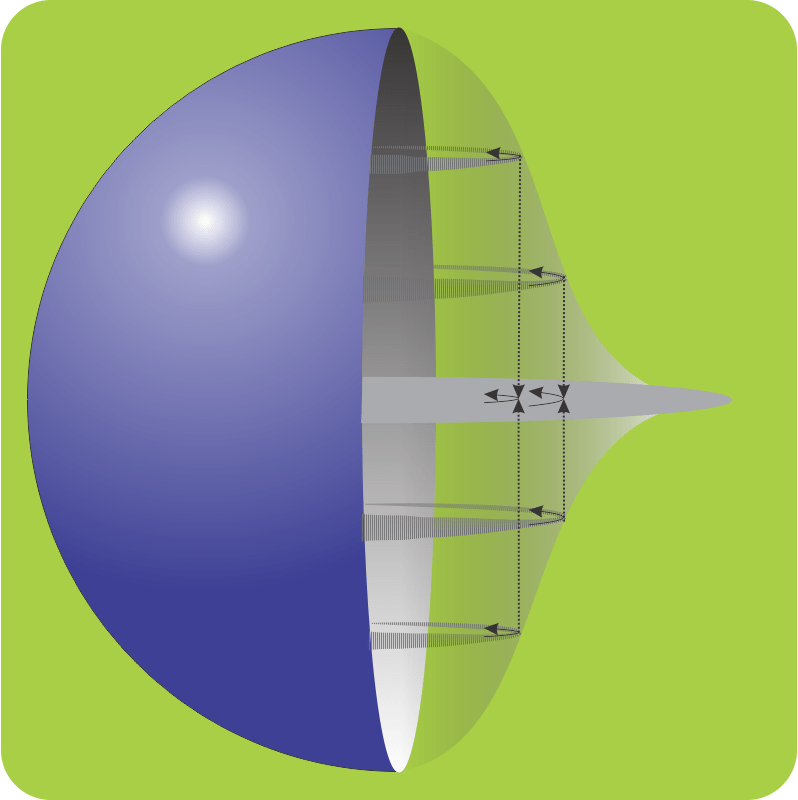
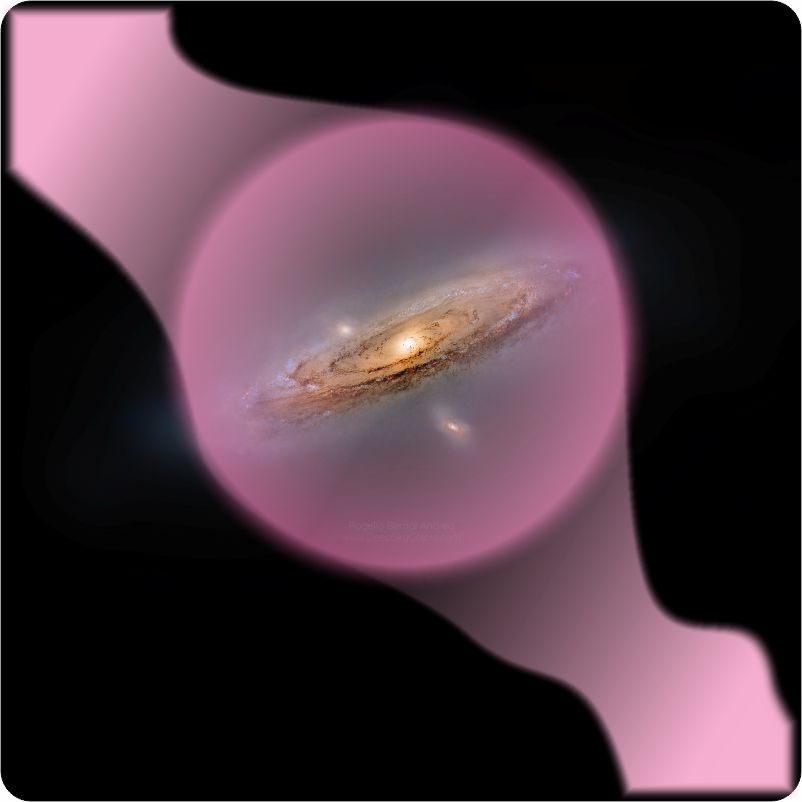
“It can if the right amount of dark matter’s distributed in the right‑shaped smeared‑out hollowed‑out spherical halo. The halo’s radial density profile looks about like this. Of course, profiles for different galaxies differ in spread‑outness and other details, but the models are pretty consistent.”

“Wait, if dark matter only does gravity like you said, why’s that hole in the middle? Why doesn’t everything just fall inward?”

“Dark matter has mass so it also has inertia, momentum and angular momentum, just as normal matter does. Suppose some of the dark matter has collected gravitationally into a blob and the blob is moving slower than escape velocity. If it’s flying straight at the center of gravity it’ll get there and stay there, more or less. But if the blob’s aimed in any other direction, it has angular momentum relative to the center. Momentum’s conserved for dark matter, too. The blob eventually goes into orbit and winds up as part of the shell.”

“Does Zwicky’s galaxy cluster have a halo, too?”

“Not in the same way. Each galaxy probably has its own halo but the galaxies are far apart relative to their size. The theoreticians have burned huge amounts of computer time simulating the chaos inside large ensembles of gravity‑driven blobs. I just read one paper about a 4‑billion‑particle calculation and mind you, a ‘particle’ in this study carried more than a million solar masses. Big halos host subhalos, with filaments of minihalos tying them together. What we can’t see is complicated, too.”

~ Rich Olcott

Five More Alternate Universes?

I unlock my office door and there’s Vinnie inside, looking out the window. “Your 12th‑floor view’s pretty nice, Sy. From above the tree tops you can see leaf buds just starting to show their early green colors.”

“What are you doing here, Vinnie? I thought you were charter‑flying to Vancouver.”

“The guy canceled. Said with all the on‑again, off‑again tariffs there’s no sense traveling to make a deal when he doesn’t know what he’s dealing with. So I got some time to think.”

“And you came here so it’s something physics‑technical.”

“Yeah, some. I notice colors a lot when I’m flying. Some of those trees down there this time of year are exactly the same bright yellow‑green as some of the rice paddies I’ve flown over. But all the trees get the same hard dark green by August before they go every different color when the chlorophyll fades away.”

I’ve noticed that. So you came here to talk about spectra?”

“Some other time. This time I want to talk about dark matter.”

“But we call it dark matter precisely because it doesn’t do light. All our normal matter is made of atoms and the atoms are made of electrons and nuclei and each nucleus is made of protons and neutrons and protons and neutrons are made of quarks. Electrons and quarks carry electrical charge. Anything with electrical charge is subject to electromagnetism, one way or another. Dark matter doesn’t notice electromagnetism. If dark matter had even the slightest interaction with light’s electromagnetic field, we wouldn’t be able to see galaxies billions of lightyears away.”

“Calm down, Sy, breath a couple times. Stay with me here. From your stuff and what else I’ve read, all we know about dark matter is a lot of things it isn’t or doesn’t do. The only force we know it respects is gravity so it attracts itself and also normal matter and they all clump up to make galaxies and such, right?”

<a bit reluctantly and on a rising note> “Mm‑hnn…?”

“I read your three‑part series about the Bullet Cluster, where we think two galaxy clusters went though each other and their gas clouds gave off a lot of X‑rays that didn’t match where the stars were or where the gravity was so the astronomers blame dark matter for the gravity, right?”

“That’s pretty much it. So?”

“So the other thing I got from that series was maybe there’s friction between dark matter and other dark matter, like it doesn’t just slide past itself. If dark matter is particles, maybe they’re sorta sticky and don’t bounce off each other like billiard balls. That doesn’t make sense if all they do is gravity.”

“I see where you’re going. You’re thinking that maybe dark matter feels some kind of force that’s not gravity or electromagnetism.”

“That’s it! We’ve got light photons carrying electromagnetic forces to hold our molecules and rocks together. Could there be dark photons carrying some dark‑sticky force to connect up dark molecules and dark rocks and stuff?”

“That’s an interesting—”

“I ain’t done yet, Sy. It gets better. I’ve read a bunch of articles saying there’s about five times as much dark matter in the Universe as normal matter. You physicists love symmetry, suppose it’s exactly five times as much. There’d be six kinds of force, one called electromagnetism and a different snooty force each for five kinds of dark matter and that’ll add up to the 25% we can’t see. Like, a purple dark force for purple dark rocks, naturally they’re not really purple, and a yellow dark force and so on.”

“You’re proposing that each kind of dark matter responds only to its own special force, so no cross‑communication?”

“Yup, gravity’s the only thing they’d all agree on. That bein’ the case, the galaxies would hold six times as many stars as we think, except 5/6 of them are invisible to our 1/6. Five alternate universes sharing space with ours. Cozy, huh?”

“Clever, Vinnie, except for the evidence that most galaxies are embedded in huge nearly‑spherical halos of dark matter. The halos would have collapsed long ago if only gravity and stickiness were in play.”

“Dang.”

~ Rich Olcott

Fields of Dreams

Vinnie takes a slug of his coffee. “So the gravitational field carries the gravitational wave. I suppose Einstein would blame sound waves on some kind of field?”

I take a slug of mine. “Mm-hm. We techies call it a pressure field. Can’t do solar physics without it. The weather maps you use when plotting up a flight plan — they lay three fields on top of the geography.”

“Lessee — temp, wind … and barometer reading. In the old days I’d use that one to calibrate my altimeter. You say those are fields?”

“In general, if a variable has a value at every point in the region of interest, the complete set of values is a field. Temperature and pressure are the simplest type. Their values are just numbers. Each point in a wind field has both speed and direction, two numbers treated as a single value, so you’ve got a field of vector values.”

“Oh, I know vectors, Sy. I’m a pilot, remember? So you’re saying instead of looking at molecules back‑and‑forthing to make sound waves we step back and look at just the pressure no matter the molecules. Makes things simpler, I can see that. Okay, how about the idea those other guys had?”

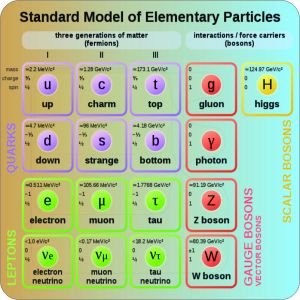
“Hm? Oh, the other wave carrier idea. Einstein’s gravitational waves are just fine, but the Quantum Field Theorists added a collection of other fields, one for each of the 17 boxes in the Standard Model.”

“Boxes?”

<displaying Old Reliable’s screen> “Here’s the usual graphic. It’s like the chemist’s Periodic Table but goes way below the atomic level. There’s a box each for six kinds of quarks; another half‑dozen for electrons, neutrinos and their kin; four more boxes for mediating electromagnetism and the weak and strong nuclear forces. Finally and at last there’s a box for the famous Higgs boson which isn’t about gravity despite what the pop‑sci press says.”

“What’s in the boxes?”

“Each box holds a list of properties — rest mass, spin, different kinds of charge, and a batch of rules for how to interact with the other thingies.”

“Thingies, Sy? I wouldn’t expect that word from you.”

“I would have said ‘particle‘ but that would violate QFT’s tenets despite the graphic’s headline.”

“Tenets? That word sounds more like you. What’s the problem?”

“That the word ‘particle‘ as we normally use it doesn’t really apply at the quantum field level. Each box names a distinct field that spreads its values and waves all across the Universe. There’s an electron field, a photon field, an up‑quark field, a down‑quark field, and so on. According to QFT, what we’d call a particle is nothing more than a localized peak in its underlying field. Where you find a peak you’ll find all the properties listed in its box. Wherever the field’s value is below its threshold, you find none of them.”

“All or none, huh? I guess that’s where quantum comes in. Wait, that means there could be gazillions of one of them popping up wherever, like maybe a big lump of one kind all right next to each other.”

“No, the rules prevent that. Quarks, for instance, only travel in twos or threes of assorted kinds. The whole job of the gluons is to enforce QFT rules so that, for instance, two up‑quarks and a down‑quark make a proton but only if they have different color charges.”

“Wait, color charge?”

“Not real colors, just quantum values that could as easily have been labeled 1, 2, 3 or A, B, C. There’s also an anti- for each value so the physicists could have used ±1, ±2, ±3, but they didn’t, they used ‘red’ and ‘anti‑red’ and so forth. And ‘color charge‘ is a different property from electric charge. Gluons only interact with color charge, photons only interact with electric charge. The rules are complicated.”

“You said ‘waves.’ Each of these fields can have waves like gravity waves?”

“Absolutely. We can’t draw good pictures of them because they’re 3‑dimensional. And they’re constantly in motion, of course.”

“How fast can those waves travel?”

“The particles are limited to lightspeed or slower; the waves, who knows?”

“Ripples zipping around underneath the quantum threshold could account for entanglement, ya’ know?”

“Maybe.”

~~ Rich Olcott

A Million Times Weaker Than Moonlight

Big Vinnie’s getting downright antsy, which is something to behold. “C’mon, Sy. We get it that sonication ain’t sonification and molecules bumping into each other can carry a sound wave across space if the frequency’s low enough and that can maybe account for galaxies having spiral arms, but you said the Cosmic Hum is a sound, too. That’s a gravity thing, not molecules, right?”

“Not quite what I said, Vinnie. The Hum’s sound‑related, but it’s not ‘sound’ even by our extended definition.”

“Then what’s the connection?”

“Waves.”

“Not frames like always?”

“Not frames, for a change.”

“So it’s waves, but they go though empty space. Can’t happen like sound waves from molecules bumping into each other ’cause molecules are too small to have enough gravity do that when they’re so far apart. What’s carrying the waves?”

“Good question. Einstein figured out one answer. A whole cohort of mid‑20th‑century theoreticians came to a slightly different conclusion.”

“Okay, I’ll bite. What was Einstein’s answer?”

“Relativity, of course. Gravity’s the effect we see from mass deforming nearby space. Moving a mass drives corresponding changes in the shapes of space where it was and where it has moved to. The shape‑changes generate follow‑on gravitational effects that propagate outward over time. Einstein even showed that the gravitational propagation speed is equal to lightspeed.”

“Gimme a sec … Okay, that black hole collision signal LIGO picked up back in 2015, the holes lost a chunk of their combined mass all of a sudden. Quick drop in the gravity thereabouts. You’re saying it took time for the missing gravity strength to get noticed where we’re at. If I remember right, the LIGO people said the event was something like a billion lightyears away so that tells me it happened about a billion years ago and what the LIGO gadget picked up was space waves, right?”

“Right, but it wasn’t just the mass loss, it was the rapid and intense waggles in the gravitational field as those two enormous bodies, each 30 times as massive as the Sun, whirled around each other multiple times per second. The ever‑faster whirling shook the field with a frequency that swept upward to the ‘POP‘ when your mass‑loss happened. LIGO eventually picked up that signal. Einstein would say there’s no ‘action at a distance‘ in the collision‑LIGO interaction, because the objects acted on the gravitational field which acted on the LIGO system.”

“Like using a towel to pop someone in the locker room. The towel’s just transmi– ulp.”

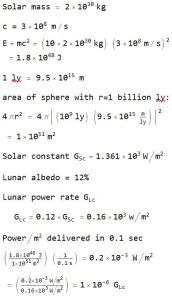
“An admission of guilt if I ever heard one. Yes, like that, except a towel pop carries all the initial energy to its final destination. Gravitational waves spread their energy across the surface of an expanding sphere. The energy per unit area goes down as the square of the distance.” <keying a calculation on Old Reliable> “Suppose the collision releases 10 solar masses worth of energy, we’re a billion lightyears away, and the ‘POP‘ signal is delivered in a tenth of a second. We’d see a signal power … about a millionth as strong as moonlight.”

“Not much there.”

“Right, which is why LIGO and its kin have been such pernickety instruments to build and run. LIGO’s sensors are mirrors roughly a meter across. You get a million times more power sensitivity if your detector’s diameter is a mile across. That was part of the NANOGrav team’s strategy, but they went much bigger.”

“Yeah, that’s the multi-telescope thing, so NANOGrav faked a receiver the size of the Earth, like the Event Horizon Telescope.”

“Much bigger. Their receiver is the entire Milky Way. Instead of LIGO’s mirrors, NANOGrav’s signal generators are neutron stars a dozen or more miles wide scattered across the galaxy.”

“Gotcha, Sy. Two ways. Neutron stars are billions heavier than a LIGO mirror so they’d be less power‑sensitive, not more. Then, power is about moving stuff closer or farther but if I got you right these space waves don’t really do that anyway, right?”

“Right and right, Vinnie, but not relevant. What NANOGrav’s been watching for is pulsar beams being twitched by a gravitational wave. A waltzing black hole pair should generate years‑long or decades‑long wavelengths. NANOGrav may have found one.”

~~ Rich Olcott

Little Strings And Big Ones

It’ll be another hot day so I’m walking the park early. No geese in the lake — they’ve either flown north or else they’re attacking a farmer’s alfalfa field. A familiar voice shatters the quiet. “Wait up, Moire, I got questions.”

“Good morning, Mr Feder. First question, but please pick up your pace, I want to get back to the air conditioning.”

“I thought string theory was about little teeny stuff but this guy said about cosmic strings. How can they be teeny and cosmic?”

“They can’t. Totally different things, probably. Next question.”

“C’mon, Moire, that wasn’t even an answer, just opened up a bunch more questions.”

“It’s a tangled path but the track mostly started in the late 18th Century. Joseph Fourier derived the equation for how heat progresses along a uniform metal bar. Turned out the equation’s general solution was the sum of an infinite series of sine waves.”

“Sign waves? Like a protest rally?”

“Haha. No, s‑i‑n‑e, a mathematical function where something regularly and smoothly deviates about some central value. Anyhow, mathematicians soon realized that Fourier’s cute trick for his heat equation could be applied to equations for everything from sound waves to signal processing to pretty much all of Physics. Economics, even. Any time you use the word ‘frequency‘ you owe something to Fourier.”

“If he ain’t got it in writing from the Patent Office, I ain’t paying nothing.”

“It’s not the kind of thing you can patent, and besides, he lived in France and died almost two centuries ago. Be generous with your gratitude, at least. Let’s move on. Fourier’s Big Idea was already <ahem> in the air early in the 20th Century when Bohr and the Physics gang were looking at atoms. No surprise, they extended the notion to describe how electronic charge worked in there.”

“I’m waiting for the strings.”

“The key is that an atom’s a confined system like a guitar string that only vibrates between the bridge and whatever fret you’re pressing on. Sound waves traveling in open space can have any wavelength, but if you pluck a confined guitar string the only wavelengths you can excite are whole number multiples of its active length. No funny fractions like π/73 of the length no matter how hard or soft you pluck the string. Atoms work the same way — charge is confined around the nucleus so only certain wave sizes and shapes are allowed.”

“You said ‘strings.’ We getting somewhere finally?”

“Closing in on it. String theory strings aren’t just teeny. If your body were suddenly made as large as the Observable Universe, string theory is about what might happen inside a box a billion times smaller than your size now.”

“Really tight quarters, got it, so only certain vibrations are allowed.”

“Mm-hm, except it’s not really vibration, it would be something that acts mathematically like vibration. Go back to your guitar string. Plucking gives it up‑down motion, strumming moves it side‑to‑side. Two degrees of freedom. The math says whatever’s going on in a string theory box needs 8 or 11 or maybe 25 degrees of freedom, depending on the theory. At the box‑size scale if there’s structure at all it looks nothing like a string.”

“Then how about the big cosmic strings? What’s confining them?”

“Nothing, and I mean that literally. If they exist they’re bounded by different flavors of empty space. It goes back to what we think happened right after the Big Bang during rapid space expansion. Whatever forces drove the process were probably limited by lightspeed. Local acceleration in one region wouldn’t immediately affect events in regions lightyears away. Nearly adjacent parts of the Universe could have been evolving at very different rates. Have you ever watched the whirlpools that form when a fast‑moving stream of water meets a slower‑moving one?”

“Fort Lee had a storm‑sewer pipe that let into the Hudson River. You got crazy whirlpools there after a hard rain.”

“Whirlpools are one kind of topological defect. They die away in water because friction dissipates the angular momentum. Hiding behind a whole stack of ifs and maybes, some theorists think collisions between differently‑evolving spacetime structures might generate long‑lived defects like cosmic strings or sheets.”

~~ Rich Olcott

Not A Hum, A Rumble

Vinnie taps on the magazine. “Sy, you’ve done it again. We ask you one question, you spend a lot of time talking about something else entire. They got this article here” <tap> “says the NANOGrav team captured the hum of the Universe. Al and me, we ask you about that and you get us discussing pulsars. Seems to me,” <tap tap> “that if you got a pulsar and the pulses got only a 3% duty cycle they’d sound more like clicks and,” <taptaptaptap> “if it’s a 10 millisecond pulsar that’s a hundred per second and they’d be more like a low‑pitched buzz, nothing like a hum.”

“One more short detour, Vinnie, sorry. Remember when we discussed the VLA, the Very Large Array of radio telescopes in northern New Mexico?”

“Sorta. I do remember visiting the place, out in the desert miles away from anywhere. They’ve got a couple dozen dish antennas each as wide as a four‑lane road, all spread out along railroad tracks. Big dishes for catching weak signals I understand, but I forget why there’s lots of dishes instead of one huge one or how that even works.”

“One reason is simple mechanics. A huge dish would try to sail away in the desert wind. VLA admins even have to safe‑mount those 25‑meter ones when things get gusty. But the real reason goes to how the array works as one big instrument. Here’s a hint — the dishes can be miles apart and lightspeed isn’t infinite.”

“Ah, that joggled my memory. It’s about when a signal comes in from some nova or something, each dish registers it with a slightly different arrival time and then the computers play match‑up games with all the time differences to figure exactly what angle the signal came from, right?”

“Roughly. The VLA’s multi‑dish design is about being able to resolve signal sources that are close together in the sky so yeah, slightly different angles. The Event Horizon Telescope team used the same strategy and a collection of radio dishes all over the world to produce those orange‑ring images of supermassive black holes. NANOGrav and the other Pulsar Timing Arrays sort of the flip the strategy.”

“At last we get to NANOGrav. Wait, they use lots of antennas to send signals to a star?”

“Nothing like that, Al. No, they use just a few antennas but they track the timing of many pulsars. About 70 at last count.”

“But we know what the timing is, to nanoseconds you said.”

“One word, Vinnie. ‘Frames‘.”

“Aw geez, Sy. Again?”

“Mm-hm. In the pulsar’s frame, it’s majestically rotating at a steady pace, tens or hundreds of times per second relative to its neighbors. Its beam proudly announces its presence on an absolutely regular schedule save for a small but steady slow‑down. In our frame, though, things can happen to a pulse as it heads our way.”

“Like what?”

“It might pass through a molecular cloud. We know those exist. Photons in the right wavelength ranges could interact with cloud components. That’d delay them, stretch the pulse, might even create interference between successive pulses. On the theory side, some cosmologists think the Universe may hold objects like cosmic strings or curvature‑induced domain walls that could delay, deflect or otherwise mess up a pulse. The best possibility, though, is that a gravitational wave could cross the path of a pulse en route to us.”

“Why is that a good thing?”

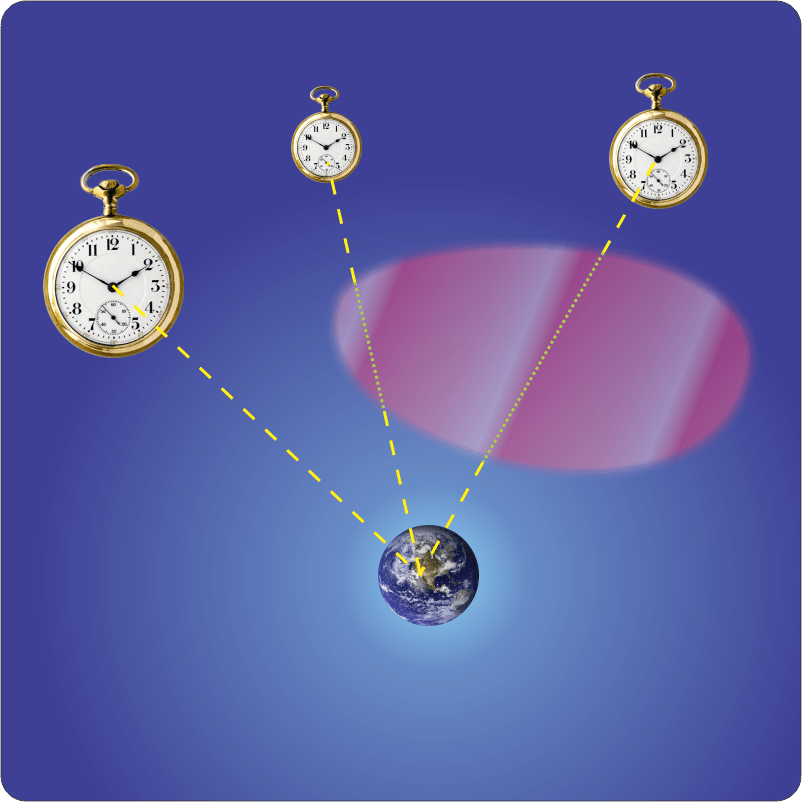
“Because they’d interact to alter that pulse’s timing. Gravitational waves stretch and squeeze time as they squeeze and stretch space. If a wave crosses a traveling pulse, the pulse will get here either early or late depending. Better yet, if we track enough pulsars scattered across the sky we might even see a parade of offset timings as the wave encounters different pulse beams. Hasn’t happened yet, though. The NANOGrav reports so far are about the background variation as waves from everywhere traverse the paths we’re watching.”

“The article says a hum.”

“Hum sounds come in waves per second. The gravitational background happens in waves per decade, such a low frequency even elephants couldn’t hear it.”

“OK, it’s rumble, not a hum. But why either one?”

~~ Rich Olcott

Symmetry And The Loopholes

“So, we’ve got geometry symmetry and relativity symmetry. Is that it, Sy?”

“Hardly, Al. There’s scores of them. Mathematics has a whole branch devoted to sorting and classifying the operations and how they group together. Shall I list a few dozen?”

“Ah, no, don’t bother, thanks. You got one I’d recognize?”

“How about charge symmetry? Flip an electron’s negative charge and you’ve got a positron that has exactly the same mass and the same interaction with light waves. OK, positrons move opposite to electrons in a magnetic field which is how their existence was confirmed, but charge is s a fundamental symmetry for normal matter.”

“Oh, right, charge is a piece of that CPT symmetry you hung your anti‑Universe story on. Which reminds me, you never said what the ‘P’ stands for.”

“Parity, as in Charge‑Parity‑Time. Before you ask, ‘parity‘ is left-right symmetry. Parity symmetry says you can replace ‘clockwise‘ with ‘counterclockwise‘ in a system and the equations describing the system will give perfectly good predictions. Time symmetry is about time running forward or backward. The equations are happy either way. The CPT theorem says the three symmetries are solidly tied together — you can’t flip one without the other two tagging along. If some process emits particle X with clockwise spin, there’s some equivalent process that soaks up an anti-X if it’s spinning counterclockwise. Very firm theorem, lots of laboratory evidence for it from electromagnetism and the nuclear strong force. But.”

“But?”

“But Chien‑Shiung Wu did an experiment that showed the nuclear weak force doesn’t always obey CPT rules. Her worked proved we live in a handed Universe. She should have gotten a Nobel for that, but it was last century and the Nobel Committee was men‑only. Two theory guys copped the prize that should have gone to the three of them. The theory guys protested but the Committee ignored Wu anyway. Sometimes things aren’t fair.”

“Tell me about it. So the theory’s got a loophole?”

“Apparently, but to my knowledge no‐one’s found it. Some string theories claim to hint at an explanation but that’s not much help, considering.”

“Huh. Could the loophole maybe be an example of symmetry breaking?”

“Very good question. I think it’s a qualified probably but that’s a guess.”

“Sy, I think that’s the wishy-washiest you’ve ever been.”

“One of my rules is, when you’re going out on a limb be sure you’re properly roped to the tree. In this case I’m generalizing from a single sample.”

“You’re gonna tell me, right?”

   Professor Higgs presents
       the Higgs Bozo.

“Just the bare outline because I don’t want to get into the deep weeds. Back in the 1960s Physics was in trouble because the nuclear strong force particles that bind the nucleus together were found to have mass and move slowly. Strong‑force theory at the time said they should be massless and move at lightspeed. The theory depended on part of the potential energy varying with the symmetry of a circle. Then Higgs—”

“The Higgs Boson guy?”

“That’s him. Anyway, he published a three‑page paper showing that those binding particles aren’t controlled solely by the nuclear strong force. Because they have a charge they also engage with the electromagnetic field. Electromagnetism is a lot weaker than the strong force, but it’s strong enough to deform the theory’s circle into an ellipse. Breaking the circular symmetry in effect gives the particles mass and slows them down.”

“So where’s the boson come in? I thought it’s what makes mass for everything.”

“Absolutely not, probably. The protons and neutrons have plenty of mass on their own, thank you very much. It’s only those strong-force particles that gain mass, less than 1% of the nucleus total. But the whole story is a great example of how making a system less symmetrical, even a little bit, can completely change how it operates. We think that’s what drove the Big Bang’s story. The early Universe was so dense and hot it was a perfectly symmetrical quark soup — chaos all the way down. Space expansion opened successive symmetry loopholes that permitted layers of structure formation.”

<looking at hands> “I don’t feel unsymmetrical.”

“Trust me, deep down you are.”

~~ Rich Olcott

Reflection, Rotation And Spacetime

“Afternoon, Al.”

“Hiya, Sy. Hey, which of these two scones d’ya like better?”

“”Mm … this oniony one, sorta. The other is too vegetable for me ‑ grass, I think, and maybe asparagus? What’s going on?”

“Experimenting, Sy, experimenting. I’m going for ‘Taste of Spring.’ The first one was spring onion, the second was fiddlehead ferns. I picked ’em myself.”

“Very seasonal, but I’m afraid neither goes well with coffee. I’ll take a caramel scone, please, plus a mug of my usual mud.”

“Aw, Sy, caramel’s a winter flavor. Here you go. Say, while you’re here, maybe you could clear up something for me?”

“I can try. What’s the something?”

“After your multiverse series I got out my astronomy magazines to read up on the Big Bang. Several of the articles said that we’ve gone through several … um, I think they said ‘epochs‘ … separated by episodes of symmetry breaking. What’s that all about?”

“It’s about a central notion in modern Physics. Name me some kinds of symmetry.”

“Mmm, there’s left‑right, of course, and the turning kind like a snowflake has. Come to think — I like listening to Bach and Vivaldi when I’m planet‑watching. I don’t know why but their stuff reminds me of geometry and feels like symmetry.”

“Would it help to know that the word comes from the Greek for ‘same measure‘? Symmetry is about transformations, like your mirror and rotation operations, that affect a system but don’t significantly change to its measurable properties. Rotate that snowflake 60° and it looks exactly the same. Both the geometric symmetries you named are two‑dimensional but the principle applies all over the place. Bach and the whole Baroque era were just saturated with symmetry. His music was so regular it even looked good on the page. Even buildings and artworks back then were planned to look balanced, as much mass and structure on the left as on the right.”

“I don’t read music, just listen to it. Why does Bach sound symmetric?”

“There’s another kind of symmetry, called a ‘translation‘ don’t ask why, where the transformation moves something along a line within some larger structure. That paper napkin dispenser, for instance. It’s got a stack of napkins that all look alike. I pull one off, napkins move up one unit but the stack doesn’t look any different.”

“Except I gotta refill it when it runs low, but I get your drift. You’re saying Bach takes a phrase and repeats it over and over and that sounds like translational symmetry along the music’s timeline.”

“Yup, maybe up or down a few tones, maybe a different register or instrument. The repeats are the thing. Play his Third Brandenberg Concerto next time you’re at your telescope, you’ll see what I mean.”

“Symmetry’s not just math then.”

“Like I said, it’s everywhere. You’ve seen diagrams of DNA’s spiral staircase. It combines translation with rotation symmetry, does about 10 translation steps per turn, over and over. The Universe has a symmetry you don’t see at all. No‑one did until Lorentz and Poincaré revised Heaviside’s version of Maxwell’s electromagnetism equations for Minkowski space. Einstein, Hilbert and Grossman used that work to give us and the Universe a new symmetry.”

“Einstein didn’t do the math?”

“The crew I just named were world‑class in math, he wasn’t. Einstein’s strengths were his physical intuition and his ability to pick problems his math buddies would find interesting. Look, Newton’s Universe depends on absolute space and time. The distance between two objects at a given time is always the same, no matter who’s measuring it or how fast anyone is moving. All observers measure the same duration between two incidents regardless. Follow me?”

“Makes sense. That’s how things work hereabouts, anyway.”

“That’s how they work everywhere until you get to high speeds or high gravity. Lorentz proved that the distances and durations you measure depend on your velocity relative to what you’re measuring. Extreme cases lead to inconsistent numbers. Newton’s absolute space and time are pliable. To Einstein such instability was an abomination. Physics needs a firm foundation, a symmetry between all observers to support consistent measurements throughout the Universe. Einstein’s Relativity Theory rescued Physics with symmetrical mathematical transformations that enforce consistency.”

~~ Rich Olcott