
Professor of Astronomy Cathleen O’Meara barges into Cal’s Coffee Shop. “There you are, Sy Moire! You numbskull! You addlepate! You … nincompoop! “
We’ve known each other since we were kids but I’ve rarely seen her this angry. “What have I done this time, Cathleen? I apologize, but what for?”
“That last post you put up. One of the hardest things to get across to planet science students is the Coriolis Effect. You got it exactly backwards, you lummox! Confused the be-jeepers out of half my students and it’s going to take a whole class period to unwind it.”
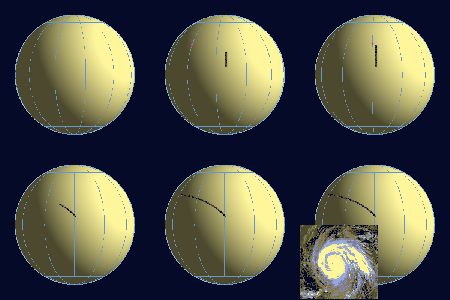
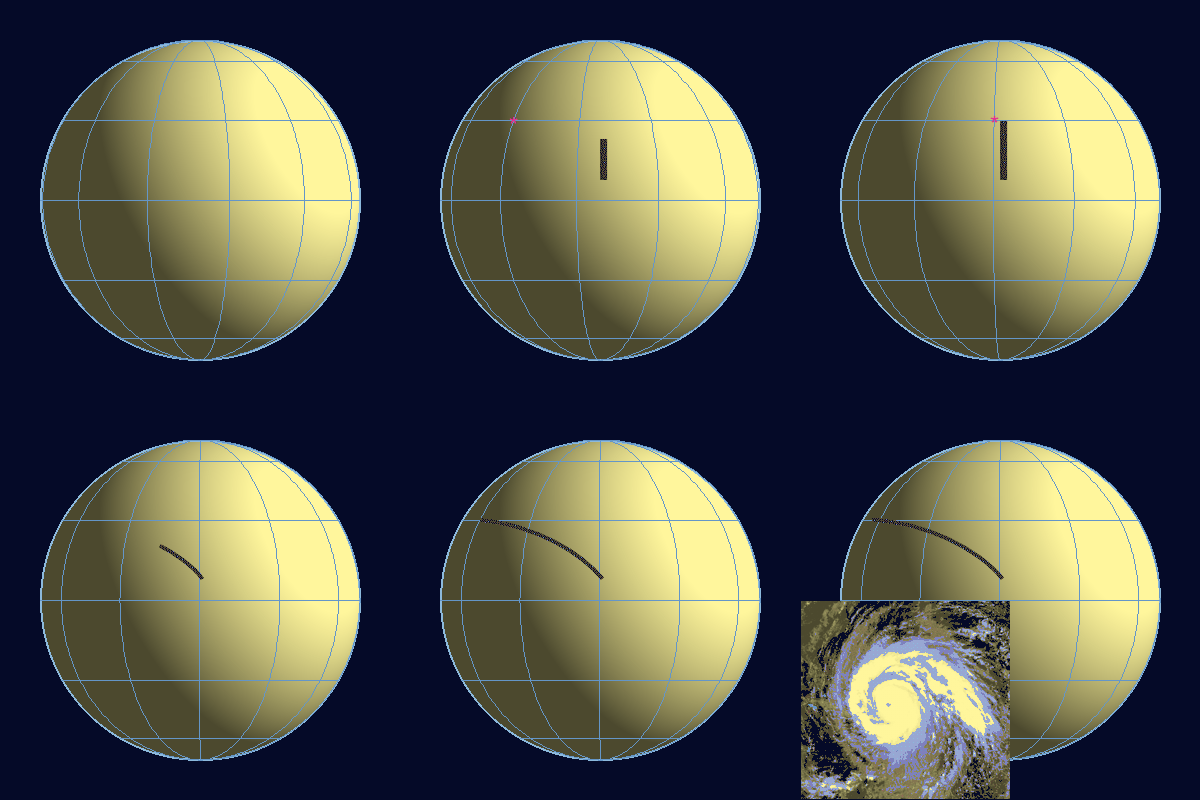
All those exclamation points sting when they strike home. “It did feel funny. All the sources I checked said Coriolis skews travel to the right in the northern hemisphere but I worked hard for hours on that video and it clearly shows ‘left‘.”
<sniff> “Stupid waste of time, chump! That video doesn’t show Coriolis.” <she grabs one of Cal’s graph-paper napkins and starts sketching> “Your balloon or whatever isn’t traveling north along Earth’s surface. It’s going out into space. That dark line tracks the thing’s shadow, or it would if you had the Sun behind it instead of off to the side. It has nothing at all to do with the cloud stream at the top of the hurricane and by the way those winds in the picture are outward, not inward as you’d’ve known if you’d’ve thought about for even a moment, blockhead! Here, look at a sideways view.”
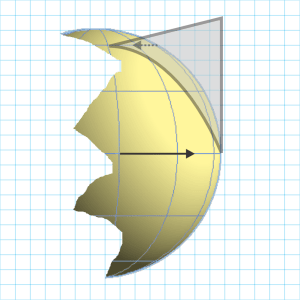
“You’re saying my balloon’s not following the surface, it’s vectored away from the surface parallel to the north‑south axis. Also that the shadow points that I plotted on Earth trend westward only because the Earth turns west‑to‑east underneath the balloon. … Okay, I can see that. Goes so high up I guess it can’t be a balloon, huh?”
“Don’t try to deflect the conversation, nitwit. Figure out what you got wrong and put up a correction post that gives a proper account of Coriolis. Sorry, Cal, I’ll need my coffee in a sippy‑cup. Gotta go revise my lesson plan, again.”
She grabs her caffeine to‑go, flings me a final “Dolt! ” and storms out the door trailing a cloud of grumbles.
Vinnie’s open-mouthed. “Geez, Sy, she does have a temper.”
“You know it, Vinnie. Fortunately she saves it up for deserving occasions but don’t ever get her started on politics. So let’s see, what part of what I posted did I get right?”
“Well, there’s the part about Helsinki’s rotation around the Earth runs fewer kilometers per hour than Quito’s. That’s just fact, can’t argue with it.”
“Yeah, Mr Moire, and there’s Conservation of Momentum.”
“Right, Jeremy.” Synapses connect in my head. “Got it! Vinnie, what’s the rule between speed and orbit size?”
“The closer the faster. The Moon’s a quarter‑million miles away, takes a month to go round the Earth; the ESS is 250 miles up, circles us every 90 minutes. If you’re in some orbit and wanna go lower, you gotta speed up. Took me an hour to convince Larry that’s the way it works. He was all about centrifugal force forcing you outward, but if you want to get deeper in the gravity well you need the extra speed to balance the extra gravity.”
“That’s the rule for space orbits, alright, but things work exactly the opposite for travel on the surface of a rotating sphere. Gravity pulls centerward with the same strength everywhere so gravity’s not what balances the centrifugal force.”
“What does?”
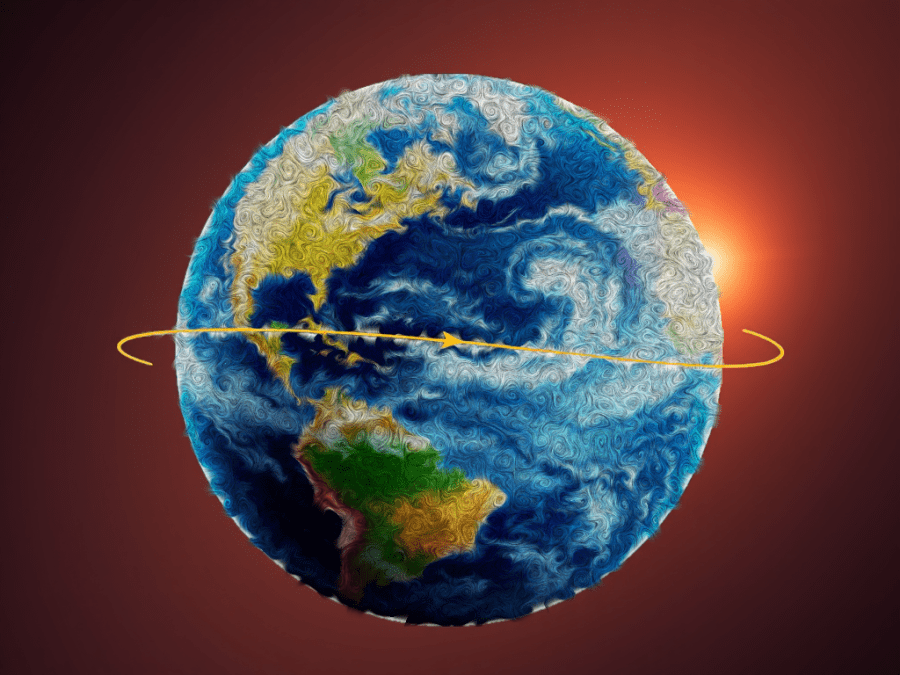
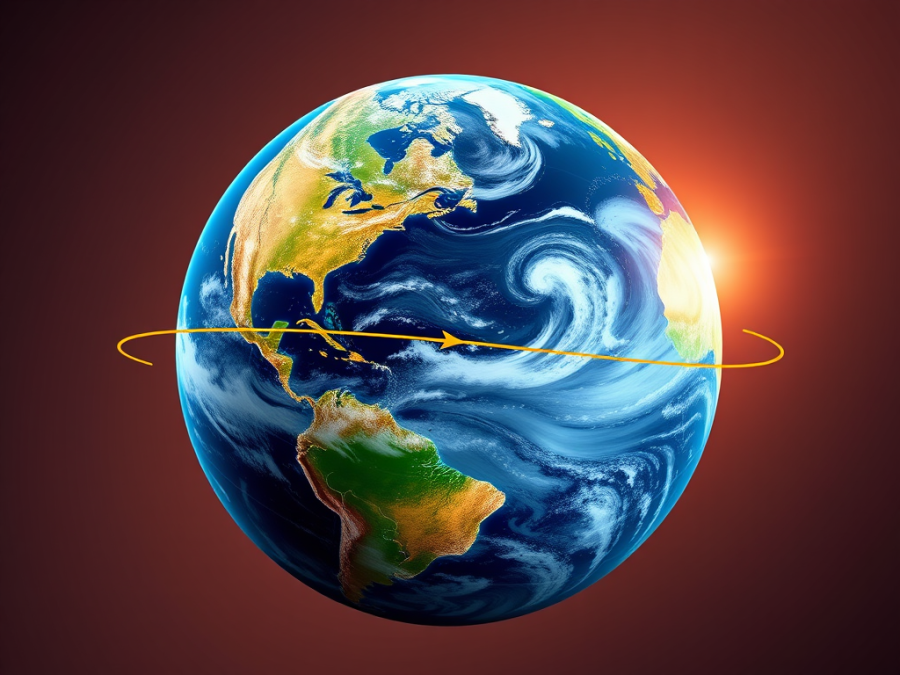
“Geometry. In space orbits, velocity and kinetic energy increase toward the core. On a sphere’s surface, the highest velocity is farthest away from the rotational axis, at the equator. Velocity falls off to zero at both poles. Every latitude has its characteristic velocity and kinetic energy. Suppose you’re loose on Earth’s northern hemisphere and moving east too fast for your latitude. You’ll drift southward, away from the axis, until you hit a latitude that matches your speed. Meanwhile, because you’re moving east the landscape will flow westward beneath you. The blend is the Coriolis Effect.”
“So if I’m slower than my latitude I drift north and Coriolis sends me east?”
“Cathleen would agree, Jeremy.”
~ Rich Olcott






 Hard Science Ain't Hard