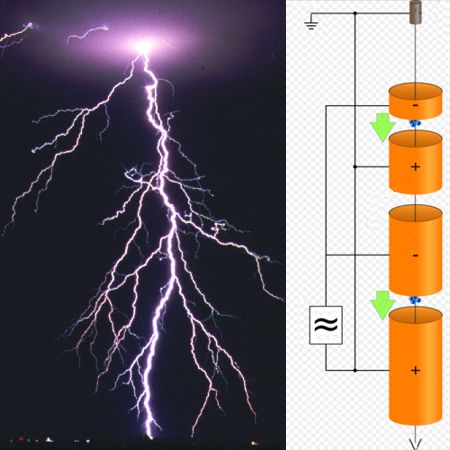
Lighting and a diagram of a linac

Curiosity in The Internet Market

“I got another question, Moire.”

“Of course you do, Mr Feder.  Let’s hear it.”

“I read on the Internet that there’s every kind of radioactivity coming out of lightning bolts.  So is that true, how’s it happen and how come we’re not all glowing in the dark?”

“Well, now, like much else you read on the Internet there’s a bit of truth in there, and a bit of not-truth, all wrapped up in hype.  The ‘every kind of radioactivity’ part, for instance, that’s false.”

“Oh yeah?  What’s false about that?”

“Kinds like heavy-atom fission and alpha-particle ejection.  Neither have been reported near lightning strikes and they’re not likely to be.  Lightning travels through air.  Air is 98% nitrogen and oxygen with a sprinkling of light atoms.  Atoms like that don’t do those kinds of radioactivity.”

“So what’s left?”

“There’s only two kinds worth worrying about — beta decay, where the nucleus spits out an electron or positron, and some processes that generate gamma-rays.  Gamma’s a high-energy photon, higher even than X-rays.  Gamma photons are strong enough to ionize atoms and molecules.”

“You said ‘worth worrying about.’  I like worrying.  What’s in the not-worth-it bucket?”

“Neutrinos.  They’re so light and interact so little with matter that many physicists think of them as just an accounting device.  Trillions go through you every second and you don’t notice and neither do they.  Really, don’t worry about them.”

“Easy for you to say.  Awright, so how does lightning make the … I guess the beta and gamma radioactivity?”

“We know the general outlines, although a lot of details have yet to be filled in.  What do you know about linear accelerators?”

“Not a clue.  What is one?”

Lighting and a diagram of a linac
Linac diagram adapted from
Sgbeer – Own work, CC BY-SA 3.0

“It’s a technology for making high-energy electrons and other charged particles.  Picture a straight evacuated pipe equipped with ring electrodes at various distances from the source end.  The source could be an electron gun or maybe a rig that spits out ions of some sort.  Voltages between adjacent electrodes downstream of a particle will give it a kick when it passes en route to the target end.  By using the right voltages at the right times you can boost an electron’s kinetic energy into the hundred-million-eV range.  That’s a lot of kinetic energy.  Got that picture?”

“Suppose that I do.  Then what?”

“Lightning is the same thing but without the pipe and it’s not straight.  The electrons have an evacuated path, because plasma formation drives most of the molecules out of there.  Activity inside the clouds gives them high voltages, up to a couple hundred megavolts.  But on top of that there’s bremsstrahlung.”

“Brem…?”

Bremsstrahlung — German for braking radiation.  You know how your car’s tires squeal when you make a turn at speed?”

“One of my favorite sounds, ‘specially when … never mind.  What about it?”

“That’s your tires converting your forward momentum into sound waves.  Electrons do that, too, but with electromagnetism.  The lightning path zigs and zags.  An electron’s path has to follow suit.  At each swerve, the electron throws off some of its kinetic energy as an electromagnetic wave, otherwise known as a photon.  Those can be very high-energy photons, X-rays or even gamma-rays.”

“So that’s where the gammas come from.”

“Yup.  But there’s more.  Remember those nitrogen atoms?  Ninety-nine-plus percent of them are nitrogen-14, a nice, stable isotope with seven protons and seven neutrons.  If a sufficiently energetic gamma strikes a nitrogen-14, the atom’s nucleus can kick out a neutron and turn into unstable nitrogen-13.  That nucleus emits a positron to become stable carbon-13.  So you’ve got free neutrons and positrons to add to the radiation list.”

“With all that going on, how come I’m not glowing in the dark?”

“‘Because the radiation goes away quickly and isn’t contagious.  Most of the neutrons are soaked up by  hydrogen atoms in passing water molecules (it’s raining, remember?).  Nitrogen-13 has a 10-minute half-life and it’s gone.  The remaining neutrons, positrons and gammas can ionize stuff, but that happens on the outsides of molecules, not in the nuclei.  Turning things radioactive is a lot harder to do.  Don’t worry about it.”

“Maybe I want to.”

“Your choice, Mr Feder.”

~~ Rich Olcott
Michelson, Morley and LIGO

Two teams of scientists, 128 years apart.  The first team, two men, got a negative result that shattered a long-standing theory.  The second team, a thousand strong, got a positive result that provided final confirmation of another long-standing theory.  Both teams used instruments based on the same physical phenomenon.  Each team’s innovations created whole new fields of science and technology.

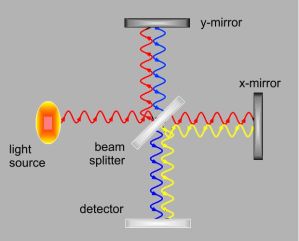
Interferometer 1Their common experimental strategy sounds simple enough — compare two beams of light that had traveled along different paths

Light (preferably nice pure laser light, but Albert Michelson didn’t have a laser when he invented interferometry in 1887) comes in from the source at left and strikes the “beam splitter” — typically, a partially-silvered mirror that reflects half the light and lets the rest through.  One beam goes up the y-arm to a mirror that reflects it back down through the half-silvered mirror to the detector.  The other beam goes on its own round-trip journey in the x-direction.  The detector (Michelson’s eye or a photocell or a fancy-dancy research-quality CCD) registers activity if the waves in the two beams are in step when they hit it.  On the other hand, if the waves cancel then there’s only darkness.

Getting the two waves in step requires careful adjustment of the x- and y-mirrors, because the waves are small.  The yellow sodium light Michelson used has a peak-to-peak wavelength of 589 nanometers.  If he twitched one mirror 0.0003 millimeter away from optimal position the valleys of one wave would cancel the peaks of the other.

So much for principles.  The specifics of each team’s device relate to the theory being tested.  Michelson was confronting the æther theory, the proposition that if light is a wave then there must be some substance, the æther, that vibrates to carry the wave.  We see sunlight and starlight, so  the æther must pervade the transparent Universe.  The Earth must be plowing through the æther as it circles the Sun.  Furthermore, we must move either with or across or against the æther as we and the Earth rotate about its axis.  If we’re moving against the æther then lightwave peaks must appear closer together (shorter wavelengths) than if we’re moving with it.Michelson-Moreley device

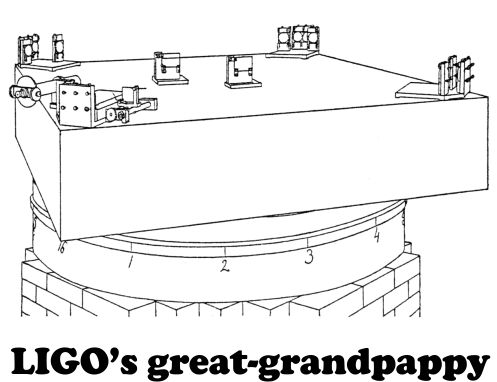
Michelson designed his device to test that chain of logic. His optical apparatus was all firmly bolted to a 4′-square block of stone resting on a wooden ring floating on a pool of mercury.  The whole thing could be put into slow rotation to enable comparison of the x– and y-arms at each point of the compass.

Interferometer 3
Suppose the æther theory is correct. Michelson should see lightwaves cancel at some orientations.

According to the æther theory, Michelson and his co-worker Edward Morley should have seen alternating light and dark as he rotated his device.  But that’s not what happened.  Instead, he saw no significant variation in the optical behavior around the full 360o rotation, whether at noon or at 6:00 PM.

Cross off the æther theory.

Michelson’s strategy depended on light waves getting out of step if something happened to the beams as they traveled through the apparatus.  Alternatively, the beams could charge along just fine but something could happen to the apparatus itself.  That’s how the LIGO team rolled.

Interferometer 2
Suppose Einstein’s GR theory is correct. Gravitational wave stretching and compression should change the relative lengths of the two arms.

Einstein’s theory of General Relativity predicts that space itself is squeezed and stretched by mass.  Miles get shorter near a black hole.  Furthermore, if the mass configuration changes, waves of compressive and expansive forces will travel outward at the speed of light.  If such a wave were to encounter a suitable interferometer in the right orientation (near-parallel to one arm, near-perpendicular to the other), that would alter the phase relationship between the two beams.

The trick was in the word “suitable.”  The expected percentage-wise length change was so small that eLIGO needed 4-kilometer arms to see movement a tiny fraction of a proton’s width.  Furthermore, the LIGO designers flipped the classical detection logic.  Instead of looking for a darkened beam, they set the beams to cancel at the detector and looked for even a trace of light.

eLIGO saw the light, and confirmed Einstein’s theory.

~~ Rich Olcott

Would the CIA want a LIGO?

So I was telling a friend about the LIGO announcement, going on about how this new “device” will lead to a whole new kind of astronomy.  He suddenly got a far-away look in his eyes and said, “I wonder how many of these the CIA has.”

The CIA has a forest of antennas, but none of them can do what LIGO does.  That’s because of the physics of how it works, and what it can and cannot detect.  (If you’re new to this topic, please read last week’s post so you’ll be up to speed on what follows.  Oh, and then come back here.)

There are remarkable parallels between electromagnetism and gravity.  The ancients knew about electrostatics — amber rubbed by a piece of cat fur will attract shreds of dry grass.  They certainly knew about gravity, too.  But it wasn’t until 100 years after Newton wrote his Principia that Priestly and then Coulomb found that the electrostatic force law, F = ke·q1·q2 / r2, has the same form as Newton’s Law of Gravity, F = G·m1·m2 / r2. (F is the force between two bodies whose centers are distance r apart, the q‘s are their charges and the m‘s are their masses.)

Jim and AlAlmost a century later, James Clerk Maxwell (the bearded fellow at left) wrote down his electromagnetism equations that explain how light works.  Half a century later, Einstein did the same for gravity.
But interesting as the parallels may be, there are some fundamental differences between the two forces — fundamental enough that not even Einstein was able to tie the two together.

One difference is in their magnitudes.  Consider, for instance, two protons.  Running the numbers, I found that the gravitational force pulling them together is a factor of 1036 smaller than the electrostatic force pushing them apart.  If a physicist wanted to add up all the forces affecting a particular proton, he’d have to get everything else (nuclear strong force, nuclear weak force, electromagnetic, etc.) nailed down to better than one part in 1036 before he could even detect gravity.

But it’s worse — electromagnetism and gravity don’t even have the same shape.

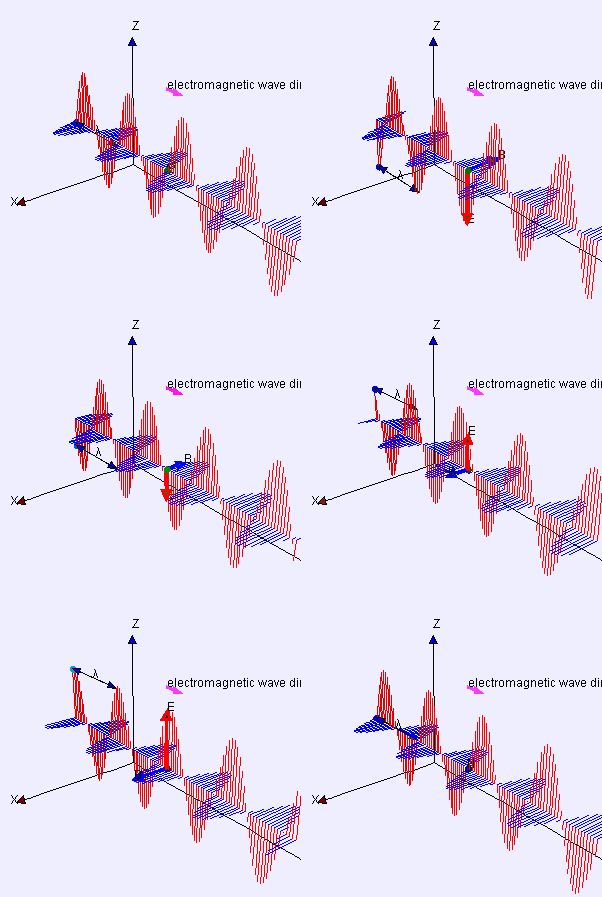
Electromagneticwave3D
Electric (red) and magnetic (blue) fields in a linearly polarized light wave
(graphic from WikiMedia Commons, posted by Lookang and Fu-Kwun Hwang)

A word first about words.  Electrostatics is about pure straight-line-between-centers (longitudinal) attraction and repulsion — that’s Coulomb’s Law.  Electrodynamics is about the cross-wise (transverse) forces exerted by one moving charged particle on the motion of another one.  Those forces are summarized by combining Maxwell’s Equations with the Lorenz Force Law.  A moving charge gives rise to two distinct forces, electric and magnetic, that operate at right angles to each other.  The combined effect is called electromagnetism.

The effect of the electric force is to vibrate a charge along one direction transverse to the wave.  The magnetic force only affects moving charges; it acts to twist their transverse motion to be perpendicular to the wave.  An EM antenna system works by sensing charge flow as electrons move back and forth under the influence of the electric field.

Gravitostatics uses Newton’s Law to calculate longitudinal gravitational interaction between masses.  That works despite gravity’s relative weakness because all the astronomical bodies we know of appear to be electrically neutral — no electrostatic forces get in the way.  A gravimeter senses the strength of the local gravitostatic field.

Maxwell and EinsteinGravitodynamics is completely unlike electrodynamics.  Gravity’s transverse “force” doesn’t act to move a whole mass up and down like Maxwell’s picture at left.  Instead, as shown by Einstein’s picture, gravitational waves stretch and compress while leaving the center of mass in place. I put “force” in quotes because what’s being stretched and compressed is space itself.  See this video for a helpful visualization of a gravitational wave.

LIGO is neither a telescope nor an electromagnetic antenna.  It operates by detecting sudden drastic changes in the disposition of matter within a “small” region.  In LIGO’s Sept 14 observation, 1031 kilograms of black hole suddenly ceased to exist, converted to gravitational waves that spread throughout the Universe.  By comparison, the Hiroshima explosion released the energy of 10-6 kilograms.

Seismometers do a fine job of detecting nuclear explosions.  Hey, CIA, they’re a lot cheaper than LIGO.

~~ Rich Olcott