Another slice of π, wrapped up in a Black Hole crust

Last week a museum visitor wondered, “What’s the volume of a black hole?”  A question easier asked than answered.

Let’s look at black hole (“BH”) anatomy.  If you’ve seen Interstellar, you saw those wonderful images of “Gargantua,” the enormous BH that plays an essential role in the plot.  (If you haven’t seen the movie, do that.  It is so cool.)

A BH isn’t just a blank spot in the Universe, it’s attractively ornamented by the effects of its gravity on the light passing by:

Gargantua 2c
Gargantua,
adapted from Dr Kip Thorne’s book, The Science of “Interstellar”

Working from the outside inward, the first decoration is a background starfield warped as though the stars beyond had moved over so they could see us past Gargantua.  That’s because of gravitational lensing, the phenomenon first observed by Sir Arthur Eddington and the initial confirmation of Einstein’s Theory of General Relativity.

No star moved, of course.  Each warped star’s light comes to us from an altered angle, its lightwaves bent on passing through the spatial compression Gargantua imposes on its neighborhood.  (“Miles are shorter near a BH” — see Gravitational Waves Are Something Else for a diagrammatic explanation.)

Moving inward we come to the Accretion Disc, a ring of doomed particles destined to fall inward forever unless they’re jostled to smithereens or spat out along one of the BH’s two polar jets (not shown).  The Disc is hot, thanks to all the jostling.  Like any hot object it emits light.

Above and below the Disc we see two arcs that are actually images of the Accretion Disc, sent our way by more gravitational lensing.  Very close to a BH there’s a region where passing light beams are bent so much that their photons go into orbit.  The disc’s a bit further out than that so its lightwaves are only bent 90o over (arc A) and under (arc B) before they come to us.

By the way, those arcs don’t only face in our direction.  Fly 360o around Gargantua’s equator and those arcs will follow you all the way.  It’s as though the BH were embedded in a sphere of lensed Disclight.

Which gets us to the next layer of weirdness.  Astrophysicists believe that most BHs rotate, though maybe not as fast as Gargantua’s edge-of-instability rate.  Einstein’s GR equations predict a phenomenon called frame dragging — rapidly spinning massive objects must tug local space along for the ride.  The deformed region is a shell called the Ergosphere.

Frame dragging is why the two arcs are asymmetrical and don’t match up.  We see space as even more compressed on the right-hand side where Gargantua is spinning away from us.  Because the effect is strongest at the equator, the shell should really be called the Ergospheroid, but what can you do?

Inside the Ergosphere we find the defining characteristic of a BH, its Event Horizon, the innermost bright ring around the central blackness in the diagram.  Barely outside the EH there may or may not be a Firewall, a “seething maelstrom of particles” that some physicists suggest must exist to neutralize the BH Information Paradox.  Last I heard, theoreticians are still fighting that battle.

The EH forms a nearly spherical boundary where gravity becomes so intense that the escape velocity exceeds the speed of light.  No light or matter or information can break out.  At the EH, the geometry of spacetime becomes so twisted that the direction of time is In.  Inside the EH and outside of the movies it’s impossible for us to know what goes on.

Finally, the mathematical models say that at the center of the EH there’s a point, the Singularity, where spacetime’s curvature and gravity’s strength must be Infinite.  As we’ve seen elsewhere, Infinity in a calculation is Nature’s was of saying, “You’ve got it wrong, make a better model.”

So we’re finally down to the volume question.  We could simply measure the EH’s external diameter d and plug that into V=(πd3)/6.  Unfortunately, that forthright approach misses all the spatial twisting and compression — it’s a long way in to the Singularity.  Include those effects and you’ve probably got another Infinity.

Gargantua’s surface area is finite, but its volume may not be.

~~ Rich Olcott

Gravitational Waves Are Something Else

gravitational-gif.0

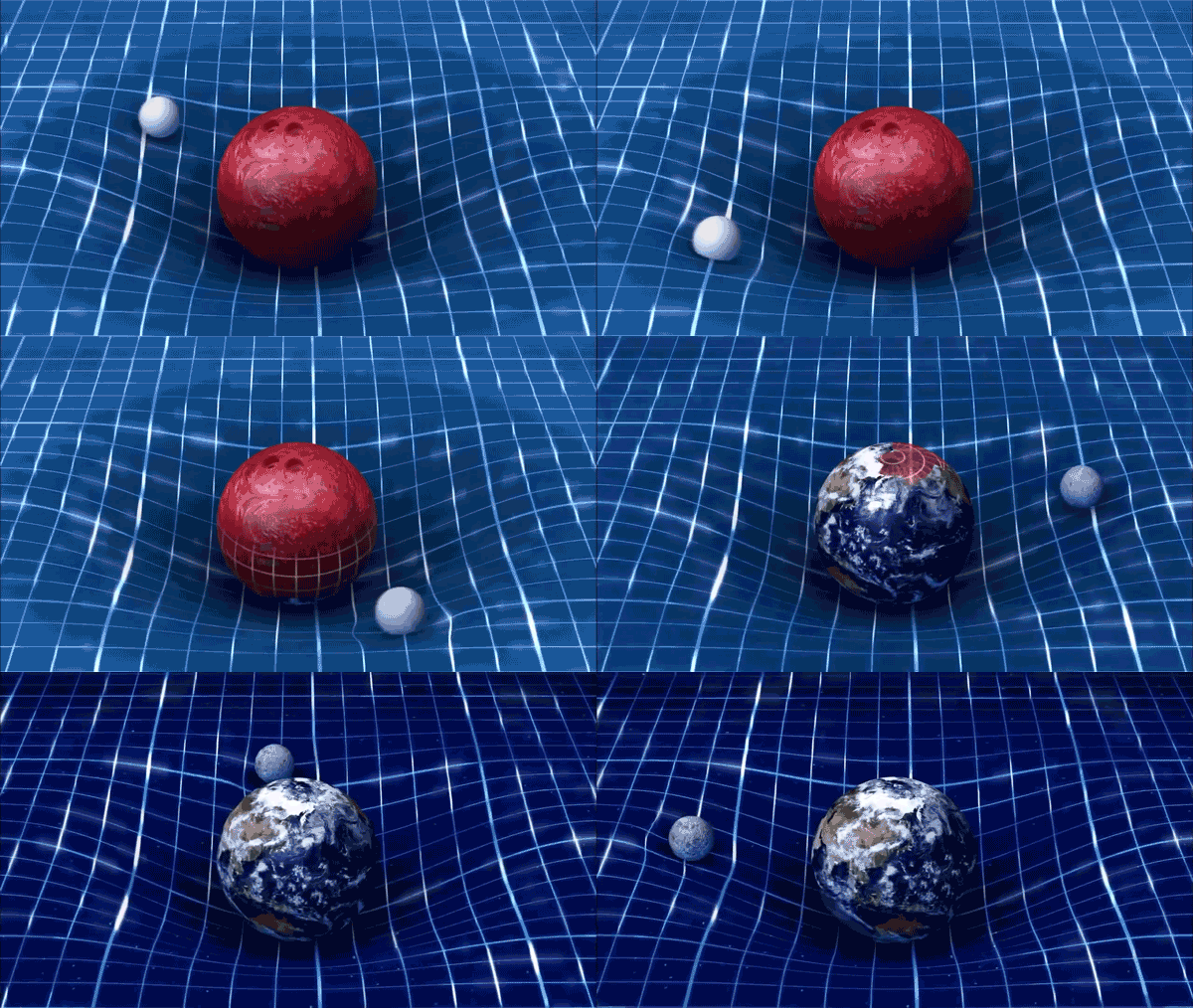
If you’re reading this post, you’ve undoubtedly seen at least one diagram like the above — a black hole or a planet or a bowling ball makes a dent in a rubber sheet and that’s supposed to explain Gravity.  But it doesn’t, and neither does this spirally screen-grab from Brian Greene’s presentation on Stephen Colbert’s Late Show:rubber-sheet waves_post

<Blush> I have to admit that the graphic I used a couple of weeks ago is just as bad.

Gravitational waves don’t make things go up and down like ocean waves, and they’re definitely not like that planet on a trampoline — after all, there’s nothing “below” to pull things downward so there can’t be a dent.  And gravitational waves don’t do spirals, much.

soundwaveOf all the wave varieties we’re familiar with, gravitational waves are most similar to (NOT identical with!!) sound waves.  A sound wave consists of cycles of compression and expansion like you see in this graphic.  Those dots could be particles in a gas (classic “sound waves”) or in a liquid (sonar) or neighboring atoms in a solid (a xylophone or marimba).

Contrary to rumor, there can be sound in space, sort of.  Any sizable volume of “empty” space contains at least a few atoms and dust particles.  A nova or similar sudden event can sweep particles together and give rise to successive waves that spread as those local collections bang into particles further away.  That kind of activity is invoked in some theories of spiral galaxy structure and the fine details of Saturn’s rings.

In a gravitational wave, space itself is compressed and stretched.  A particle caught in a gravitational wave doesn’t get pushed back and forth.  Instead, it shrinks and expands in place.  If you encounter a gravitational wave, you and all your calibrated measurement gear (yardsticks, digital rangers, that slide rule you’re so proud of) shrink and expand together.  You’d only notice the experience if you happened to be comparing two extremely precise laser rangers set perpendicular to each other (LIGO!).  One would briefly register a slight change compared to the other one.

Light always travels at 186,000 miles per second but in a compressed region of space those miles are shorter.  bent lightEinstein noticed that implication of his Theory of General Relativity and in 1916 predicted that the path of starlight would be bent when it passed close to a heavy object like the Sun.  The graphic shows a wave front passing through a static gravitational structure.  Two points on the front each progress at one graph-paper increment per step.  But the increments don’t match so the front as a whole changes direction.  Sure enough, three years after Einstein’s prediction, Eddington observed just that effect while watching a total solar eclipse in the South Atlantic.

Unlike the Sun’s steady field, a gravitational wave is dynamic. Gravitational waves are generated by changes in a mass configuration.  The wave’s compression and stretching forces spread out through space.

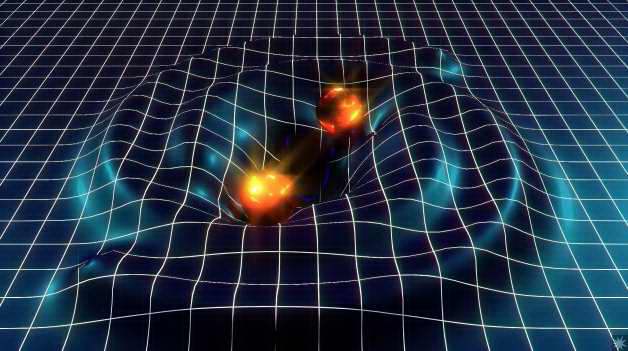
Here’s a simulation of the gravitational forces generated by two black holes orbiting into a collision.  The contours show the net force felt at each point in the region around the pair.
2 black holesWe’re being dynamic here, so the simulation has to include the fact that changes in the mass configuration aren’t felt everywhere instantaneously.  Einstein showed that space transmits gravitational waves at the speed of light, so I used a scaled “speed of light” in the calculation.  You can see how each of the new features expands outward at a steady rate.

Even near the violent end, the massive objects move much more slowly than light speed.  The variation in their nearby field quickly smooths out to an oval and then a circle about the central point, which is why the calculated gravity field generates no spiral like the ones in the pretty pictures.

Oh, and those “gravity well” pictures?  They’re not showing gravitational fields, they’re really gravitational potential energy diagrams, showing how hard it’d be to get away from somewhere.  In the top video, for example, the satellite orbits the planet because it doesn’t have enough kinetic energy to get out of the well.  The more massive the attractor, the tighter it curves space around itself and the deeper the well.

~~ Rich Olcott

Would the CIA want a LIGO?

So I was telling a friend about the LIGO announcement, going on about how this new “device” will lead to a whole new kind of astronomy.  He suddenly got a far-away look in his eyes and said, “I wonder how many of these the CIA has.”

The CIA has a forest of antennas, but none of them can do what LIGO does.  That’s because of the physics of how it works, and what it can and cannot detect.  (If you’re new to this topic, please read last week’s post so you’ll be up to speed on what follows.  Oh, and then come back here.)

There are remarkable parallels between electromagnetism and gravity.  The ancients knew about electrostatics — amber rubbed by a piece of cat fur will attract shreds of dry grass.  They certainly knew about gravity, too.  But it wasn’t until 100 years after Newton wrote his Principia that Priestly and then Coulomb found that the electrostatic force law, F = ke·q1·q2 / r2, has the same form as Newton’s Law of Gravity, F = G·m1·m2 / r2. (F is the force between two bodies whose centers are distance r apart, the q‘s are their charges and the m‘s are their masses.)

Jim and AlAlmost a century later, James Clerk Maxwell (the bearded fellow at left) wrote down his electromagnetism equations that explain how light works.  Half a century later, Einstein did the same for gravity.
But interesting as the parallels may be, there are some fundamental differences between the two forces — fundamental enough that not even Einstein was able to tie the two together.

One difference is in their magnitudes.  Consider, for instance, two protons.  Running the numbers, I found that the gravitational force pulling them together is a factor of 1036 smaller than the electrostatic force pushing them apart.  If a physicist wanted to add up all the forces affecting a particular proton, he’d have to get everything else (nuclear strong force, nuclear weak force, electromagnetic, etc.) nailed down to better than one part in 1036 before he could even detect gravity.

But it’s worse — electromagnetism and gravity don’t even have the same shape.

Electromagneticwave3D
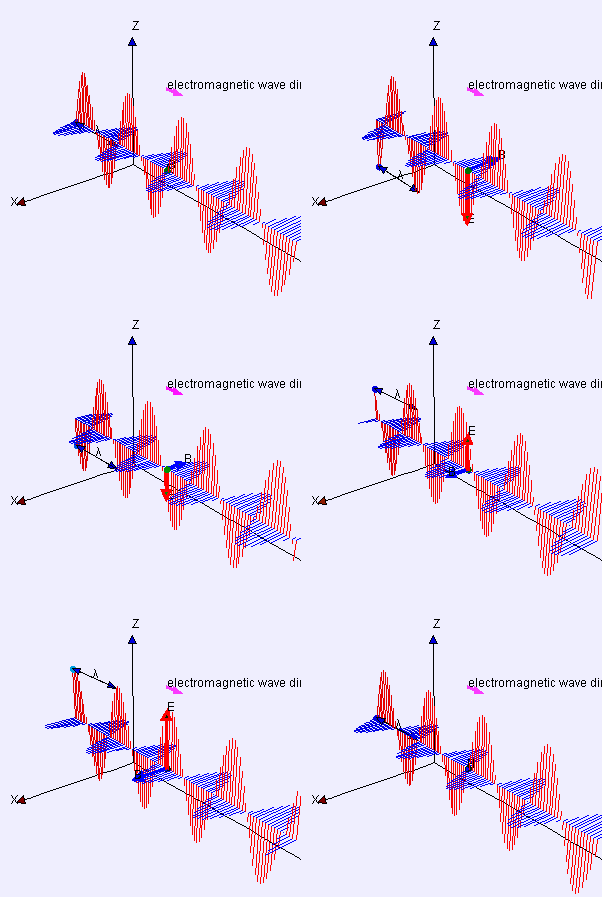
Electric (red) and magnetic (blue) fields in a linearly polarized light wave
(graphic from WikiMedia Commons, posted by Lookang and Fu-Kwun Hwang)

A word first about words.  Electrostatics is about pure straight-line-between-centers (longitudinal) attraction and repulsion — that’s Coulomb’s Law.  Electrodynamics is about the cross-wise (transverse) forces exerted by one moving charged particle on the motion of another one.  Those forces are summarized by combining Maxwell’s Equations with the Lorenz Force Law.  A moving charge gives rise to two distinct forces, electric and magnetic, that operate at right angles to each other.  The combined effect is called electromagnetism.

The effect of the electric force is to vibrate a charge along one direction transverse to the wave.  The magnetic force only affects moving charges; it acts to twist their transverse motion to be perpendicular to the wave.  An EM antenna system works by sensing charge flow as electrons move back and forth under the influence of the electric field.

Gravitostatics uses Newton’s Law to calculate longitudinal gravitational interaction between masses.  That works despite gravity’s relative weakness because all the astronomical bodies we know of appear to be electrically neutral — no electrostatic forces get in the way.  A gravimeter senses the strength of the local gravitostatic field.

Maxwell and EinsteinGravitodynamics is completely unlike electrodynamics.  Gravity’s transverse “force” doesn’t act to move a whole mass up and down like Maxwell’s picture at left.  Instead, as shown by Einstein’s picture, gravitational waves stretch and compress while leaving the center of mass in place. I put “force” in quotes because what’s being stretched and compressed is space itself.  See this video for a helpful visualization of a gravitational wave.

LIGO is neither a telescope nor an electromagnetic antenna.  It operates by detecting sudden drastic changes in the disposition of matter within a “small” region.  In LIGO’s Sept 14 observation, 1031 kilograms of black hole suddenly ceased to exist, converted to gravitational waves that spread throughout the Universe.  By comparison, the Hiroshima explosion released the energy of 10-6 kilograms.

Seismometers do a fine job of detecting nuclear explosions.  Hey, CIA, they’re a lot cheaper than LIGO.

~~ Rich Olcott

LIGO, a new kind of astronomy

Like thousands of physics geeks around the world, I was glued to the tube Thursday morning for the big LIGO (Laser Interferometer Gravitational-Wave Observatory) announcement.  As I watched the for-the-public videos (this is a good one), I was puzzled by one aspect of the LIGO setup.  The de-puzzling explanation spotlit just how different gravitational astronomy will be from what we’re used to.

There are two LIGO installations, 2500 miles apart, one near New Orleans and the other near Seattle.  Each one looks like a big L with steel-pipe arms 4 kilometers long.  By the way, both arms are evacuated to eliminate some sources of interference and a modest theoretical consideration.

LIGO3The experiment consists of shooting laser beams out along both arms, then comparing the returned beams.
Some background: Einstein conquered an apparent relativity paradox.  If Ethel on vehicle A is speeding (like, just shy of light-speed speeding) past Fred on vehicle B, Fred sees that Ethel’s yardstick appears to be shorter than his own yardstick.  Meanwhile, Ethel is quite sure that Fred’s yardstick is the shorter one.

Einstein explained that both observations are valid.  Fred and Ethel can agree with each other but only after each takes proper account of their relative motion.  “Proper account” is a calculation called the Lorenz transformation.   What Fred (for instance) should do is divide what he thinks is the length of Ethel’s yardstick by √[1-(v/c)²] to get her “proper” length.  (Her relative velocity is v, and c is the speed of light.)

Suppose Fred’s standing in the lab and Ethel’s riding a laser beam.  Here’s the puzzle: wouldn’t the same Fred/Ethel logic apply to LIGO?  Wouldn’t the same yardstick distortion affect both the interferometer apparatus and the laser beams?

Well, no, for two reasons.  First, the Lorenz effect doesn’t even apply, because the back-and-forth reflected laser beams are standing waves.  That means nothing is actually traveling.  Put another way, if Ethel rode that light wave she’d be standing as still as Fred.

The other reason is that the experiment is less about distance traveled and more about time of flight.

Suppose you’re one of a pair of photons (no, entanglement doesn’t enter into the game) that simultaneously traverse the interferometer’s beam-splitter mirror.  Your buddy goes down one arm, strikes the far-end mirror and comes back to the detector.  You take the same trip, but use the other arm.

The beam lengths are carefully adjusted so that under normal circumstances, when the two of you reach the detector you’re out of step.   You peak when your buddy troughs and vice-versa.  The waves cancel and the detector sees no light.

Now a gravitational wave passes by (red arcs in the diagram).  In general, the wave will affect the two arms differently.  In the optimal case, the wave front hits one arm broadside but cuts across the perpendicular one.  Suppose the wave is in a space-compression phase when it hits.  The broadside arm, beam AND apparatus, is shortened relative to the other one which barely sees the wave at all.

The local speed of light (miles per second) in a vacuum is constant.  Where space is compressed, the miles per second don’t change but the miles get smaller.  The light wave slows down relative to the uncompressed laboratory reference frame.  As a result, your buddy in the compressed arm takes just a leetle longer than you do to complete his trip to the detector.  Now the two of you are in-step.  The detector sees light, there is great rejoicing and Kip Thorne gets his Nobel Prize.

But the other wonderful thing is, LIGO and neutrino astronomy are humanity’s first fundamentally new ways to investigate our off-planet Universe.  Ever since Galileo trained his crude telescope on Jupiter the astronomers have been using electromagnetic radiation for that purpose – first visible light, then infra-red and radio waves.  In 1964 we added microwave astronomy to the list.  Later on we put up satellites that gave us the UV and gamma-ray skies.

The astronomers have been incredibly ingenious in wringing information out of every photon, but when you look back it’s all photons.  Gravitational astronomy offers a whole new path to new phenomena.  Who knows what we’ll see.

~~ Rich Olcott

Smoke and a mirror

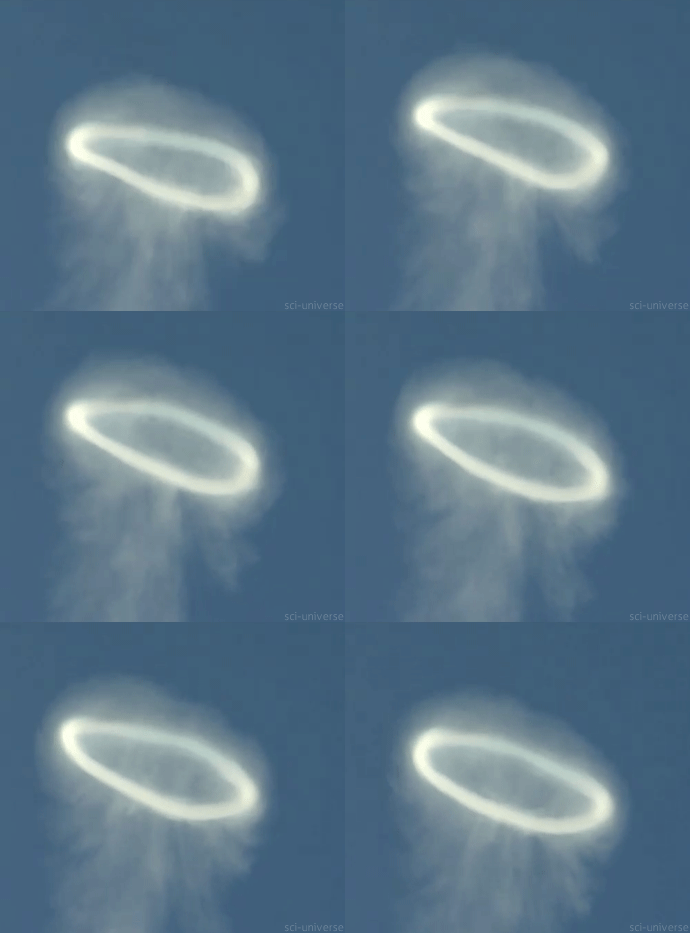
Etna jellyfish pairGrammie always grimaced when Grampie lit up one of his cigars inside the house.  We kids grinned though because he’d soon be blowing smoke rings for us.  Great fun to try poking a finger into the center, but we quickly learned that the ring itself vanished if we touched it.
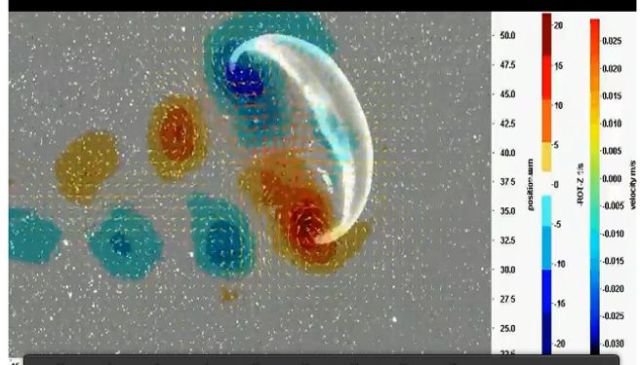
My grandfather can’t take credit for the smoke ring on the left — it was “blown” by Mt Etna.  Looks very like the jellyfish on the right, doesn’t it?  When I see two such similar structures, I always wonder if the resemblance comes from the same physics phenomenon.

This one does — the physics area is Fluid Dynamics, and the phenomenon is a vortex ring. We need to get a little technical and abstract here: to a physicist a fluid is anything that’s composed of particles that don’t have a fixed spatial relationship to each other. Liquid water is a fluid, of course (its molecules can slide past each other) and so is air.  The sun’s ionized protons and electrons comprise a fluid, and so can a mob of people and so can vehicle traffic (if it’s moving at all).  You can use Fluid Dynamics to analyze motion when the individual particles are numerous and small relative to the volume in question.

Ring x-section
Adapted from a NOAA page

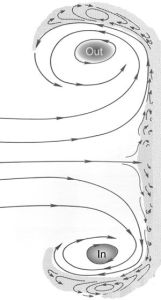
You get a vortex whenever you have two distinct fluids in contact but moving at sufficiently different velocities.  (Remember that “velocity” includes both speed and direction.)  When Grampie let out that little puff of air (with some smoke in it), his fast-moving breath collided with the still air around him.  When the still air didn’t get out of the way, his breath curled back toward him.  The smoke collected in the dark gray areas in this diagram.

That curl is the essence of vorticity and turbulence.  The general underlying rule is “faster curls toward slower,” just like that skater video in my previous post.  Suppose fluid is flowing through a pipe.  Layers next to the outside surface move slowly whereas the bulk material near the center moves quickly.  If the bulk is going fast enough, the speed difference will generate many little whorls against the circumference, converting pump energy to turbulence and heat.  The plant operator might complain about “back pressure” because the fluid isn’t flowing as rapidly as expected from the applied pressure.

But Grampie didn’t puff into a pipe (he’s a cigar man, right?), he puffed into the open air.  Those curls weren’t just at the top and bottom of his breath, they formed a complete circle all around his mouth.  If his puff didn’t come out perfectly straight, the smoke had a twist to it and circulated along that circle, the way Etna’s ring seems to be doing (note the words In and Out buried in the diagram’s gray blobs).  When a vortex closes its loop like that, you’ve got a vortex ring.

A vortex ring is a peculiar beast because it seems to have a life of its own, independent of the surrounding medium.  Grampie’s little puff of vortical air usually retained its integrity and carried its smoke particles for several feet before energy loss or little fingers broke up the circulation.

To show just how special vortex rings are, consider the jellyfish.  Until I ran across this article, I’d thought that jellyfish used jet propulsion like octopuses and squids do — squirt water out one way to move the other way.  Not the case.  Jellyfish do something much more sophisticated, something that makes them possibly “the most energy-efficient animals in the world.”

jellyfish vortices

Thanks to a very nice piece of biophysics detective work (read the paper, it’s cool, no equations), we now know that a jellyfish doesn’t just squirt.  Rather, it relaxes its single ring of muscle tissue to open wide.  That motion pulls in a pre-existing vortex ring that pushes against the bell.  On the power stroke, the jellyfish contracts its bell to push water out (OK, that’s a squirt) and create another vortex ring rolling in the opposite direction.  In effect, the jellyfish continually builds and climbs a ladder of vortex rings.

Vortex rings are encapsulated angular momentum, potentially in play at any size in any medium.

~~ Rich Olcott

The Force(s) of Geometry

There’s a lot more to Geometry than congruent triangles.  Geometry can generate hurricanes and slam you to the floor.

It all starts (of course) with Newton.  His three laws boil down to

Effect is to Cause as Change of Motion is to Force.

They successfully account for the physical movement of pretty much everything bigger than an atom.  But sometimes the forces are a bit weird and it takes Geometry to understand them.

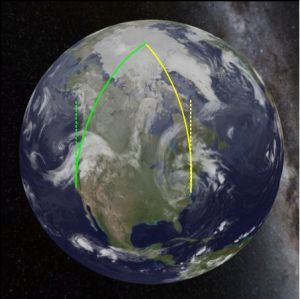
Side forceFor instance, suppose Fred and Ethel collaborate on a narwhale research project.  Fred is based in San Diego CA and Ethel works out of Norfolk VA. They fly to meet their research vessel at the North Pole. Fred’s plane follows the green track, Ethel’s plane follows the yellow one.  At the start of the trip, they’re on parallel paths going straight north (the dotted lines).  After a few hours, though, Ethel notices the two planes pulling closer together.

Ethel calls on her Newton knowledge to explain the phenomenon.  “It can’t be Earth’s gravity moving us together, because that force points down to Earth’s center and this is a sideways motion.  Our planes each weigh about 2000 kilograms and we’re still 2,000 kilometers apart.  By Newton’s F = G m1m2/r2 equation, the gravitational force between us should be (6.7×10⁻¹¹ N m2/kg2) x (2000 kg) x (2000 kg) / (2,000 m)2 = 6.7×10⁻¹¹ newtons, way too small to account for our speed of approach.  Both planes were electrically grounded when we fueled up, so we’re both carrying a neutral electric charge and it can’t be an electrostatic force.  If it were magnetic my compass would be going nuts and it’s not.  Woo-hoo, I’ve discovered a new kind of force!”

See what I did there?  Fred and Ethel would have stayed a constant distance apart if Earth were a cylinder.  Parallel lines running up a cylinder never meet.  But Earth is a sphere, not a cylinder.  Any pair of lines on a sphere must meet, sooner or later.  Ethel’s “sideways force” is a product of Geometry.

Sandy
Images extracted from NOAA’s SOS Explorer app, available from sos.noaa.gov

Hurricanes, too.  This video shows a day in the life of Hurricane Sandy.  Weather geeks will find several interesting details there, but for now just notice the centers of  counter-clockwise rotation (the one off the Florida coast is Sandy).  Storm centers in the Northern Hemisphere virtually always spin counterclockwise.  Funny thing is, in the Southern Hemisphere those centers go clockwise instead.

The difference has to do with angular momentum.  We could get all formal vector math here, but the easy way is to consider how fast the air is moving in different parts of the world.

We’ve all seen at least one ice show act where skaters form a spinning line. The last skater to join up (usually it’s a short girl) has to push like mad to catch the end of that moving line and everyone applauds her success. Meanwhile the tall girl at the center of the line is barely moving except to fend off dizziness.

YellowknifeThe line rotates as a unit — every skater completes a 360o rotation in the same time. Similarly, everywhere on Earth a day lasts for exactly 24 hours.

Skaters at the end of the line must skate faster than those further in because they have to cover a greater distance in the same amount of time.  The same geometry applies to Earth’s atmosphere.  The Earth is 25,000 miles around at the equator but only 12,500 miles around near the latitude of Whitehorse, Canada.  By and large, a blob of air at the equator must move twice as fast as a blob at 60o north.

chain 2Now suppose our speedy skater hits a slushy patch of ice.  Her end of the line is slowed down, so what happens to the rest of the line?  It deforms — there’s a new center of rotation that forces the entire line to curl around towards the slow spot.  Similarly, that blob near the Equator in the split-Earth diagram curls in the direction of the slower-moving air to its north, which is counter-clockwise.

In the Southern hemisphere, “slower” is southward and clockwise.

If not for Geometry (those differing circle sizes), we wouldn’t have hurricanes.  Or gravity — but that’s another story.

~~ Rich Olcott

Sir Isaac, The Atom And The Whirlpool

Newton and atomNewton definitely didn’t see that one coming.  He has an excuse, though.  No-one in in the 17th Century even realized that electricity is a thing, much less that the electrostatic force follows the same inverse-square law that gravity does. So there’s no way poor Isaac would have come up with quantum mechanics.
Lemme ‘splain.  Suppose you have a mathematical model that’s good at predicting some things, like exactly where Jupiter will be next week.  But if the model predicts an infinite value under some circumstances, that tells you it’s time to look for a new model for those particular circumstances.

For example, Newton’s Law of Gravity says that the force between two objects is proportional to 1/r2, where r is the distance between their centers of mass.  The Law does a marvelous job with stars and satellites but does the infinity thing when r approaches zero.  In prior posts I’ve described some physics models that supercede Newton’s gravity law at close distances.

Electrical forces are same song second verse with a coda.  They follow the 1/r2 law, so they also have those infinity singularities.  According to the force law, an electron (the ultimate “particle” of negative charge) that approaches another electron would feel a repulsion that rises to infinity.  The coda is that as an electron approaches a positive atomic nucleus it would feel an attraction that rises to infinity.  Nature abhors infinities, so something else, some new physics, must come into play.

I put that word “particle” in quotes because common as the electron-is-a-particle notion is, it leads us astray.  We tend to think of the electron as this teeny little billiard-ballish thing, but it’s not like that at all.  It’s also not a wave, although it sometimes acts like one.  “Wavicle” is just  a weasel-word.  It’s far better to think of the electron as just a little traveling parcel of energy.  Photons, too, and all those other denizens of the sub-atomic zoo.

An electron can’t crumble or leak mass or deform to merge the way that sizable objects can.  What it does is smear. Quantum mechanics is all about the smear.  Much more about that in later posts.


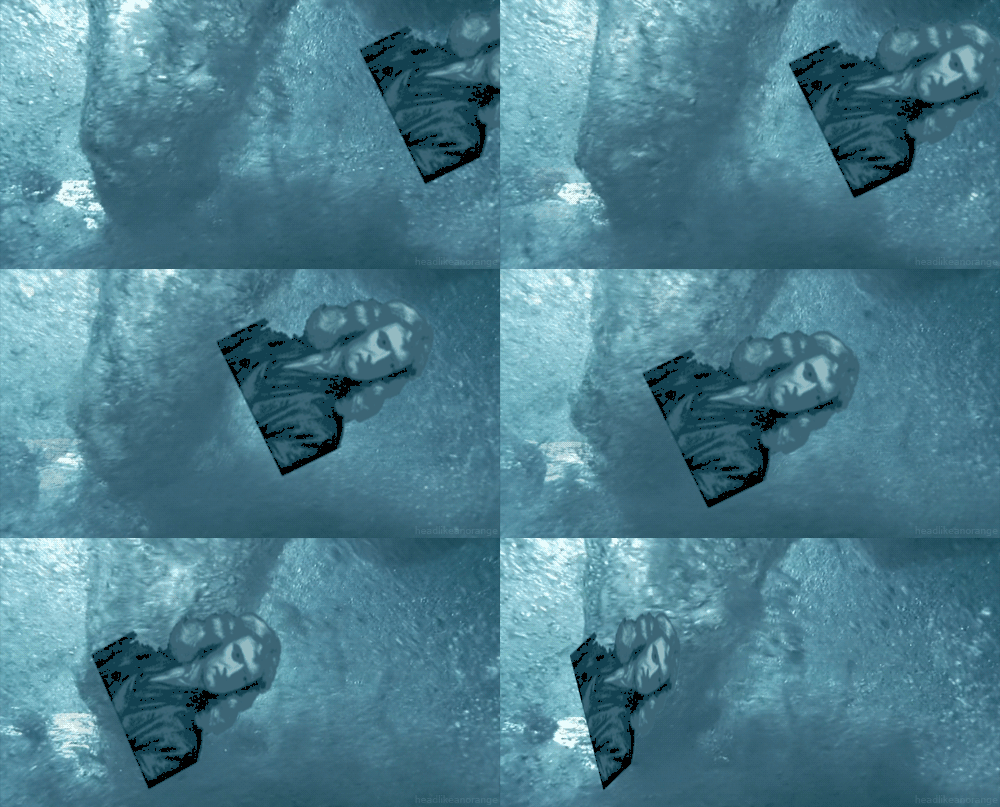
Newton in whirlpoolIf Newton loved anything (and that question has been discussed at length), he loved an argument.  His battle with Leibniz is legendary.  He even fought with Descartes, who was a decade dead when Newton entered Cambridge.

Descartes had grabbed “Nature abhors a vacuum” from Aristotle and never let it go.  He insisted that the Universe must be filled with some sort of water-like fluid.  He know the planets went round the Sun despite the fluid getting in the way, so he reasoned they moved as they did because of the fluid.

Surely you once played with toy boats in the bathtub.  You may have noticed that when you pulled your arm quickly through the water little whirlpools followed your arm.  If a whirlpool encountered a very small boat, the boat might get caught in it and move in the same direction.  Descartes held that the Solar System worked like that, with the Sun as your arm and the planets caught in Sun-stirred vortices within that watery fluid.

Newton knew that couldn’t be right.  The planets don’t run behind the Sun, they share the same plane.  Furthermore, comets orbit in from all directions.  Crucially, Descartes’ theory conflicted with his own and that settled the matter for Newton.  Much of Principia‘s “Book II” is about motions of and through fluid media.  He laid out there what a trajectory would look like under a variety of conditions.  As you’d expect, none of the paths do what planets, moons and comets do.

From Newton’s point of view, the only use for Book II was to demolish Descartes.  For us in later generations, though, he’d invented the science of hydrodynamics.

Which was a good thing so long as you don’t go too far upstream towards the center of the whirlpool.  As you might expect (or I wouldn’t even be writing this section), Book II is littered with 1/rn formulas that go BLOOIE when the distances get short.  What happens near the center?  That’s where the new physics of turbulence kicks in.

~~ Rich Olcott

Squeezing past Newton’s infinity

One of the most powerful moments in musical theater — Philip Quast Quastin his Les Miz role of Inspector Javert, praising the stars for the steadfastness and reverence for law that they signify for him.  The performance is well worth a listen.

Javert’s certitude came from Newton’s sublimely reliable mechanics — the notion that every star’s and planet’s motion is controlled by a single law, F~(1/r2).  The law says that the attractive force between any pair of bodies is inversely proportional to the square of the distance between their centers.  But as Javert’s steel-clad resolve hid a fatal spark of mercy towards Jean Valjean, so Newton’s clockworks hold catastrophe at their axles.

Newton’s gravity law has a problem.  As the distance approaches zero, the predicted force approaches infinity.  The law demands that nearby objects accelerate relentlessly at each other to collide with infinite force, after which their combined mass attracts other objects.  In time, everything must collapse in a reverse of The Big Bang.

Victor Hugo wrote Les Misérables about 180 years after Newton published his Principia.  A decade before Hugo’s book, Professeur Édouard Roche (pronounced rōsh) solved at least part of Newton’s problem.

Roche realized that Newton had made an important but crucial simplification.  Early in the Principia, he’d proven that for many purposes you can treat an entire object as though all of its mass were concentrated at a single point (the “center of mass”).  But in real gravity problems every particle of one object exerts an attraction for every particle of the other.

That distinction makes no difference when the two objects are far apart.  However, when they’re close together there are actually two opposing forces in play:

  • gravity, which preferentially affects the closest particles, and
  • tension, which maintains the integrity of each structure.
contact_binary_1
Binary star pair demonstrating Roche lobes, image courtesy of Cronodon.com

Roche noted that the gravity fields of any pair of objects must overlap.  There will always be a point on the line between them where a particle will be tugged equally in either direction.  If two bodies are close and one or both are fluid (gases and plasmas are fluid in this sense), the tension force is a weak competitor.  The partner with the less intense gravity field will lose material across that bridge to the other partner. Binary star systems often evolve by draining rather than collision.

Now suppose both bodies are solid.  Tension’s game is much stronger.  Nonetheless, as they approach each other gravity will eventually start ripping chunks off of one or both objects.  The only question is the size of the chunks — friable materials like ices will probably yield small flakes, as opposed to larger lumps made from silicates and other rocky materials.  Roche described the final stage of the process, where the less-massive body shatters completely.  The famous rings of Saturn and the less famous rings of Neptune, Uranus and Jupiter all appear to have been formed by this mechanism.

Roche was even able to calculate how close the bodies need to be for that final stage to occur. The threshold, now called the Roche Limit, depends on the size and mass of each body. You can get more detail here.

Klingon3And then there’s spaghettification.  That’s a non-relativistic tidal phenomenon that occurs near an extremely dense body like a neutron star or a black hole.  Because these objects pack an enormous amount of mass into a very small volume, the force of gravity at a close-in point is significantly greater than the force just a little bit further out. Any object, say a Klingon Warbird that ignored peril markings on a space map (Klingons view warnings as personal challenges), would find itself stretched like a noodle between high gravity on the side near the black hole and lower gravity on the opposite side.  (In this cartoon, notice how the stretching doesn’t care which way the pin-wheeling ship is pointed.)

Nature abhors singularities.  Where a mathematical model like Newton’s gravity law predicts an infinity, Nature generally says, “You forgot something.”  Newton assumed that objects collide as coherent units.  Real bodies drain, crumble, or deform to slide together.  Look to the apparent singularities to find new physics.

~~ Rich Olcott

The direction Newton avoided facing

Reading Newton’s Philosophiæ Naturalis Principia Mathematica is less challenging than listening to Vogon poetry.  You just have to get your head working like a 17th Century genius who had just invented Calculus and who would have deep-fried his right arm in rancid skunk oil before he’d admit to using any of his rival Leibniz’ math notations or techniques.

Newton II-II ellipseNewton was essentially a geometer. These illustrations (from Book 1 of the Principia) will give you an idea of his style.  He’d set himself a problem then solve it by constructing sometimes elaborate diagrams by which he could prove that certain components were equal or in strict proportion.

Newton XII-VII hyperbolaFor instance, in the first diagram (Proposition II, Theorem II), we see an initial glimpse of his technique of successive approximation.  He defines a sequence of triangles which as they proliferate get closer and closer to the curve he wants to characterize.

The lines and trig functions escalate in the second diagram (Prop XII, Problem VII), where he calculates the force  on a body traveling along a hyperbola.

Newton XLIV-XIV precessionThe third diagram is particularly relevant to the point I’ll finally get to when I get around to it.  In Prop XLIV, Theorem XIV he demonstrates something weird.  Suppose two objects A and B are orbiting around attractive center C, but B is moving twice as fast as A.  If C exerts an additional force on B that is inversely dependent on the cube of the B-C distance, then A‘s orbit will be a perfect circle (yawn) but B‘s will be an ellipse that rotates around C, even though no external force pushes it laterally.
In modern-day math we’d write the additional force as F∼(1/rBC3), but Newton verbalized it as “in a triplicate ratio of their common altitudes inversely.”  See what I mean about Vogon poetry?

Now, about that point I was going to get to.  It’s C, in the center of that circle.  If the force is proportional to 1/r3, what happens when r approaches zero?  BLOOIE, the force becomes infinite.

In the previous post we used geometry to understand the optical singularity at the center of the Christmas ball.  I said there that my modeling project showed me a deeper reason for a BLOOIE.  That reason showed up partway through the calculation for the angle between the axis and the ring of reflected  light.  A certain ratio came out to be (1-x)/2x, where x is proportional to the distance between the LED and the ball’s center.  Same problem: as the LED approaches the center, x approaches zero and BLOOIE.  (No problem when x is one, because the ratio is 0/2 which is zero which is OK.)

Singularities happen when the formula for something goes to infinity.

Now, Newton recognized that his central-force (1/rn)-type equations covered gravity and magnetism and even the inward force on the rim of a rotating wheel.  It’s surprising that he didn’t seem too worried about BLOOIE.

I think he had two excuses.  First, he was limited by his graphical methodology.  In most of his constructions, when a certain distance goes to zero there’s a general catastrophe — rectangles and triangles collapse to lines or even points, radii whirl aimlessly without a vertex to aim at…  His lovely derivations devolve into meaninglessness.  Further advances would depend on the  algebraic approach to Calculus taken by the detested Leibniz.

Second (here’s the hook for this post’s title), Newton was looking outward, not inward.  He was considering the orbits of planets and other sizable objects.  r is always the distance between object centers.  For sizable objects you don’t have to worry about r=0 because “center-to-center equals zero” never occurs.  If the Moon (radius 1080 miles) were to drop down to touch the Earth (radius 3960 miles), their centers would still be 5000 miles apart.  No BLOOIE.

Actually, there would be CRUMBLE instead of BLOOIE because a different physical model would apply — but that’s a tale for another post.

The moral of the story is this.  Mathematical models don’t care about infinities, but Nature does.  Any conditions where the math predicts an infinite value (for instance, where a denominator can become zero) are prime territory for new models that make better predictions.

~~ Rich Olcott

And now for some completely different dimensions

Terry Pratchett wrote that Knowledge = Power = Energy = Matter = Mass.  Physicists don’t agree because the units don’t match up.

Physicists check equations with a powerful technique called “Dimensional Analysis,” but it’s only theoretically related to the “travel in space and time” kinds of dimension we discussed earlier.

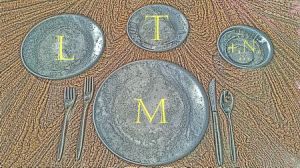
Place setting LMTIt all started with Newton’s mechanics, his study of how objects affect the motion of other objects.  His vocabulary list included words like force, momentum, velocity, acceleration, mass, …, all concepts that seem familiar to us but which Newton either originated or fundamentally re-defined. As time went on, other thinkers added more terms like power, energy and action.
They’re all linked mathematically by various equations, but also by three fundamental dimensions: length (L), time (T) and mass (M). (There are a few others, like electric charge and temperature, that apply to problems outside of mechanics proper.)

Velocity, for example.  (Strictly speaking, velocity is speed in a particular direction but here we’re just concerned with its magnitude.)   You can measure it in miles per hour or millimeters per second or parsecs per millennium — in each case it’s length per time.  Velocity’s dimension expression is L/T no matter what units you use.

Momentum is the product of mass and velocity.  A 6,000-lb Escalade SUV doing 60 miles an hour has twice the momentum of a 3,000-lb compact car traveling at the same speed.  (Insurance companies are well aware of that fact and charge accordingly.)  In terms of dimensions, momentum is M*(L/T) = ML/T.

Acceleration is how rapidly velocity changes — a car clocked at “zero to 60 in 6 seconds” accelerated an average of 10 miles per hour per second.  Time’s in the denominator twice (who cares what the units are?), so the dimensional expression for acceleration is L/T2.

Physicists and chemists and engineers pay attention to these dimensional expressions because they have to match up across an equal sign.  Everyone knows Einstein’s equation, E = mc2. The c is the velocity of light.  As a velocity its dimension expression is L/T.  Therefore, the expression for energy must be M*(L/T)2 = ML2/T2.  See how easy?

Now things get more interesting.  Newton’s original Second Law calculated force on an object by how rapidly its momentum changed: (ML/T)/T.  Later on (possibly influenced by his feud with Leibniz about who invented calculus), he changed that to mass times acceleration M*(L/T2).  Conceptually they’re different but dimensionally they’re identical — both expressions for force work out to ML/T2.

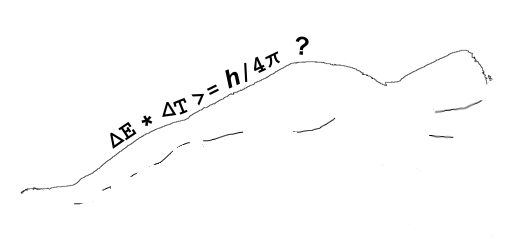
Something seductively similar seems to apply to Heisenberg’s Area.  As we’ve seen, it’s the product of uncertainties in position (L) and momentum (ML/T) so the Area’s dimension expression works out to L*(ML/T) = ML2/T.

SeductiveThere is another way to get the same dimension expression but things aren’t not as nice there as they look at first glance.  Action is given by the amount of energy expended in a given time interval, times the length of that interval.  If you take the product of energy and time the dimensions work out as (ML2/T2)*T = ML2/T, just like Heisenberg’s Area.

It’s so tempting to think that energy and time negotiate precision like position and momentum do.  But they don’t.  In quantum mechanics, time is a driver, not a result.  If you tell me when an event happens (the t-coordinate), I can maybe calculate its energy and such.  But if you tell me the energy, I can’t give you a time when it’ll happen.  The situation reminds me of geologists trying to predict an earthquake.  They’ve got lots of statistics on tremor size distribution and can even give you average time between tremors of a certain size, but when will the next one hit?  Lord only knows.

File the detailed reasoning under “Arcane” — in technicalese, there are operators for position, momentum and energy but there’s no operator for time.  If you’re curious, John Baez’s paper has all the details.  Be warned, it contains equations!

Trust me — if you’ve spent a couple of days going through a long derivation, totting up the dimensions on either side of equations along the way is a great technique for reassuring yourself that you probably didn’t do something stupid back at hour 14.  Or maybe to detect that you did.

~~ Rich Olcott