The Music of The Spherical Harmonics

Eddie’s diner serves tasty pizza, but his music playlist’s tasty, too — heavy with small-group vocals.  We’re talking atomic structure but suddenly Vinnie surprises me.  “Whoa, she’s got a hot voice!”

“Who?”

“That girl who’s singing.”

“Which one?  That’s a quartet.”

“The alto.”

“How can you pick one voice out of that close-harmony performance?”

“By listening!  She’s the only one singing those notes.”

“You’re hearing a chaotic sound wave yet you can pick out just one sound.”

“Yeah, just her special notes.”

“Interesting thing is, atoms do that, too.  Think about, say, a uranium atom, 92 electrons attracted by the nucleus, repelled by every other electron, all dashing about in the nuclear field and getting in each other’s way.  Think that’d be a nice, orderly picture?”

“Sure not.  It’d be, like you say, chaotic.”

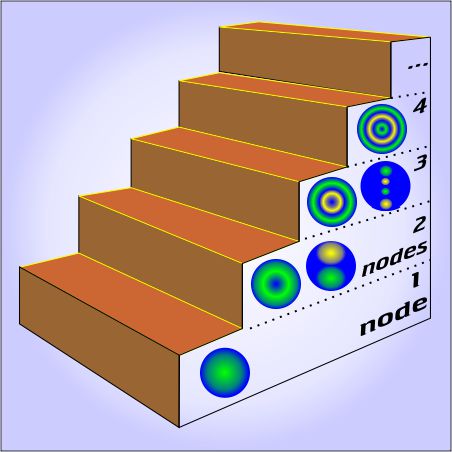
“But just like we can describe a messy sound wave as a combination of frequencies, we can describe that atom’s electron structure as a combination of basic patterns.”  I pull Old Reliable from its holster and bring up an image.  “Here’s something I built for a presentation.  It’s a little busy so I’ll walk you through it.”Shell levels

“Busy, uh-huh.”

“Start with those blue circles.  They look familiar?”

“Right, they’re Laplace’s spherical patterns.  You got them sorted by how many blue spaces they got.”

“Yup.  Blue represents a node, a 2-D region where the value touches or crosses zero.  There are patterns with three or more nodes, but I ran out of space and patience to draw them.  Laplace showed there’s an infinite number of candidate patterns as you add more and more nodes.  You can describe any physically reasonable distribution around the central point as some combination of his patterns.”

“Why’d you draw them on stair-steps?”

“Because each step (we call it a shell) is at a different potential energy level.  Suppose, for instance, that there’s charge in that one-node pattern.  Moving it away from the nucleus puts a node there.  That’ll cost some energy and shift charge to the two-node shell.  To exclude it from there and also from another node, say a larger spherical surface, would take even more energy, and so on.”

“How is that potential energy?”

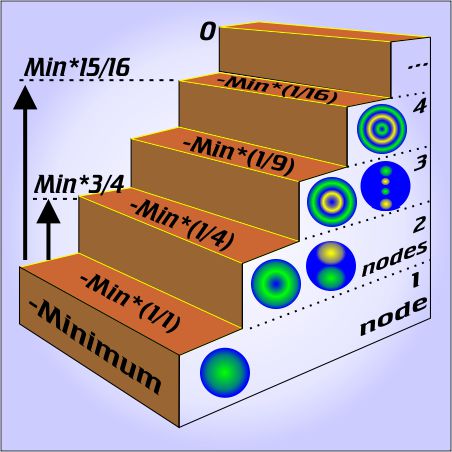
“We’re comparing shell energy to the energy of an electron that’s far away.  It’s like gravitational potential energy, maybe the energy a space rock converts to kinetic energy as it falls to Earth.  Call the far-away energy zero.  The numbers get more and more negative as the rock or the charge get closer to the center of attraction.”

“Ah, so that’s why you’ve got minus signs in the picture.”

“Exactly.  See zero at the top of the stairs?  With a hydrogen atom, for instance, an electron would give up 13.6 electron-volts of energy to get close to the nucleus in that 1-node pattern.  Conversely, it’d take 13.6 eV to rip that charge completely away.”

“If the 13.6 is what you’re calling ‘Minimum’, why not just write ‘–13.6’ in there?”

“It’s a different number for different atoms and even ions.  Astronomers see all kinds of ions with every amount of charge so they have to keep things general in their calculations.”

“What are those fractions about?  Wait, don’t tell me, I can figure this.  Each divisor is the square of its node count.  Are those the 1/n² numbers from whosit’s formula?”

Rydberg’s.  You’re on the right track, keep going.”

“If the minimum is 13.6 eV, the diagram says that the two-node shell is … 3.4 eV down from the top and … 10.2 eV up from the bottom.  And from what we said about the hydrogen spectrum, I’ll bet that 10.2 eV jump is the first line in that, was it the Ly series, the one in the ultra-violet?”

“Bravo, Vinnie!  The Lyman series it is.  Excellent memory for detail there.”

“I noticed something else.  You carefully didn’t say we moved an electron between shells.”

“That’s an important point.  At the atomic size scale we can’t treat the electron as a particle moving around.  Lightwaves act to turn off one shell and excite another one, like your singer exciting a different note.”

“Yes, she does.”

~~ Rich Olcott

  • Thanks to the Molnars for a delightful meal, and to their dinner party guests the Jumps for instigating this post.

Shells A-poppin’

We step into Eddie’s.  Vinnie spots Jeremy behind the gelato stand.  “Hey, kid, you studying something Science-y?”

“Yessir, my geology text.”

“Lemme see it a sec, OK?”

“Sure.  Want a gelato?”

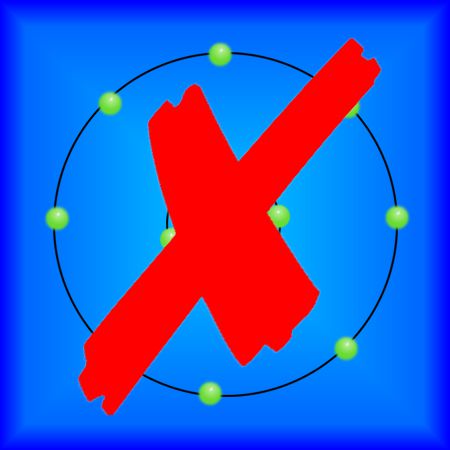
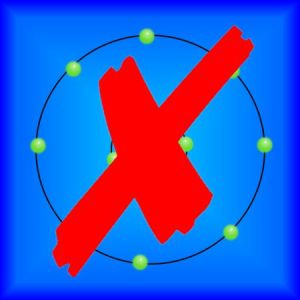
“Yeah, gimme a pistachio, double-dip.  I’ll hold your book while you’re doing that.  Ah-hah, Sy, lookie here, page 37 — new textbook but this atom diagram coulda come right out of that 1912 Bohr paper you don’t like.  See, eight dots in a ring around the nucleus.  Can’t be wrong or it wouldn’t have survived this long, right?”

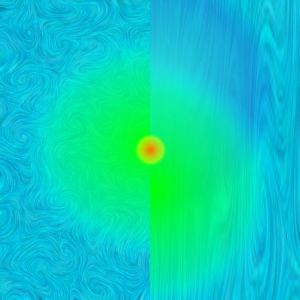
<sigh>  “What it is isn’t what it was.  Bohr proposed his model as a way to explain atomic spectra.  We’ve got a much better model now — but the two agree on three points.  Atoms organize their electronic charge in concentric shells, innermost shells deepest in the nuclear energy well.  Second, each shell has a limited capacity.  Third, when charge moves from one shell to another, light energy is absorbed or emitted to match the energy difference between shells.  Beyond those, not much.  Here, this diagram hints at the differences.”Better Bohr

“The scrambled-looking half is the new picture?”

“Pure chaos, where the only thing you can be sure of is the averages.  These days the Bohr model survives as just an accounting device to keep track of how much charge is in each shell.  That diagram — what kind of atom is it describing?”

“I dunno, two electrons inside, eight outside, ten total.”

“Could be neon, or a fluoride, oxide, sodium or magnesium ion.  From a quantum perspective they all look the same.”

“Here’s your gelato, sir.”

“Thanks, kid, here’s your book back.  But those are different elements, Sy.”

“The important thing, Vinnie, is they all have an outer shell with eight units of charge.  That’s the most stable configuration.”

“What’s so special about eight, Mr Moire?  If it’s pure chaos shouldn’t any number be OK?”

“Like I said, Jeremy, it’s the averages that count.  Actually, this is one of my favorite examples of what Wigner called ‘The Unreasonable Effectiveness of Mathematics in the Natural Sciences.’  Back in 1782, a century and a quarter before anyone took atoms seriously, Laplace did some interesting math.  Have you ever waited for a pot of water to boil and spent the time tapping the pot to see the ripples?”

“Who hasn’t?  Doesn’t boil any faster, though.”

“True.  Looking at those waves, you saw patterns you don’t see with flat reflectors, right?”

“Oh, yeah — some like dumbbells, a lot of circles.”

“Mm-hm.  In a completely random situation all possible patterns could appear, but the pot’s circular boundary suppresses everything except wave patterns that match its symmetry.  You don’t see hexagons, for instance.”

“That’s right, I didn’t.”

“So there’s Laplace in the 1790s, thinking about Newton’s Law of Gravity, and he realizes that even in the boundaryless Solar System there’s still a boundary condition — any well-behaved standing wave has to have the same value at the central point no matter what direction you come from.  He worked out all the possible stable patterns that could exist in a central field like that.  Some of them look like what you saw in the water.  We now classify them by symmetry and node count.”

“Node?”Disk orbitals

“A region where the pattern hits zero, Vinnie.  Density waves range from zero to some positive value; other kinds range from positive to negative values.  A spherical wave could peak at the center and then go to zero infinitely far away.  One node.  Or it could be zero at the center, peak in a spherical shell some distance out and then fade away.  That’d be two nodes.  Or it could be zero at the center, zero far away, and have two peaks at different distances with a spherical third node in between.  Here’s another two-node pattern — that dumbbell shape with nodes at the center and infinity.  You can add radial nodes partway out.”

“I’m getting the picture.”

“Sure.  You might think Laplace’s patterns are just pretty pictures, but electron charge in atoms and ions just happens to collect in exactly those patterns.  Combine Laplace’s one-node and two-node patterns, you get the two lowest-energy stable shells.  They hold exactly ten charge units.  The energies are right, too.  Effective?”

“Unreasonably.”

~~ Rich Olcott

Prelude to A Shell Game

Big Vinnie barrels into the office.  “Hey, Sy, word is that you’ve been trash-talking Niels Bohr.  What’s the story?”

“Nothing against Bohr, Vinnie, he was a smart guy who ran a numbers game out of C-town —”

“Which C-town, Cincy or Cleveland?”

“Copenhagen.  But he got caught short at payoff time.  Trouble is, some people still think the game’s good which it’s not.”

Hydrogen spectrum
Hydrogen spectrum, adapted from work by Caitlin Jo Ramsey
(CC BY-SA 3.0)
via Wikimedia Commons

“Which numbers game was this — policy, mutuale, bolita?”

“Rydberg.”

“Never heard of that one.”

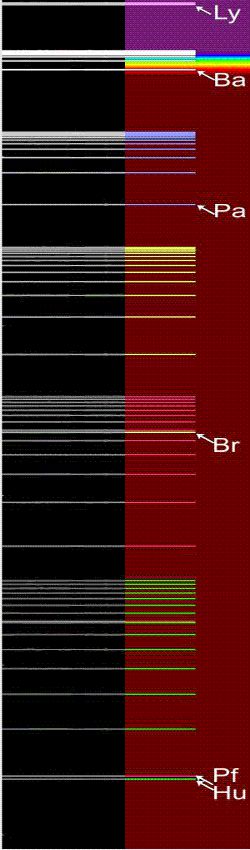
“Rydberg was a Swedish physicist in the late 1800s.  He systemized a pile of lab and astronomy data about how hydrogen gas interacts with light.  Physicists like Lyman and Balmer showed how hydrogen’s complicated pattern (the white lines on black on this diagram) could be broken down to subsets that all have a similar shape (the colored lines).  Rydberg found a remarkably simple formula that worked for all the subsets.  Pick a line, measure its waves per meter. There’ll be a pair of numbers n1 and n2 such that the wave count is given by  Rydberg equationZ is the nuclear charge, which they’d just figured out how to measure, and R is a constant.  Funny how it just happens to be Rydberg’s initial.”
“Any numbers?”

“Small whole numbers, like 1, 2, up to 20 or so.  Each subset has the same n1 and a range of values for n2. The Lyman series, for instance, is based on n1=1, so you’ve got 1/1–1/4=3/4, 1/1–1/9=8/9, 15/16, 24/25, and so on. See how the fractions get closer together just like those lines do?”

“Nice, but why does it work out that way?”

“Excellent question, but no-one had an answer to that for 25 years until Bohr came up with his model.  Which on the one hand was genius and on the other was so bogus I can’t believe it’s still taught in schools.”

“So what did he say?”

“He suggested that an atom is structured like a solar system, planar, with electrons circling a central nucleus like little planets in their orbits. Unlike our Solar System, multiple electrons could share an orbit, chasing each other around a ring.  The 1/n² numbers are the energies of the different orbits, from n=1 outwards.  An electron in a close-in orbit would be tightly held by the nuclear electrical field; not so much for electrons further out.”

“Yeah, that sounds like what they taught us, alright.”

“Bohr then proposed that an incoming lightwave (he didn’t believe in photons) energizes an electron, moves it to a further-out orbit.  Conversely, a far-away electron can fall inward, emitting energy in the form of a lightwave.  Either way, the amount of energy in the lightwave depends only on the (1/n1²–1/n2²) energy difference between the two orbits.  The lightwave’s energy shows up in that wave number — more energy means more waves per meter and bluer light.”

“Ah, so that Ly series with n1=1 is from electrons falling all the way to the lowest-energy orbit and that’s why it’s all up in the … is that ultra-violet?”

“Yup, and you got it.  The Balmer series is the one with four lines in the visible.”

“Uhh… why wouldn’t everything just fall into the middle?”

“Bohr said each orbit would have a capacity limit, beyond which the ring would crinkle and eject surplus electrons.  He worked out limits for the first half-dozen elements but then things get fuzzy, with rings maybe colliding and swapping places.  Not satisfactory for predictions.  Worse, the physics just doesn’t work for his basic model.”No Bohr

“Really?  Bohr was a world-class physicist.”

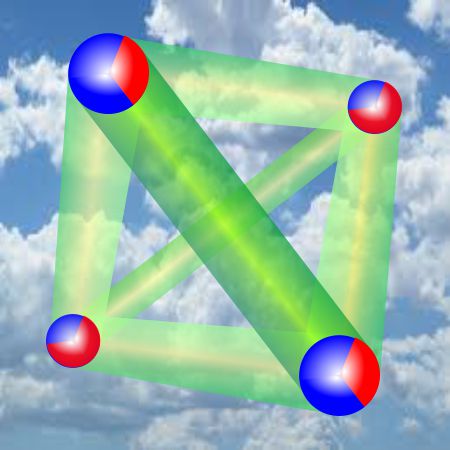
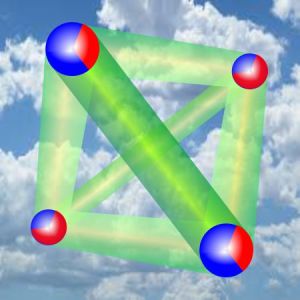
“This was early days for atomic physics and people were still learning what to think about.  The Solar System is flat, more or less, so Bohr came up with a flat model.  But electrons repel each other.  They wouldn’t stay in a ring, they’d pop out to the corners of a regular figure like a tetrahedron or a cube.  That’d blow all his numbers.  The breaker payout, though, is his orbiting electrons must continually radiate lightwaves but don’t have an energy source for that.”

“Was he right about anything?”

“The model’s only correct notion was that lightwaves participate in shell transitions.  Schools should teach shells, not orbits.”

~~ Rich Olcott

Gravity from Another Perspective

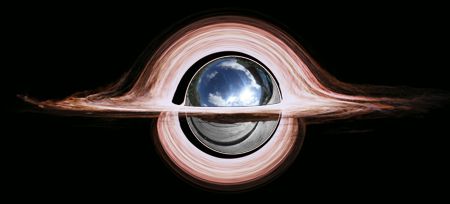
“OK, we’re looking at that robot next to the black hole and he looks smaller to us because of space compression down there.  I get that.  But when the robot looks back at us do we look bigger?”

We’re walking off a couple of Eddie’s large pizzas.  “Sorry, Mr Feder, it’s not that simple.  Multiple effects are in play but only two are magnifiers.”

“What isn’t?”

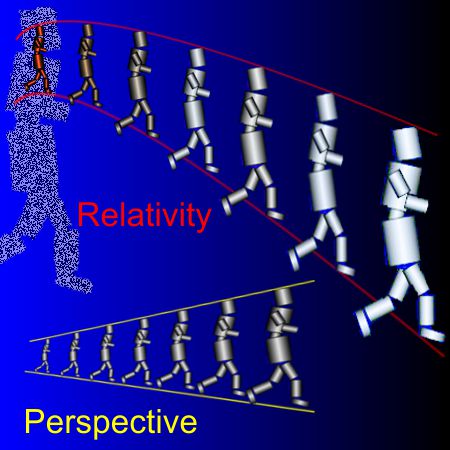
“Perspective for one.  That works the same in both directions — the image of an object shrinks in direct proportion to how far away it is.  Relativity has nothing to do with that principle.”

“That makes sense, but we’re talking black holes.  What does relativity do?”

“Several things, but it’s complicated.”

“Of course it is.”

“OK, you know the difference between General and Special Relativity?”

“Yeah, right, we learned that in kindergarten.  C’mon.”

“Well, the short story is that General Relativity effects depend on where you are and Special Relativity effects depend on how fast you’re going.  GR says that the scale of space is compressed near a massive object.  That’s the effect that makes our survey robot appear to shrink as it approaches a black hole.  GR leaves the scale of our space larger than the robot’s.  Robot looks back at us, factors out the effect of perspective, and reports that we appear to have grown.  But there’s the color thing, too.”

“Color thing?”

“Think about two photons, say 700-nanometer red light, emitted by some star on the other side of our black hole.  One photon slides past it.  We detect that one as red light.  The other photon hits our robot’s photosensor down in the gravity well.  What color does the robot see?”

“It’s not red, ’cause otherwise you wouldn’t’ve asked me the question.”

“Check.”

“Robot’s down there where space is compressed…  Does the lightwave get compressed, too?”

“Yup.  It’s called gravitational blue shift.  Like anything else, a photon heading towards a massive object loses gravitational potential energy.  Rocks and such make up for that loss by speeding up and gaining kinetic energy.  Light’s already at the speed limit so to keep the accounts balanced the photon’s own energy increases — its wavelength gets shorter and the color shifts blue-ward.  Depending on where the robot is, that once-red photon could look green or blue or even X-ray-colored.”

“So the robot sees us bigger and blue-ish like.”Robots and perspective and relativity 2“But GR’s not the only player.  Special Relativity’s in there, too.”

“Maybe our robot’s standing still.”

“Can’t, once it gets close enough.  Inside about 1½ diameters there’s no stable orbit around the black hole, and of course inside the event horizon anything not disintegrated will be irresistibly drawn inward at ever-increasing velocity.  Sooner or later, our poor robot is going to be moving at near lightspeed.”

“Which is when Special Relativity gets into the game?”

“Mm-hm.  Suppose we’ve sent in a whole parade of robots and somehow they maintain position in an arc so that they’re all in view of the lead robot.  The leader, we’ll call it RP-73, is deepest in the gravity well and falling just shy of lightspeed.  Gravity’s weaker further out — trailing followers fall slower.  When RP-73 looks back, what will it see?”

“Leaving aside the perspective and GR effects?  I dunno, you tell me.”

“Well, we’ve got another flavor of red-shift/blue-shift.  Speedy RP-73 records a stretched-out version of lightwaves coming from its slower-falling followers, so so it sees their colors shifted towards the red, just the opposite of the GR effect.  Then there’s dimming — the robots in the back are sending out n photons per second but because of the speed difference, their arrival rate at RP-73 is lower.  But the most interesting effect is relativistic aberration.”

“OK, I’ll bite.”

“Start off by having RP-73 look forward.  Going super-fast, it intercepts more oncoming photons than it would standing still.”

“Bet they look blue to it, and really bright.”

“Right on.  In fact, its whole field of view contracts towards its line of flight.  The angular distortion continues all the way around.  Rearward objects appear to swell.”

“So yeah, we’d look bigger.”

“And redder.  If RP-73 is falling fast enough.”

~~ Rich Olcott

  • Thanks to Timothy Heyer for the question that inspired this post.

A Perspective on Gravity

“I got another question, Moire.”

“Of course you do, Mr Feder.”

“When someone’s far away they look smaller, right, and when someone’s standing near a black hole they look smaller, too.  How’s the black hole any different?”

“The short answer is, perspective depends on the distance between the object and you, but space compression depends on the distance between the object and the space-distorting mass.  The long answer’s more interesting.”

“And you’re gonna tell it to me, right?”

“Of course.  I never let a teachable moment pass by.  Remember the August eclipse?”

“Do I?  I was stuck in that traffic for hours.”

“How’s it work then?”

“The eclipse?  The Moon gets in front of the Sun and puts us in its shadow. ‘S weird how they’re both the same size so we can see the Sun’s corundum and protuberances.”

“Corona and prominences.  Is the Moon really the same size as the Sun?”

“Naw, I know better than that.  Like they said on TV, the Moon’s about ¼ the Earth’s width and the Sun’s about 100 times bigger than us.  It’s just they look the same size when they meet up.”

“So the diameter ratio is about 400-to-1.  Off the top of your head, do you know their distances from us?”

“Millions of miles, right?”

“Not so much, at least for the Moon.  It’s a bit less than ¼ of a million miles away.  The Sun’s a bit less than 100 million miles away.”

“I see where you’re going here — the distances are the same 400-to-1 ratio.”

“Bingo.  The Moon’s actual size is 400 times smaller than the Sun’s, but perspective reduces the Sun’s visual size by the same ratio and we can enjoy eclipses.  Let’s try another one.  To keep the arithmetic simple I’m going to call that almost-100-million-mile distance an Astronomical Unit.  OK?”

“No problemo.”

“Jupiter’s diameter is about 10% of the Sun’s, and Jupiter is about 5 AUs away from the Sun.  How far behind Jupiter would we have to stand to get a nice eclipse?”

“Oh, you’re making me work, too, huh?  OK, I gotta shrink the Sun by a factor of 10 to match the size of Jupiter so we gotta pull back from Jupiter by the same factor of 10 times its distance from the Sun … fifty of those AUs.”

“You got it.  And by the way, that 55 AU total is just outside the farthest point of Pluto’s orbit.  It took the New Horizons spacecraft nine years to get there.  Anyhow, perspective’s all about simple ratios and proportions, straight lines all the way.  So … on to space compression, which isn’t.”

“We’re not going to do calculus, are we?”

“Nope, just some algebra.  And I’m going to simplify things just a little by saying that our black hole doesn’t spin and has no charge, and the object we’re watching, say a survey robot, is small relative to the black hole’s diameter.  Of course, it’s also completely outside the event horizon or else we couldn’t see it.  With me?”

“I suppose.”

“OK, given all that, suppose the robot’s as-built height is h and it’s a distance r away from the geometric center of an event horizon’s sphere.  The radius of the sphere is rs.  Looking down from our spaceship we’d see the robot’s height h’ as something smaller than h by a factor that depends on r.  There’s a couple of different ways to write the factor.  The formula I like best is h’=h√[(r-rs)/r].”

“Hey, (r-rs) inside the brackets is the robot’s distance to the event horizon.”

“Well-spotted, Mr Feder.  We’re dividing that length by the distance from the event horizon’s geometric center.  If the robot’s far away so that r>>rs, then (r-rs)/r is essentially 1.0 and h’=h.  We and the robot would agree on its height.  But as the robot closes in, that ratio really gets small.  In our frame the robot’s shrinking even though in its frame its height doesn’t change.”

“We’d see it getting smaller because of perspective, too, right?”

“Sure, but toward the end relativity shrinks the robot even faster than perspective does.”

“Poor robot.”

~~ Rich Olcott

  • Thanks to Carol, who inspired this post by asking Mr Feder’s question but in more precise form.

Water, Water Everywhere — How Come?

Lunch time, so I elbow my way past Feder and head for the elevator.  He keeps peppering me with questions.

“Was Einstein ever wrong?”

“Sure. His equations pointed the way to black holes but he thought the Universe couldn’t pack that much mass into that small a space.  It could.  There are other cases.”

We’re on the elevator and I punch 2.  “Where you going?  I ain’t done yet.”

“Down to Eddie’s Pizza.  You’re buying.”

“Awright, long as I get my answers.  Next one — if the force pulling an electron toward a nucleus goes as 1/r², when it gets to where r=0 won’t it get stuck there by the infinite force?”

“No, because at very short distances you can’t use that simple force law.  The electron’s quantum wave properties dominate and the charge is a spread-out blur.”

The elevator stops at 7.  Cathleen and a couple of her Astronomy students get on, but Feder just peppers on.  “So I read that everywhere we look in the Solar System there’s water.  How come?”

I look over at Cathleen.  “This is Mr Richard Feder of Fort Lee, NJ.  He’s got questions.  Care to take this one?  He’s buying the pizza.”

“Well, in that case.  It all starts with alpha particles, Mr Feder.”

The elevator door opens on 2, we march into Eddie’s, order and find a table.  “What’s an alpha particle and what’s that got to do with water?”

Alpha particle
Two protons and two neutrons, assembled as an alpha particle

“An alpha particle’s a fragment of nuclear material that contains two protons and two neutrons.  99.999% of all helium atoms have an alpha particle for a nucleus, but alphas are so stable relative to other possible combinations that when heavy atoms get indigestion they usually burp alpha particles.”

“And the water part?”

“That goes back to where our atoms come from — all our atoms, but in particular our hydrogen and oxygen.  Hydrogen’s the simplest atom, just a proton in its nucleus.  That was virtually the only kind of nucleus right after the Big Bang, and it’s still the most common kind.  The first generation of stars got their energy by fusing hydrogen nuclei to make helium.  Even now, that’s true for stars about the size of the Sun or smaller.  More massive stars support hotter processes that can make heavier elements.  Umm, Maria, do you have your class notes from last Tuesday?”

“Yes, Professor.”

“Please show Mr Feder that chart of the most abundant elements in the Universe.  Do you see any patterns in the second and fourth columns, Mr Feder?”

Element Atomic number Mass % *103 Atomic weight Atom % *103
Hydrogen 1 73,900 1 92,351
Helium 2 24,000 4 7,500
Oxygen 8 1,040 16 81
Carbon 6 460 12 48
Neon 10 134 20 8
Iron 26 109 56 2
Nitrogen 7 96 14 <1
Silicon 14 65 32 <1

“Hmm…  I’m gonna skip hydrogen, OK?  All the rest except nitrogen have an even atomic number, and all of ’em except nitrogen the atomic weight is a multiple of four.”

“Bravo, Mr Feder.  You’ve distinguished between two of the primary reaction paths that larger stars use to generate energy.  The alpha ladder starts with carbon-12 and adds one alpha particle after another to go from oxygen-16 on up to iron-56.  The CNO cycle starts with carbon-12 and builds alphas from hydrogens but a slow step in the cycle creates nitrogen-14.”

“Where’s the carbon-12 come from?”

“That’s the third process, triple alpha.  If three alphas with enough kinetic energy meet up within a ridiculously short time interval, you get a carbon-12.  That mostly happens only while a star’s going nova, simultaneously collapsing its interior and spraying most of its hydrogen, helium, carbon and whatever out into space where it can be picked up by neighboring stars.”

“Where’s the water?”

“Part of the whatever is oxygen-16 atoms.  What would a lonely oxygen atom do, floating around out there?  Look at Maria’s table.  Odds are the first couple of atoms it runs across will be hydrogens to link up with.  Presto!  H2O, water in astronomical quantities.  The carbon atoms can make methane, CH4; the nitrogens can make ammonia, NH3; and then photons from Momma star or somewhere can help drive chemical reactions  between those molecules.”

“You’re saying that the water astronomers find on the planets and moons and comets comes from alpha particles inside stars?”

“We’re star dust, Mr Feder.”

~~ Rich Olcott

Shopping The Old Curiosity

“Still got questions, Moire.”

“This’ll be your last shot this year, Mr Feder.  What’s the question?”

“They say a black hole absorbs all the light that falls on it. But the theory of blackbody radiation says a perfect absorber is also a perfect radiator. Emission should be an exact opposite flow to the incoming flow in every direction. Wouldn’t a black hole be shiny like a ball bearing?”Black hole as ball bearing 1
“A perfectly good question, but with crucial imperfections. Let’s start with the definition of a perfect absorber — it’s an object that doesn’t transmit or reflect any light. Super-black, in other words. So by definition it can’t be a mirror.”

“OK, maybe not a mirror, but the black hole has to send out some kind of exact opposite light to balance the arriving light.”

“Yes, but not in the way you think. Blackbody theory does include the assumption that the object is in equilibrium, your ‘exact opposite flow.’ The object must indeed send out as much energy as it receives, otherwise it’d heat up or cool down. But the outbound light doesn’t necessarily have to be at the same frequencies as the inbound light had. In fact, it almost never will.”

“How come not?”

“Because absorption and emission are two different processes and they play by different rules. If we’re including black holes in the discussion there are four different processes. No, five.  Maybe six.”

“I’m listening.”

“Good. Blackbody first. When a photon is absorbed by regular matter, it affects the behavior of some electron in there. Maybe it starts spending more time in a different part of the molecule, maybe it moves faster — one way or another, the electron configuration changes and that pulls the atomic nuclei away from where they were and the object’s atoms wobble differently. So the photon raises the object’s internal kinetic energy, which means raising its temperature, and we’ve got energy absorption, OK?”

“Yeah, and…?”

“At some later time, to keep things in equilibrium that additional energy has to be gotten rid of. But you can’t just paint one bit of energy red, say it’s special and follow it until it’s emitted. The whole molecule or crystal or whatever has excess energy as the result of all the incoming photons. When the total gets high enough, something has to give.  The object emits some photons to get rid of some of the excess. The only thing you can say about the outbound photons is that they generally have a lower energy than the incoming ones.”

“Why’s that?”

“Think of a bucket that’s brim-full and you’re dumping in cupfuls of water. Unless you’re pouring slowly and carefully, the dribbles escaping over the bucket’s rim will generally be many small amounts sloshing out more often than those cupfuls come in.  For light that’s fluorescence.”

“I suppose. What about the black hole?”

“The problem with a black hole is the mystery of what’s inside its event horizon. It probably doesn’t contain matter in the form of electrons and nuclei but we don’t know. There are fundamental reasons why information about what’s inside can’t leak out to us. All we can say is that when a light wave encounters a black hole, it’s trapped by the intense gravity field and its energy increments the black hole’s mass.  The mechanism … who knows?”

“Like I said, it gets absorbed. And gets emitted as Hawking radiation.”

“Sorry, that’s exactly what doesn’t happen. Hawking radiation arises from a different pair of processes. Process 1 generates pairs of virtual particles, which could be photons, electrons or something heavier. That happens at a chaotic but steady rate throughout the Universe.  Usually the particle pairs get back together and annihilate.  However, right next to the black hole’s event horizon there’s Process 2, in which one member of a virtual pair flies inward and the other member flies outward as a piece of Hawking radiation. Neither process even notices incoming photons. That’s not mirroring or even fluorescence.”

“Phooey, it was a neat idea.”

“That it was, but facts.”

~~ Rich Olcott

  • Thanks to lifeisthermal for inspiring this post.
  • Thus endeth a full year of Sy Moire stories.  I hope you enjoyed them.  Here’s to a new year and new ideas for all.
Lighting and a diagram of a linac

Curiosity in The Internet Market

“I got another question, Moire.”

“Of course you do, Mr Feder.  Let’s hear it.”

“I read on the Internet that there’s every kind of radioactivity coming out of lightning bolts.  So is that true, how’s it happen and how come we’re not all glowing in the dark?”

“Well, now, like much else you read on the Internet there’s a bit of truth in there, and a bit of not-truth, all wrapped up in hype.  The ‘every kind of radioactivity’ part, for instance, that’s false.”

“Oh yeah?  What’s false about that?”

“Kinds like heavy-atom fission and alpha-particle ejection.  Neither have been reported near lightning strikes and they’re not likely to be.  Lightning travels through air.  Air is 98% nitrogen and oxygen with a sprinkling of light atoms.  Atoms like that don’t do those kinds of radioactivity.”

“So what’s left?”

“There’s only two kinds worth worrying about — beta decay, where the nucleus spits out an electron or positron, and some processes that generate gamma-rays.  Gamma’s a high-energy photon, higher even than X-rays.  Gamma photons are strong enough to ionize atoms and molecules.”

“You said ‘worth worrying about.’  I like worrying.  What’s in the not-worth-it bucket?”

“Neutrinos.  They’re so light and interact so little with matter that many physicists think of them as just an accounting device.  Trillions go through you every second and you don’t notice and neither do they.  Really, don’t worry about them.”

“Easy for you to say.  Awright, so how does lightning make the … I guess the beta and gamma radioactivity?”

“We know the general outlines, although a lot of details have yet to be filled in.  What do you know about linear accelerators?”

“Not a clue.  What is one?”

Lighting and a diagram of a linac
Linac diagram adapted from
Sgbeer – Own work, CC BY-SA 3.0

“It’s a technology for making high-energy electrons and other charged particles.  Picture a straight evacuated pipe equipped with ring electrodes at various distances from the source end.  The source could be an electron gun or maybe a rig that spits out ions of some sort.  Voltages between adjacent electrodes downstream of a particle will give it a kick when it passes en route to the target end.  By using the right voltages at the right times you can boost an electron’s kinetic energy into the hundred-million-eV range.  That’s a lot of kinetic energy.  Got that picture?”

“Suppose that I do.  Then what?”

“Lightning is the same thing but without the pipe and it’s not straight.  The electrons have an evacuated path, because plasma formation drives most of the molecules out of there.  Activity inside the clouds gives them high voltages, up to a couple hundred megavolts.  But on top of that there’s bremsstrahlung.”

“Brem…?”

Bremsstrahlung — German for braking radiation.  You know how your car’s tires squeal when you make a turn at speed?”

“One of my favorite sounds, ‘specially when … never mind.  What about it?”

“That’s your tires converting your forward momentum into sound waves.  Electrons do that, too, but with electromagnetism.  The lightning path zigs and zags.  An electron’s path has to follow suit.  At each swerve, the electron throws off some of its kinetic energy as an electromagnetic wave, otherwise known as a photon.  Those can be very high-energy photons, X-rays or even gamma-rays.”

“So that’s where the gammas come from.”

“Yup.  But there’s more.  Remember those nitrogen atoms?  Ninety-nine-plus percent of them are nitrogen-14, a nice, stable isotope with seven protons and seven neutrons.  If a sufficiently energetic gamma strikes a nitrogen-14, the atom’s nucleus can kick out a neutron and turn into unstable nitrogen-13.  That nucleus emits a positron to become stable carbon-13.  So you’ve got free neutrons and positrons to add to the radiation list.”

“With all that going on, how come I’m not glowing in the dark?”

“‘Because the radiation goes away quickly and isn’t contagious.  Most of the neutrons are soaked up by  hydrogen atoms in passing water molecules (it’s raining, remember?).  Nitrogen-13 has a 10-minute half-life and it’s gone.  The remaining neutrons, positrons and gammas can ionize stuff, but that happens on the outsides of molecules, not in the nuclei.  Turning things radioactive is a lot harder to do.  Don’t worry about it.”

“Maybe I want to.”

“Your choice, Mr Feder.”

~~ Rich Olcott

At The Old Curiosity Shop

An imposing knock at the door, both impetuous and imperious.  I figured it for an Internet denizen.  “C’mon in, the door’s open.”

“You’re Moire?”

“I am.  And you are..?”

“The name’s Feder, Richard Feder, from Fort Lee, NJ.  I’m a stand-in for some of your commenters.”

“Ah, the post of business past.  You have a question?”

“Yeah.  How come hot water can freeze faster than cold water?”

“That’s really two questions. The first is, ‘Can hot water freeze faster than cold water?’ and the second is, ‘How come?‘  To the surprise of a lot of physicists, the experimental answer to the first question is, ‘Yes, sometimes.‘  But it’s only sometimes and even that depends on how you define freeze.”

“What’s to define?  Frozen is frozen.”

“Not so fast.  Are we talking surface ice formation, or complete solidification, or maybe just descent to freezing temperature?  Three very different processes.  There’s multiple reports of anomalous behavior for each one, but many of the reports have been contested by other researchers.  Lots of explanations, too.  The situation reminds me of Anne’s Elephant.”

“Why an elephant?  And who’s Anne?”

“Remember the old story about the blind men trying to figure out an elephant?  The guy touching its trunk said it’s a snake, the one at its side said it’s a wall, the dude at its leg said it’s a tree, and so on?  The descriptions differed because each observer had limited knowledge of something complicated.  This chilled-water issue is like that — irreproducible experiments because of uncontrolled unknown variables, mostly maybes on the theory side because we’re still far from a fundamental understanding.”

“Who’s Anne?”

“Anne is … an experience.  I showed her how the notion of Entropy depends on how you look at it.  Scientists have looked at this paradoxical cooling effect pretty much every way you can think of, trying to rule out various hypotheses.  Different teams have both found and not found the anomaly working with distilled water and with tap water, large amounts and small, in the open air and in sealed containers, in glass or metal containers, with and without stirring, with various pre-washing regimens or none, using a variety of initial and final temperatures.  They’ve clocked the first appearance of surface ice and complete opacity of the bulk.  They’ve tracked temperature’s trajectory in the middle of the container or near its wall… you name it.  My favorite observation was the 20th Century’s first-published one — in 1963 Erasto Mpemba noticed the effect while preparing ice cream.”

“What flavor?  Never mind.  Is there a verdict?”

“Vaguely.  Once you get approximately the right conditions, whether or not you see the effect seems to be a matter of chance.  The more sophisticated researchers have done trials in the hundreds and then reported percentages, rather than just ‘we see it’ or not.  Which in itself is interesting.”many elephants

“How’s that?”

“Well, to begin with, the percents aren’t zero.  That answers your first question — warm water sometimes does freeze faster than cold.  Better yet, the variability tells us that the answer to your second question is at the nanoscopic level.  Macroscopic processes, even chemical ones, have statistics that go the same way all the time.  Put a lit match to gasoline in air, you’ll always get a fire.  But if you set out 100 teaspoons of water under certain conditions and 37 of them freeze and the others don’t, something very unusual must be going on that starts with just a few molecules out of the 10²³ in those teaspoons.”

“Weird odds.”

This experiment’s even more interesting.  You’ve got two bottles of water.  You heat up bottle A and let it cool to room temperature.  B‘s been at room temperature all along.  You put ’em both in the fridge and track their temperatures.  A cools quicker.”

“That’s where I came in.”

“Both start at the same temperature, finish at the same temperature, and their Joules-per-second energy-shedding rates should be the same.  A cools in less time so A releases less heat.  Entropy change is released heat energy divided by temperature.  Somehow, bottle A went into the fridge with less entropy than B had.  Why?  We don’t really know.”

~~ Rich Olcott

  • – Thanks to Ilias Tirovolas, whose paper inspired this post.

Meanwhile, back at the office

Closing time.  Anne and I stroll from Al’s coffee shop back to the Acme Building.  It’s a clear night with at least 4,500 stars, but Anne’s looking at the velvet black between them.

“What you said, Sy, about the Universe not obeying Conservation of Energy — tell me more about that.”

“Aaa-hmmm … OK.  You’ve heard about the Universe expanding, right?”

“Ye-es, but I don’t know why that happens.”

“Neither do the scientists, but there’s pretty firm evidence that it’s happening, if only at the longest scales.  Stars within galaxies get closer together as they radiate away their gravitational energy.  But the galaxies themselves are getting further apart, as far out as we can measure.”

“What’s that got to do with Conservation of Energy?”

“Well, galaxies have mass so they should be drawn together by gravity the way that gravity pulls stars together inside galaxies.  But that’s not what’s happening.  Something’s actively pushing galaxies or galaxy clusters away from each other.  Giving the something a name like ‘dark energy‘ is just an accounting gimmick to pretend the First Law is still in effect at very large distances — we don’t know the energy source for the pushing, or even if there is one.  There’s a separate set of observations we attribute to a ‘dark energy‘ that may or may not have the same underlying cause.  That’s what I was talking about.”Fading white satin

We’re at the Acme Building.  I flash my badge to get us past Security and into the elevator.  As I reach out to press the ’12’ button she puts her hand on my arm.  “Sy, I want to see if I understand this entropy-elephant thing.  You said entropy started as an accounting gimmick, to help engineers keep track of fuel energy escaping into the surroundings.  Energy absorbed at one temperature they called the environment’s heat capacity.  Total energy absorbed over a range of temperatures, divided by the difference in temperature, they called change in entropy.”

The elevator lets us out on my floor and we walk to door 1217.  “You’ve got it right so far, Anne.  Then what?”

“Then the chemists realized that you can predict how lots of systems will work from only knowing a certain set of properties for the beginning and end states.  Pressure, volume, chemical composition, whatever, but also entropy.  But except for simple gases they couldn’t predict heat capacity or entropy, only measure it.”

My key lets us in.  She leans back against the door frame.  “That’s where your physicists come in, Sy.  They learned that heat in a substance is actually the kinetic energy of its molecules.  Gas molecules can move around, but that motion’s constrained in liquids and even more constrained in solids.  Going from solid to liquid and from liquid to gas absorbs heat energy in breaking those constraints.  That absorbed heat appears as increased entropy.”

She’s lounging against my filing cabinet.  “The other way that substances absorb heat is for parts of molecules to rotate and vibrate relative to other parts.  But there are levels.  Some vibrations excite easier than others, and many rotations are even easier.  In a cold material only some motions are active.  Rising temperature puts more kinds of motion into play.  Heat energy spreads across more and more sub-molecular absorbers.”

She’s perched on the edge of my desk.  “Here’s where entropy as possibility-counting shows up.  More heat, more possibilities, more entropy.  Now we can do arithmetic and prediction instead of measuring.  Anything you can count possibilities for you can think about defining an entropy for, like information bits or black holes or socks.  But it’ll be a different entropy, with its own rules and its own range of validity.  … And…”Riding the Elephant

She’s looming directly over me.  Her dark eyes are huge.

“And…?”

When we first met, Sy, you asked what you could do for me.  You’ve helped me see that when I travel across time and probability I’m riding the Entropy Elephant.  I’d like to show my appreciation.  Can you think of a possibility?”

A dark night, in a city that knows how to keep its secrets.  On the 12th floor of the Acme Building, one man still tries to answer the Universe’s persistent questions — Sy Moire, Physics Eye.

~~ Rich Olcott