Why A Disk?

Late Summer is quiet time on campus and in my office. Too quiet. I head over to Cal’s coffee shop in search of company. “Morning, Cal.”

“Morning, Sy. Sure am glad to see you. There’s no‑one else around.”

“So I see. No scones in the rack?”

“Not enough traffic yet to justify firing up the oven on such a hot day. How about a biscotti instead?”

“If it’s only the one it’s a biscotto. Pizza Eddie’s very firm on that. Yeah, I’ll have one.”

“Always learning. By the way, a photo spread in one of my astronomy magazines got me thinking. How come there’s so much flat out there?”

“Huh? I know you’re not one of those flat‑Earthers.”

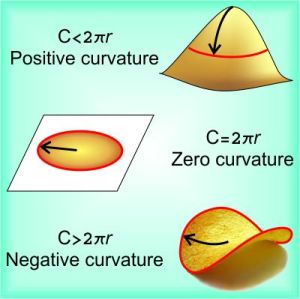
“Not the planets, I mean the way their orbits go all in the same plane. Same for most of the asteroids and the Kuiper belt, even. Our Milky Way galaxy’s basically flat, too, and so are a lot of the others. Black hole accretion disks are flat. You’d think if some baby star or galaxy was attracting stuff from everywhere to grow itself, the incoming would make a big globe. But it’s not, we get flatness. How come?”

“Bad aim and angular momentum.”

“What’s aim got to do with it?”

“Suppose there’s only two objects in the Universe and they’re closing in on each other. If they’re aimed dead‑center to each other, what happens?”

“CaaaRUNCH!!!”

“Right. Now what if the aim’s off so they don’t quite touch?”

“Oh, I know that one … it’ll come to me … yeah, Roche’s limit, it was in an article a few months ago. Whichever’s less dense will break up and all the pieces go like Saturn’s rings. Which are also flat, by the way.”

“In orbit around the survivor, mm‑hm. The pieces can’t fall straight down because they still have angular momentum.”

“I know about momentum like when you crash a car if you go too fast for your brakes. Heavier car or faster speed, you get a worse crash. How does angle fit into that — bigger angle, more angular momentum?”

“Not quite. In general, momentum is mass multiplied by speed. It’s a measure of the force required to stop something or at least slow it down. You’ve described linear momentum, where ‘speed’ is straight‑line distance per time. If you’re moving along a curve, ‘speed’ is arc‑length per time.”

“Arc‑length?”

“Distance around part of a circle. Arc‑length is angle in radians, multiplied by the circle’s radius. If you zip halfway around a big circle in the same time it took me to go halfway around a small circle, you’ve got more angular momentum than I do and it’d take more force to stop you. Make sense?”

“What if it’s not a circle? The planet orbits are all ellipses.”

“It’s still arc‑length except that you need calculus to figure it. That’s why Newton and Leibniz invented their methods. A falling something that misses a gravity center keeps falling but on an orbit. Whatever momentum it has acts as angular momentum relative to that center. There’s no falling any further in without banging into something else coming the other way and each object canceling the other’s momentum.”

“Or burning fuel if it’s a spaceship.”

“… Right. … So anyway, suppose you’ve got a star or something initially surrounded by a spherical cloud of space junk whirling around in all different orbits. What’s going to happen?”

“Lots of banging and momentum canceling until everything’s swirling more‑or‑less in the same direction and closer in than at come‑together time. But it’s still a ball.”

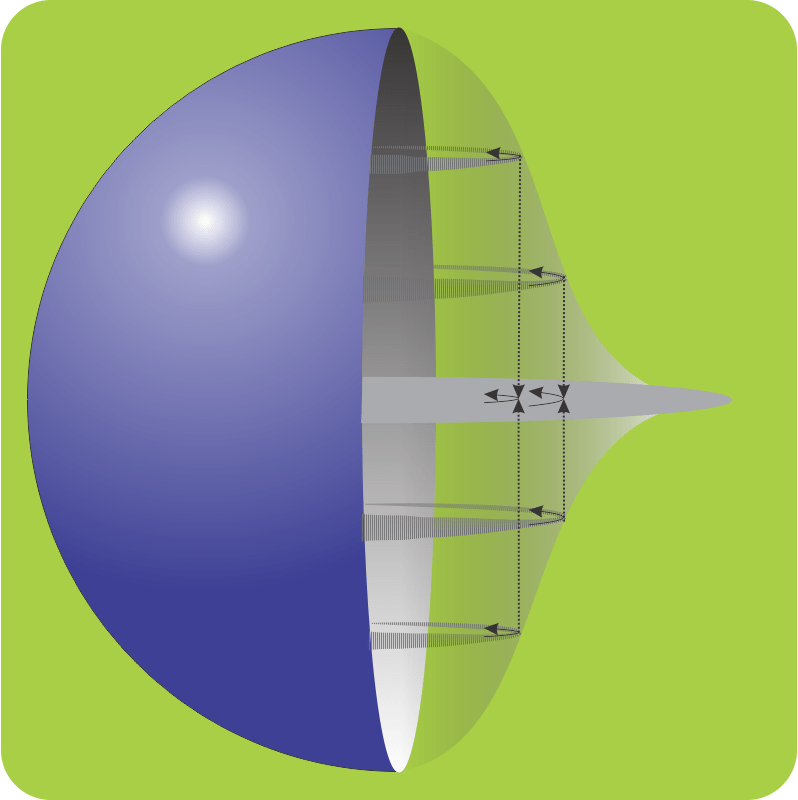
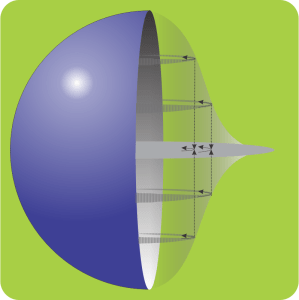
“Gravity’s not done. Think about northern debris. It’s attracted to the center, but it’s also attracted to the southern debris and vice-versa. They’ll meet midway and build a disk. The ball‑to‑disk collapse isn’t even opposed by angular momentum. Material at high latitudes, north and south, can lose gravitational potential energy by dropping straight in toward the equator and still be at the orbitally correct distance from the axis of rotation.”

“That’d work for stuff collecting around a planet, wouldn’t it?”

“It’d even work for stuff collecting around nothing, just a clump in a random density field. That may be how stars are born. Collapsing’s the hard part.”

~ Rich Olcott

Look, Look Again, Then Think

Cathleen and I are sharing scones and memories when Vinnie trundles up to our table. “Glad I got you two together. I just ran across a couple news items and I need some explanations.”

“Astronomy AND Physics in the same news items? Do tell.”

“They’re only one paragraph each and read like someone wrote ’em before their morning coffee. They’re both about that big black hole they’ve been taking pictures of.”

“The one in our galaxy or the M87* supermassive black hole in the Messier‑87 galaxy?”

“The second one, Cathleen. This item says it shot out a jet traveling faster than light.”

<sigh> “Pop‑sci journalism at its worst, right, Sy? I know the work that’s based on and the academic reports don’t say that. Good observations leading to less flamboyant conclusions.”

“Maybe it was supposed to be a bigger article but the editors cut it down badly. That happens. I’m sure it’s not really a superluminal jet—”

“Superluminal’s faster‑than‑light, right?”

“Right, Vinnie. Sorry to get technical. Anyway, it’s an illusion.”

“Ah geez, it’ll be frames again, right?” <eyes suddenly open wide> “Wait, I got it! I betcha it’s about the time difference. Take a blob in that jet, it’s flying out at near lightspeed. Time dilation happens when relativity’s in the game, me and Sy talked about that, so blob‑frame seconds look like they take longer than ours do. We see the blob cramming a lightsecond of distance traveled into less than one of our seconds and that’s superluminal. Am I right, Sy?”

“Right answer to a different question, I’m afraid. You’re straight on the time dilation but it doesn’t apply to this situation. Something happening within the blob’s frame, maybe a star blowing up or something weird metabolizing in there, Special Relativity’s time distortion hijinks would show us that action taking place in slow motion. But this superluminal blob claim hinges on how the blob’s whole frame moves relative to ours. That motion isn’t superluminal but it can look that way if conditions are right. As I understand it, the M87* jet qualifies. Your bailiwick rather than mine, Cathleen.”

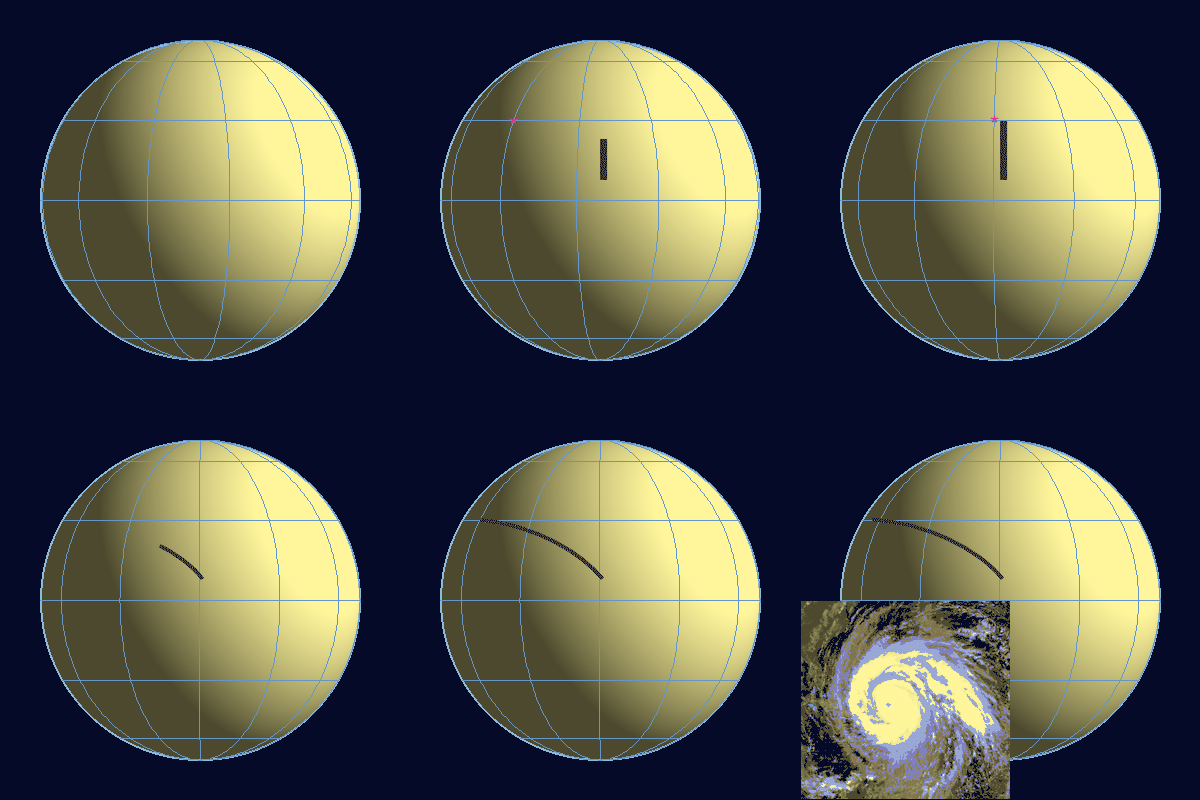
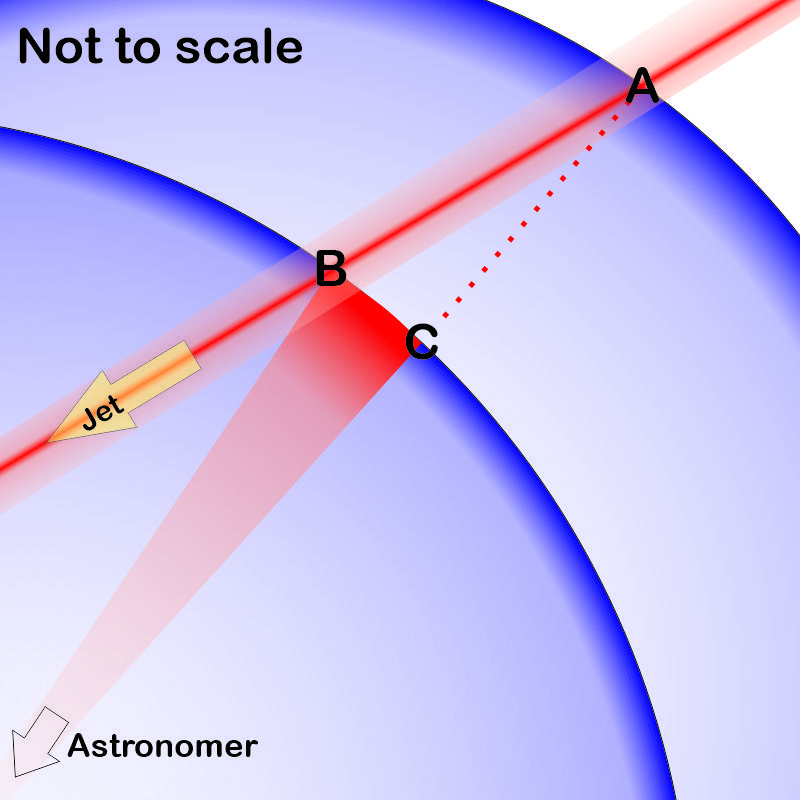
“Actually it is a frames thing, Vinnie, but timeframes, not spacetime. Those blobs move too slowly in our sky to watch in real time. We take snapshot A and then maybe a few years later we take snapshot B and compare. Speed is the ratio of distance to time. We need the A‑B distance in 3‑D space to compare to the known time between snapshots. But we can’t see the blob’s trajectory in 3‑D. All we can capture is its 2‑D arc C‑B across an imaginary spherical shell we call the sky. If the M87* jet were perpendicular to our line of sight the C‑B image on the sky‑sphere would match the 3‑D path. Multiply the image’s angle in radians by the distance to M87* and we’re done.”

“We’re not done?”

“Nope. This jet points only 20° away from our direct line of sight. I’ll spare you the trigonometry and just say that distance A‑B is about 3 times longer than C‑B.”

“So we measure C‑B, triple the angle and multiply by the M87* distance. No problem.”

“Problem. That tripling is what makes the blob’s A‑B journey appear to go faster than light. Three times 0.4c equals 1.2c. But you missed something important. Your arithmetic assumed you could use a simple ‘M87* distance’. Not in this case, because the blob moves towards us at close to lightspeed. Visualize two concentric sky‑spheres. The outer one’s radius runs from us to the blob’s location at A‑time. The inner sphere’s radius runs to the blob’s location at B‑time. The B‑sphere is our reference frame. The light we saw at A‑time had to travel from the outer sphere to the inner one before we could register the C‑B image.”

“Can’t be very far.”

“We’re talking years at lightspeed, so lightyears, so significant. A properly illusion‑free A‑B travel calculation must include the A‑C travel time in the denominator of the distance/time ratio. The true kilometers per second come out well below lightspeed. Oh, and relativity’s not involved.”

“Dang, Cathleen, it was such a cool illusion.”

~ Rich Olcott

Sharpening The Image

“One coffee, one latte and two scones, Cal. Next time is Cathleen’s turn. Hey, you’ve got a new poster behind the cash register. What are we looking at?”

“You like it, Sy? Built the file myself from pics in my astronomy magazines, used the Library’s large‑format printer for the frameable copy. Came out pretty well, didn’t it, Cathleen?”

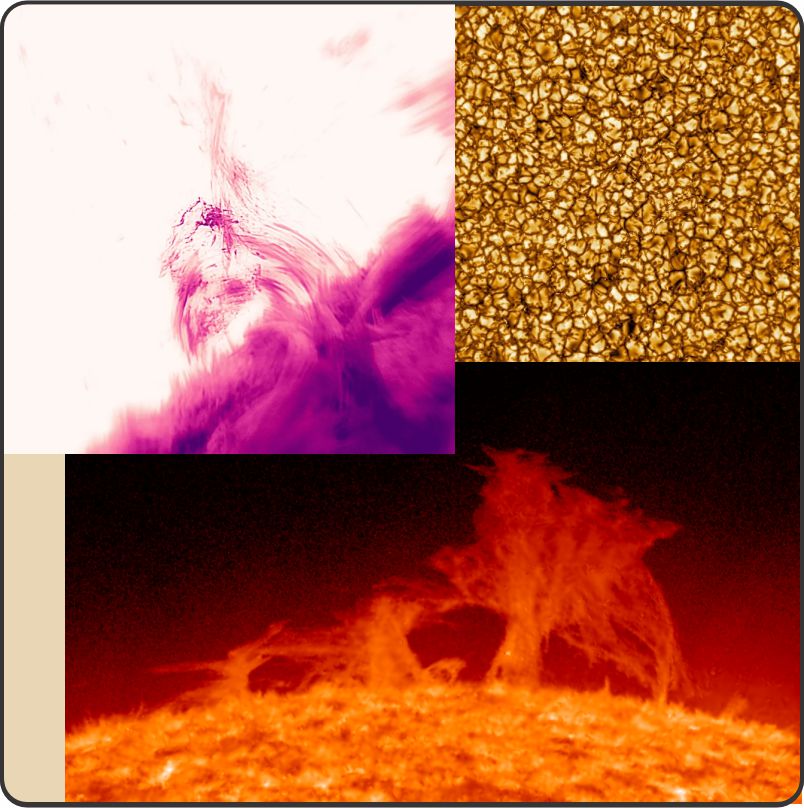
“Mm‑hm. Sy, you should recognize the pebbly-looking one. It’s granules at the bottom of the Sun’s atmosphere. The image came from the Inouye Solar Telescope at Haleakala Observatory on Maui, probably Earth’s best ground‑based facility for studying the Sun. I showed the image to your niece in that phone call. For scale, those granules of super‑heated rising gas are each about the size of Texas.”

“My magazine article didn’t mention Texas but it said there’s about ten million granules. What it was mostly about was the IST and its resolution. Those edges in the picture are as narrow as 18 miles across. It’s that good ’cause the beast has a 4‑meter mirror, which used to be amazing, but they made it even better with active and adaptive optics.”

“Hmm. It’s obvious that the bigger the mirror, the better it is for catching photons. If someone’s going to build a big mirror they’re going to put it behind a big aperture, which is important for resolving points that are close together. But what are ‘active and adaptive optics’ and why did you say that like they’re two different things?”

” ‘Cause they are two different things, Sy. Different jobs, different time‑scales. Gravity here on Earth can make a big mirror sag, and the sag changes depending on where the machine is pointed and maybe part of it gets the wrong temperature. Active optics is about keeping the whole mirror in the right shape to focus the photons where they’re supposed to go. There’s a bunch of actuators rigged up to give adjustable support at different points behind the mirror. The astronomer tells the system to watch a certain guide point and there’s a computer that directs each actuator’s pushing to sharpen the point’s image.”

“And adaptive optics?”

“That’s about solving a different problem. Stars twinkle, right, and the reason they twinkle is because of the atmosphere. One part refracts light one way, another part maybe warmer or with different humidity sends the light another way. Everything moves second to second. By the time a light‑wave gets down to us it’s been jiggled a lot. Adaptive optics is a small mirror, also with a lot of actuators, placed up in the light path after the primary mirror. Again with a guide point and a computer, the little mirror’s job is to cancel the jiggles so the scope’s sensors see a smooth wave. Adaptive works a lot faster than active, which sounds backwards, but I guess active came first.”

“The granules must be in the Sun’s disk somewhere. The other two images look like they’re on the edge.”

“That’s right, Sy. The bottom one is from the Solar Dynamic Observatory satellite a few years ago. That’s not visible light, it’s EUV—”

“EUV?”

“Extreme UltraViolet, light‑waves too short even for hydrogen so it’s mostly from iron atoms heated to millions of degrees. SDO had to be a satellite to catch that part of the spectrum because the atmosphere absorbs it. Of course, up there there’s no need for active or adaptive optics but imaging EUV has its own problems.”

“How tall is that photogenic tree?”

“It’s a prominence. The article said it’s about twenty times Earth’s diameter.”

“What about the pink one?”

“That’s new, Cathleen, from another Maui telescope. Adaptive optics were in play but there’s a problem. If you’re probing inside the corona there’s no fixed guide point. The team focused their adjustment system on corona features where they were a few seconds ago. The article said the process was ‘tricky,’ but look at the results. The loop is about the size of Earth, and those fine lines are about the width of Vancouver Island. They discovered details no‑one’s ever seen before.”

Top left: Schmidt et al./NJIT/NSO/AURA/NSF;
Top right: NSO/AURA/NSF under CC A4.0 Intl license;
Bottom: NASA/SDO

~ Rich Olcott

Why Those Curtains Ripple

I’m in the scone line at Cal’s Coffee when suddenly there’s a too‑familiar poke at my back, a bit right of the spine and just below the shoulder blade. I don’t look around. “Morning, Cathleen.”

“Morning, Sy. Your niece Teena certainly likes auroras, doesn’t she?”

“She likes everything. She’s the embodiment of ‘unquenchable enthusiasm.’ At that age she’s allowed.”

“It’s a gift at any age. Some of the kids in my classes, they just can’t see the wonders no matter how I try. I show them aurora photos and they say, ‘Oh yes, red and green in the sky‘ and go back to their phone screens. Of course there’s no way to get them outside late at night at a location with minimal light pollution.”

“I feel your pain.”

“Thanks. By the way, your aurora write-ups have been all about Earth’s end of the magnetic show. When you you going to do the rest of the story?”

“How do you mean?”

“Magnetism on the Sun, how a CME works, that sort of thing.”

“As a physicist I know a lot about magnetism, but you’re going to have to educate me on the astronomy.”

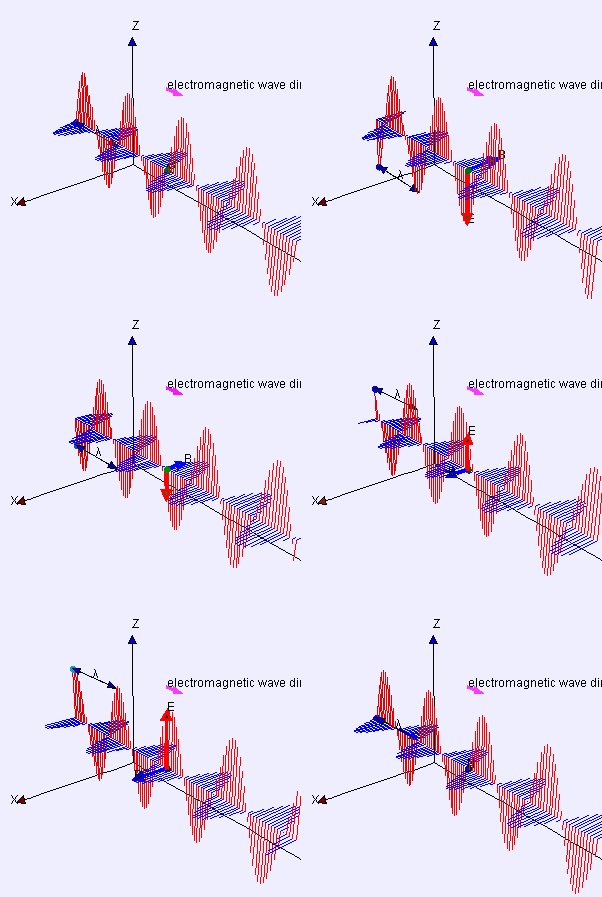
Plane‑polarized Lorentz (electromagnetic) wave
 Electric (E) component is red
 Magnetic (B) component is blue
(Image by Loo Kang Wee and Fu-Kwun Hwang from Wikimedia Commons)
Licensed under CC ASA3.0 Unported

“Deal. You go first.”

<displaying an animation on Old Reliable> “We’ll have to flip between microscopic and macroscopic a couple times. Here’s the ultimate micro — a single charged particle bouncing up and down somewhere far away has generated this Lorentz‑force wave traveling all alone in the Universe. The force has two components, electric and magnetic, that travel together. Neither component does a thing until the wave encounters another charged particle.”

“An electron, right?”

“Could be but doesn’t have to be. All the electric component cares about is how much charge the particle’s carrying. The magnetic component cares about that and also about its speed and direction. Say the Lorentz wave is traveling east. The magnetic component reaches out perpendicular, to the north and south. If the particle’s headed in exactly the same direction, there’s no interaction. Any other direction, though, the particle’s forced to swerve perpendicular to both the field and the original travel. Its path twists up- or downward.”

“But if the particle swerves, won’t it keep swerving?”

“Absolutely. The particle follows a helical path until the wave gives out or a stronger field comes along.”

“Wait. If a Lorentz wave redirects charge motion and moving charges generate Lorentz waves, then a swerved particle ought to mess up the original wave.”

“True. It’s complicated. You can simplify the problem by stepping back far enough that you don’t see individual particles any more and the whole assembly looks like a simple fluid. We’ve known for centuries how to do Physics with water and such. Newton invented hydrodynamics while battling the ghost of Descartes to prove that the Solar System’s motion was governed by gravity, not vortices in an interplanetary fluid. People had tried using Newton‑style hydrodynamics math to understand plasma phenomena but it didn’t work.”

<grinning> “I don’t imagine it would — all that twistiness would have thrown things for a loop.”

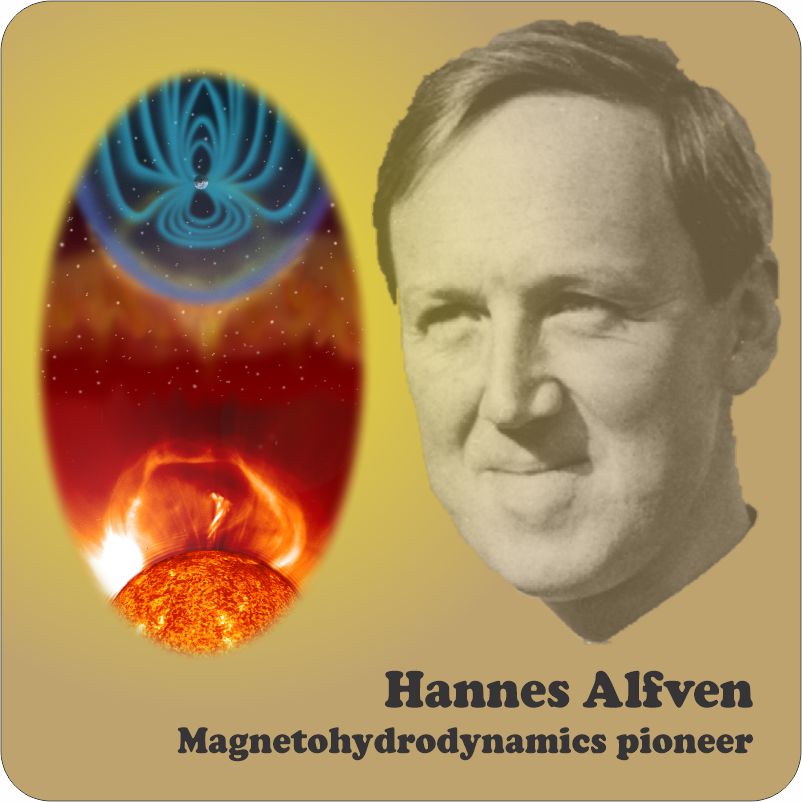
“Haha. Well, in the early 1940s Swedish physicist Hannes Alfven started developing ideas and techniques, extending hydrodynamics to cover systems containing charged particles. Their micro‑level electromagnetic interactions have macro‑level effects.”

“Like what?”

“Those aurora curtains up there. Alfven showed that in a magnetic field plasmas can self‑organize into what he called ‘double layers’, pairs of wide, thin sheets with positive particles on one side against negative particles in the other. Neither sheet is stable on its own but the paired‑up structure can persist. Better yet, plasma magnetic fields can support coherent waves like the ones making that curtain ripple.”

“Any plasma?”

“Sure.”

“Most of the astronomical objects I show my students are associated with plasmas — the stars themselves, of course, but also the planetary nebulae that survive nova explosions, the interstellar medium in galactic star‑forming regions, the Solar wind, CMEs…”

“Alfven said we can’t understand the Universe unless we understand magnetic fields and electric currents.”

~ Rich Olcott
Phases And Changes

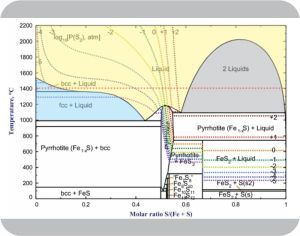
“Okay, so the yellow part of your graph is molten iron and sulfur, Kareem. What’s with all the complicated stuff going on in the bottom half?”

“It’s not a graph, Cal, it’s a phase diagram. Mmm… what do you think a phase is?”

“What we learned in school — solid, liquid, gas.”

“Sorry, no. Those are states of matter. Water can be in the solid state, that’s ice, or in the liquid state like in my coffee cup here, or in the gaseous state, that’d be water vapor. Phase is a tighter notion. By definition, it’s an instance of matter in a particular state where the same chemical and physical properties hold at every point. Diamond and graphite, for example, are two different phases of solid carbon.”

“Like when Superman squeezes a lump of coal into a diamond?”

“Mm-hm. Come to think of it, Cal, have you ever wondered why the diamonds come out as faceted gems instead of a mold of the inside of his fist? But you’ve got the idea — same material, both in the solid state but in different phases. Anyway, in this diagram each bordered region represents a phase.”

“It’s more complicated that that, Kareem. If you look close, each region is actually a mixture of phases. The blue region, for instance, has parts labeled ‘bcc+Liquid’ and ‘fcc+Liquid’. Both ‘bcc’ and ‘fcc’ are crystalline forms of pure iron. Each blue region is really a slush of iron crystals floating in a melt with just enough sulfur to make up the indicated sulfur:iron composition. That line at 1380°C separates conditions where you have one 2‑phase mix or the other.”

“Point taken, Susan. Face it, if region’s not just a straight vertical line then it must enclose a range of compositions. If it’s not strictly molten it must be some mix of at least two separate more‑or‑less pure components. That cool‑temperature mess around 50:50 composition is a jumble when you look at micro sections of a sample that didn’t cool perfectly and they never can. The diagram’s a high‑level look at equilibrium behaviors.”

“Equilibrium?”

“‘Equi–librium’ came from the Latin ‘equal weight’ for a two-pan balance when the beam was perfectly level. The chemists abstracted the idea to refer to a reaction going both ways at the same rate.”

“Can it do that, Susan?”

“Many can, Cal. Say you’ve got a beaker holding some dilute acetic acid and you bubble in some ammonia gas. The two react to produce ammonium ions and acetate ions. But the reaction doesn’t go all the way. Sometimes an ammonium ion and an acetate ion react to produce ammonia and acetic acid. We write the equation with a double arrow to show both directions. Sooner or later you get equally many molecules reacting in each direction and that’s a chemical equilibrium. It looks like nothing’s changing in there but actually a lot’s going on at the molecular level. Given the reactant and product enthalpies Sy’s been banging on about, we can predict how much of each substance will be in the reaction vessel when things settle down.”

“Banging on, indeed. You’re disrespecting a major triumph of 19th‑Century science. Before Gibbs and Helmholtz, industrial chemists had to depend on rules of thumb to figure reaction yields. Now they just look up the enthalpies and they’ can make good estimates. Gibbs even came up with his famous phase rule.”

“You’re gonna tell us, right?”

“Try to stop him.”

“The Gibbs Rule applies to systems in equilibrium where there’s nothing going on that’s biological or involves electromagnetic or gravitational work. Under those restrictions, there’s a limit to how things can vary. According to the rule, a system’s degrees of freedom equals the number of chemical components, minus the number of phases, plus 2. In each blue range, for instance, iron and sulfur make 2 components, minus 2 phases, plus 2, that’s 2 degrees of freedom.”

“So?”

“Composition, temperature and pressure are three intensive variables that you might vary in an experiment. Pick any two, the third is locked in by thermodynamics. Set temperature and pressure, thermodynamics sets the composition.”

~ Rich Olcott

Xanax For Molecules

Vinnie plops down by our table at Cal’s Coffee. “Hi, guys. Glad you’re both here. Susan, Sy here says you’re an RDX expert so I got a question.”

“Not an expert, Vinnie, it’s just one of a series of compounds in one of my projects. What’s your question?”

“How come the stuff is so touchy but it’s not touchy? You can shoot a bullet into a lump of it, nothing happens, but set off a detonator next to it and WHAMO! Why do we need a detonator, and what’s in one anyway?”

“Sy, what sets off an H‑bomb?”

“An A‑bomb. You need a lot of energy in a confined region to crowd those protons enough that they fuse.”

“And what sets off an A‑bomb?”

“Hey I know that one, Susan, I saw the Oppenheimer movie. You need some kind of explosives going off just right to cram two chunks of plutonium together real fast so they do the BANG! thing instead of just melting. Wait! I see where you’re going — little explosions trigger big explosions, right?”

“Bravo! You’ve got the idea behind activation energy.”

“Geez, another kind of energy?”

“Yes and no, Vinnie. Enthalpy and its cousins are about the net change when something happens. We can use them to predict how a complex reaction will settle down, but they don’t tell us much about the kinetics, how fast things will happen. Think for a minute about those H‑bomb hydrogen atoms. What prevents them from fusing?”

“I guess under normal conditions they’re too far apart and even when they get close their electron clouds push against each other.”

<Sketching on a paper napkin> “Fair enough. Okay, here’s what the potential energy curve looks like, sorta. There’s hydrogen atom A over there at the right-hand end of the curve. B‘s a second hydrogen on the left and heading inwards. With me?”

“So far.”

“Right. Now, B comes roaring in with some amount of kinetic energy and hits the potential energy bump where those electron clouds overlap. If it has enough kinetic energy to overcome that barrier, it keeps on going. Otherwise it bounces back with the kinetic energy it had maybe minus some that A picked up in the recoil.”

“So the first barrier is the electron‑electron repulsion, but the potential dips in the middle where the clouds merge and that’s where molecules happen.”

“Right, Sy. But then there’s the second barrier as B‘s positive charge encounters A‘s. Inverse‑square law and all that, it’s an enormous hurdle. Visualize lots of Bs with different kinetic energies running up against that wall again and again until finally, if the pressure’s high enough, one gets past and the fusion releases more energy than the winning B had originally. The higher the wall, the fewer Bs hit As per unit time and the slower the reaction.”

“Looking at the before‑and‑afters, the reaction only happens if energy’s released, but how fast it goes is that barrier’s fault.”

“Perfect, Vinnie. Take RDX, for example. You’re right, it’s touchy. If you’ve got the pure stuff, never look at it cross‑eyed unless you’re behind a blast shield. Lots of energy released, very low energy of activation.”

“But like I said, you can shoot a gun at it, no effect.”

“That wasn’t pure RDX, it was probably some version of C‑4.”

“Yeah, C‑4, don’t know any of the details.”

“C‑4’s explosive is RDX, but it’s also got some plasticizer for that putty consistency, and a phlegmatizer. I love that word.”

“Phlegmatizer? That’s a new one for me.”

“It’s an additive to keep the explosive calm — phlegmatic, get it? — until it gets excited on purpose, which is the detonator’s job.” <scribbling on a stack of paper napkins> “Okay, here’s that same activation energy curve, an RDX particle on the right, and an incoming shock wave. The gray region is the phlegmatizer, usually paraffin or a heavy oil. Think of it as a shock absorber, absorbing or deflecting the shockwave before it can activate the explosive. A detonator’s designed to activate and erupt so quickly that its shock peak arrives before the phlegmatizer can spread it out.”

“Like they say, timing is everything.”

~ Rich Olcott

Tightening Up Fast And Loose

Cal brings out a fresh batch of scones. He’s tonging them onto the racks when I suddenly get a whiff of mocha latte. I glance back and there’s Susan Kim, grinning at me. “Hi, Sy. Grab your scone and a table. I have a bone to pick with you.”

A few moments later we’re seated. Cal’s coffee’s especially smooth today. “Okay, what’s the bone?”

“You’re playing fast and loose with your enthalpy definition. Yes, there’s change in temperature times entropy, enthalpy’s thermal component, and an expansion‑contraction component you called pressure‑volume. But it’s just sloppy to call what’s left ‘the chemical portion.’ What it is, really, is the combination of every other kind of energy something has that some process could extract. Chemical reactions are just one piece.”

“Strong words, coming from a chemist. What else should be packed in there?”

“Radioactivity, for one. It’s a heat source that doesn’t depend on chemical reactions. Atom for atom, a nuclear disintegration can yield millions of times more energy than a chemical reaction does. Trouble is, radioactive atoms only break down when they feel like it so the energy’s all random heat. I’m sure there’s a bunch of other non‑chemical ways to increase something’s apparent enthalpy.”

“Hmm. Challenge accepted. … It’s all about which process will extract some kind of energy from your something. How about the something’s a tightly‑wound spring? No, wait, that’s chemical, because the energy’s stored in stretched metal‑metal bonds.”

“No, I’ll accept spring tension because there’s no change in chemical composition during the unwind process. What’s another one?”

“Ah. Easy. Kinetic energy if the something’s flying through the air to hit something else.”

“Now you’re cooking. Gravitational potential energy if it’s falling down. Oh, suppose it’s magnetized and goes through a conductive loop on the way down?”

“Nope, doesn’t count. The object’s kinetic energy would produce a jolt of electrical potential in the loop, but it’s own magnetization wouldn’t change. Nice, that distinction sharpens the point — what you count as enthalpy’s third component depends on which change process you’re talking about. If there’s no chemical change, then the chemical part of the internal component of the enthalpy change is zero. In the early days of thermodynamics, for instance, everyone was working on steam. Water may corrode your equipment over the long term, but otherwise it’s just hot water molecules becoming not‑as‑hot water molecules and there’s no change in internal energy. The only energy terms you have to think about are pressure‑volume and temperature‑entropy. That’s why they defined it that way.”

“Which one wins?”

“Hmm?”

“You’ve pared enthalpy changes down to just two kinds of energy. I’ve got to wonder, which one has the bigger contribution?”

<pulls up a display on Old Reliable> “This is just for the water‑steam system, mind you. Vinnie was surprised. It’s all based on specific heat measurements so visualize one kilogram of liquid water.”

“A liter, right.”

“The line labeled ‘Mechanical’ is the amount of energy you’d get by expanding that kilogram from 0°C up to the temperatures laid out on the x‑axis. No significant expansion up near boiling temperature, then it follows the Ideal Gas Law, PV=nRT. At atmospheric pressure and in this temperature range the expansion relative to 0°C runs about 200 kilojoules per kilogram.”

“And the ‘Thermal’ line?”

“That’s lab‑measured heat capacity values I pulled from the CRC Handbook, each multiplied by the corresponding temperature in kelvins. That’s the amount of energy our kilogram of water molecules holds just by being at the temperature it’s at. The gas makes a nice straight line, at least in the range before heat shatters the molecules.”

“That’s what, fifteen or sixteen times more energy than the mechanical part? Wow! You know, back in Physical Chemistry class they just threw around lots of confusing thermodynamics formulas but never put numbers to them. I had no idea the entropy effect could just swamp whatever else.”

“Numbers do make a difference.”

“This clarifies something I didn’t understand back then. Entropy’s about randomness, right, and a gas molecule can be in more locations in a large volume than in a small one. V=nRT/P says volume rises linearly with temperature and that’s the linear rise in your chart.”

~ Rich Olcott

New (Old) Word: Frigorific!

A quiet morning at Cal’s Coffee. I’m sipping my morning mud when Susan Kim bustles to my table, mocha latte in hand. “There you are, Sy. I loved your posts in tribute to the well‑thumbed copy of the CRC Handbook on my desk.”

“Glad you enjoyed them.”

“Your Rumford stuff made it even better because I did a class report on him once so I caught your ‘frigorific‘ reference. What do you know about the background to that?”

“Not much. Didn’t sound like a real word when I ran across it.”

“Oh, it’s a real word but it has a technical meaning now that it didn’t in Newton’s time. Back then it was only about making something cold. These days we also use the word for a mixture that maintains a dependable cold temperature. Liquid water and ice, for instance, stays at 0°C as long as there’s still ice in the cold bath. I used to use an ammonium chloride/water frigorific when I needed something down around -15°C. Now of course I use a benchtop refrigerator.”

“Rumford would have liked that. What were the ‘frigorific rays‘ he got all excited about?”

“Long story but there’s a couple of fun twists. Background first. At the end of the 1700s there was a <grin> heated debate about heat. The phlogiston theory was dead by that time but people still liked the idea that heat was a material fluid. It addressed some chemical puzzles but heat transmission was still mysterious. Everyone knew that a hot object gives off heat by radiation, that the radiation travels in straight lines and that it’s reflected by metal mirrors.”

“Right, the Greeks are supposed to have used huge sun‑focusing mirrors to burn up attacking Roman ships.”

“Maybe. Anyhow, those properties connected heat with light. However, a pane of glass blocks radiated heat, at least until the glass gets hot. People argued this meant heat and light weren’t connected. About 1790 a group of physicists loosely associated with the Academy of Geneva dove into the fray. Rumford was in the group, along with Prévost, Saussure and his student Pictet. They had lots of fun with heat theories and experiments. One of Pictet’s experiments lit Rumford’s fire, so to speak.”

“Good one.”

<smile> “It’s a fairly simple setup that a high school science teacher could do. Pictet hung a concave metallic mirror facing down from the ceiling of a draft‑free room. He placed another concave metallic mirror at floor level immediately beneath it, facing upward. He probably used spherical mirrors which are easy to make, but they could have been elliptical or parabolic sections. Anyhow, he put a thermoscope at the upper mirror’s focal point and a hot object at the lower focal point. Sure enough, the upper focal point got hotter, just as you’d expect.”

“No great surprise, the Greeks would have expected that, too.”

“The surprise happened when he put a cold object in there. The thermoscope’s droplet moved in the cold direction.”

“Wait, like anti‑infrared?”

“That’s the effect. Wave‑theory supporter Rumford took that thought, called it ‘frigorific radiation‘ and ran with it. He constructed a whole thesis around cold waves and heat waves as symmetric partners. He maintained wave intensity, both kinds, increases with temperature difference. Our heat sources are hundreds or thousand of degrees hotter than we are but our cold sources are at most a few dozen degrees colder. By his theory that’s why cold wave phenomena are masked by heat waves.”

“Give me a minute. … Ah, got it. The very meaning of a focal point is that all waves end or start there. A cold object at the sending station emits much less infrared than the warm object did. The thermoscope bulb now gets less than it emits. With less input from below its net energy drops. It chills.”

“Nice, Sy. Now for the other twist. Rumford published his theory in 1805. Herschel had already identified infrared radiation in the Sun’s spectrum in 1800. Two strikes against Herschel, I guess — he was British and he was an astronomer. Continental physicists wouldn’t bother to read his stuff.”

~ Rich Olcott

Not Enough Monkeys

“Morning, Sy. You see the news about the Infinite Monkey thing?”

“No, Cal, with everything else going on I seem to have missed that.”

“Understandable. I only heard about it from a ‘lighter side of the news’ piece on the radio. Something about disproving what everybody used to believe. You wrote about it a while ago, didn’t you?”

“Mm-hm. Did a lot of arithmetic for that one. The idea is that if you somehow managed to get an infinite number of monkeys banging away on typewriters, sooner or later one of them would produce the complete works of Shakespeare. The piece I did, gee, years ago, used Terry Pratchett’s idea of a library that contains all the books that have been written, all those that will be written, and all those that would have been written but the author thought better of it. I asked, how big is that library?”

“That’s gotta be a lot of books. Here’s your coffee.”

“Thanks. I guessed maybe a billion, maximum. The Library of Congress has only 30‑some million, last I looked, and that’s real books. Anyhow, I decided to compare that to the number of possible books, printed up using some configuration of 500 characters.”

“500? What else besides ‘a, b, c‘?”

“Upper case, lower case, blanks, punctuation, math symbols, alphabets from other languages, whatever. No pictographic systems like Japanese kanji and Chinese but you can’t have everything. I defined ‘possible book’ as 500 pages, 4000 characters per page so two million per book.”

“All my books are shorter than that and they don’t scramble alphabets from different languages.”

“Short books you could pad to 500 characters with blanks at the end. Some of the experimental fanfic I’ve seen is pretty creative. At any rate, I calculated 5002,000,000 = 105,397,940 different possible books. Limit the library to 250 pages and 100 characters in, say, Spanish with no math that’d be 1001,000,000 = 102,000,000 different possible books, which is still huge, right?”

“My calculator doesn’t do numbers up in the air like that. I’ll believe you, it’s a big number. So where are you going with this?”

“So even a billion‑book library would be swamped by the other 105,397,931 books in an all‑possible‑books library. My point in that old post was that the monkeys could indeed type up Shakespeare but you wouldn’t be able to find it in the welter of absolute nonsense books.”

“Looks good to me, so what’d these guys prove?”

“Dunno, haven’t seen their paper yet. Give me a minute with Old Reliable … Ah, here it is, ‘A numerical evaluation of the Finite Monkeys Theorem by Woodcock and Falletta. Aand it’s not paywalled!” <reading> “Wait, finite — that’s different.”

“How’s it different? Arithmetic’s arithmetic, right?”

“Until you get into infinities. True infinity operates differently than ‘large beyond anything we can measure’. I highlighted the difference in a tech note I wrote a few years ago. How would you bet if someone suggested there’s an exact duplicate Earth existing somewhere else in the Universe?”

“That’s what that goofy ‘Everything Everywhere’ movie was all about, right? Multiverses?”

“Mmm, no, the bet’s about only in our Universe.”

“Knowing you, I’d stay out of the betting.”

“Wise choice. The right answer is ‘It depends’. I calculated that there could be 1.54×10154 possible Earths with exactly the same atom count that we have, just arranged differently, maybe swap one nickel atom with one iron atom inside a hematite rock. So 1.54×10154 chances for an identical copy of you. If the Universe is infinite, then you’re guaranteed to have not just one, but an infinite number of identical copies, each of whom thinks they’re the only you.”

“That’s comforting, somehow.”

“On the other hand, if the Universe is finite, then the planet creation process would have to run through something like 10150 creations before it had a good shot at re‑making you. Vanishingly small odds.”

“So what’s this got to do with finite monkeys?”

“Woodcock and Falletta maintain that there’s only a limited number of monkeys and they’re time‑constrained. Under those conditions, there’s vanishingly small odds for Shakespeare or even the word ‘bananas’.”

~ Rich Olcott

Caged But Free

Afternoon coffee time. Cal waves a handful of astronomy magazines at us as Cathleen and I enter his shop. “Hey, guys, there’s a ton of black hole stuff in the news all of a sudden.”

Cathleen plucks a scone from the rack. “Not surprised, Cal. James Webb Space Telescope looks harder and deeper than we ever could before and my colleagues have been feasting on the data. Black holes are highly energetic so the most extreme ones show up well. The Hubble and JWST folks find new extremes every week.”

Cal would be disappointed if I didn’t ask. “So what’s the new stuff in there?”

<flipping through the magazines> “This seems to be quasar jet month. We’ve got a new champion jet and this article says M87’s quasar makes novas.”

“Remind me, Cathleen, what’s a quasar?”

“A quasi‑stellar object, Sy, except we now know it’s a galaxy with a supermassive black hole—”

“I thought they all had super‑massives.”

“Most do, but these guys are special. For reasons researchers are still arguing about, they emit enormous amounts of energy, as much as a trillion average stars. Quasar luminosity is more‑or‑less flat all across the spectrum from X-rays down as low as we can measure. Which isn’t easy, because the things are so far away that Universe expansion has stretched their waves by z‑factors of 6 or 8 or more. We see their X‑ray emissions in the infrared range, which is why JWST’s optimized for infrared.”

“What does ‘flat’ tell you?”

“Sy’d give a better answer than I would. Sy?”

“Fun fact, Cal. Neither atoms nor the Sun have flat spectra and for the same reason: confinement. Electromagnetic waves come from jiggling charges, right? In an atom the electron charge clouds are confined to specific patterns centered on the nucleus. Each pattern holds a certain amount of energy. The atom can only move to a different charge pattern by emitting or absorbing a wave whose energy matches the difference between the pattern it’s in and some alternate pattern. Atomic and molecular spectra show peaks at the energies where those transitions happen.”

“But the Sun doesn’t have those patterns.”

“Not in the stepped energy‑difference sense. The Sun’s made of plasma, free electrons and nuclei all bouncing off each other, moving wherever but confined to the Sun’s spherical shape by gravity. Any particle that’s much more or less energetic than the local average eventually gets closer to average by exchanging energy with its neighbors. Free charged particles radiate over a continuous, not stepwise, spectrum of energies. The free‑particle combined spectrum has a single peak that depends on the average temperature. You only get flat spectra from systems that aren’t confined either way.”

“What I get from all that is a jet’s flat spectrum says that its electrons or whatever aren’t confined. But they must be — the things are thin as a pencil for thousands of lightyears. Something’s gotta be holding them together but why no peaks?”

“Excellent question, Cal. By the way, jets can be even longer than you said. I’ve read about your champion jet. It extends 23 million lightyears, more than a hundred times the width of the Milky Way galaxy. Straight as a string, no kinks or wiggles during a billion years of growth. I think what’s going on is that the charged particles are confined side‑to‑side somehow but they’re free to roam along the jet’s axis. If that’s the case, the flat‑spectrum light ought to be polarized. I’m sure someone is working on that test now. Your thoughts, Sy?”

“As a physicist I’m interested in the ‘somehow.’ We only know of four forces. The distances are too big for weak and strong nuclear forces. Gravity’s out, too, because it acts equally in all directions, not just crosswise to the axis. That leaves electromagnetic fields in some super‑strong self‑reinforcing configuration. The particles must be spiraling like mad about that central axis. I’ll bet that explains Cal’s quasar galaxy concentrating novae close to its SMBH jet axis. A field that strong could generate enough interference to wreak havoc on an unstable star’s plasma.”

Hubble’s view of the M87 galaxy and jet
Credit NASA and the Hubble Heritage Team (STScI/AURA)

~ Rich Olcott