Dark Passage

Change-me Charlie’s not giving up easily. “You said that NASA picture did three things, but you only told us two of them — that dark matter’s a thing and that it’s separate from normal matter. What’s the third thing? What exactly is in that picture? Does it tell us what dark matter is?”

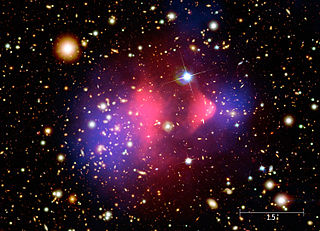
The Bullet Cluster ( 1E 0657-56 )

Physicist-in-training Newt’s ready for him. “Not much of a clue about what dark matter is, but a good clue about how it behaves. As to what’s in the picture, we need some background information first.”

“Go ahead, it’s not dinner-time yet.”

“First, this isn’t two stars colliding. It’s not even two galaxies. It’s two clusters of galaxies, about 40 all together. The big one on the left probably has the mass of a couple quintillion Suns, the small one about 10% of that.”

“That’s a lot of stars.”

“Oh, most of it’s definitely not stars. Maybe only 1-2%. Those stars and the galaxies they form are embedded in ginormous clouds of proton-electron plasma that make up 5-20% of the mass. The rest is that dark matter you don’t like.”

“Quadrillions of stars are gonna make a super-super-nova when they collide!”

“Well, no. That doesn’t even happen when two galaxies collide. The average distance between neighboring stars in a galaxy is 200-300 times the diameter of a star so it’s unlikely that any two of them will come even close. Next level up, the average distance between galaxies in a cluster is about 60 galaxy diameters or more, depending. The galaxies will mostly just slide past each other. The real colliders are the spread-out stuff — the plasma clouds and of course the dark matter, whatever that is.”

Astronomer-in-training Jim cuts in. “Anyway, the collision has already happened. The light from this configuration took 3.7 billion years to reach us. The collision itself was longer ago than that because the bullet’s already passed through the big guy. From that scale-bar in the bottom corner I’d say the centers are about 2 parsecs apart. If I recall right, their relative velocity is about 3000 kilometers per second so…” <poking at his smartphone> “…the peak intersection was about 700 million years earlier than that. Call it 4.3 billion years ago.”

“So what’s with the cotton candy?”

Newt looks puzzled. “Cotton… oh, the pink pixels. They’re markers for where NASA’s Chandra telescope saw X-rays coming from.”

“What can make X-rays so far from star radiation that could set them going?”

“The electrons do it themselves. An electron emits radiation every time it collides with another charged particle and changes direction. When two plasma clouds interpenetrate you get twice as many particles per unit volume and four times the collision rate so the radiation intensity quadruples. There’s always some X-radiation in the plasma because the temperature in there is about 8400 K and particle collisions are really violent. The Chandra signal pink shows the excess over background.”

“The blue in the Jim’s picture is supposed to be what, extra gravity?”

“Basically, yeah. It’s not easy to see from the figure, but there are systematic distortions in the images of the background galaxies in the blue areas. Disks and ellipsoids appear to be bent, depending on where they sit relative to the clusters’ centers of mass. The researchers used Einstein’s equations and lots of computer time to work back from the distortions to the lensing mass distributions.”

“So what we’ve got is a mostly-not-from-stars gravity lump to the left, another one to the right, and a big cloud in the middle with high-density hot bits on its two sides. Something in the middle blew up and spread gas around mostly in the direction of those two clusters. What’s that tell us?”

“Sorry, that’s not what happened. If there’d been a central explosion the excess to the right would be arc-shaped, not a cone like you see. No, this really is the record of one galaxy cluster bursting through another one. Particle-particle friction within the plasma clouds held them back while the embedded galaxies and dark matter moved on.”

“OK, the galaxies aren’t close-set enough for them to slow each other down, but wouldn’t friction in the dark matter hold things back, too?”

“Now that’s an interesting question…”

~~ Rich Olcott

The Prints of Darkness

There’s a commotion in front of Al’s coffee shop. Perennial antiestablishmentarian Change-me Charlie’s set up his argument table there and this time the ‘establishment’ he’s taking on is Astrophysics. Charlie’s an accomplished chain-yanker and he’s working it hard. “There’s no evidence for dark matter, they’ve never found any of the stuff and there’s tons of no-dark-matter theories to explain the evidence.”

Big Cap’n Mike’s shouts from the back of the crowd. “What they’ve been looking for and haven’t found is particles. By my theory dark matter’s an aspect of gravity which ain’t particles so there’s no particles for them to find.”

Astronomer-in-training Jim spouts off right in Charlie’s face. “Dude, you can’t have it both ways. Either there’s no evidence to theorize about, or there’s evidence.”

Physicist-in-training Newt Barnes takes the oppo chair. “So what exactly are we talking about here?”

“That’s the thing, guy, no-one knows. It’s like that song, ‘Last night I saw upon the stair / A little man who wasn’t there. / He wasn’t there again today. / Oh how I wish he’d go away.‘ It’s just buzzwords about a bogosity. Nothin’ there.”

I gotta have my joke. “Oh, it’s past nothing, it’s a negative.”

“Come again?”

“The Universe is loaded with large rotating but stable structures — solar systems, stellar binaries, globular star clusters, galaxies, galaxy clusters, whatever. Newton’s Law of Gravity accounts nicely for the stability of the smallest ones. Their angular momentum would send them flying apart if it weren’t for the gravitational attraction between each component and the mass of the rest. Things as big as galaxies and galaxy clusters are another matter. You can calculate from its spin rate how much mass a galaxy must have in order to keep an outlying star from flying away. Subtract that from the observed mass of stars and gas. You get a negative number. Something like five times more negative than the mass you can account for.”

“Negative mass?”

“Uh-uh, missing positive mass to combine with the observed mass to account for the gravitational attraction holding the structure together. Zwicky and Rubin gave us the initial object-tracking evidence but many other astronomers have added to that particular stack since then. According to the equations, the unobserved mass seems to form a spherical shell surrounding a galaxy.”

“How about black holes and rogue planets?”

Newt’s thing is cosmology so he catches that one. “No dice. The current relative amounts of hydrogen, helium and photons say that the total amount of normal matter (including black holes) in the Universe is nowhere near enough to make up the difference.”

“So maybe Newton’s Law of Gravity doesn’t work when you get to big distances.”

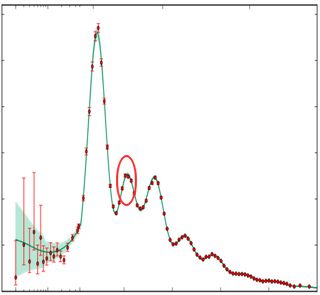
“Biggest distance we’ve got is the edge of the observable Universe. Jim, show him that chart of the angular power distribution in the Planck satellite data for the Cosmological Microwave Background.” <Jim pulls out his smart-phone, pulls up an image.> “See the circled peak? If there were no dark matter that peak would be a valley.”

Charlie’s beginning to wilt a little. “Ahh, that’s all theory.”

The Bullet Cluster ( 1E 0657-56 )

<Jim pulls up another picture.> “Nope, we’ve got several kinds of direct evidence now. The most famous one is this image of the Bullet Cluster, actually two clusters caught in the act of colliding head-on. High-energy particle-particle collisions emit X-rays that NASA’s Chandra satellite picked up. That’s marked in pink. But on either side of the pink you have these blue-marked regions where images of further-away galaxies are stretched and twisted. We’ve known for a century how mass bends light so we can figure from the distortions how much lensing mass there is and where it is. This picture does three things — it confirms the existence of invisible mass by demonstrating its effect, and it shows that invisible mass and visible mass are separate phenomena. I’ve got no pictures but I just read a paper about two galaxies that don’t seem to be associated with dark matter at all. They rotate just as Newton would’ve expected from their visible mass alone. No surprise, they’re also a lot less dense without that five-fold greater mass squeezing them in.”

“You said three.”

“Gotcha hooked, huh?

~~ Rich Olcott

Rhythm Method

A warm Summer day.  I’m under a shady tree by the lake, watching the geese and doing some math on Old Reliable.  Suddenly a text-message window opens up on its screen.  The header bar says 710-555-1701.  Old Reliable has never held a messaging app, that’s not what I use it for.  The whole thing doesn’t add up.  I type in, Hello?

Hello, Mr Moire.  Remember me?

Suddenly I do.  That sultry knowing stare, those pointed ears.  It’s been a yearHello, Ms Baird.  What can I do for you?

Another tip for you, Mr Moire.  One of my favorite star systems — the view as you approach it at near-lightspeed is so ... meaningful.  Your astronomers call it PSR J0337+1715.

So of course I head over to Al’s coffee shop after erasing everything but that astronomical designation.  As I hoped, Cathleen and a few of her astronomy students are on their mid-morning break.  Cathleen winces a little when she sees me coming.  “Now what, Sy?  You’re going to ask about blazars and neutrinos?”

I show her Old Reliable’s screen.  “Afraid not, Cathleen, I’ll have to save that for later.  I just got a message about this star system.  Recognize it?”

“Why, Sy, is that a clue or something?  And why is the lettering in orange?”

“Long story.  But what can you tell me about this star system?”

“Well, it’s probably one of the most compact multi-component systems we’re ever going to run across.  You know what compact objects are?”

“Sure.  When a star the size of our Sun exhausts most of its hydrogen fuel, gravity wins its battle against heat.  The star collapses down to a white dwarf, a Sun-full of mass packed into a planet-size body.  If the star’s a bit bigger it collapses even further, down to a neutron star just a few miles across.  The next step would be a black hole, but that’s not really a star, is it?”

“No, it’s not.  Jim, why not?”

“Because by definition a black hole doesn’t emit light.  A black hole’s accretion disk or polar jets might, but not the object itself.”

“Mm-hm.  Sy, your ‘object’ is actually three compact objects orbiting  around each other.  There’s a neutron star with a white dwarf going around it, and another white dwarf swinging around the pair of them.  Vivian, does that sound familiar?”

“That’s a three-body system, like the Moon going around the Earth and both going around the Sun.  Mmm, except really both white dwarfs would go around the neutron star because it’s heaviest and we can calculate the motion like we do the Solar System.”

“Not quite.  We can treat the Sun as motionless because it has 99% of the mass.  J0337+1715’s neutron star doesn’t dominate its system as much as the Sun does ours.  That outermost dwarf has 20% of its system’s mass.  Phil, what does that suggest to you?”

“It’d be like Pluto and Charon.  Charon’s got 10% of their combined mass and so Pluto and Charon both orbit a point 10% of the way out from Pluto.  From Earth we see Pluto wobbling side to side around that point.  So the neutron star must wobble around the point 20% outward towards the heavy dwarf.  Hey, star-wobble is how we find exoplanets.  Is that what this is about, Mr Moire?  Did someone measure its red-shift behavior?”PSR J0337+1715Cathleen saves me from answering.  “Not quite.  The study Sy’s chasing is actually a cute variation on red-shift measurements.  That ‘PSR‘ designation means the neutron star is a pulsar.  Those things emit electromagnetic radiation pulses with astounding precision, generally regular within a few dozen nanoseconds.  If we receive slowed-down pulses then the object’s going away; sped-up and it’s approaching, just like with red-shifting.  The researchers  derived orbital parameters for all three bodies from the between-pulse durations.  The heavy dwarf is 200 times further out than the light one, for instance.  Not an easy experiment, but it yielded an important result.”

My ears perk up.  “Which was…?”

“The gravitational force between the pulsar and each dwarf was within six parts per million of what Newton’s Laws prescribe.  That observation rules out whole classes of theories that tried to explain galaxies and galaxy clusters without invoking dark matter.”

Cool, huh?

Uh-huh.

~~ Rich Olcott

Zwicky Too Soon

Big Vinnie barrels into the office, again. “Hey, Sy, word is you been short-changing Fritz Zwicky. What’s the story?”

“Hey, I never even met the guy.  He died in 1974.  How could I do him a bad deal?”

“Not giving him full credit.  I read an article about him.  He talked about ‘dark matter’ almost fifty years before Vera Rubin.”

“You’ve got a point there.  Like Vera Rubin he had a political problem, but his was quite different than hers.”

“Political?  I thought all you had to do was be right.”

“No, you have to be right and you have to have people willing to spend time validating or refuting your claims.  Rubin wasn’t a self-advertiser, so it took a while for people to realize why her results were important.  They did look at them, though, and they did give her credit.  Zwicky’s was a different story.”

“Wasn’t he right?”

“Sometimes right, often wrong.  Thing was, he generated too many ideas for people to cope with.  Worse, he was one of those wide-ranging intellects who adds one plus one to make two.  Trouble was, Zwicky got his ones from different specialties that don’t normally interact.  When people didn’t immediately run with one of his claims he took it personally and lashed out, publicly called ’em fools or worse.  Never a good tactic.”

“Gimme a f’rinstance.”

“OK.  Early 1930’s, Zwicky’s out in the still-raw wilds of California, practically nothing out there but movie studios and oil wells, using a manual blink-comparator like the one Clyde Tombaugh used about the same time to find Pluto.  He’s scanning images taken with Palomar’s new wide-angle telescope to search out novae, stars that suddenly get brighter.  He’s finding dozens of them but a few somehow get orders of magnitude brighter than the rest.  He and his buddy Walter Baade call the special ones ‘supernovae.'”

“Ain’t that novas?”

“Novae — we’re being proper astronomers here and it’s a Latin word.  Anyway, Zwiky’s trying to figure out where a supernova’s enormous luminosity comes from.  He got his start in solid-state physics and he still keeps up on both Physics and Astronomy.  Just a year earlier, James Cavendish over in atomic physics had announced the discovery of the neutron.  Zwicky sees that neutrons are the solution to his problem — gravity can pack together no-charge neutrons to a much higher density than it can pack positive-charge protons.  He proposes that a supernova happens when a big-enough star uses up its fuel and collapses to the smallest possible object, a neutron star.  Furthermore, he says that the collapse releases so much gravitational energy that supernovae give off cosmic rays, the super-high-energy photons that were one of the Big Questions of the day.”

“Sounds reasonable, I suppose.”

“Well, yeah, now.  But back then most astronomers had never heard of neutrons.  To solve at a stroke both cosmic rays and supernovae, using this weird new thing called a neutron, and with the proposal coming from somewhere other than Europe or Ivy League academia — well, it was all too outlandish to take seriously.  No-one did, for decades.”

“He didn’t like that, huh?”Zwicky inspecting dark matter

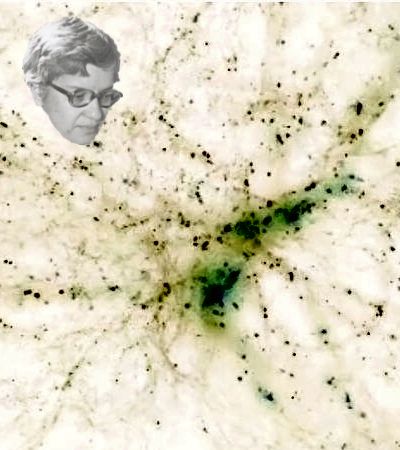
“No, he did not.  And he railed about it, not only in private conversations but in papers and in the preface to one of the two galaxy catalogs he published.  Same thing with galaxy clusters.”

“Wait, you wrote that Rubin found clusters.”

“I did and she did.  Actually, I wrote that she confirmed clustering.  We knew for 150 years that galaxies bunch together in our 2-D sky, but it took Zwicky’s measurements to group the Coma Cluster galaxies in 3-D.  Problem was, they were moving too fast.  If star gravity were the only thing holding them together they should have scattered ages ago.”

“Dark matter, huh?”

“Yup, Zwicky claimed invisible extra mass bound the cluster together.  More Zwicky outlandishness and once again his work was ignored for years.”

“Even though he was right.”

“Mm-hm.  But he could be wrong, too.  He didn’t like Hubble’s expanding Universe idea so he came up with a ‘tired light’ theory to explain the red-shifts.  He touted that idea heavily but there was too much evidence against it.”

“One of those angry ‘lone wolf’ scientists.”

“And bitter.”

~~ Rich Olcott

Symphony for Rubber Ruler

“But Mr Moire, first Vera Rubin shows that galaxies don’t spread out like sand grains on a beach…”

“That’s right, Maria.”

“And then she shows that galaxy streams flow like rivers through the Universe…”

“Yes.”

“And then she finds evidence for dark matter!  She changed how we see the Universe and still they don’t give her the Nobel Prize??!?”

“All true, but there’s a place on Mars that’s named for her and it’ll be famous forever.”

“Really?  I didn’t know about that.  Where is it and why did they give it her name?”

“What do you know about dark matter?”

Rubin inspecting dark matter“Not much.  We can’t see it, and they say there is much more of it than the matter we can see.  If we can’t see it, how did she find it?  That’s a thing I don’t understand, what I came to your office to ask.”
“It all has to do with gravity.  Rubin’s studies of dozens of galaxies showed that they really shouldn’t exist, at least on the basis of the physics we knew about at the time.  She’d scan across a galaxy’s image, measuring how its red-shifted spectrum changed from the coming-toward-us side to the going-away-from-us side.  The red-shift translates to velocity.  The variation she found amazed the people she showed it to.”Pinwheel Galaxy NGC 5457 reduced

“What was amazing about it?”

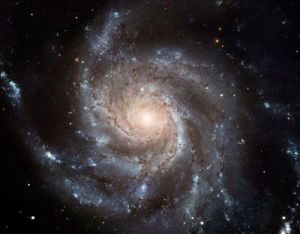
“It was a flat line.  Look at the galaxy poster on my wall over there.”

“Oh, la galaxia del Molinete.  It’s one of my favorites.”

“We call it the Pinwheel Galaxy.  Where would you expect the stars to be moving fastest?”

“Near the center, of course, and they must move slower in those trailing arms.”

“That’s exactly what Rubin didn’t find.  From a couple of reasonable assumptions you can show that a star’s speed in a rotating galaxy composed only of other stars should be proportional to 1/√R, where R is its distance from the center.  If you pick two stars, one twice as far out as the other, you’d expect the outermost star to be going 1/√2 or only about 70% as fast as the other one.”

“And she found…?”

“Both stars have the same speed.”

“Truly the same?”

“Yes!  It gets better.  Most galaxies are embedded in a ball of neutral hydrogen atoms.  With a different spectroscopic technique Rubin showed that each hydrogen ball around her galaxies rotates at the same speed its galaxy does,  even 50% further out than the outermost stars.  Everything away from the center is traveling faster than it should be if gravity from the stars and gas were the only thing holding the galaxy together.  Her galaxies should have dispersed long ago.”

“Could electrical charge be holding things together?”

“Good idea — electromagnetic forces can be stronger than gravity.  But not here.  Suppose the galaxy has negative charge at its center and the stars are all positive.  That’d draw the stars inward, sure, but star-to-star repulsion would push them apart.  Supposing that neighboring stars have opposite charges doesn’t work, either.  And neutral hydrogen atoms don’t care about charge, anyway.  The only way Rubin and her co-workers could make the galaxy be stable is to assume it’s surrounded by an invisible spherical halo with ten times as much mass as the matter they could account for.”

“Mass that doesn’t shine.  She found ‘dark matter’ with gravity!”

“Exactly.”

“What about planets and dust?  Couldn’t they add up to the missing mass?”

“Nowhere near enough.  In out Solar System, for instance, all the planets add up to only 0.1% of the Sun’s mass.”

“Ah, ‘planets’ reminds me.  Why is Vera Rubin’s name on Mars?”

“Well, it’s not strictly speaking on Mars, yet, but it’s on our maps of Mars.  You know the Curiosity rover we have running around up there?”

“Oh yes, it’s looking for minerals that deposit from water.”

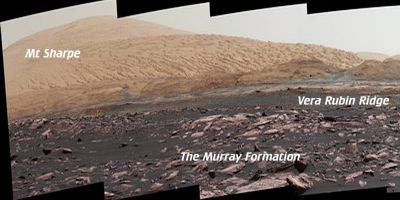
“Mm-hm.  One of those minerals is an iron oxide called hematite.  Sometimes it’s in volcanic lava but most of the time it’s laid down in a watery environment.  And get this — it’s often black or dark gray.  Curiosity found a whole hill of the stuff.”

Vera Rubin Ridge labeled
Adopted from a Curiosity Mastcam image from NASA

“Yes, so…?”

“What else would the researchers name an important geologic feature made of darkish matter?”

~~ Rich Olcott

The Fellowship of A Ring

Einstein ring 2018
Hubble photo from NASA’s Web site

Cathleen and I are at a table in Al’s coffee shop, discussing not much, when Vinnie comes barreling in.  “Hey, guys.  Glad I found you together.  I just saw this ‘Einstein ring’ photo.  They say it’s some kind of lensing phenomenon and I’m thinking that a lens floating out in space to do that has to be yuuuge.  What’s it made of, and d’ya think aliens put it there to send us a message?”

Astronomer Cathleen rises to the bait.  I sit back to watch the fun.  “No, Vinnie, I don’t.  We’re not that special, the rings aren’t signals, and the lenses aren’t things, at least not in the way you’re thinking.”

“There’s more than one?”

“Hundreds we know of so far and it’s early days because the technology’s still improving.”

“How come so many?”

“It’s because of what makes the phenomenon happen.  What do you know about gravity and light rays?”

Me and Sy talked about that a while ago.  Light rays think they travel in straight lines past a heavy object, but if you’re watching the beam from somewhere else you think it bends there.”

I chip in.  “Nice summary, good to know you’re storing this stuff away.”Gravitational lens 1

“Hey, Sy, it’s why I ask questions is to catch up.  So go on, Cathleen.”

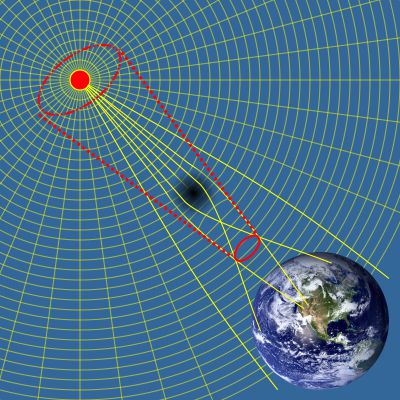
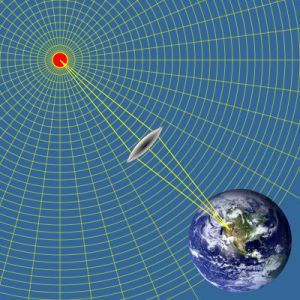
She swings her laptop around to show us a graphic.  “So think about a star far, far away.  It’s sending out light rays in every direction.  We’re here in Earth and catch only the rays emitted in our direction.  But suppose there’s a black hole exactly in the way of the direct beam.”

“We couldn’t see the star, I get that.”

“Well, actually we could see some of its light, thanks to the massive black hole’s ray-bending trick. Rays that would have missed us are bent inward towards our telescope.  The net effect is similar to having a big magnifying lens out there, focusing the star’s light on us.”

“You said, ‘similar.’  How’s it different?”Refraction lens

“In the pattern of light deflection.  Your standard Sherlock magnifying lens bends light most strongly at the edges so all the light is directed towards a point.  Gravitational lenses bend light most strongly near the center.  Their light pattern is hollow.  If we’re exactly in a straight line with the star and the black hole, we see the image ‘focused’ to a ring.”

“That’d be the Einstein ring, right?”

“Yes, he gets credit because he was the one who first set out the equation for how the rays would converge.  We don’t see the star, but we do see the ring.  His equation says that the angular size of the ring grows as the square root of the deflecting object’s mass.  That’s the basis of a widely-used technique for measuring the masses not only of black holes but of galaxies and even larger structures.”

“The magnification makes the star look brighter?”

“Brighter only in the sense that we’re gathering photons from a wider field then if we had only the direct beam.  The lens doesn’t make additional photons, probably.”

Suddenly I’m interested.  “Probably?”

“Yes, Sy, theoreticians have suggested a couple of possible effects, but to my knowledge there’s no good evidence yet for either of them.  You both know about Hawking radiation?”

“Sure.”

“Yup.”

“Well, there’s the possibility that starlight falling on a black hole’s event horizon could enhance virtual particle production.  That would generate more photons than one would expect from first principles.  On the other hand, we don’t really have a good handle on first principles for black holes.”

“And the other effect?”

“There’s a stack of IFs under this one.  IF dark matter exists and if the lens is a concentration of dark matter, then maybe photons passing through dark matter might have some subtle interaction with it that could generate more photons.  Like I said, no evidence.”

“Hundreds, you say.”

“Pardon?”

“We’ve found hundreds of these lenses.”

“All it takes is for one object to be more-or-less behind some other object that’s heavy enough to bend light towards us.”

“Seein’ the forest by using the trees, I guess.”

“That’s a good way to put, it, Vinnie.”

~~ Rich Olcott