Why Physics Is Complex

“I guess I’m not surprised, Sy.”

“At what, Vinnie?”

“That quantum uses these imaginary numbers — sorry, you’d prefer we call them i‑numbers.”

“Makes no difference to me, Vinnie. Descartes’ pejorative term has been around for three centuries so that’s what the literature uses. It’s just that most people pick up the basic idea more quickly without the woo baggage that the real/imaginary nomenclature carries along. So, yes, it’s true that both i‑numbers and quantum mechanics appear mystical, but really quantum mechanics is the weird one. And relativity.”

“Wait, relativity too? That’s hard to imagine, HAW!”

“Were you in the room for Jim’s Open Mic session where he talked about Minkowski’s geometry?”

“Nope, missed that.”

“Ah, okay. Do you remember the formula for the diagonal of a rectangle?”

“That’d be the hypotenuse formula, c²=a²+b². Told you I was good at Geometry.”

“Let’s use ‘d‘ for distance, because we’re going to need ‘c‘ for the speed of light. While we’re at it, let’s replace your ‘a and ‘b‘ with ‘x‘ and ‘y,’ okay?”

“Sure, why not?”
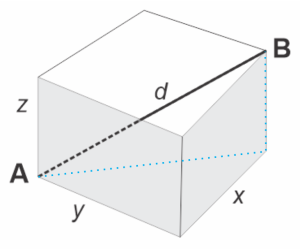
<casting image onto office monitor> “So the formula for the body diagonal of this box is…”

“Umm … That blue line across the bottom’s still √(x²+y²) and it’s part of another right triangle. d‘s gotta be the square root of x²+y²+z².”

“Great. Now for a fourth dimension, time, so call it ‘t.’ Say we’re going for light’s path between A at one moment and B some time t later.”

“Easy. Square root of x²+y²+z²+t².”

“That’s almost a good answer.”

“Almost?”

“The x, y and z are distance but t is a duration. The units are different so you can’t just add the numbers together. It’d be like adding apples to bicycles.”

“Distance is time times speed, so we multiply time by lightspeed to make distance traveled. The formula’s x²+y²+z²+(ct)². Better?”

“In Euclid’s or Newton’s world that’d be just fine. Not so much in our Universe where Einstein’s General Relativity sets the rules. Einstein or Minkowski, no‑one knows which one, realized that time is fundamentally perpendicular to space so it works by i‑numbers. You need to multiply t by ic.”

“But i²=–1 so that makes the formula x²+y²+z²–(ct)².”

“Which is Minkowski’s ‘interval between an event at A and another event at B. Can’t do relativity work without using intervals and complex numbers.”

“Well that’s nice but we started talking about quantum. Where do your i‑numbers come into play there?”

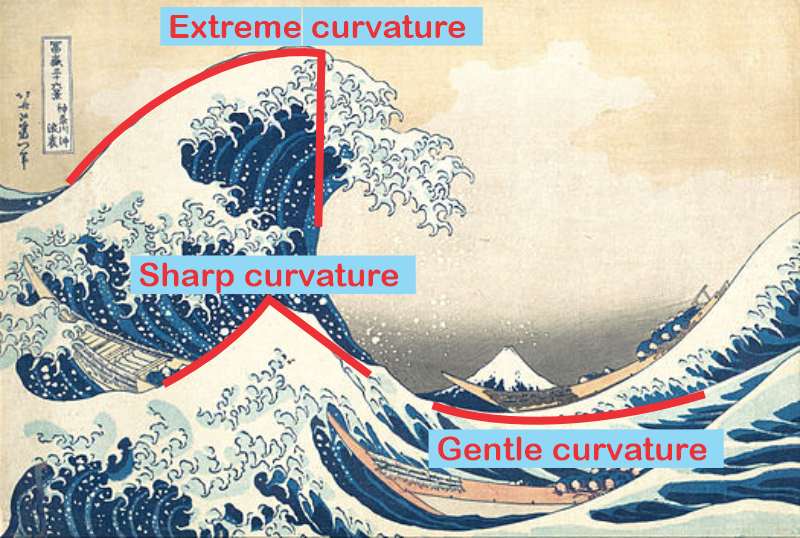
“It goes back to the wave equation— no, I know you hate equations. Visualize an ocean wave and think about describing its surface curvature.”
“Curvature?”

“How abruptly the slope changes. If the surface is flat the slope is zero everywhere and the curvature is zero. Up near the peak the slope changes drastically within a short distance and we say the surface is highly curved. With me?”

“So far.”

“Good. Now, visualize the wave moving past you at some convenient speed. Does it make sense that the slope change per unit time is proportional to the curvature?”

“The pointier the wave segment, the faster its slope has to change. Yeah, makes sense.”

“Which is what the classical wave equation says — ‘time‑change is proportional to space‑change’. The quantum wave equation is fundamental to QM and has exactly the same form, except there’s an i in the proportionality constant and that changes how the waves work.” <casting a video> “The equation’s general solution has a complex exponential factor eix. At any point its value is a single complex number with two components. From the x‑direction, the circle looks like a sine wave. From the i‑direction it also looks like a sine wave, but out of phase with the x‑wave, okay?”
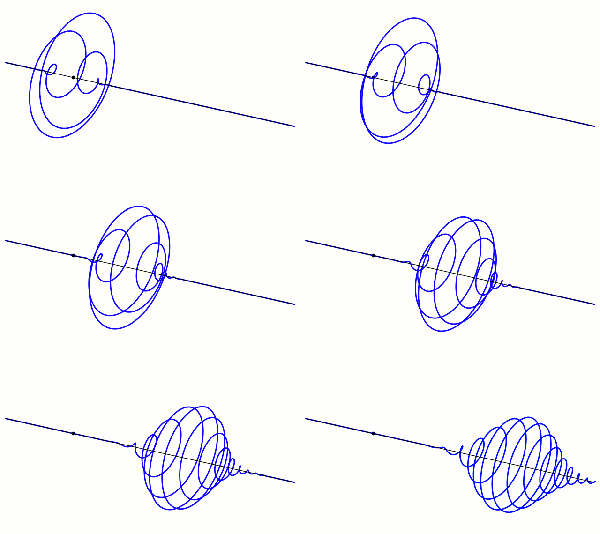
“Out of phase?”

“When one wave peaks, the other’s at zero and vice‑versa. The point is, rotation’s built into the quantum waves because of that i‑component.” <another video> “Here’s a lovely example — that black dot emits a photon that twists and releases the electromagnetic field as it moves along.”

~ Rich Olcott

A Million Times Weaker Than Moonlight

Big Vinnie’s getting downright antsy, which is something to behold. “C’mon, Sy. We get it that sonication ain’t sonification and molecules bumping into each other can carry a sound wave across space if the frequency’s low enough and that can maybe account for galaxies having spiral arms, but you said the Cosmic Hum is a sound, too. That’s a gravity thing, not molecules, right?”

“Not quite what I said, Vinnie. The Hum’s sound‑related, but it’s not ‘sound’ even by our extended definition.”

“Then what’s the connection?”

“Waves.”

“Not frames like always?”

“Not frames, for a change.”

“So it’s waves, but they go though empty space. Can’t happen like sound waves from molecules bumping into each other ’cause molecules are too small to have enough gravity do that when they’re so far apart. What’s carrying the waves?”

“Good question. Einstein figured out one answer. A whole cohort of mid‑20th‑century theoreticians came to a slightly different conclusion.”

“Okay, I’ll bite. What was Einstein’s answer?”

“Relativity, of course. Gravity’s the effect we see from mass deforming nearby space. Moving a mass drives corresponding changes in the shapes of space where it was and where it has moved to. The shape‑changes generate follow‑on gravitational effects that propagate outward over time. Einstein even showed that the gravitational propagation speed is equal to lightspeed.”

“Gimme a sec … Okay, that black hole collision signal LIGO picked up back in 2015, the holes lost a chunk of their combined mass all of a sudden. Quick drop in the gravity thereabouts. You’re saying it took time for the missing gravity strength to get noticed where we’re at. If I remember right, the LIGO people said the event was something like a billion lightyears away so that tells me it happened about a billion years ago and what the LIGO gadget picked up was space waves, right?”

“Right, but it wasn’t just the mass loss, it was the rapid and intense waggles in the gravitational field as those two enormous bodies, each 30 times as massive as the Sun, whirled around each other multiple times per second. The ever‑faster whirling shook the field with a frequency that swept upward to the ‘POP‘ when your mass‑loss happened. LIGO eventually picked up that signal. Einstein would say there’s no ‘action at a distance‘ in the collision‑LIGO interaction, because the objects acted on the gravitational field which acted on the LIGO system.”

“Like using a towel to pop someone in the locker room. The towel’s just transmi– ulp.”

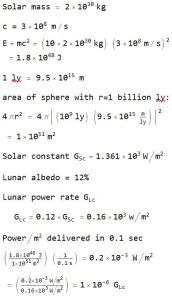
“An admission of guilt if I ever heard one. Yes, like that, except a towel pop carries all the initial energy to its final destination. Gravitational waves spread their energy across the surface of an expanding sphere. The energy per unit area goes down as the square of the distance.” <keying a calculation on Old Reliable> “Suppose the collision releases 10 solar masses worth of energy, we’re a billion lightyears away, and the ‘POP‘ signal is delivered in a tenth of a second. We’d see a signal power … about a millionth as strong as moonlight.”

“Not much there.”

“Right, which is why LIGO and its kin have been such pernickety instruments to build and run. LIGO’s sensors are mirrors roughly a meter across. You get a million times more power sensitivity if your detector’s diameter is a mile across. That was part of the NANOGrav team’s strategy, but they went much bigger.”

“Yeah, that’s the multi-telescope thing, so NANOGrav faked a receiver the size of the Earth, like the Event Horizon Telescope.”

“Much bigger. Their receiver is the entire Milky Way. Instead of LIGO’s mirrors, NANOGrav’s signal generators are neutron stars a dozen or more miles wide scattered across the galaxy.”

“Gotcha, Sy. Two ways. Neutron stars are billions heavier than a LIGO mirror so they’d be less power‑sensitive, not more. Then, power is about moving stuff closer or farther but if I got you right these space waves don’t really do that anyway, right?”

“Right and right, Vinnie, but not relevant. What NANOGrav’s been watching for is pulsar beams being twitched by a gravitational wave. A waltzing black hole pair should generate years‑long or decades‑long wavelengths. NANOGrav may have found one.”

~~ Rich Olcott

Tilting at Black Holes

“What’s the cause-effect-time thing got to do with black holes and information?”

“We’re getting there, Al. What happens to spacetime near a black hole?”

“Everybody knows that, Sy, spacetime gets stretched and squeezed until there’s infinite time dilation at the Event Horizon.”

“As usual, Vinnie, what everybody knows isn’t quite what is. Yes, Schwarzschild’s famous solution includes that Event Horizon infinity but it’s an artifact of his coordinate system. Al, you know about coordinate systems?”

“I’m a star-watcher, Sy. Sure, I know about latitude and longitude, declination and right ascension, all that stuff no problem.”

“Good. Well, Einstein wrote his General Relativity equations using generalized coordinates, like x,y,z but with no requirement that they be straight lines or at right angles. Schwarzschild solved the equations for a non‑rotating sphere so naturally he used spherical coordinates — radius, latitude and longitude. Since then other people have solved the equations for more complicated cases using more complicated coordinate systems. Their solutions don’t have that infinity.”

“No infinity?”

“Not that one, anyhow. The singularity at the hole’s geometric center is a real thing, not an artifact. So’s a general Event Horizon, but it’s not quite where Schwarzschild said it should be and it doesn’t have quite the properties that everybody thinks they know it has. It’s still weird, though.”

“How so?”

“First thing you have to understand is that when you get close to a black hole, you don’t feel any different. Except for the spaghettification, of course.”

“It’s frames again, ain’t it?”

“With black holes it’s always frames, Vinnie. If you’re living in a distorted space you won’t notice it. Whirl a meter‑long sword around, you’d always see it as a meter long. A distant observer would see you and everything around you as being distorted right along with your space. They’ll see that sword shrink and grow as it passes through different parts of the distortion.”

“Weird.”

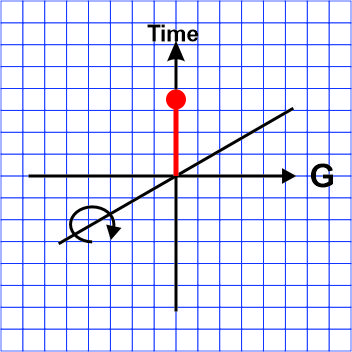
“We’re just getting started, Al. Time’s involved, too. <grabbing a paper napkin and sketching> Here’s three axes, just like x,y,z except one’s time, the G one points along a gravity field, and the third one is perpendicular to the other two. By the way, Al, great idea, getting paper napkins printed like graph paper.”

“My location’s between the Physics and Astronomy buildings, Sy. Gotta consider my clientele. Besides, I got a deal on the shipment. What’s the twirly around that third axis?”

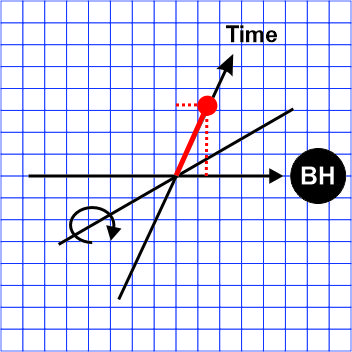
“It’s a reminder that there’s a couple of space dimensions that aren’t in the picture. Now suppose the red ball is a shuttlecraft on an exploration mission. The blue lines are its frame. The thick vertical red line shows it’s not moving because there’s no spatial extent along G. <another paper napkin, more sketching> This second drawing is the mothership’s view from a comfortable distance of the shuttlecraft near a black hole.”

“You’ve got the time axis tilted. What’s that about?”

“Spacetime being distorted by the black hole. You’ve heard Vinnie and me talk about time dilation and space compression like they’re two different phenomena. Thing is, they’re two sides of the same coin. On this graph that shows up as time tilted to mix in with the BH direction.”

“How about those twirly directions?”

“Vinnie, you had to ask. In the simple case where everything’s holding still and you’re not too close to the black hole, those two aren’t much affected. If the big guy’s spinning or if the Event Horizon spans a significant amount of your sky, all four dimensions get stressed. Let’s keep things simple, okay?”

“Fine. So the time axis is tilted, so what?”

“We in the distant mothership see the shuttlecraft moving along pure tilted time. The shuttlecraft doesn’t. The dotted red lines mark its measurements in its blue‑line personal frame. Shuttlecraft clocks run slower than the mothership’s. Worse, it’s falling toward the black hole.”

“Can’t it get away?”

“Al, it’s a shuttlecraft. It can just accelerate to the left.”

“If it’s not too close, Vinnie. The accelerative force it needs is the product of both masses, divided by the distance squared. Sound familiar?”

“That’s Newton’s Law of Gravity. This is how gravity works?”

“General Relativity cut its teeth on describing that tilt.”

~~ Rich Olcott

What Time Is It on Mars?

I’m puffing a little after hiking up a dozen flights of stairs. That whole bank of Acme Building elevators is closed off while the repair crew tries to free up the one that trapped us. The crowd waiting for the other bank is forgetaboutit. I unlock my office door and there’s Vinnie, tinkering with the thermostat. “Geez, Sy, it’s almost as cold in here as it is out in the hall. Hey, ya think there’s anything to the rumor that building management is gonna rent out that elevator as office space? And how does time work on Mars?”

“Morning, Vinnie. You’re right, I don’t think so, and where’d that last question come from?”

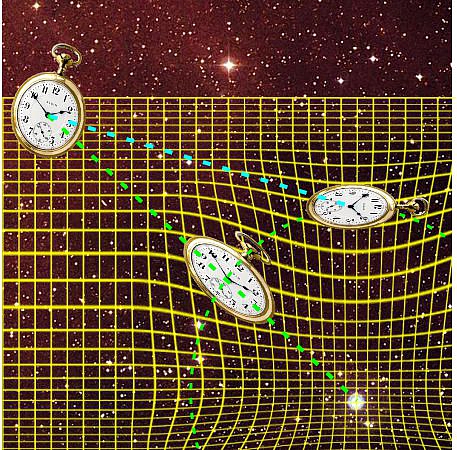
“I been thinking about those ultra-accurate clocks and how they’d play into that relativity stuff we talked about with Ramona.” <short lull in the conversation as we both consider Ramona> “Suppose there’s one of those clocks in a satellite going around Earth. If I remember right, it’s going ZIP around the planet so its clock ought to run faster than my wristwatch, but it’s further out of Earth’s gravity well so its clock ought to run slower. Which would win?”

“You remembered right — you’ve got Special Relativity and General Relativity in a couple of nutshells, and yes, they sometimes work in opposite directions. You have to look at the numbers. Give me a sec to work up a few examples on Old Reliable… OK, let’s start with the speed part. That’s Special Relativity because they both start with ‘SP’.”

“Cute.”

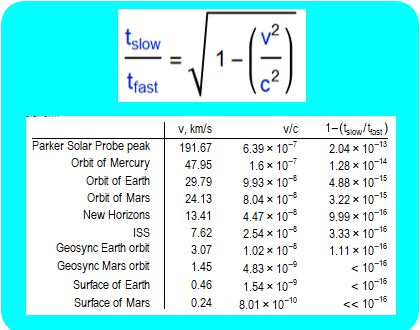
“I thought so.  OK, here’s a handful of locations and their associated straight-line speeds relative to some star far away. That last column shows a difference factor for a clock at each location compared to a far-away motionless clock in a zero gravitational field. Multiply the factor by 86,400 seconds per day to get the time difference per day. The fastest thing on the list is that spacecraft we’re sending to the Sun by way of some slingshot maneuvers around Venus to speed it up. The Special Relativity difference comes to less than two nanoseconds per day. That’s barely in the range we can detect. It’s way less for everyplace else. ”

“Hey, Mars is down at the bottom. Lemme think why… OK, slower rotation than Earth’s, AND smaller radius so you don’t move as far for the same degrees of spin, so the formula barely subtracts anything from 1.0, right?”

“Yup, the slower you go compared to lightspeed the smaller the time adjustment. The difference between unity and the ratio for a point on Mars’ surface is so small that Old Reliable suffered a floating-point underflow trying to calculate it. That’s hard to make it do. Bottom line, the SR effect doesn’t really kick in unless you’re going faster than practically everything larger than an atom.”

“So how about the gravity wells? I’ll bet the deeper the well, the more time gets stretched.”

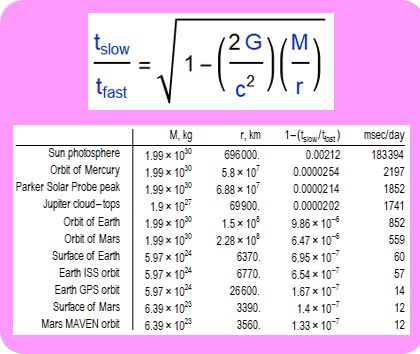
“Good bet. The well gets deeper as the attracting mass increases. But your clock feels less of a squeeze if it’s further away. The net effect is controlled by the mass-to-distance ratio inside that square root. Worst case in this table is at the top. A clock embedded in the Sun’s photosphere loses 0.00212*(86400 sec/day)=183 seconds compared to a far-away motionless clock in free-fall. We here on Earth lose 912 milliseconds a day total, but the astronauts on the ISS lose about 3 milliseconds less than we do because they’re further away from Earth’s center.”

“Yeah, I read about those twin astronauts. The one flying on the ISS didn’t get older as fast as the one that stayed on Earth.”

“About a second’s-worth over a year. So, do you have your relativity and Mars-time answer?”

“Sorta. But what time is it up there right now?”

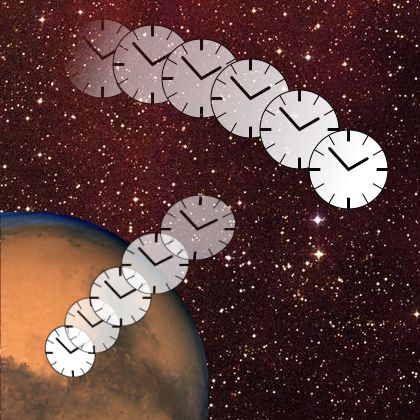
“Hey, Mars is a whole world and has different times at different places just like Earth does. Wherever you are on Mars, ‘noon’ is when the Sun is overhead. Mars spins about 3% slower than Earth does — noon-to-noon there is Earth’s 24 hours plus 37 minutes and change. Add in the net 340-millisecond relativistic daily drift away from Earth time. No way can you sync up Earth and Mars times.”

“Nothin’s simple, huh?”

~~ Rich Olcott

Gravity from Another Perspective

“OK, we’re looking at that robot next to the black hole and he looks smaller to us because of space compression down there.  I get that.  But when the robot looks back at us do we look bigger?”

We’re walking off a couple of Eddie’s large pizzas.  “Sorry, Mr Feder, it’s not that simple.  Multiple effects are in play but only two are magnifiers.”

“What isn’t?”

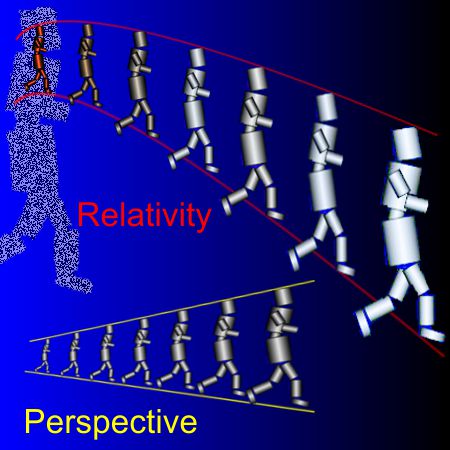
“Perspective for one.  That works the same in both directions — the image of an object shrinks in direct proportion to how far away it is.  Relativity has nothing to do with that principle.”

“That makes sense, but we’re talking black holes.  What does relativity do?”

“Several things, but it’s complicated.”

“Of course it is.”

“OK, you know the difference between General and Special Relativity?”

“Yeah, right, we learned that in kindergarten.  C’mon.”

“Well, the short story is that General Relativity effects depend on where you are and Special Relativity effects depend on how fast you’re going.  GR says that the scale of space is compressed near a massive object.  That’s the effect that makes our survey robot appear to shrink as it approaches a black hole.  GR leaves the scale of our space larger than the robot’s.  Robot looks back at us, factors out the effect of perspective, and reports that we appear to have grown.  But there’s the color thing, too.”

“Color thing?”

“Think about two photons, say 700-nanometer red light, emitted by some star on the other side of our black hole.  One photon slides past it.  We detect that one as red light.  The other photon hits our robot’s photosensor down in the gravity well.  What color does the robot see?”

“It’s not red, ’cause otherwise you wouldn’t’ve asked me the question.”

“Check.”

“Robot’s down there where space is compressed…  Does the lightwave get compressed, too?”

“Yup.  It’s called gravitational blue shift.  Like anything else, a photon heading towards a massive object loses gravitational potential energy.  Rocks and such make up for that loss by speeding up and gaining kinetic energy.  Light’s already at the speed limit so to keep the accounts balanced the photon’s own energy increases — its wavelength gets shorter and the color shifts blue-ward.  Depending on where the robot is, that once-red photon could look green or blue or even X-ray-colored.”

“So the robot sees us bigger and blue-ish like.”Robots and perspective and relativity 2“But GR’s not the only player.  Special Relativity’s in there, too.”
“Maybe our robot’s standing still.”

“Can’t, once it gets close enough.  Inside about 1½ diameters there’s no stable orbit around the black hole, and of course inside the event horizon anything not disintegrated will be irresistibly drawn inward at ever-increasing velocity.  Sooner or later, our poor robot is going to be moving at near lightspeed.”

“Which is when Special Relativity gets into the game?”

“Mm-hm.  Suppose we’ve sent in a whole parade of robots and somehow they maintain position in an arc so that they’re all in view of the lead robot.  The leader, we’ll call it RP-73, is deepest in the gravity well and falling just shy of lightspeed.  Gravity’s weaker further out — trailing followers fall slower.  When RP-73 looks back, what will it see?”

“Leaving aside the perspective and GR effects?  I dunno, you tell me.”

“Well, we’ve got another flavor of red-shift/blue-shift.  Speedy RP-73 records a stretched-out version of lightwaves coming from its slower-falling followers, so so it sees their colors shifted towards the red, just the opposite of the GR effect.  Then there’s dimming — the robots in the back are sending out n photons per second but because of the speed difference, their arrival rate at RP-73 is lower.  But the most interesting effect is relativistic aberration.”

“OK, I’ll bite.”

“Start off by having RP-73 look forward.  Going super-fast, it intercepts more oncoming photons than it would standing still.”

“Bet they look blue to it, and really bright.”

“Right on.  In fact, its whole field of view contracts towards its line of flight.  The angular distortion continues all the way around.  Rearward objects appear to swell.”

“So yeah, we’d look bigger.”

“And redder.  If RP-73 is falling fast enough.”

~~ Rich Olcott

  • Thanks to Timothy Heyer for the question that inspired this post.

Questions, Meta-questions and Answers

<We rejoin Sy and Vinnie in the library stacks…> “Are you boys discussing me?”

<unison> “Oh, hi, Ramona.”

“Actually no, Ramona, we were discussing relativistic time dilation.”

“I know that, Sy, I’ve been reading your posts. Now I’ve got a question.”

“But how…?  Never mind.  Guess I’d better watch my writing.  What can I do for you?”

“You and Vinnie have been going on about kinetic time dilation and gravitational time dilation like they’re two separate things, right?”

“That’s how we’ve treated them, right, but the textbooks do the same.  The velocity-dependent time-stretch equation, tslow/tfast = √[1-(v²/c²)], comes out of Einstein’s Special Theory of Relativity. The gravity-dependent equation, tslow/tfast = √[1-(2G·M/r·c²)], came from his General Theory of Relativity.”

“But there’s no rule that says an object can’t be moving rapidly while it’s in a gravitational field, is there?  That Endurance spacecraft orbiting the black hole in the Interstellar movie certainly seemed to be in that situation.”

“No question, Ramona.  General Relativity’s just more, er, general.”

“Fine, but shouldn’t they work together?”

That got Vinnie started.  “Yeah, Sy, I started this with LIGO and gravity but you and those space shuttles got me into this speed thing.  How do you bridge ’em?”

“Not easily.  Einstein set the rules of the game when he wrote down his fundamental equations.  Physicists and mathematicians have been trying to solve them ever since.  Schwarzchild found the first solution within a year after the equations hit the streets, but he did the simplest possible system — a non-rotating spherical object with no electrical charge and alone in the Universe.  It took another half-century before Kerr and friends figured out how to handle rotating spheres with an electric charge, but even those objects are assumed to be isolated from all other masses.  Mm … how do you figure velocity, Vinnie?”

“Distance divided by time, easy.”

“Not quite that easy.  The equations say that if you’re close to a massive object, space gets compressed, time gets stretched, and the time and space dimensions get scrambled.  Literally.  Time near a Schwarzchild object points inward as you approach the sphere’s center, and don’t ask me how to visualize that.  A Kerr object has a belt around its equator where time runs backwards.  Craziness.”

“Well, how about if I’m not that close?”

“That’s easier to answer, Ramona.  Suppose the three of us are each flying at safe distances from some heavy object with mass M.  I’m farthest away so I’m holding the fastest clock.  We’ll compare Vinnie’s and your clocks to mine.  OK?”3-clocks

“Sure, why not?”

“Fine.  Now, Vinnie, you’re closer in, resting on the direct line between me and the object.  You’re at distance r from it.  How fast does your clock run?”

“Uhhh…  We’re both on that same radial line so we’re in the same inertial frame, no kinetic effect.  I suppose you see it ticking slower because of the gravitational effect.”

“M-hm, and my clock ticks how often between ticks of yours?”

“You want the equation, huh?  All right, it’s tvinnie/tsy = √[1-(2G·M/r·c²)].”

“You’re reading my mind with those subscripts.  Now, Ramona, you’re at that same distance from the object but you’re in orbit around it.  Measured against Vinnie’s position you’ve got velocity v.  How fast is his clock ticking compared to yours?”

“Mmm…  We’re at the same level in the gravity field, so the gravitational thing makes no difference.  So … tramona/tvinnie = √[1-(v²/c²)].  Aaand, he’d see my clock running slow by the same amount. That’s weird.”

“Weird but true.  Last step — Ramona, you’re deeper in the gravitational field and you’re speeding away from me, so tramona/tsy=(tramona/tvinnie)*(tvinnie/tsy)=√[1-(2G·M/r·c²)]*√[1-(v²/c²)] covers both.”

“OK, that’s settled.  Back to Vinnie’s original question.  LIGOs are set in concrete, their velocities are zero so LIGO signals are all about gravity, right?”

“Right.”

Ramona links arms with him.  “Let’s go dancing.”  Then she gives me the eye.  “Sugarlumps, Sy?  Really?”

On the 12th floor of the Acme Building, high above the city, one man still tries to answer the Universe’s persistent questions — Sy Moire, Physics Eye.

~~ Rich Olcott