You can’t get there from here

In this series of posts I’ve tried to get across several ideas:

  • By Einstein’s theories, in our Universe every possible combination of place and time is an event that can be identified with an “address” like (ct,x,y,z) where t is time, c is the speed of light, and x, y and z are spatial coordinates
  • The Pythagorean distance between two events is d=√[(x1-x2)2+(y1-y2)2+(z1-z2)2]
  • The Minkowski interval between two events is √[(ct1-ct2)2 d2]
  • When i=√(-1) shows up somewhere, whatever it’s with is in some way perpendicular to the stuff that doesn’t involve i

That minus sign in the third bullet has some interesting implications.  If the time term is bigger then the spatial term, then the interval (that square root) is a real number.  On the other hand, if the time term is smaller, the interval is an imaginary number and therefore is in some sense perpendicular to the real intervals.

We’ll see what that means in a bit.  But first, suppose the two terms are exactly equal, which would make the interval zero.  Can that happen?

Sure, if you’re a light wave.  The interval can only be zero if d=(ct1-ct2).  In other words, if the distance between two events is exactly the distance light would travel in the elapsed time between the same two events.

In this Minkowski diagram, we’ve got two number lines.  The real numbers (time) run vertically (sorry, I know we had the imaginary line running upward in a previous post, but this is the way that Minkowski drew it).  Perpendicular to that, the line of imaginary numbers (distance) runs horizontally, which is why that starscape runs off to the right.Minkowski diagram
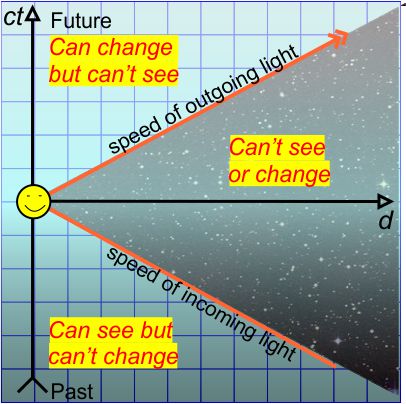
The smiley face is us at the origin (0,0,0,0).  If we look upwards toward positive time, that’s the future at our present locationLooking downward to negative time is looking into the past.  Unless we move (change x and/or y and/or z), all the events in our past and future have addresses like (ct,0,0,0).

What about all those points (events) that aren’t on the time axis?  Pick one and use its address to figure the interval between it and us.  In general, the interval will be a complex number, part real and part imaginary, because the event you picked isn’t on either axis.

The two orange lines are special.  Each of them is drawn through all the events for which the distance is equal to ct.  All the intervals between those events and us are zero.  Those are the events that could be connected to us by a light beam.

The orange connections go one way only — someone in our past (t less than zero) can shine a light at us that we’ll see when it reaches us.  However, if someone in our future tried to shine a light our way, well, the passage of time wouldn’t allow it (except maybe in the movies).  Conversely, we can shine a light at some spatial point (x,y,z) at distance d=√(x2+y2+z2) from us, but those photons won’t arrive until the event in our future at (d,x,y,z).
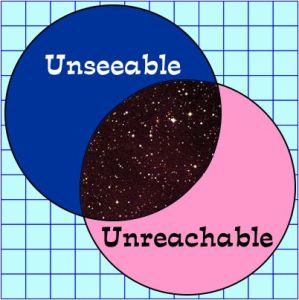
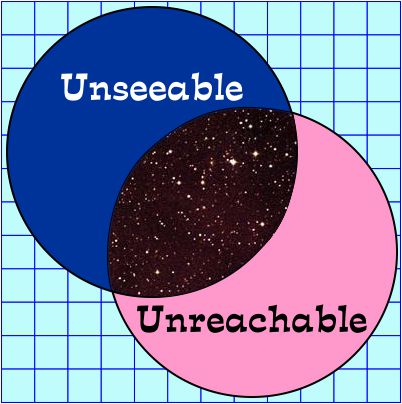
space VennThe rest of the Minkowski diagram could do for a Venn diagram.  We at (0,0,0,0) can do something that will cause something to happen at (ct,x,y,z) to the left of the top orange line.  However, we won’t be able to see that effect until we time-travel forward to its t.  That region is “reachable but not seeable.”

Similarly, events to the left of the bottom orange line can affect us (we can see stars, for instance) but they’re in our past and we can’t cause anything to happen then/there.  The region is “seeable but not reachable.”

Then there’s the overlap, the segment between the two orange lines.  Events there are so far away in spacetime that the intervals between them and us are imaginary (in the mathematical sense).  To put it another way, light can’t get here from there.  Neither can cause and effect.

Physicists call that third region space-like, as opposed to the two time-like regions.  Without a warp drive or some other way around Einstein’s universal speed limit, the edge of “space-like” will always be The Final Frontier.

~~ Rich Olcott
Does a photon experience time?

My brother Ken asked me, “Is it true that a photon doesn’t experience time?”  Good question.  As I was thinking about it I wondered if the answer could have implications for Einstein’s bubble.

When Einstein was a grad student in Göttingen, he skipped out on most of the classes given by his math professor Hermann Minkowski.  Then in 1905 Einstein’s Special Relativity paper scooped some work that Minkowski was doing.  In response, Minkowski wrote his own paper that supported and expanded on Einstein’s.  In fact, Minkowski’s contribution changed Einstein’s whole approach to the subject, from algebraic to geometrical.

But not just any geometry, four-dimensional geometry — 3D space AND time.  But not just any space-AND-time geometry — space-MINUS-time geometry.  Wait, what?Pythagoras1

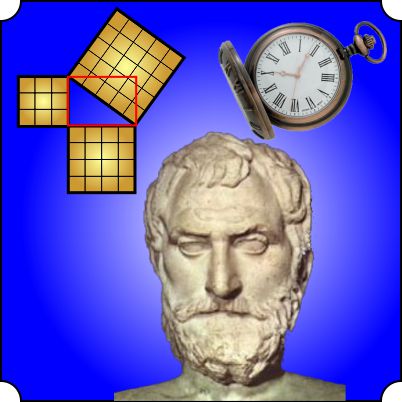
Early geometer Pythagoras showed us how to calculate the hypotenuse of a right triangle from the lengths of the other two sides. His a2+b2 = c2 formula works for the diagonal of the enclosing rectangle, too.

Extending the idea, the body diagonal of an x×y×z cube is √(x2+y2+z2) and the hyperdiagonal  of a an ct×x×y×z tesseract is √(c2t2+x2+y2+z2) where t is time.  Why the “c“?  All terms in a sum have to be in the same units.  x, y, and z are lengths so we need to turn t into a length.  With c as the speed of light, ct is the distance (length) that light travels in time t.

But Minkowski and the other physicists weren’t happy with Pythagorean hyperdiagonals.  Here’s the problem they wanted to solve.  Suppose you’re watching your spacecraft’s first flight.  You built it, you know its tip-to-tail length, but your telescope says it’s shorter than that.  George FitzGerald and Hendrik Lorentz explained that in 1892 with their length contraction analysis.

What if there are two observers, Fred and Ethel, each of whom is also moving?  They’d better be able to come up with the same at-rest (intrinsic) size for the object.

Minkowski’s solution was to treat the ct term differently from the others.  Think of each 4D address (ct,x,y,z) as a distinct event.  Whether or not something happens then/there, this event’s distinct from all other spatial locations at moment t, and all other moments at location (x,y,z).

To simplify things, let’s compare events to the origin (0,0,0,0).  Pythagoras would say that the “distance” between the origin event and an event I’ll call Lucy at (ct,x,y,z) is √(c2t2+x2+y2+z2).

Minkowski proposed a different kind of “distance,” which he called the interval.  It’s the difference between the time term and the space terms: √[c2t2 + (-1)*(x2+y2+z2)].

If Lucy’s time is t=0 [her event address (0,x,y,z)], then the origin-to-Lucy interval is  √[02+(-1)*(x2+y2+z2)]=i(x2+y2+z2).  Except for the i=√(-1) factor, that matches the familiar origin-to-Lucy spatial distance.

Now for the moment let’s convert the sum from lengths to times by dividing by c2.  The expression becomes √[t2-(x/c)2-(y/c)2-(z/c)2].  If Lucy is at (ct,0,0,0) then the origin-to-Lucy interval is simply √(t2)=t, exactly the time difference we’d expect.

Finally, suppose that Lucy departed the origin at time zero and traveled along x at the speed of light.   At any time t, her address is (ct,ct,0,0) and the interval for her trip is √[(ct)2-(ct)2-02-02] = √0 = 0.  Both Fred’s and Ethel’s clocks show time passing as Lucy speeds along, but the interval is always zero no matter where they stand and when they make their measurements.

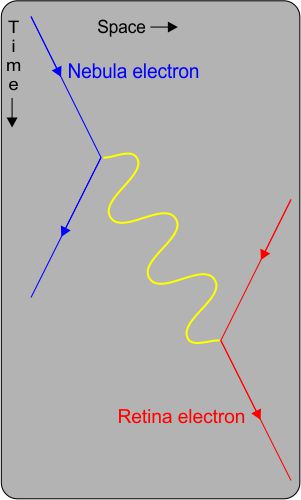
Feynman diagramOne more step and we can answer Ken’s question.  A moving object’s proper time is defined to be the time measured by a clock affixed to that object.  The proper time interval between two events encountered by an object is exactly Minkowski’s spacetime interval.  Lucy’s clock never moves from zero.
So yeah, Ken, a photon moving at the speed of light experiences no change in proper time although externally we see it traveling.

Now on to Einstein’s bubble, a lightwave’s spherical shell that vanishes instantly when its photon is absorbed by an electron somewhere.  We see that the photon experiences zero proper time while traversing the yellow line in this Feynman diagram.  But viewed from any other frame of reference the journey takes longer.  Einstein’s objection to instantaneous wave collapse still stands.

~~ Rich Olcott

Calvin And Hobbes And i

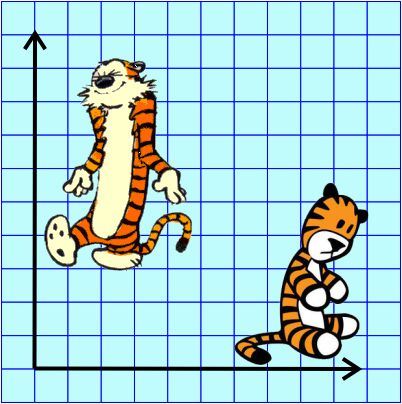
Hobbes 2I so miss Calvin and Hobbes, the wondrous, joyful comic strip that cartoonist Bill Watterson gave us between 1985 and 1995.  Hobbes was a stuffed toy tiger — except that 6-year-old Calvin saw him as a walking, talking man-sized tiger with a sarcastic sense of humor.
So many things in life and physics are like Hobbes — they depend on how you look at them.  As we saw earlier, a fictitious force disappears when viewed from the right frame of reference.  There’s that particle/wave duality thing that Duc de Broglie “blessed” us with.  And polarized light.

In an earlier post I mentioned that light is polar, in the sense that a single photon’s electric field acts to vibrate an electron (pole-to-pole) within a single plane.
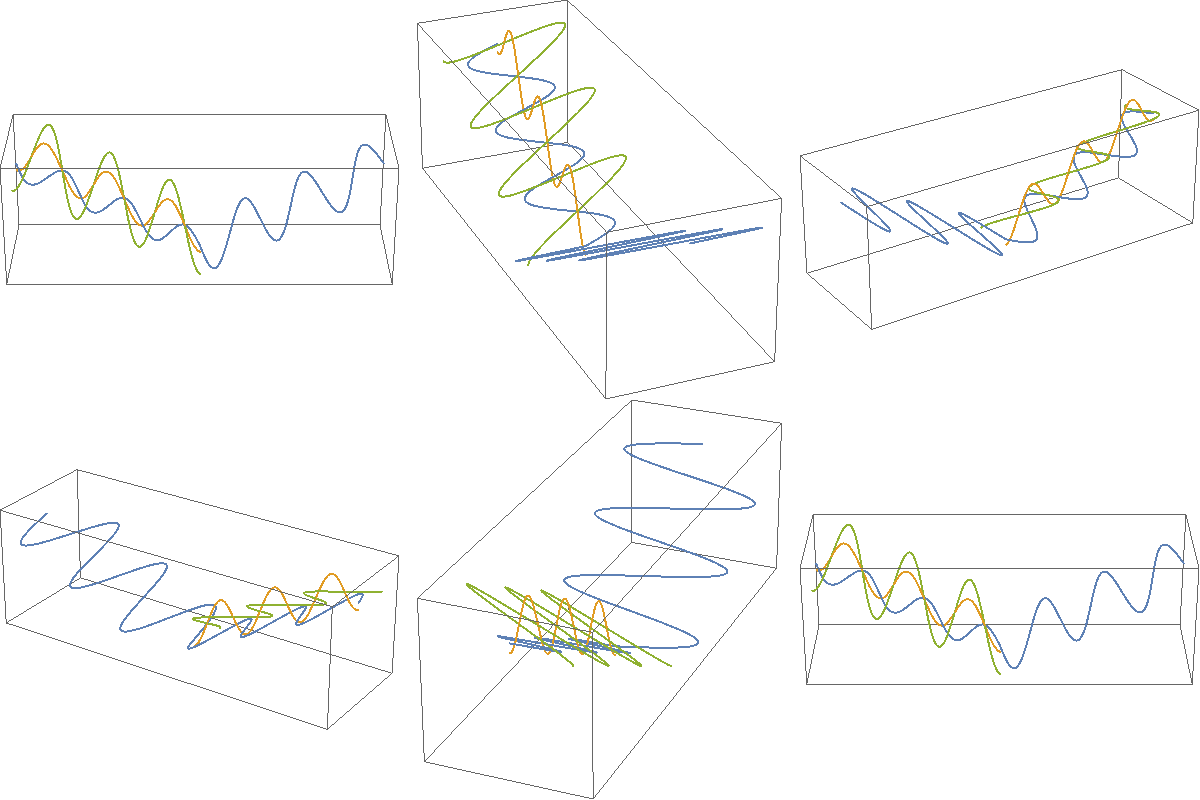
wavesIn this video, orange, green and blue electromagnetic fields shine in from one side of the box onto its floor.  Each color’s field is polar because it “lives” in only one plane.  However, the beam as a whole is unpolarized because different components of the total field direct recipient electrons into different planes giving zero net polarization.  The Sun and most other familiar light sources emit unpolarized light.

When sunlight bounces at a low angle off a surface, say paint on a car body or water at the beach, energy in a field that is directed perpendicular to the surface is absorbed and turned into heat energy.  (Yeah, I’m skipping over a semester’s-worth of Optics class, but bear with me.)  In the video, that’s the orange wave.

At the same time, fields parallel to the surface are reflected.  That’s what happens to the blue wave.

Suppose a wave is somewhere in between parallel and perpendicular, like the green wave.  No surprise, the vertical part of its energy is absorbed and the horizontal part adds to the reflection intensity.  That’s why the video shows the outgoing blue wave with a wider swing than its incoming precursor had.

The net effect of all this is that low-angle reflected light is polarized and generally more intense than the incident light that induced it.  We call that “glare.”  Polarizing sunglasses can help by selectively blocking horizontally-polarized electric fields reflected from water, streets, and that *@%*# car in front of me.

Wave_Polarisation
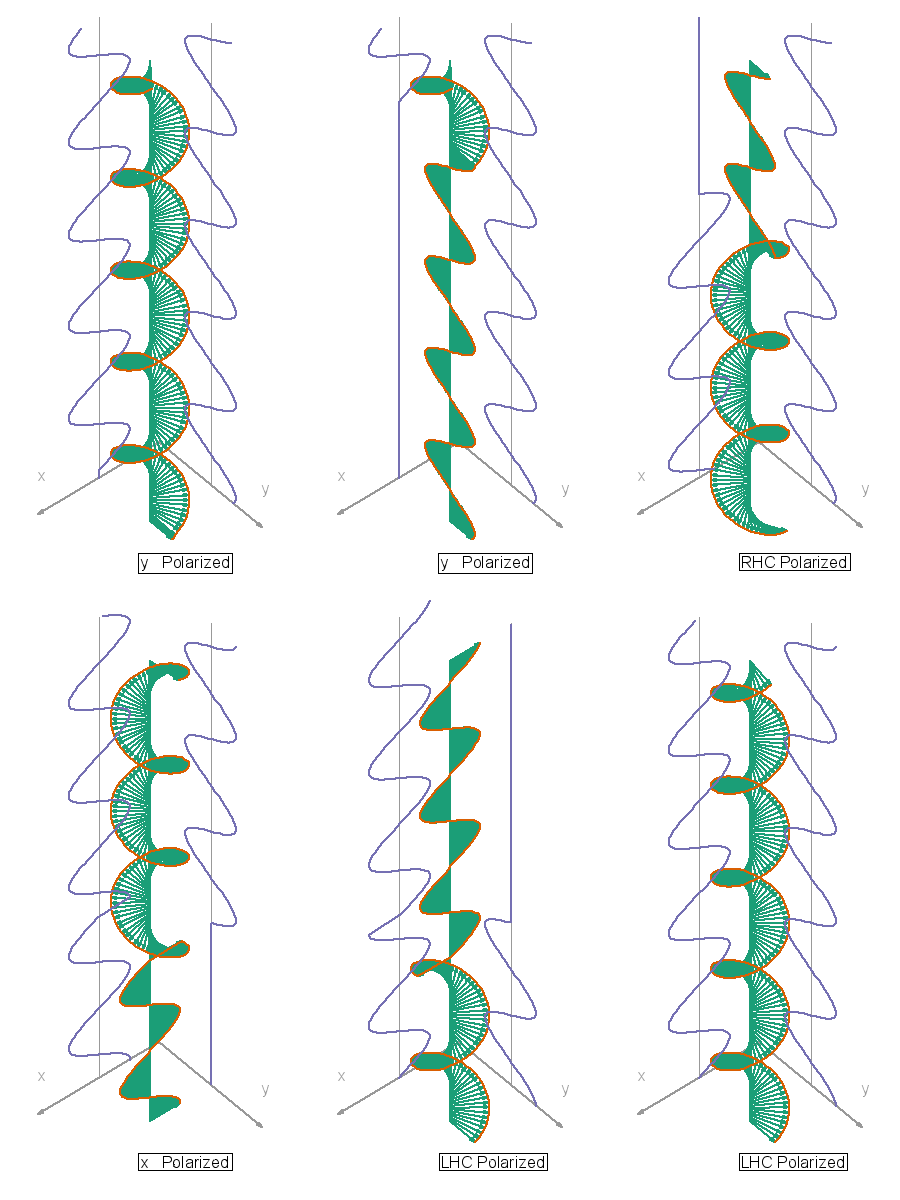
David Jessop’s brilliant depiction of plane and circularly polarized light

Things can get more complicated. The waves in the first video are all in synch — their peaks and valleys match up (mostly). But suppose an x-directed field and a y-directed field are headed along the same course.  Depending on how they match up, the two can combine to produce a field driving electrons along the x-direction, the y-direction, or in clockwise or counterclockwise circles.  Check the red line in this video — RHC and LHC depict the circularly polarized light that sci-fi writers sometimes invoke when they need a gimmick.

Physicists have several ways to describe such a situation mathematically.  I’ve already used the first, which goes back 380 years to René Descartes and the Cartesian x, y,… coordinate system he planted the seed for.  We’ve become so familiar with it that reading a graph is like reading words.  Sometimes easier.

In Cartesian coordinates we write x– and y-coordinates as separate functions of time t:
x = f1(t)
y = f2(t)
where each f could be something like 0.7·t2-1.3·t+π/4 or whatever.  Then for each t-value we graph a point where the vertical line at the calculated x intersects the horizontal line at the calculated y.

But we can simplify that with a couple of conventions.  Write √(-1) as i, and say that i-numbers run along the y-axis.  With those conventions we can write our two functions in a single line:
x + i y = f1(t) + i f2(t)
One line is better than two when you’re trying to keep track of a big calculation.

But people have a long-running hang-up that’s part theory and part psychology.  When Bombelli introduced these complex numbers back in the 16th century, mathematicians complained that you can’t pile up i thingies.  Descartes and others simply couldn’t accept the notion, called the numbers “imaginary,” and the term stuck.

Which is why Hobbes the way Calvin sees him is on the imaginary axis.

~~ Rich Olcott

Is cyber warfare imaginary?

Rule One in hooking the reader with a query headline is: Don’t answer the question immediately.  Let’s break that one.  Yes, cyber warfare is imaginary, but only for a certain kind of “imaginary.”  What kind is that, you ask.  AaaHAH!

spy1
Antonio Prohías’ Mad Magazine spies
didn’t normally use cyber weaponry

It all has to do with number lines.  If the early Greek theoreticians had been in charge, the only numbers in the Universe would have been the integers: 1, 2, 3,….  Life is simple when your only calculating tool is an abacus without a decimal point.  Zero hadn’t been invented in their day, nor had negative numbers.

Then Pythagoras did his experiments with harmony and harp strings, and the Greeks had to admit that ratios of integers are rational.

More trouble from Pythagoras: his a2+b2=c2 equation naturally led to c=√(a2+b2).  Unfortunately, for most integer values of a and b, c can’t be expressed as either an integer or a ratio of integers.  The Greeks labeled such numbers (including π) as irrational and tried to ignore them.

Move ahead to the Middle Ages, after Europe had imported zero and the decimal point from Brahmagupta’s work in India, and after the post-Medieval rise of trade spawned bookkeepers who had to cope with debt.  At that point we had a continuous number line running from “minus a whole lot” to “plus you couldn’t believe” (infinity wasn’t seriously considered in Western math until the 17th century).

By then European mathematicians had started playing around with algebraic equations and had stumbled into a problem.  They had Brahmagupta’s quadratic formula (you know, that [-b±√(b2-4a·c)]/2a thing we all sang-memorized in high school).  What do you do when b2 is less than 4a·c and you’re looking at the square root of a negative number?

Back in high school they told us, “Well, that means there’s no solution,” but that wasn’t good enough for Renaissance Italy.  Rafael Bombelli realized there’s simply no room for weird quadratic solutions on the conventional number line.  He made room by building a new number line perpendicular to it.  The new line is just like the old one, except everything on it is multiplied by i=√(-1).

(Bombelli used words rather than symbols, calling his creation “plus of minus.”  Eighty years later, René Descartes derisively called Bombelli’s numbers “imaginary,” as opposed to “real” numbers, and pasted them with that letter i.  Those labels have stuck for 380 years.  Except for electricity theoreticians who use j instead because i is for current.)

AxesSuppose you had a graph with one axis for counting animal things and another for counting vegetable things.  Animals added to animals makes more animals; vegetables added to vegetables makes more vegetables.  If you’ve got a chicken, two potatoes and an onion, and you share with your buddy who has a couple of carrots, some green beans and another onion, you’re on your way to a nice chicken stew.
Needs salt, but that’s on yet another axis.

Bombelli’s rules for doing arithmetic on two perpendicular number lines work pretty much the same.  Real numbers added to reals make reals, imaginaries added to imaginaries make more imaginaries.  If you’ve got numbers like x+i·y that are part real and part imaginary, the separate parts each follow their own rule.  Multiplication and division work, too, but I’ll let you figure those out.

The important point is that what happens on each number line can be specified independently of what happens on the other, just like the x and y axes in Descartes’ charts.  Together, Bombelli’s and Descartes’ concepts constitute a nutritious dish for physicists and mathematicians.

Scientists love to plot different experimental results against each other to see if there’s an interesting relationship in play.  For certain problems, for example, it’s useful to plot real-number energy of motion (kinetic energy) against some other variable on the i-axis.

Two-time Defense Secretary Donald Rumsfeld used to speak of “kinetic warfare,” where people get killed, as opposed to the “non-kinetic” kind.  Apparently, he would have visualized cyber somewhere up near the i-axis.  In that scheme, cyber warriors with their ones and zeros are Bombelli-imaginary even if they’re real.

 ~~ Rich Olcott


The question Newton couldn’t answer

250 years ago, when people were getting used to the idea that the planets circle the Sun and not the other way around, they wondered how that worked.  Isaac Newton said, “I can explain it with my Laws of Motion and my Law of Gravity.”

The first Law of Motion is that an object will move in a straight line unless acted upon by a force.  If you’re holding a ball by a string and swing the ball in a circle, the reason the ball doesn’t fly away is that the string is exerting a force on the ball.  Using Newton’s Laws, if you know the mass of the ball and the length of the string, you can calculate how fast the ball moves along that circle.

Newton said that the Solar System works the same way.  Between the Sun and each planet there’s an attractive force which he called gravity.  If you can determine three points in a planet’s orbit, you can use the Laws of Motion and the Law of Gravity to calculate the planet’s speed at any time, how close it gets to the Sun, even how much the planet weighs.

Astronomers said, “This is wonderful!  We can calculate the whole Solar System this way, but… we don’t see any strings.  How does gravity work?”

Newton was an honest man.  His response was, “I don’t know how gravity works.  But I can calculate it and that should be good enough.”

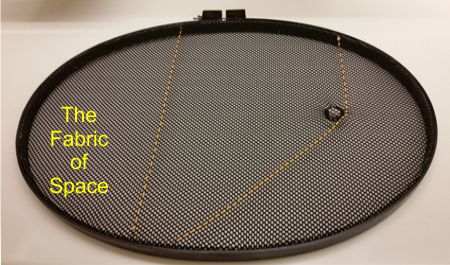
And that was good enough for 250 years until Albert Einstein produced his Theories of Relativity.  This graphic shows one model of Einstein’s model of “the fabric of space.”  According to the theory, light (the yellow threads) travels at 186,000 miles per second everywhere in the Universe.

Fabric of Space 4a

As we’ve seen, the theory also says that space is curved and compressed near a massive object.  Accordingly, the model’s threads are drawn together near the dark circle, which could represent a planet or a star or a black hole.  If you were standing next to a black hole (but not too close). you’d feel fine because all your atoms and the air you breathe would shrink to the same scale.  You’d just notice through your telescope that planetary orbits and other things in the Universe appear larger than you expect.FoS wave

This video shows how a massive object’s space compression affects a passing light wave.  The brown dot and the blue dot both travel at 186,000 miles per second, but “miles are shorter near a black hole.”  The wave’s forward motion is deflected around the object because the blue dot’s miles are longer than the miles traveled by the brown dot.

When Einstein presented his General Theory of Relativity in 1916, his calculations led him to predict that this effect would cause a star’s apparent position to be altered by the Sun’s gravitational field. Fabric of Space 4b

An observer at the bottom of this diagram can pinpoint the position of star #1 by following its light ray back to the star’s location.  Star #2, however, is so situated that its light ray is bent by our massive object.  To the observer, star #2’s apparent position is shifted away from its true position.

In 1919, English physicist-astronomer Arthur Eddington led an expedition to the South Atlantic to test Einstein’s prediction.  Why the South Atlantic?  To observe the total eclipse of the sun that would occur there.  With the Sun’s light blocked by the Moon, Eddington would be able to photograph the constellation Taurus behind the Sun.

Sure enough, in Eddington’s photographs the stars closest to the Sun were shifted in their apparent position relative to those further way.  Furthermore, the sizes of the shifts were almost embarrassingly close to Einstein’s predicted values.

Eddington presented his photographs to a scientific conference in Cambridge and thus produced the first public confirmation of Einstein’s theory of gravity.

Wait, how does an object bending a light ray connect with that object’s pull on another mass?  Another piece of Einstein’s theory says that if a light ray and a freely falling mass both start from the same point in spacetime, both will follow the same path through space.  American physicist John Archibald Wheeler said, “Mass bends space, and bent space tells mass how to move.”


~~ Rich Olcott