Is there a lurker in the Solar System?

The Solar System is much bigger than we learned in school, with a more complicated history.
pillars-with-vortex
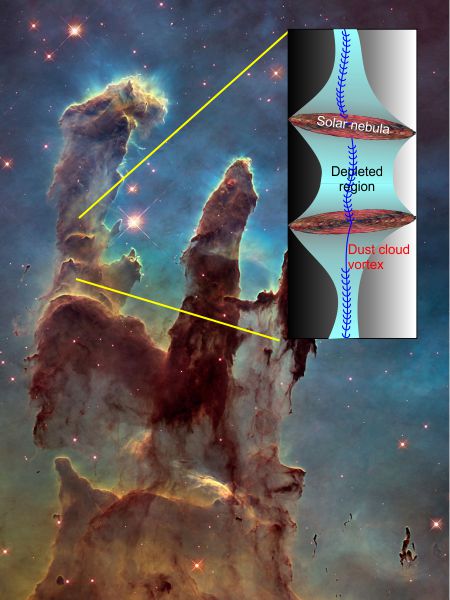
NASA’s 2014 edition of “The Pillars of Creation,”
plus a speculative addition

This famous photograph shows a portion of the Eagle Nebula, about 7,000 lightyears away from us but still within the Milky Way Galaxy.  The nebula is a diffuse mass of dust, gas  (mostly hydrogen atoms, of course) and hundreds of stars aborning.  Spectroscopic red- and blue-shift data could prove me wrong, but to my eye those “pillars” are exactly what you’d expect to see if each had formed around a vortex such as I described in my previous post.  Those two bright rings look very much like solar nebulae, don’t they?

If that’s what the rings are, then the region between them should be even emptier than normal interstellar space (estimated at one hydrogen atom per cm³ or about 30 atoms per fluid ounce if you swing that way).  If you’re floating in vacuum and a whole solar system’s gravity is pulling you towards it, then that’s where you’ll go.  Interstellar space will be emptier without you.

By the way, space between galaxies is a million times emptier than space between stars.

The solar nebula hypothesis does a decent job of explaining the familiar structure — an inward succession of gas giants, then an asteroid belt, then rocky planets, all orbiting within a degree or so of their common Plane of The Ecliptic.  When the Sun lit up 4.6 billion years ago, its fierce light stripped hydrogen and other light elements from the region where the inner planets were coalescing.  Those atoms fled outward to the asteroids, the gas giants and beyond.  An eon later, the rocky planets collected water and other volatiles from impacting comets and such.

But some incoming objects, especially the long-period comets, seem to have no respect for the Ecliptic.  They come at us from all angles, an oddity that led Ernst Öpik and Jan Oort to suggest that the familiar planar Solar System is in fact enclosed by a spherical shell of loosely-held objects, ready to pelt us at any time from wherever they happened to be.

No-one’s yet seen that shell, but statistical models suggest it’s huge.  Earth is one Astronomical Unit (AU) from the Sun.  Neptune, our farthest-out known planet, orbits at about 30 AU.  Researchers think the Oort Cloud starts somewhere near 2,000 AU and runs out to 20,000 or more.  Some suggest it may contain material from other solar systems.

Astronomers also think the Cloud contains something like a trillion objects, pebble-size up to planetoids or bigger.  In a volume that large, the average distance between objects is about 30 AU.  When NASA’s New Horizon spacecraft finally flies through the Oort Cloud 900 years from now, accidentally colliding with something shouldn’t be a problem.

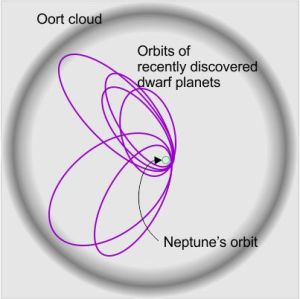
outer-orbits
I drew the Oort Cloud much too small
compared to the purple Kuiper Belt Object orbits
(adapted from the Batygin-Brown paper)

In between the familiar Solar System and the Oort Cloud there’s a whole zoo of objects we’ve only started to glimpse in the past 25 years.  The Kuiper Belt is a doughnut of about 100,000 bodies that stay close to the Ecliptic Plane but orbit from just beyond Neptune’s orbit out to about twice as far.  (By my calculation the average distance between the rocks is, you guessed it, about 30 AU.)  These guys are heavily influenced by Neptune’s gravity and thought to be leftovers from our solar nebula.  Most short-period comets seem to come from the Kuiper Belt.

Recently, CalTech astrophysicists Konstantin Batygin and Michael Brown, drew attention to a half-dozen objects with orbits that were strangely similar.  Unlike the other thousand-or-so Kuiper Belt Objects characterized so far, these all

  • go further than 250 AU from the Sun despite getting as close as 50 AU
  • have a perihelion (the point of closest approach to the Sun) at about the same equatorial latitude (see the diagram)
  • (the kicker) the perihelion drops below the ecliptic by about the same amount.

The authors account for these observations, and more, by hypothesizing a Planet 9 that roams out beyond the Kuiper Belt.  They call it “a mildly inclined, highly eccentric distant perturber.”  I know what you’re thinking, but in the paper those are technical terms.

~~ Rich Olcott
Gettin’ kinky in space

Things were simpler in the pre-Enlightenment days when we only five planets to keep track of.  But Haley realized that comets could have orbits, Herschel discovered Uranus, and Galle (with Le Verrier’s guidance) found Neptune.  Then a host of other astronomers detected Ceres and a host of other asteroids, and Tombaugh observed Pluto in 1930.whirlpool-44x100-reversed

Astronomers relished the proliferation — every new-found object up there was a new test case for challenging one or another competing theory.

Here’s the currently accepted narrative…  Long ago but quite close-by, there was a cloud of dust in the Milky Way galaxy.  Random motion within it produced a swirl that grew into a vortex dozens of lightyears long.

Consider one dust particle (we’ll call it Isaac) afloat in a slice perpendicular to the vortex.  Assume for the moment that the vortex is perfectly straight, the dust is evenly spread across it, and all particles have the same mass.  Isaac is subject to two influences — gravitational and rotational.

making-a-solar-nebula
A kinked galactic cloud vortex,
out of balance and giving rise
to a solar system.

Gravity pulls Isaac towards towards every other particle in the slice.  Except for very near the slice’s center there are generally more particles (and thus more mass) toward and beyond the center than back toward the edge behind him.  Furthermore, there will generally be as many particles to Isaac’s left as to his right.  Gravity’s net effect is to pull Isaac toward the vortex center.

But the vortex spins.  Isaac and his cohorts have angular momentum, which is like straight-line momentum except you’re rotating about a center.  Both of them are conserved quantities — you can only get rid of either kind of momentum by passing it along to something else.  Angular momentum keeps Isaac rotating within the plane of his slice.

An object’s angular momentum is its linear momentum multiplied by its distance from the center.  If Isaac drifts towards the slice’s center (radial distance decreases), either he speeds up to compensate or he transfers angular momentum to other particles by colliding with them.

But vortices are rarely perfectly straight.  Moreover, the galactic-cloud kind are generally lumpy and composed of different-sized particles.  Suppose our vortex gets kinked by passing a star or a magnetic field or even another vortex.  Between-slice gravity near the kink shifts mass kinkward and unbalances the slices to form a lump (see the diagram).  The lump’s concentrated mass in turn attracts particles from adjacent slices in a viscous cycle (pun intended).

After a while the lumpward drift depletes the whole neighborhood near the kink.  The vortex becomes host to a solar nebula, a concentrated disk of dust whirling about its center because even when you come in from a different slice, you’ve still got your angular momentum.  When gravity smacks together Isaac and a few billion other particles, the whole ball of whacks inherits the angular momentum that each of its stuck-together components had.  Any particle or planetoid that tries to make a break for it up- or down-vortex gets pulled back into the disk by gravity.

That theory does a pretty good job on the conventional Solar System — four rocky Inner Planets, four gas giant Outer Planets, plus that host of asteroids and such, all tightly held in the Plane of The Ecliptic.

How then to explain out-of-plane objects like Pluto and Eris, not to mention long-period comets with orbits at all angles?outer-orbits-1

We now know that the Solar System holds more than we used to believe.  Who’s in is still “objects whose motion is dominated by the Sun’s gravitational field,” but the Sun’s net spreads far further than we’d thought.  Astronomers now hypothesize that after its creation in the vortex, the Sun accumulated an Oort cloud — a 100-billion-mile spherical shell containing a trillion objects, pebbles to planet-sized.

At the shell’s average distance from the Sun (see how tiny Neptune’s path is in the diagram) Solar gravity is a millionth of its strength at Earth’s orbit.  The gravity of a passing star or even a conjunction of our own gas giants is enough to start an Oort-cloud object on an inward journey.

These trans-Neptunian objects are small and hard to see, but they’re revolutionizing planetary astronomy.

~~ Rich Olcott

Plutonic Goofyness

goofy-and-dp-pluto
Is Pluto wearing a space helmet?
No, that helmet is Pluto.
(Based on a cartoon by Andy Diehl)

Andy Diehl brings up a question worth considering over a tasty beverage.  How come Pluto’s a dog and Goofy’s a dog but Pluto gets the collar end of the leash?  Hardly seems fair.

Which brings us to that other controversial Pluto, the one that NASA’s New Horizon spacecraft visited last July.  (News flash — on 28 October, NASA announced that they’d received the very last of the data NH accumulated during that 2½-hour visit.)  Official Astronomy has reclassified Pluto from “planet” to “dwarf planet,” but NH honcho Alan Stern and much of the rest of the world say, “No way!”

The traditionalist position is, “But we’ve always called Pluto the ninth planet.”  Well, “always” only goes back to when the preternaturally persistent Clyde Tombaugh discovered the object in 1930.  At the time he found it Pluto was indeed the ninth “planet” out from the Sun.  However, it spends about 10% of each orbit* closer to the Sun than the eighth planet, Neptune.  So should we call it the “seven-and-a-fraction-th” planet?

No, because (1) that contravenes Official Astronomy’s rules, and (2) it’d be silly.

So what are the rules for what’s a planet?

  1. The object must be in orbit around its star.
  2. The object must be massive enough to be rounded by its own gravity.
  3. It must have cleared the neighborhood around its orbit.

“Rounded” is a bit tricky.  It doesn’t mean “spherical” because if you spin a  sphere, centrifugal forces move mass towards its equator.  Earth’s equator is 13.3 miles further away from its center than its poles are.  Miller’s Planet in the Interstellar movie is also a spheroid, even further deformed by elongation towards the black hole it orbits, yet it still rates as “rounded by its gravity” and qualifies as a planet.

Clearing the neighborhood” means “my gravity dominates the motion of everything in my orbit.”  Earth and Jupiter, both acknowledged planets, each have retinues of asteroids in the Trojan positions, at the same distance from the Sun as the host planet but in regions 60º ahead of or behind it.  Even so, both planets often suffer messy encounters (remember Chicxulub and Chelyabinsk?) with asteroids and such that hadn’t gotten the memo.

Neptune meets all three criteria.  Its gravity dominates Pluto’s motion even though Pluto’s in a separate orbit.  For every three of Neptune’s trips around the Sun, Pluto makes exactly two.  The gravitational converse doesn’t hold, though.  Pluto’s mass is 0.1% of Neptune’s so the big guy doesn’t care.

pluto-orbits-1This video, from an Orbits Table display at the Denver Museum of Nature and Science, shows a different Plutonian weirdness.  We’re circling the Solar System at about 50 times Earth’s distance from the Sun (50 AU).  Reading inward, the white lines represent the orbits of Neptune, Uranus, Saturn and Jupiter.  The Asteroid Belt is the small greenish ring close to the Sun.  The four terrestrial planets are even further in.  The Kuiper Belt is the greenish ring that encloses the lot.
The  yellow-orange line is Pluto’s orbit.  Most of the Solar System lies within a thin pancake, the Plane of The Ecliptic. Pluto’s orbit is inclined 17º out of the Plane.  That’s odd.

Theory says that the System evolved from an eddy in a primordial cloud of dust and gas.  Gravity shrank that blob of stuff to form a disk at the eddy’s equator as it drew 99.9% of the system’s mass to form the Sun at the disk’s center.

Newton’s First Law is all about Conservation of Momentum.  When applied to circular motion, it says that if you’re whirling in a certain plane, you’ll continue whirling in that plane unless something knocks you out of that plane.  Hence, the Plane of The Ecliptic.

Pluto’s path is a puzzling challenge to the theory.  It was only a minor puzzle until the 1990’s when astronomers discovered a plethora of Pluto-type objects outside of Neptune’s orbit.  Most run way out of the Plane.  Worst is Eris, at inclination 44º .  Clearly, Pluto’s not special.  It belongs to a large tribe that Astrophysicists must explain if they’re to claim to  understand the Solar System.

~~ Rich Olcott

* – During its current 248-year orbit, Pluto was inside Neptune’s orbit between 1979 and 1999.

Hoppin’ water molecules

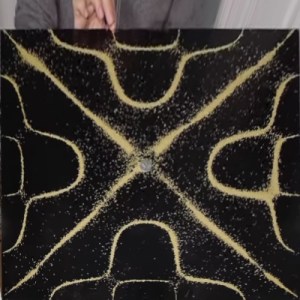
chladny-2Before you get any further in this post, follow this link to Steve Mould’s demonstration of  Chladni figures.  (I’ll wait here.)  It’s a neat demo and the effect plays into some recent discoveries in planetary science.

Steve’s couscous grains dance to the vibrations of the iron plate they’re sitting on.  The patterns happen because he controls where those vibrations happen.  Or more importantly, don’t happen (see his fingers pinching the plate?).

The study of vibration goes back to Pythagoras, the ancient Greek geek who determined that a plucked stretched string invariably exhibits a whole number of peaks and nodes.  (A node is a point on the string that doesn’t move, like those dots on the chart).  I’m so tempted to yammer about the relationship between nodes and quantum mechanics, but I’ve already posted on that topic.sines

The important point for this post is that Steve’s demonstration shows individual particles, each moving under the influence of random impacts, nonetheless winding up at a common destination.  They’re repeatedly kicked away from points where the iron plate is fluctuating strongly.  If a particle suddenly finds itself on a non-fluctuating nodal point (or nodal line, which is just a collection of nodal points), it stays there because why not?

The basic principle applies to numerous phenomena in Physics, Chemistry and other Sciences.  The particles in Chladni’s experiment were grains of sand.  Steve used coucous grains, which work better in video.  But they could also be molecules.  On the Moon.

Back in the 2000s there was intense debate in the lunar astronomy community.  One argument went, “The Solar Wind teems with hydrogen ions (H+).  The Moon’s surface rocks are mostly silicon oxides.  Those H+ ions will yank oxygen O2- ions off exposed rocks to make H2O molecules.  There has to be water on the Moon!”

The other side of the argument (in real Science there’s always at least one other side) went, “Maybe so, but Solar radiation also contains high-energy electrons and photons that’ll rip those molecules apart.  Water can’t survive up there!”

If/when we plant a Moon colony, the colonists will need water.  Either it gets shipped up from Earth — EXPENSIVE — or we find and mine water up there.  NASA did the only thing that could be done — they sent up a spacecraft for a close look.   When the Lunar Reconnaissance Orbiter (the LRO) launched in 2009 it carried half-a-dozen instruments.  One of them was the Lyman Alpha Mapping Project (LAMP) camera.

LAMP was the embodiment of a sly trick.  Buried in starlight’s ultraviolet spectrum are photons (a.k.a. Lyman-α  light) with a wavelength of 121.6 nanometers.  They’re generated by excited hydrogen atoms and they’re (mostly) absorbed by hydrogen atoms but reflected by rock that doesn’t contain hydrogen.

LAMP’s camera was designed to be sensitive to just those Lyman-α photons.  As LRO circled the Moon, the LAMP camera recorded what fraction of those special photons was bouncing off the Moon.  By subtraction, it told us  what fraction was being absorbed by surface hydrogen.

LAMP did find water.  The fun facts are its form and location — it was frost, buried in “fluffy soils” in the walls of craters.
water-moonThis photo, part of the LAMP exhibit at the Denver Museum of Nature and Science, shows why.  It’s a model of a cratered Moon lit by sunlight.

An H2O molecule may develop anywhere on the Moon’s surface.  Then it experiences life’s usual slings and arrows (well, electrons and photons) that might blast it apart or might merely give it a kinetic kick to somewhere else.  That process continues until the molecule or a descendant drops into a nice shady crater.

The best craters would be the ones in the polar regions, where sunlight arrives at a low angle and the crater walls are permanently shadowed like the one at the top in the model.  That’s exactly were LAMP found the most dark spots.  HAH —  Chladni in space!

But there’s more.  In 2012, NASA’s MESSENGER spacecraft produced evidence for water on Mercury, the hottest planet in the Solar System.  Once again, those molecules were hiding in polar craters along with a few other surprising molecular species.  That knocked my socks off when I read the scientific report.

~~ Rich Olcott