Planetary Pastry, First Course

“Morning, Al.  What’s the scone of the day?”

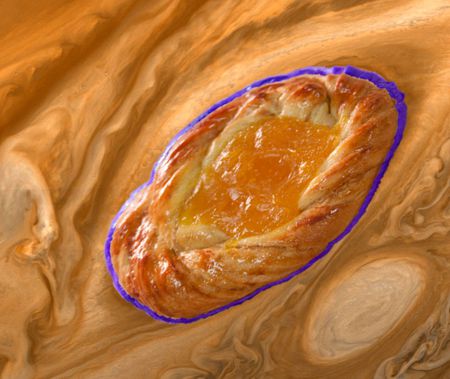
“No scones today, Sy.  Cathleen and one of her Astronomy students used my oven to do a whole batch of these orange-and-apricot Danishes.  Something to do with Jupiter.  Try one.”Great Apricot Spot 1
Cathleen was standing behind me.  “They’re in honor of NASA’s Juno spacecraft.  She just completed a close-up survey of Jupiter’s famous cloud formation, the Great Red Spot.  Whaddaya think?”

“Not bad.  Nice bright color and a good balance of sweetness from the apricot against tartness from the orange.”

“You noticed that, hey?  We had to do a lot of balancing — flavors, colors, the right amount of liquid.  Too juicy and the pastry part comes out gummy, too dry and you break a tooth.  Notice something else?”

“The structure, right?  Like the Spot’s collar around a mushed-up center.”

“Close, but Juno showed us that center’s anything but mushed-up.  <pulls out her smartphone>  Here’s what she sent back.”

GRS 1 @400
Credits: NASA/JPL-Caltech/SwRI/MSSS/Jason Major

“See, it’s swirls within swirls. We tried stirring the filling to look like that but it mostly smoothed out in the baking.”

“Hey, is it true what I heard that the Great Red Spot has been there for 400 years?”

“We think so, Al, but nobody knows for sure.  When Galileo published his telescopic observations of Jupiter in 1610 he didn’t mention a spot.  But that could be because he’d already caught flak from the Church by describing mountains and craters on the supposedly perfect face of the Moon.   Besides, the Jovian moons he saw were much more exciting for the science of the time.  A planet with satellites was a direct contradiction to Aristotle’s Earth-centered Solar System.”

“OK, but what about after Galileo?”

“There are records of a spot between 1665 and 1713 but then no reports of a spot for more than a century.  Maybe it was there and nobody was looking for it, maybe it had disappeared.  But Jupiter’s got one now and it’s been growing and shrinking for the past 185 years.”

“So what is it, what’s it made of and why’s it been there so long?”

“Three questions, one of them easy.”

“Which is easy, Sy?”

“The middle one.  The answer is, no-one knows what it’s made of.  That’s part of Juno‘s mission, to do close-up spectroscopy and help us wheedle what kinds of molecules are in there.  We know that Jupiter’s mostly hydrogen and helium, just like the Sun, but both of those are colorless.  Why some of the planet’s clouds are blue and some are pink — that’s a puzzle, right, Cathleen?”

“Well, we know a little more than that, especially since the Galileo probe dove 100 miles into the clouds in 1995.  The white clouds are colder and made of ammonia ice particles.  The pink clouds are warmer and … ok, we’re still working on that.”

“What about my other two questions, Cathleen?”

“People often call it a hurricane, but that’s a misnomer.  On Earth, a typical hurricane is a broad, complex ring of rainstorms with wind speeds from 75 to 200 mph.  Inside the ring wall people say it’s eerily calm.  The whole thing goes counterclockwise in the northern hemisphere, clockwise in the southern one.”

“So how’s the Great Red Spot different?”

“Size, speed, complexity, even direction.  East-to-west, the Spot is eight times wider than the biggest hurricanes.  Its collar winds run about 350 mph and it rotates counterclockwise even though it’s in Jupiter’s southern hemisphere.  It’s like a hurricane inside-out.”

“It’s not calm inside?”

“Nope, take another look at that Juno image.  There’s at least three very busy bands wrapped around a central structure that looks like it holds three distinct swirls.  That’s the part that’s easiest to understand.” GRS core

“Why so?”

“Geometry.  Adjacent segments of separate swirls have to be moving in the same direction or they’ll cancel each other out.  <scribbles diagram on a paper napkin>  Suppose I’ve got just one inside another one.  If they go in the same direction the faster one speeds up the slower one and they merge.  If they go in opposite directions, one of them disappears.  If there’s more than one inner swirl, there has to be an odd number, see?”

“So if it’s not a hurricane, what is it?”

“Got any donuts, Al?”

~~ Rich Olcott

Through The Looking Glass, Darkly

The Acme Building is quiet on summer evenings.  I was in my office, using the silence to catch up on paperwork.  Suddenly I heard a fizzing sound.  Naturally I looked around.  She was leaning against the door frame.

White satin looked good on her, and she looked good in it.  A voice like molten silver — “Hello, Mr Moire.”White satin and chessboard 1

“Hello yourself.  What can I do for you?”

“I’m open to suggestions, but first you can help me find myself.”

“Excuse me, but you’re right here.  And besides, who are you?”

“Not where I am but when I am.  Anne.”

“You said it right the first time.”

“No, no, my name is Anne.  At the moment.  I think.  Oh, it’s so confusing when your memory works in circles but not very well.  Do you have the time?”

“Well, I was busy, but you’re here and much more interesting.”

“No, I mean, what time is it?”

I showed her my desk clock — date, time, even the phase of the moon.

“Half past gibbous already?  Oh, bread-and-butter…”

“Wait — circles?  Time’s one-dimensional.  Clock readings increase or decrease, they don’t go sideways.”

“You don’t know Time as well as I do, Mr Moire.  It’s a lot more complicated than that.  Time can be triangular, haven’t you noticed?”

“Can’t say as I have.”

“That paperwork you’re working on, are you near a deadline?”

“Nah.”

“And given that expanse of time, you feel free to permit distractions.  There are so many distractions.”

“You’re very distracting.”

“Thank you, I guess.  But suppose you had an important deadline coming up tomorrow.   That broad flow of possibilities at the beginning of the project has narrowed to just two — finish or don’t finish.  Your Time has closed in on you.”

“So you’re saying we can think of Time as two-dimensional.  The second dimension being…?”

“I don’t know.  I just go there.  That’s the problem.”

“Hmm… When you do, do you feel like you’re turning left or right?”

“No turning or moving forward or backward.  Generally I have to … umm… ‘push’ like I’m going uphill, but that only works if there’s a ‘being pushed’ when I get past that.  Otherwise I’m back where I started, whatever that means.”

“What do you see?  What changes during the episode?”

“Little things. <brief fizzing sound.  She … flickered.>  Like ‘over there’ you’re wearing a bright green T-shirt instead of what you’re wearing here.  And you’re using pen-and-paper instead of that laptop.  Green doesn’t suit you.”

“I know, which is why there’s nothing green in my wardrobe, here.  But that gives me an idea.  Did you always have to ‘push’ to get ‘over there’?”

“Usually.”

“Fine.  OK, I’m going to flip this coin.  While it’s in the air, ‘push’ just lightly and come back to tell me which way the coin fell.”

<fizzing> “Heads.”

“It’s tails here.  OK, we’re going to do that again but this time ‘push’ much harder.”

<louder fizzing> “That was weird.  Your coin rolled off the desk and landed on edge in a crack in the floor so it’s not heads or tails.”

“AaaHAH!”Coins 1

“?”

“Your ‘over theres’ have different levels of probability than ‘over here.’  They’re different realities.  Actually, I’ll bet you travel across ranges of probability.  Or tunnel through them, maybe.  That’d why you have to ‘push’ to get past something that’s less probable in order to get to something that’s more probable.  Like getting past a reality where the coin can just hang in the air or fly apart.”

“I’ve done that.  Once I sneezed while ‘pushing’ and wound up sitting at a tea party where the cream and sugar just refused to stir into the tea.  When I ‘pushed’ from there I practically fell into a coffee shop where the coffee was well-behaved.”

“Case closed.  Now I can answer your question.  Spacewise, you’re in my office on the twelfth floor.  Timewise, I just showed you my clock.  As for which reality, you’re in one with a very high probability because, well, you’re here.”

“So provincial.  Oh, Mr Moire, how little you know.” <fizzing>

On the 12th floor of the Acme Building, high above the city, one man still tries to answer the Universe’s persistent questions — Sy Moire, Physics Eye.

~~ Rich Olcott

Twinkle, Twinkle, Tabby’s Star

Al was carrying his coffee pot past our table.  “Refills?  Hey, I heard you guys talking about Tabby’s Star.  Have you seen the latest?”

“Ohmigawd, there’s more?”

“Yeah, Cathleen.  They’ve finally found something that’s periodic.”

“Catch us up, Al.  Cathleen said that the dimmings are irregular.”

“They’ve been, Sy.  But remember Cathleen’s chart that showed big dips in 2011 and 2013, about 750 days apart?  Well, guess what?”

“They’ve seen more dips at 750-day intervals, in 2015 and 2017.”

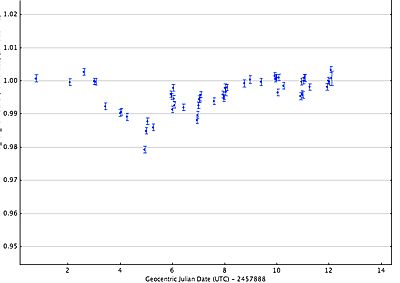
“Well, not quite.  Nobody was looking in 2015.  But Kickstarter funding let the team buy observing time in 2017.  A dip came in right on schedule.  Here’s the picture. [shows smartphone around]”

WTF 2017 peak after day 5
Visible-light photometry of Tabby’s Star
14-28 May 2017
Image from Dr Boyajian’s blog

Cathleen snorted.  “Damn shame we need crowd-funding to support Science these days.”

“True,” I agreed, “but the good news is that the support is there.  Suddenly you’re scribbling on the back of that envelope.  So what does this chart tell us?”

“I’m sure every astronomer out there will tell you, ‘It’s too soon to say anything for sure.‘  This is raw data, which means it’s hasn’t gone through the usual clean-up process to account for instrumental issues, long-term trending, things like that.  The timing is great, though.  The bottom of this dip is at 18May2017.  The first dip bottomed out 2267 days earlier on 4March2011.  Counting the 2015 case that no-one saw, there’d be three intervals from first to most recent.  2267÷3 makes the average 756 days.  Add 756 to the first date and we’re at 28Mar2013, right in the midst of that year’s complex mess.  It does fit together.”

“So whatever’s causing it has a 756-day orbit?”

“Could be.  I know your next question.  If the eclipsing material were in our Solar System, it’d be a bit outside the 687-day orbit of Mars.  But we’ve already ruled out causes near our solar system.  Tabby’s Star is about 1½ times our Sun’s mass.  That 756-day orbit around Tabby, if it is one, is maybe 30% wider than the orbit of Mars.  But.”

[both] “But?”

“But the dip profiles don’t match up from one cycle to the next.  This dip’s only 2% or so, a tenth of the ones in 2011 and 2013.  Of course, the 2013 event spanned multiple dips so Heaven knows which one we should match to.  Even 2011 and 2017 don’t look the same.  The usual quick-and-dirty way to compare dips is to pair up widths at half depth.  That statistic for 2011 is about a day.  This one is twice that or more.  If the absorber is orbiting the star, it’s changing shape and can’t be a planet.”Tabby in orbit
“So what do we got, Sy?”

“Damifino, Al.  Everything Cathleen just told us points to something like an enormous comet loaded with loose rocks that go flying along random paths away from the star.”

“Sorry, Sy, the infrared data rules out the comet dust that would have to be spewed out along with the rocks.  Besides, someone calculated just how much rocky material would be required to reproduce the dimming we’ve seen already.  You’d need a ‘comet’ somewhere between Earth-size and Jupiter-size, and maybe more than one, and with that much mass the rocks wouldn’t fly apart very well.  Oh, and there’s that long-term fading, which the comet idea doesn’t account for.”

“So we’re down to…”

[sigh] “The explanation of last resort, which astronomers are very reluctant to talk about because journalists tend to go overboard.  Maybe, just maybe, we’re witnessing an advanced civilization at work, constructing a Dyson sphere around a star 1500 light years away.  People have talked about such things for decades.  Think about it — the Sun sends out light in all directions.  Earth intercepts only a billionth of that.  If we could completely surround the Sun with solar panels we’d have access to a billion times more energy than if we covered our own planet with panels.  Better yet, it’s all renewable and producing 24 hours a day.  But even with advanced technology, panels around Tabby’s Star would still radiate in the infrared and we don’t see that.”

My smartphone chirped that same odd ringtone and it was that same odd number, 710-555-1701. “Hello, Ms Baird.”

“The Universe is not only stranger than you imagine, Mr Moire, it’s stranger than you can imagine.”

~~ Rich Olcott

Tabby’s Star — Weird Or Really Weird?

I needed some time to mull over what Cathleen had told me about Tabby’s Star, so I went to the counter to replenish our coffee and scones. When I returned I said, “OK, let’s recap.  Dr Boyajian’s Planet Hunters citizen scientists found a star that dims oddly.  But I understand there’s lots of variable stars out there.  What’s so special about this one that the SETI project got interested?”

“There’s variable stars and variable stars, but this one shouldn’t vary.  Look, one of the triumphs of 20th-century science is that we pretty much understand how stars work.  You tell me a handful of a star’s properties, things like radius, surface temperature, iron/hydrogen ratio, a couple more, and I can give you its whole life story from light-up to nova.  We’ve catalogued about 70,000 variable stars.  Virtually all of them do episodic brightening — pulsating or flaring up.  There’s about a hundred that dim more or less regularly, but they’re supergiants with cool, sooty atmospheres.  Tabby’s Star is a flat-out normal F-type main sequence star, about 1½ times the Sun’s mass and a little bit warmer.  Like the clean-cut kid next door — no reason to expect trouble from it.”

“So if it’s not the star itself that’s dimming, then something must be getting between it and us.”

“Well, yeah.  The question is what.  There’s so many theories that one pair of authors wrote a 15-page paper just classifying and rating them.”

“Gimme a few.”
Multi-Tabby Star

“Clouds of interstellar dust, for starters.  Sodium’s sparse in stars and the interstellar medium, but it’s got two easily recognized strong absorption lines in the yellow part of the visible spectrum.  Tabby’s sodium lines are broad and weak like you’d expect in a star’s atmosphere, but in the data they’re overlain by sharp, intense absorption peaks that can only come from sodium-bearing gas or dust in the nine-quadrillion-mile journey from there to here.  So there’s dispersed matter in the line of sight, but it can account for at most 35% of the dimming.  Furthermore, an interstellar cloud would have a hard time maintaining structures small enough to produce the sharp dim-and-recover pattern Boyajian found.  Loosely-bound stuff like dust clouds and gas tends to smear out in space.”

“How about comets, or rings, or clumps of asteroids orbiting the star?”

“There’s evidence against all those, but I guess I haven’t mentioned it yet.  You’ve seen the heat lamps over Eddie’s pizza bar?”

“Sure.  Infrared radiation heats things up.”

“And warm things give off infrared radiation.  ‘Warm’ meaning anything above absolute zero.  Better yet, there’s a well-known relation between an object’s temperature and its infrared spectrum.  Rocks or dust anywhere near the star would absorb energy from whatever kind of light and re-radiate it as heat infrared we could see.  The spectrum would show more infrared than you’d expect from the star itself.  And there isn’t any extra infrared.”

“None?”

“Not so’s our technology can detect.  If there’s any there, it’s less than 0.2% of the total coming from the star, nowhere near enough to account for those 8%, 16% and 22% dips.  So no, no comets or rings or asteroid clumps orbiting Tabby’s Star.”

“How about something orbiting our Sun, way far out where we’ve not found it yet?”

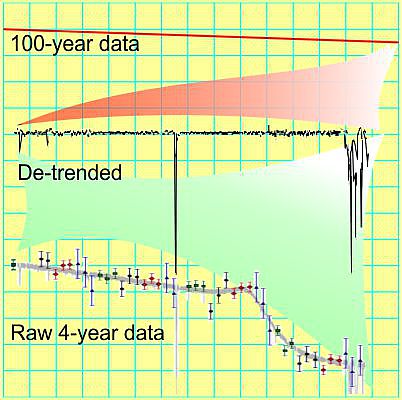
“Any light-blocking object near us, like maybe in the Oort Cloud that sends us long-term comets, should produce the same sort of weirdness from Tabby’s near neighbors.  We don’t see that.  One astronomer studied a star only 25 arc-seconds away — steady as a rock.  So whatever’s causing the dimming is probably close to Tabby’s star.  Oh, wait, here’s one more weirdness.  I just saw a report…” [twiddles on tablet] “Yeah, here it is.  Check out this chart.”Dimming montage“You’ll have to unravel that for me.”

“Sure.  The Planet Hunter team was looking for transits, which generally take at most a few days, so the Kepler science team filtered out slow variations before passing the data along.  After Boyajian’s report came out, two Keplerians looked back at the raw data.  I told you about the 3-6% dimming (estimates vary) since 1890.  The raw Kepler data show a 3% drop in four years!”

“I’m starting to think about Dyson Spheres and Larry Niven’s Ringworld.”

“Now you know why SETI got excited.”

~~ Rich Olcott

The Weirdest, And Naughtiest, Star in The Galaxy

It was an interesting ringtone — aggressive but feminine, with a hint of desperation.  And it was a ringtone I hadn’t programmed into my phone.  The number was intriguing, too — 710-555-1701.  It didn’t add up, so I answered the ring. “Moire here.”

“Hello, Mr Moire, this is Victoria Baird.”

It’s been a long time, Ms Baird.  What can I do for you?”  Her voice and the memory of her pointed ears sent chills down my spine.

“This time it’s what I can do for you, Mr Moire.  Here’s a tip — Tabby’s star.”  I could hear the italics.  I wanted to ask questions but the line went dead.

Considering the context, I called my Astronomy Department source.  “Morning, Cathleen.  It’s break time, can I buy you some of Al’s coffee and a scone?”

“You’re going to ask me questions, aren’t you?  What am I going to have to bone up on?  I know, it’s Tabby’s Star, right?”

“Got it in one, Cathleen.  Meet you at Al’s?”

“Yeah, give me 15 minutes.”Tabbystar 400

A quarter-hour later we had a table, two mugs of coffee and a plate of scones in front of us.  “So how’d you know I’d be asking about Tabby’s star?  And what is it?  And who is Tabby?”

“Tabby is Tabetha (she spells it with an ‘e’) Boyajian, PhD.  She teaches Astronomy at Louisiana State, does research specializing in high-precision star measurement.  In her spare time she manages a citizen-scientist project called Planet Hunters.  The Hunters get their kicks combing through databases from the Kepler satellite telescope.  They get all excited if the records indicate that a star’s been transited.”

“Oh, like that star-dimming that found the TRAPPIST-1 planets?”

“Exactly.  I think they’ve got over a hundred candidate planetary systems and a couple-dozen confirmed ones to their credit by now.  Anyhow, 2012 was a banner year for them, ’cause they raised an alert on what’s now being called the weirdest star in the galaxy.”

“Which would be Tabby’s Star.  Got it.  But what’s weird about it?”

“Poets like to write about ‘the constant stars.’  This star is world-champion not-constant.  You know how stars seem to flicker when you look at them?”

“Yeah, that’s how I tell them apart from planets.”

“Then you know that the flickering comes from starlight getting messed up going through our turbulent atmosphere.  Astronauts don’t see the flickering.  Neither does Kepler up there, so it can reliably detect miniscule variations in a star’s output.  Virtually all of the 150,000 stars it tracked for four years had rock-steady production.  A few of them occasionally dimmed or flared by maybe a percent, but Tabby’s Star (formally known as KIC 8462852) got the Hunters’ attention when it dimmed by 16%.”

“Twenty times a normal dimming!  Did it stay that way or did the light come back up again?”

“Oh, it came back all right, but the curve on the way up didn’t match the curve on the way down.  That was even weirder.  So the team scoured through the star’s 4-year record and found a dozen events on the 0.05-2% scale, plus one at 8% and another at 21%.”

“21%?  That’s a big shadow.”

“Ya think?  Especially since the between-event timing was seriously irregular and some of those events were complex with three or more separate components.  But that’s not all the weirdness. Those dips lasted for hours or even days, longer than most planetary transits.  After Boyajian and her 48 collaborators published their initial report, which has to have one of the naughtiest titles in the astronomical literature, some other —”

“Wait, a naughty title?  C’mon, don’t tease.”

“OK <sigh>.  The technical term for a star’s light output is flux.  That paper was half about the observations and half about what might be causing the variation.  Assuming the star’s real output is constant, the question becomes, ‘What happened to that missing light?‘  Or as the authors put it, ‘Where’s The Flux?‘  Since then both the paper and the star have been informally referred to as WTF.  OK?”

“OK <sigh>.  So you were saying there’s something else.”

“Yeah.  Some other astronomers went digging in the archives.  WTF has been dimming gradually for at least the past 100 years.  Weird, eh?”

“Yeah.  So what’s causing it?”

“We don’t even have good guesses.”

~~ Rich Olcott